How to Transfer Tokens across Blockchains using a Bridge?
Web3 has grown into a network of L1 blockchains and L2 scaling solutions, each with its own set of features and trade-offs. We are finally in a multi-chain market structure. This market structure needs connectivity between these different networks. As the number of blockchain protocols grows, so does the need for assets to be moved across chains. Many developers have recognized this, and there is now a need for critical infrastructure to link them. This is when Blockchain Bridges enter the picture. In this article, we will get a complete idea of Blockchain Bridges.
Summary (TL;DR)
- Blockchain Bridge is a path that enables the movement of assets from one chain to another.
- Both these chains have distinct protocols, rules, and governance structures, but the bridge provides a means for both chains to interact.
- When we examine various bridge solutions, we will see that there is no one method for connecting different blockchains.
- Different bridging solutions focus on different elements, and each has its own set of advantages and disadvantages.
- Users can now enjoy cheaper transaction fees on a different blockchain than a traditional host chain and explore multiple blockchain ecosystems.
- We can quickly transfer tokens from Binance to Ethereum and vice-versa through Binance Bridge.
- We can quickly transfer tokens from Polygon to Ethereum and vice-versa through Polygon Bridge.
- AnySwap, Allbridge, and cBridge are some of the Best Blockchain Bridge Projects.
What is a Blockchain Bridge?
Suppose Ram is from India; he wants to visit the United States for vacation. He has Indian Rupees, but he needs our dollars for his trip. He can easily swap his INR for USD at a currency exchange or bank in a traditional scenario. Similarly, in the crypto world, Assume we wish to swap ETH from the Ethereum Mainnet for BSC from Binance Smart Chain. We need the means to shift our ETH from Ethereum to Binance. Such a transaction is made possible through bridges. Blockchain bridges function similar to physical bridges do as they link two blockchain ecosystems in the same way that a natural bridge connects two physical locations.
Features:
- Makes it simple to move assets from one blockchain to another.
- It is the most effective method for resolving the issue of blockchain interoperability.
- Allows the usage of DApps hosted on other networks.
- Enables users to get the benefits of other blockchains.
- Helps in the collaboration of developers from different blockchain ecosystems.
What are Different Types of Blockchain Bridges?
When we examine various bridge solutions, we will see that there is no one method for connecting different blockchains. Different bridging solutions focus on different elements, and each has its own set of advantages and disadvantages. As a result, different bridge designs exist, each with its own unique value proposition. However, many types of bridges exist based on what they connect and their primary use-cases. Now, we will see different types of bridges based on different factors.
- Trusted Bridges: Bridges that rely on the use of a central authority for their operations. Users need to trust a third party to hold their funds. Examples: Multichain Bridges and Chain-Specific Bridges like Binance <> Ethereum Bridge.
- Trustless Bridges: Bridges that rely on the use of smart contracts and algorithms. Users don’t need to trust a third party to hold their funds. Examples: Connext, cBridge, Hop.
- L1 <> L1 Bridges: Bridges that connect different L1 blockchains with each other. Examples: Avalanche Bridge.
- L1/L2 <> L2 Bridges: Bridges that connect the Mainnet with different L2 solutions and the L2s with each other. Examples: Across, Hop.
- Lock & Mint: Bridges that lock assets on the source chain and mint assets on the destination chain. Examples: Polygon’s PoS bridge, Avalanche Bridge.
- Burn & Mint: Bridges that burn assets on the source chain and mint assets on the destination chain. Examples: Hop, Across.
- Atomic Swaps: Bridges that swap assets on the source chain for assets on the destination chain. Examples: cBridge, Connext.
- Chain-To-Chain Bridges: Bridges that are mainly designed to support the movement of assets between two blockchains. Examples: Polygon’s PoS bridge, Avalanche Bridge.
- Multi-Chain Bridges: Bridges that are designed for transferring assets across multiple blockchains. Examples: cBridge, Connext.
- Specialized Bridges: Bridges that are focused on specific ecosystems and are designed to support the movement of assets across focused regions. Examples: Hop, Across.
- Wrapped Asset Bridges: Bridges that are designed specifically to enable the transfer of non-native assets to different blockchains. Examples: WrappedBTC, Interlay, wMonero.
- Data Specific Bridges: Bridges that are designed specifically for transferring arbitrary data across multiple blockchains. Examples: Nomad.
- DApp Specific Bridges: By connecting to different blockchains, these dApps have built an ecosystem that allows value to be transferred across blockchains. Examples: Anyswap, Wanchain.
What are the Pros and Cons of using Blockchain Bridges?
How to transfer tokens from Binance to Ethereum?
In this section, we will learn how to transfer tokens from Binance Chain to Different Networks. All credits of images used here belong to Binance Docs.
Step 1: Go to https://www.bnbchain.world/en/bridge and click on “Connect Wallet“.
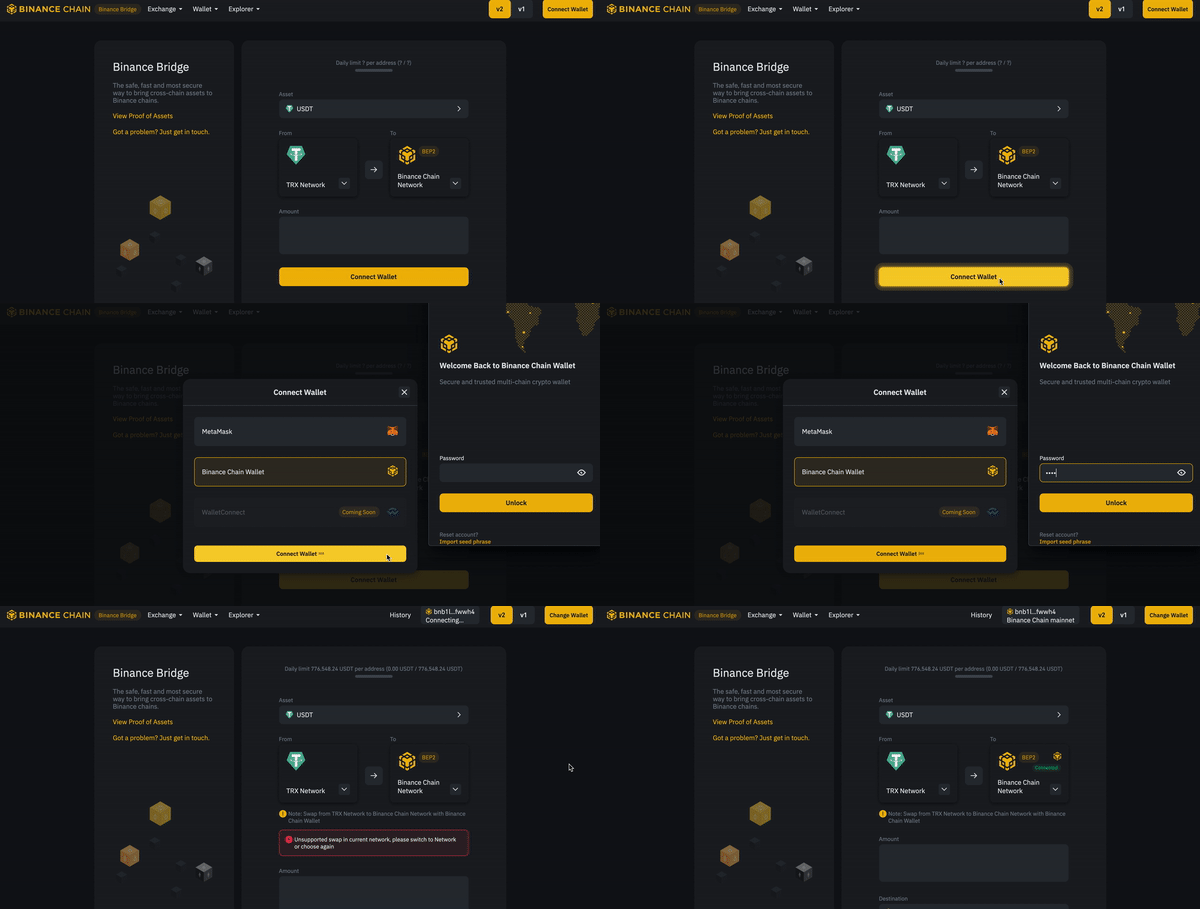 Connect Wallet
Step 2: After connecting the wallet, we can see our address in the “Destination” box.
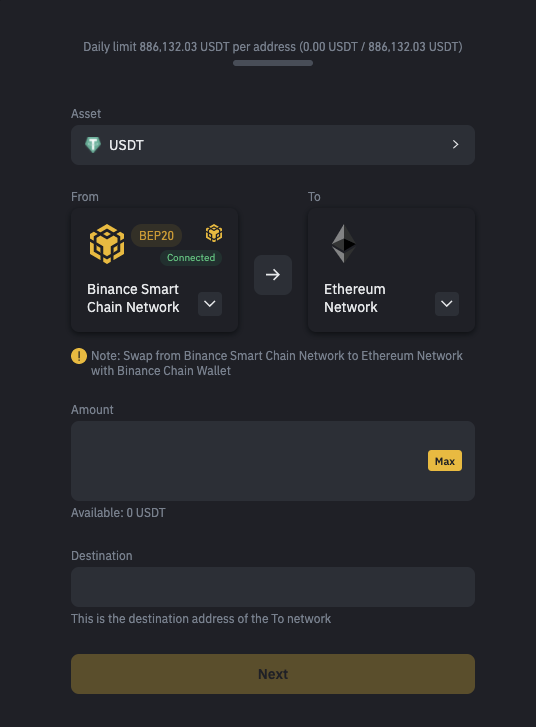 Check Address
Step 3: Choose “Assets“.
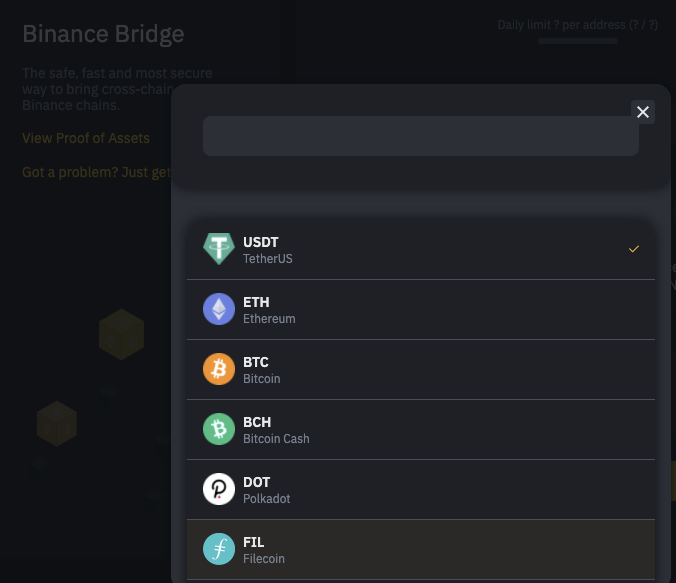 Choose Assets
Step 4: Choose “From and To” network types.
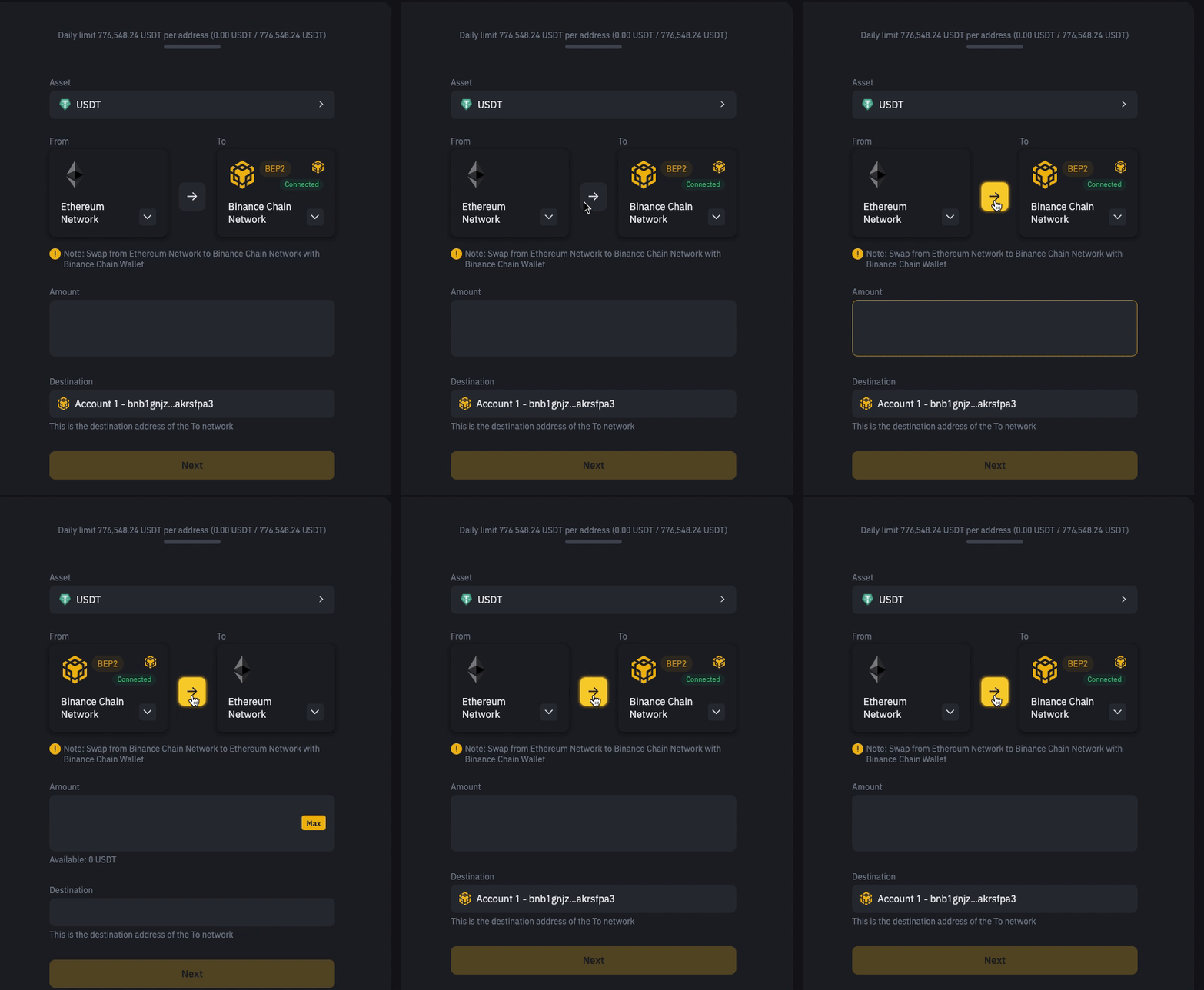 Choose Network Types
Step 5: Enter Swap “Amount” then Click on “Confirm“. We will see a Transaction Confirmation after this process.
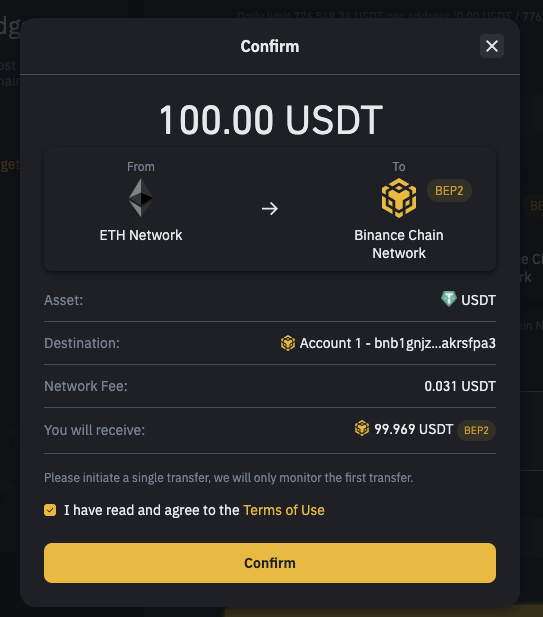 Click on Confirm
How to transfer tokens from Ethereum to Binance?
In this section, we will learn how to transfer tokens to Binance Chain from Different Networks. All credits of images used here belong to Binance Docs.
Step 1: Go to https://www.bnbchain.world/en/bridge and click on “Connect Wallet“.
Connect Wallet
Step 2: After connecting the wallet, we can see our address in the “Destination” box.
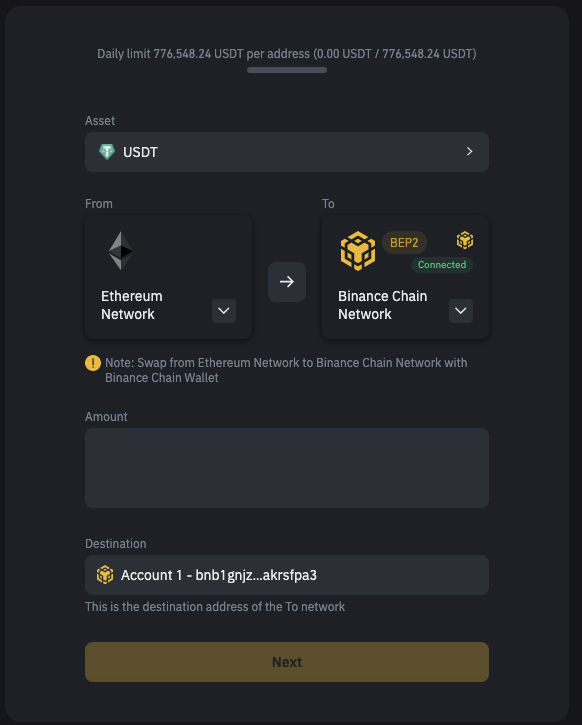 Check Address
Step 3: Choose “Assets“.
Choose Assets
Step 4: Choose “From” and To network types.
Choose Network Types
Step 5: Enter “Swap Amount” then Click on “Confirm“. We will see a Transaction Confirmation after this process.
How to transfer tokens from Ethereum to Polygon?
In this section, we will learn how to transfer tokens from Ethereum to Polygon. All credits of images used here belong to Binance Docs.
Step 1: Go to https://wallet.polygon.technology/ and click on “Polygon Bridge“.
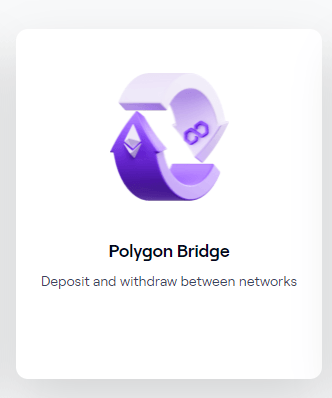 Polygon Bridge
Step 2: Now its time to “Connect Wallet“.
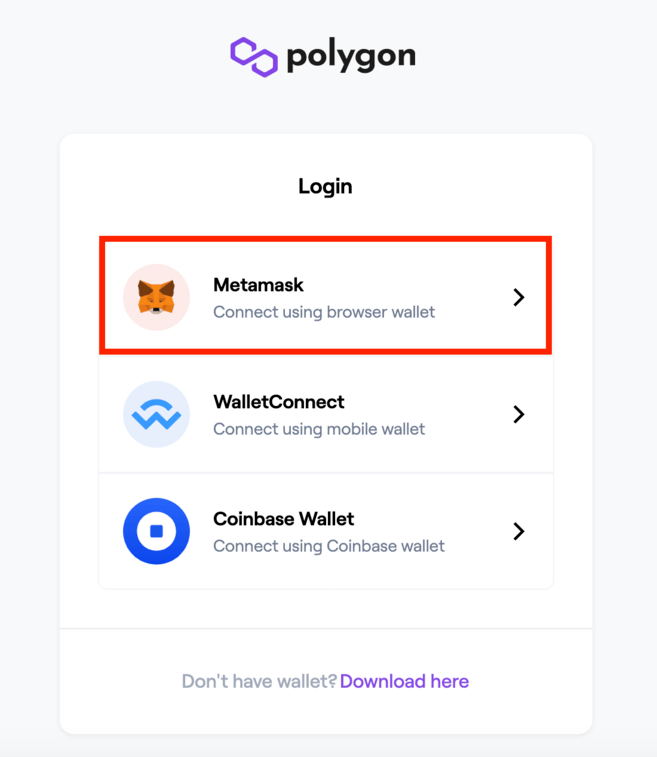 Connect Wallet
Step 3: Now sign the message to connect MetaMask wallet to your Polygon wallet. Then, we will be redirected to the Polygon Bridge interface.
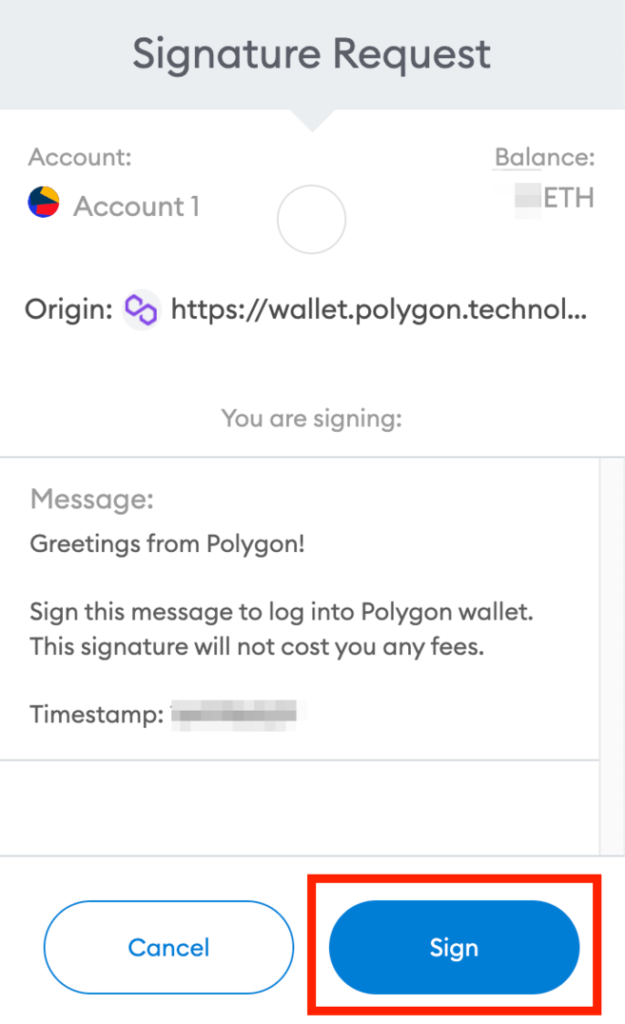 Sign Message
Step 4: To send tokens from the Ethereum Mainnet to Polygon, go to the “Deposit” tab. Click on the token name to choose the token to bridge.
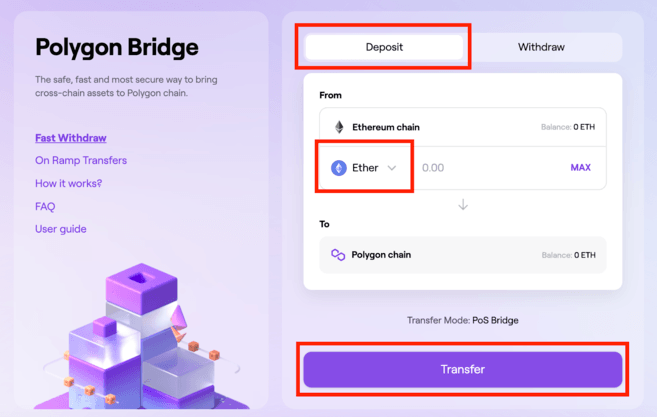 Click on the token name
Step 5: Click on “Continue“.
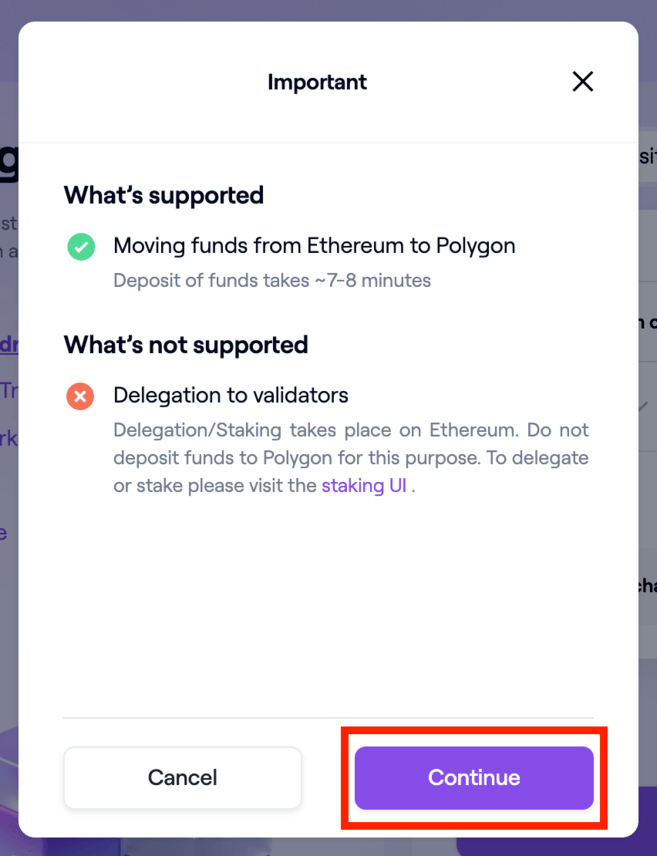 Click on Continue
Step 6: Now, we will see the estimated gas fee for the transaction and then Click on “Continue“.
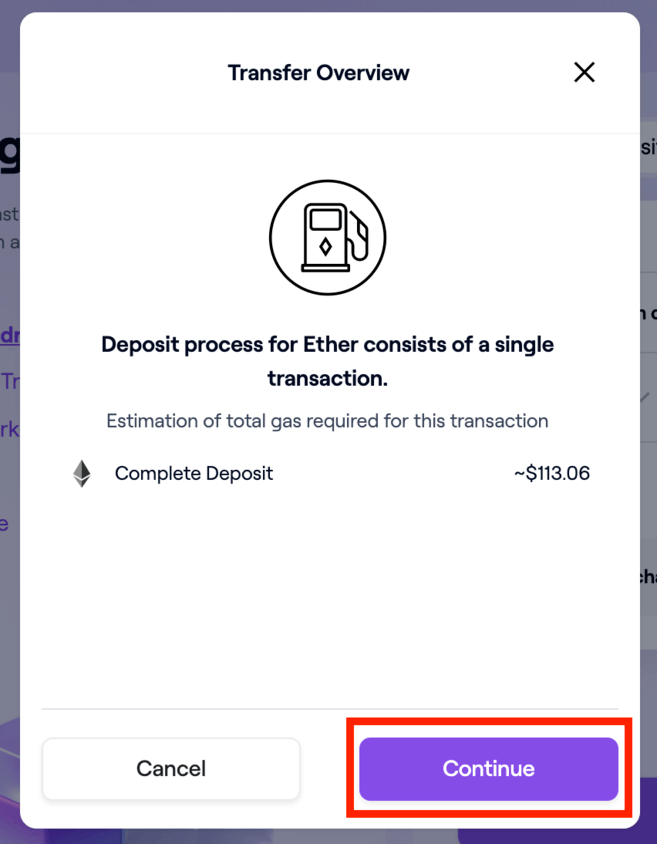 Click on
 Continue
Step 7: Now, check the transaction details and then Click on “Continue.
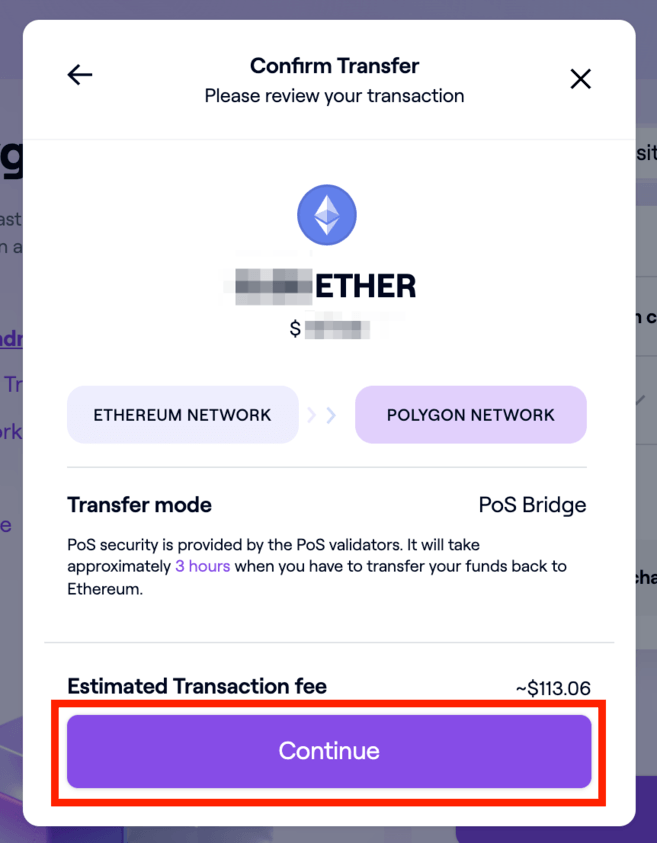 Click on
 Continue
Step 8: We will then be prompted to sign and approve the transfer in our MetaMask wallet and then Click on “Confirm“.
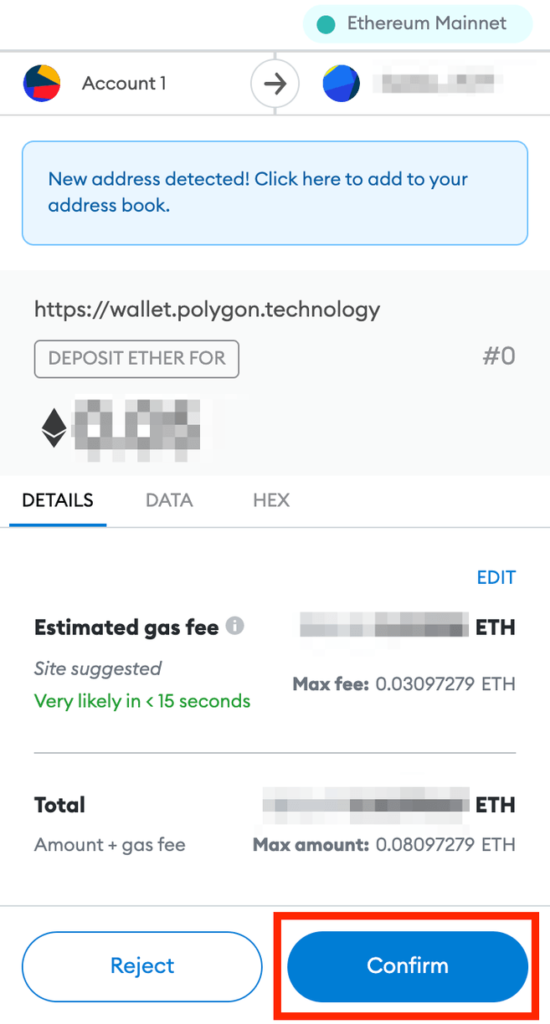 Click on
 Confirm
Step 9: Once confirmed, wait for the tokens to arrive in the Polygon wallet. We can also check the transaction status on Etherscan.
What are the Best Blockchain Bridge Projects?
In this section, we will see some of the Best Blockchain Bridge Projects available in the Market.
1. AnySwap: It is a fully decentralized cross-chain swap protocol with an automated pricing and liquidity system based on Fusion DCRM technology. It is a decentralized application running on the Fusion, Binance Smart Chain, Ethereum, and Fantom blockchains. It charges a fee of 0.4% for each swap transaction, 0.1% goes to the project, and 0.3% goes to the liquidity providers.
2. cBridge: It is a multi-chain platform that allows users low-cost and instant value transfers. It supports all EVM-compatible blockchains such as Avalanche and Fantom for cross-chain transfers, and it also includes layer-2 scaling solutions and some layer-1 blockchains with EVM compatibility. The fees percentage of the platform ranges from 0.04% to 0.1% for most transactions.
3. Allbridge: It is a simple, modern, and reliable way to transfer assets between networks. It is a bridge between both EVM (Like Ethereum, Polygon, BSC) and non-EVM compatible (like Solana, Terra) blockchains that aim to cover L2 (like Arbitrum, Optimism) solutions and NFT transfers in the future. Its mission is to make the blockchain world borderless and provide a tool to move assets between networks freely.
Transfer Tokens across Blockchains: Conclusion
Bridges are essential for users of L2 scaling solutions and those that wish to explore multiple ecosystems. Blockchain bridges allow users to reap the benefits of various blockchain systems without switching platforms. This also encourages innovation in other ecosystems. We have tried to cover everything in detail from scratch. We hope that this guide will be helpful for newcomers.
Frequently Asked Questions
Why are Bridges Important for DeFi?
Bridges have allowed users to transfer assets from a blockchain that holds significant value, such as Bitcoin, to one with a developed DeFi ecosystem, like Ethereum. As a result, users can now make and receive transactions quickly without paying high transaction fees, enabling better gaming and e-commerce experiences on DApps.
Can I transfer tokens between networks on MetaMask?
We recommend that our readers use bridges to move tokens between networks as MetaMask cannot track network transactions between networks, and also, it is not possible.
What is the future of Blockchain Bridges?
Bridges have enabled the blockchain ecosystems for more innovation, but they also pose some threats discussed above. An ideal bridge should be the most secure, interconnected, rapid, capital-efficient, cost-effective, and resistant to censorship.
Also read,
- How to Transfer Funds from Binance to Coinbase?
- 4 Best Crypto Copy Trading Platforms in France
- Top 5 Meme Tokens to keep an eye on this week: SMI, DOGE, SHIB, MONA, HOGE
- DeFi Staking Tokens to Look Out For
- Where and How to Buy Tron Token?


You May Also Like

Ripple CEO Says CLARITY Act Is a Done Deal as Senate Prepares Markup

Tempus AI (TEM) Stock Drops 7% After Earnings — Here’s Why a Beat Wasn’t Enough