Airtel money struggle in Nigeria with $3m revenue in Q1 2026
Airtel Nigeria has reported a mobile money revenue of $3 million for the first three months of 2026, reflecting the continued struggle to establish the services in the Nigerian fintech-controlled market.
According to the financial results made available on the Nigerian Exchange (NGX) on Friday, the revenue from the Nigerian market represents just 0.81% of Airtel Africa’s $369 million in mobile money revenue during the period.
Despite the popularity of SmartCash Payment Service Bank (PSB) in other African markets, the company’s mobile money brand product is struggling to gain attention in Nigeria’s vast population, which uses digital payment daily.
In fact, as of March 2026, the company only has 2.7 million mobile money users in Nigeria. While this is a 60.7% year-on-year surge, it accounts for 5% of the group’s 54.1 million customer base across its 14 African markets.
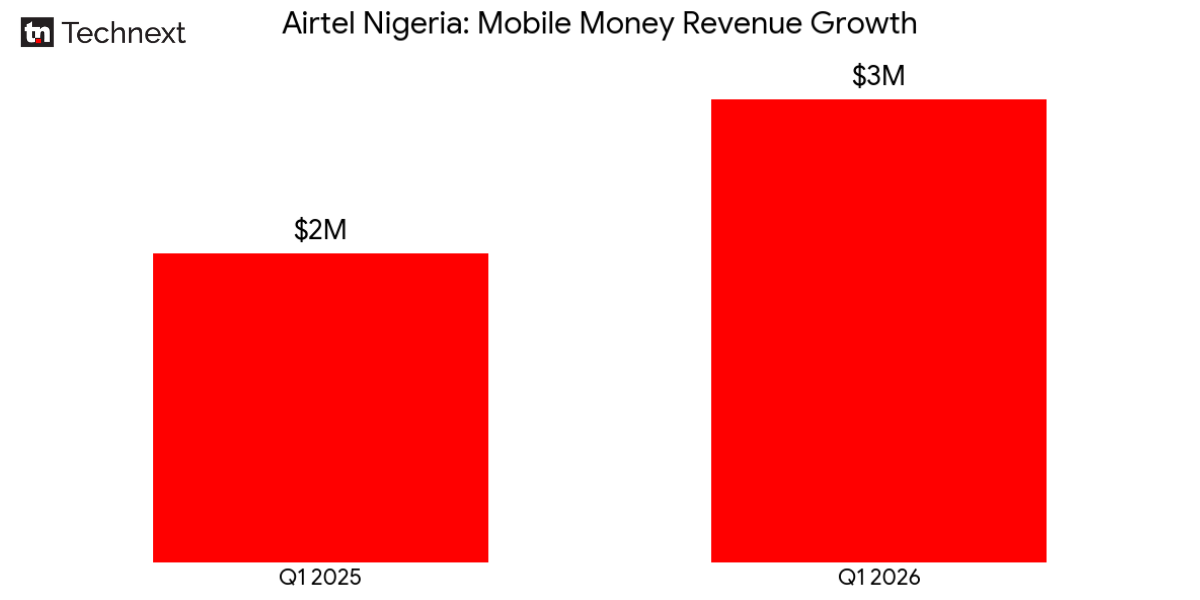 Airtel Money (Q1 26 vs Q1 25)
The numbers seem far more distant when compared to Airtel Nigeria’s 68.6 million subscriber base. This translates to the fact that the company could only capture 4% of its subscribers to its mobile money operation.
Airtel’s mobile money struggles are attributed to operating in an environment dominated by fintech heavyweights such as Moniepoint, OPay and PalmPay. Mobile money is fast-growing in Nigeria, with transactions jumping 1,518.64% to N20.71 trillion in Q1 2025 from Q1 2021.
Another constraint is regulation. Airtel’s PSB cannot offer loans, battles with higher capital requirements and also entered the market late. In addition, lending restrictions placed on PSB have limited their growth trajectory in the Nigerian mobile money market.
Repositioning Airtel Mobile Money in Nigeria
While acknowledging that the market is competitive, Group Chief Executive Officer, Sunil Taldar, in January, noted that the company would keep on relying on its collective brand, agent network, customer base and digital capabilities to improve its mobile money position in Nigeria.
In February, Airtel announced the introduction of features such as cashback on airtime recharge, free transfers, and a flat 15% annual interest rate savings on its SmartCash platform. The company said it will collaborate with other financial institutions to enable inter-bank transactions and wallet transfers.
 Sunil Taldar
In addition, the company shared that it will introduce an expansion strategy through physical distribution of 60,000 point-of-sale (POS) terminals to agents, supermarkets, small businesses, and merchants nationwide.
It also revealed plans to launch a virtual card together with other embedded initiatives to deepen Nigerian’s acceptance of the product.
Also Read: Airtel targets $2bn London IPO that could value its African mobile money unit at $10bn.
Airtel Money: Massive performance outside Nigeria
Despite the struggles in the Nigerian market, the group’s mobile money is on a fine run in other countries, especially in the East African Market.
During the quarter, mobile money recorded $369 million in revenue, signifying a 25.7% YoY jump in constant currency. While Francophone Africa saw $93 million in revenue, East Africa contributed to the latest revenue share of $273 million.
The customer base now stands at 54.1 million, with 40.9 million from the East African markets and 10.5 million from the Francophone African markets.
On earnings between April 2025 and March 2026, Airtel mobile money witnessed a 14.4% increase in total processed value (TPV) per customer. Also, mobile money revenue contributed 21.1% to the group’s revenue during the period.
 Airtel
Airtel Mobile Money is expected to grow in value after the group revealed plans to list the product on the London Stock Exchange by the second half of the year. The development is expected to raise about $2 billion and value the mobile money at $10 billion.
“Our focus remains on scaling digital adoption, expanding our ecosystem, including merchant payment, and strengthening access across our markets,” said Sunil Taidar.
Group performance
Airtel Africa reported a $1.7 billion revenue in Q1 2026, representing a 22.3% increase in constant currency. The earnings were fueled by $705 million in data revenue and $613 million in voice revenue. Profit after tax jumped 183.3% to $227 million, with the total customer base now 183.5 million.
Airtel Nigeria’s earnings for the quarter surged by 40.2% to $475 million, also attributed to a $244 million data revenue. East Africa, comprising 6 markets, saw $577 million in total revenue for the quarter.
Also, the group’s seven Francophone African markets recorded $400 million in revenue during the quarter.


You May Also Like
TON Surges 90% in a Week, Flips XLM and SUI in Market Cap

Solana price confirms bearish crossover following Drift exploit, will it crash?