

4 things First Bank’s 2025 results reveal about Nigeria’s competitive fintech landscape
A ₦826 billion impairment charge, a 12x jump in electronic purse deposits, ₦155 billion in digital fees, and a 70% profit collapse that obscures what is actually growing. First HoldCo's FY2025 audited accounts are a detailed map of where the money is moving in Nigerian financial services, and where the risks are building.
First HoldCo Plc, the parent company of First Bank of Nigeria, published its FY2025 audited group financial statements in May 2026. The headline number, a group profit of ₦139.5 billion against ₦677 billion in 2024, will define how this report is covered.
But for anyone whose interest is in Nigerian fintech, payments infrastructure, credit markets, and the evolving relationship between legacy banks and digital financial services companies, the more important reading is what the numbers say about the environment every player in this space is operating in.
Four findings stand out.
FIRST HOLDCO GROUP: KEY FIGURES FY2025 vs FY2024
| Metric | FY2025 | FY2024 |
| Group profit after tax | ₦139.5bn | ₦677bn |
| Interest income | ₦2.99 trillion | ₦2.40 trillion |
| Impairment charges | ₦826.3bn | ₦426.3bn |
| Electronic banking fees | ₦89.5bn | ₦77bn |
| Funds transfer fees | ₦65.8bn | ₦46.6bn |
| Electronic purse deposits | ₦65.4bn | ₦5.4bn |
| Customer deposits (total) | ₦18.88 trillion | ₦17.17 trillion |
| Total assets | ₦27.25 trillion | ₦26.52 trillion |
| CBN penalties paid | ₦344 million | — |
Read also; First Bank allegedly fired contract workers after making them train their replacements
1. The credit environment deteriorated sharply, and fintechs are not immune
First Bank set aside ₦826.3 billion in impairment charges in 2025, up from ₦426.3 billion the year before.
That near-doubling of provisioning, against a loan book that grew only marginally from ₦8.77 trillion to ₦8.97 trillion, is the most consequential signal in the entire filing for anyone operating a lending business in Nigeria.
 FirstHoldCo Chairman, Femi Otedola
Impairment charges represent a bank’s forward-looking estimate of loans that will not be repaid. When that estimate nearly doubles in a single year, it means one of two things, or both simultaneously: the borrowers the bank lent to in prior years are performing worse than expected, or the model the bank uses to forecast defaults is now recognising risks that were previously being understated.
In First Bank’s case, the auditors specifically flagged the expected credit loss determination as a key audit matter, meaning they devoted elevated scrutiny to the assumptions behind those provisions and found them material enough to call out explicitly.
The fintech implication is direct. Fintechs operating consumer lending products, buy-now-pay-later schemes, or SME credit facilities in Nigeria are lending into the same macroeconomic environment that is stressing First Bank's book.
They share many of the same borrower categories. They face the same inflation, the same foreign exchange dynamics, and the same income compression affecting Nigerian households and businesses.
The investment banking and asset management segment recorded a ₦2.2 billion impairment recovery in 2025, meaning it actually reversed prior provisions rather than adding new ones. The entire ₦826 billion burden sat in commercial banking.
That segmentation tells you where the stress is concentrated: in the mass-market and corporate lending business, the same territory where most Nigerian fintechs with credit ambitions are building.
2. Digital transaction fees are now more valuable than First Bank’s entire annual profit
First Bank’s electronic banking fees reached ₦89.5 billion in 2025, up from ₦77 billion in 2024. Its funds transfer and intermediation fees grew from ₦46.6 billion to ₦65.8 billion, a 41% increase. Combined, those two line items alone generated ₦155.3 billion in fee income from digital transaction infrastructure.
Group profit for the year was ₦139.5 billion.
That relationship, where the revenue generated by transaction infrastructure exceeds total profit, is not a coincidence. It reflects how Nigerian banking economics are actually shifting.
Net interest income, the traditional engine of bank profit, remains the largest line at ₦1.92 trillion before impairments, but credit losses and funding costs are aggressively eroding its contribution to bottom-line profit.
Fee income from digital channels, by contrast, carries far lower credit risk. A transfer fee is earned the moment the transaction clears. There is no default risk, no provisioning required, no exposure to the macroeconomic deterioration that is punishing the loan book.
 Olusegun Alebiosu, MD/CEO, First Bank of Nigeria Limited (FirstBank Group)
This is the structural argument that fintechs have been making for years, and First Bank’s 2025 accounts make the case in raw naira terms. The most defensible, high-margin, risk-adjusted revenue in Nigerian financial services is now flowing through transaction infrastructure, not through the credit book.
Every fintech building on payment rails, whether as a processor, a switching platform, a wallet provider, or an embedded finance layer, is competing for a share of a pool that First Bank’s numbers confirm is both large and growing.
3. Something moved ₦60 billion into First Bank’s electronic purse in 2025, and nobody is explaining it
Buried in the deposits from customers’ notes is a figure that deserves far more attention than it will receive in mainstream coverage. Electronic purse deposits at First Bank grew from ₦5.4 billion at the end of 2024 to ₦65.4 billion at the end of 2025. That is a 12x increase in 12 months.
Electronic purse is a specific financial category for digital wallet balances and prepaid funds. Unlike standard savings or current accounts, these are “prepaid floats” where money is stored specifically for quick digital spending rather than traditional banking.
The financial statements report all five categories separately. Electronic purse is the smallest by far in absolute terms, sitting alongside ₦5.71 trillion in current deposits, ₦4.63 trillion in savings, ₦3.27 trillion in term deposits, and ₦5.21 trillion in domiciliary accounts.
But its growth rate in 2025 is not comparable to any other category. Current deposits grew 16%. Savings grew 11%. Term deposits grew 38%. Electronic purse grew 1,111%.
Several explanations for the deafening silence from auditors and management are plausible. A significant expansion of First Bank’s agent banking network in 2025 would generate float balances that could sit under the electronic purse classification before settlement.
A new arrangement with a major payment service provider, routing float through First Bank’s balance sheet, would produce a similar result. A product integration with a mobile money operator or a bulk payment aggregator is another possibility.
4. The 70% profit collapse has a specific mechanical cause that most headlines will miss
When the dominant framing of a large bank’s results is a 70-79% profit decline, the natural assumption is that the core business is failing. In First HoldCo’s case, that assumption requires significant qualification, and the qualification matters for how the fintech industry reads its own competitive position relative to legacy institutions.
Two things happened in 2025 that mechanically explain most of the profit decline. The first is the ₦400 billion increase in impairment charges already described. The second is a ₦706 billion swing in income from financial instruments measured at fair value through profit or loss.
In 2024, First Bank recorded a ₦549.9 billion gain on these instruments. In 2025, it recorded a ₦155.6 billion loss. That single accounting line moved from positive ₦550 billion to negative ₦156 billion in one year.
Financial instruments at fair value through profit or loss include trading securities, derivatives, and other market-sensitive assets. The ₦550 billion gain in 2024 was itself exceptional, driven substantially by the naira devaluation environment and the elevated yield on government securities in that period. Its reversal in 2025 is partly a function of those conditions normalising.
A bank whose profit swings by ₦700 billion because of FVTPL (Fair Value Through Profit or Loss) accounting treatment is not the same as a bank whose operating business is deteriorating.
The operating business evidence points the other way. Interest income grew 25% from ₦2.40 trillion to ₦2.99 trillion. Fee and commission income grew 17% from ₦304.5 billion to ₦357.5 billion. Customer deposits grew ₦1.71 trillion, or 10%. Total assets crossed ₦27.25 trillion.
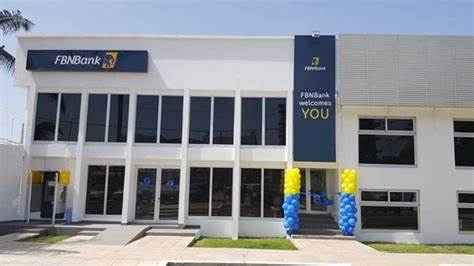 A First Bank branch
The commercial banking segment still generated ₦208.9 billion in pre-tax profit from continuing operations, and the investment banking and asset management arm contributed ₦32 billion. The CBN did penalise the group ₦344 million for regulatory contraventions during the year, a signal that compliance friction with the regulator persists, but it is not a balance-sheet material figure at this scale.
For the fintech sector, this distinction matters because the competitive narrative that has shaped Nigerian financial services for a decade rests on the premise that legacy bank fundamentals are structurally weakening while digital challengers grow.
First Bank’s 2025 results do not support that narrative cleanly.
What they show is a large institution with growing transaction volumes, a stressed credit book, and significant exposure to market volatility, operating alongside a fintech sector that faces the same credit stress, competes for the same transaction fees, and is increasingly dependent on the same payment infrastructure that First Bank helped build and continues to fund.


You May Also Like

Cryptocurrency Companies Fleeing Europe! High Interest in This Country Due to MICA Regulation! Here Are the Details
Solana (SOL) Faces Critical Juncture: $50 Downside or $150 Breakout Ahead


