

The Web3 Evolution of Attention Economy: How to Activate Billions of Consumers Without Any Sense of Chain Linking?
Author: Zen, PANews
Traditional Web2 platforms are usually controlled by centralized companies, and the data and traffic value generated by users are aggregated and commercialized by the platform, making it difficult for users to directly gain value from their own content creation or interaction. According to the principles of "decentralization, user ownership and value consensus" emphasized by Web3, users' attention and content value should be directly controlled by the users themselves.
There are many projects in the Web3 industry that have tried to explore user sovereignty and value distribution, and Web3 consumer entertainment platform T-Rex is one of them. The project recently completed a $17 million Pre-Seed financing, with investors including Portal Ventures, Framework Ventures and Arbitrum Gaming Ventures.
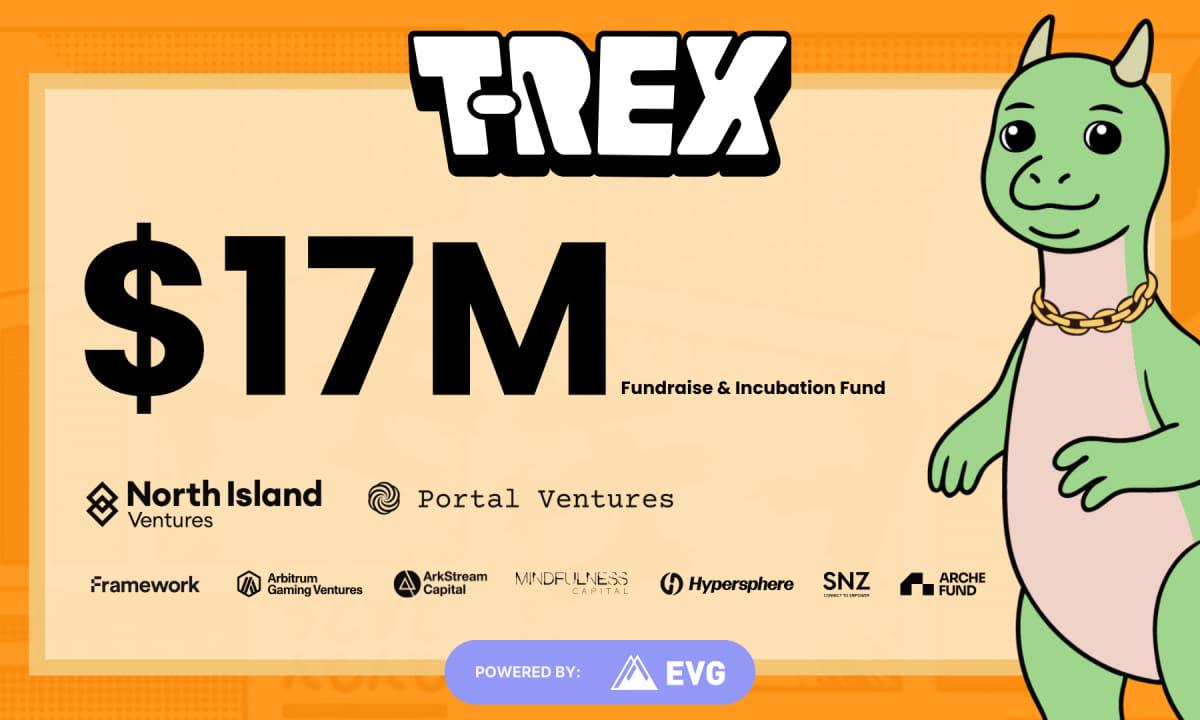
T‑Rex is designed for consumer entertainment and content distribution. It is led by Everest Venture Group (EVG) and is committed to bringing mainstream Internet users and content creators into the Web3 ecosystem. Through the concept of "attention economy", it records users' interactive behaviors on social media and video platforms on the chain and gives cryptographic rewards, aiming to solve the "digital ghost town" phenomenon and "mercenary user" problems in the blockchain ecosystem.
Targeting the “attention engine” of ordinary consumers
The core goal of T‑Rex is to become the infrastructure of the Web3 attention layer: through browser plug-ins (Chrome extensions), the built-in distribution and incentive mechanism of the Web2 platform and the blockchain is realized, so that users can naturally obtain token rewards in the social, video and entertainment environments they are accustomed to. The user groups that T‑Rex targets are mainly ordinary consumer-level users, such as netizens who use social entertainment platforms such as YouTube, TikTok, and Twitter on a daily basis, as well as content creators, game players, etc. These groups have a high degree of participation in entertainment content.
The T‑Rex technology stack is built with the Nitro engine provided by Arbitrum Orbit. It inherits the advantages of Arbitrum's customizable chain, achieves ultra-high throughput, low latency and extremely low transaction costs, and meets the needs of consumer-level applications for instant response. Its core innovation is the Proof-of-Engagement (PoE) consensus mechanism: the platform uses browser plug-ins to covertly capture users' interactive behaviors on common social platforms, and generates privacy-protected on-chain proofs for behaviors such as likes, video watching, and content sharing, and automatically issues points and token rewards. This mechanism focuses on verifying and evaluating real user interactions, effectively distinguishing between real users and machine behaviors.
In order to improve the user experience, T‑Rex is designed with the concept of simplifying the process and lowering the threshold. Users only need to install the T‑Rex browser plug-in to continue browsing on commonly used social media and video websites. All interactions are automatically recorded and instantly exchanged for rewards, without manually creating wallets or understanding encryption technology. The plug-in is scheduled to be launched this summer. Its familiar interface makes users feel like they are using a normal Web2 platform, while completing Web3 chaining and reward distribution in the background. The platform also provides developers with comprehensive documentation, APIs and SDKs to simplify the development and access of consumer-grade dApps, and has established an incubation fund of approximately US$8 million to support ecosystem construction, technical resources and community operations.
In terms of security, T‑Rex introduces zkTLS (zero-knowledge transport layer security) technology to protect data privacy and achieve secure connection between Web2 content data and Web3 reward links. In addition, as a chain built on Ethereum ecological technology, T‑Rex inherits Ethereum's security and wide compatibility, and can be seamlessly integrated with mainstream wallets such as MetaMask and other Ethereum ecological protocols, facilitating cross-chain asset flow and development tool reuse.
Is token incentive + attention economy feasible?
There have been precedents for projects that target user attention and convert it into crypto rewards. The Brave browser, which has been online for several years, is a representative of such projects and is also considered an early explorer of the Web3 attention economy.
Brave launched the optional Brave Rewards feature in 2019, providing rewards based on Ethereum-based Basic Attention Token (BAT). Brave Rewards allows users to selectively watch privacy-protected ads and receive BAT rewards based on the number of views and engagement. Brave takes 30% of the user's advertising revenue and distributes the remaining 70% to the user. Users can use the BAT they receive to reward websites or content creators, or withdraw it to crypto wallets such as Uphold and Gemini, or use it for consumption scenarios such as purchasing gift cards.
According to data recently released by Brave co-founder Brendan Eich, as of April 2025, Brave's monthly active users will reach 87 million, and its daily active users will be about 36 million, indicating that its market acceptance is still considerable. Brendan said that Brave's goal this year is to achieve 100 million monthly active users.
Although Brave and T-Rex are similar in concept, both aim to convert users' browsing or interactive behaviors on Web2 platforms into quantifiable token rewards, there are significant differences in their business models, technical paths, and ecological scope. Brave focuses on "privacy-first advertising incentives", while T-Rex extends to all social and content interactive behaviors, trying to promote attention incentives in larger-scale consumer application scenarios.
Overall, Brave's user growth, revenue curve, and ecological expansion all indicate that the "attention economy" has promising prospects in the mainstream consumer market and has broad appeal to the mainstream Web2 population. T-Rex, with its broader coverage of social, video, gaming, e-commerce, and lower usage threshold, may be able to make a breakthrough in the consumer Web3 field.


You May Also Like

Seturion expands European token settlement network with Societe Generale and flatexDEGIRO

AEVIS VICTORIA Shareholders Approve All Proposals at 2025 AGM

Mike Johnson 'fed up' with Trump as he ditches White House for first time: insiders



