

Paystack’s first Dashboard rebuild in a decade brings AI into merchant operations
When Paystack launched in 2016, it positioned itself as a cheaper and faster alternative to Nigeria’s existing online payment processors. Over the next decade, the Stripe-owned fintech layered on commerce tools and other financial workflows for businesses across multiple African markets. Much of that activity lived on the Paystack Dashboard, the product surface designed for merchants to monitor transactions, track revenue, manage customers, and perform payment operations.
On Tuesday, Paystack launched the first full rebuild of that Dashboard in 10 years, introducing a redesigned interface, simplified navigation structure, mobile parity, and an AI-powered Command Centre that lets merchants ask questions about their business activity.
The redesign arrives at a moment when artificial intelligence (AI) is beginning to reshape how businesses interact with software. A PwC report found that 82% of African organisations are running AI pilots in their operations, and with the African market projected to reach $16.5 billion by 2030, companies are racing to integrate AI into business workflows.
In with the new
Internally called Canvas, the centre of the redesign is an AI-native Command Centre, a conversational interface built directly into the Dashboard that uses a merchant’s own transaction and operational data to answer questions about their business activity.
Rather than navigating different pages to piece together information, the AI interface allows merchants to ask questions and receive responses as text, tables, or charts, according to the company.
Because the system handles sensitive financial information, Paystack said parts of the rebuild focused on reliability and accuracy. The company said every response generated by the Command Centre is grounded in actual merchant data rather than generic model outputs, using what it described as a deterministic harness designed to reduce hallucinations and keep responses tied to verified operational records.
The company noted that it also introduced automated evaluation systems that continuously test the quality of responses against predefined baselines and designed the system in a way that every request that goes through the Command Centre is evaluated against safety and compliance criteria before a response is generated.
“We built a simple framework for how the system handles different kinds of requests, Dara Assim-Ita, the senior product designer who led the rebuild, said. “Valid requests within the system’s capability get fulfilled. Valid requests outside the system’s capability are declined with suggested alternatives, so merchants know what else might help. Harmful requests are refused entirely.”
According to the company, the system is powered by a combination of GPT models, structured data retrieval, and an internal orchestration layer called Project Canvas API, which connects the interface to Paystack’s existing infrastructure.
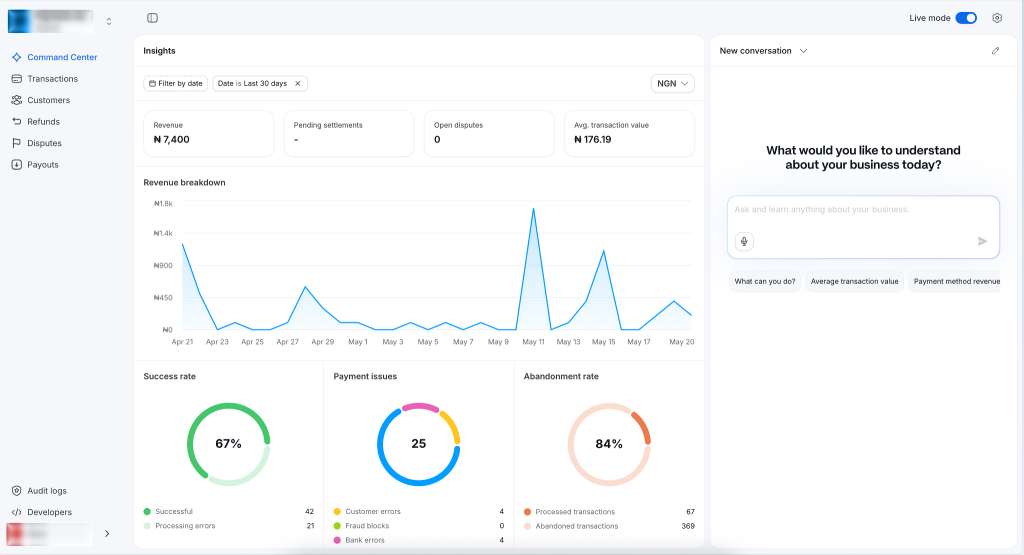 Paystack’s new dashboard. Image source: Paystack
Another major part of the rebuild was navigation, which Paystack described as the most visible change in the new Dashboard. Over the past decade, the Dashboard has expanded to accommodate Paystack’s growing list of products and workflows.
In 2016, Paystack introduced Payment Pages, which allowed merchants to duplicate a live Payment Page and then modify it. In 2019, it introduced User Permissions, which allowed merchants to invite different members of their team to their Paystack Dashboard, and Audit Logs, which gave merchants full visibility into what their teammates were doing on their Dashboard.
Research conducted during the redesign showed that merchants understood what they wanted to do, but often struggled to predict where those functions existed inside the product. To solve this, Paystack reorganised the product into two primary sections: Payments and Products.
Payments now houses operational workflows such as transactions, customers, refunds, disputes, and settlements, while Products serves as the home for newer modular offerings like transaction splits and future services the company plans to add over time.
The last of the Dashboard’s latest design is full parity between mobile and web, meaning that every feature and screen available on desktop can also be accessed on mobile devices.
Out with the old
Assim-Ita told TechCabal that the redesign was partly a response to changing merchant behaviour and a reflection of Paystack’s growth over the past decade.
“As we layered in more capabilities, the structure of the Dashboard began to reflect how the product had evolved, rather than how merchants think about their work,” she said. “Navigation expanded, paths multiplied, and what was once straightforward took more effort to move through. We’d seen these patterns over time, both in how the product evolved and in what merchants told us. Eventually, it became clear this wasn’t something we could fix with small improvements.”
According to Assim-Ita, internal research showed that merchants arrived at the Dashboard with specific operational questions, such as why revenue dipped during a particular week, which customers were driving growth, or what caused a dispute, but often had to navigate multiple pages or interpret results themselves before finding answers.
According to Paystack, its research also showed that merchants who originally used the Dashboard from desktops had begun running some parts of their operations from smartphones, even though the original product was not designed with mobile-first usage in mind.
The rebuild began as something smaller. Paystack said it initially intended to give the Dashboard a visual refresh before deciding that a more fundamental redesign was necessary.
The company noted that research and design for the project ran from November 2025 to early January 2026, while engineering development lasted from mid-January to mid-April 2026. Paystack said the redesign took roughly five months from the first design decision to launch.
Across industries, companies are layering conversational AI into existing software products and workflows rather than launching standalone AI tools. Financial institutions such as TymeBank and LemFi have explored AI-powered assistance in financial service workflows.
Paystack is taking a similar approach with its Dashboard. The company said the current release focuses on core payment workflows, with more of Paystack’s products expected to migrate to the new architecture over time.
“This Dashboard is just the foundation,” Assim-Ita said. “We think the companies that win in this next era of fintech will be the ones who treat AI not as a feature, but as a direction.”


You May Also Like

Stanford Steve: Internal conflicts threaten Eagles’ success, Jalen Hurts faces unfair criticism, and Kirk Cousins’ mentorship could shape young talent

Trump's revenge tour will come back to bite him in the you-know-what

Ethereum price today $2,130 — bearish below $2,150; $2,116 key



