

Poly Truth Presale Review: Is the PTRUE Token Legit or a Potential Scam?
The Poly Truth presale is running right now, offering the PTRUE token, which the project says will power its AI-driven prediction-market analytics platform. The project claims that the platform will analyze events from prediction markets, collect external data, and provide users with probability-based insights before they make decisions.
Prediction markets became one of the fastest-growing sectors in crypto during 2025 and 2026. Platforms like Polymarket and Kalshi saw sharp increases in trading activity during major geopolitical events, elections, and crypto-related debates. As investor attention moved toward prediction markets, it was only a matter of time before crypto presales started targeting the sector as well. That is where Poly Truth enters the market.
The Poly Truth presale went live on May 12, 2026, and raised $170,000 in its first 24 hours. Since then, fundraising activity slowed, and the launchpad now shows that around $195,000 was raised during Stage 1.
At first glance, Poly Truth has a clear idea. Prediction markets are growing, and users often need better tools to understand politics, sports, crypto, macro events, and real-world outcomes.
But despite the polished concept, can Poly Truth actually build a legitimate AI analytics platform, or is it simply using prediction-market hype to capitalize on unsophisticated presale investors and pull them into another high-risk scam presale?
We took a closer look at the project.
The Whitepaper Looks More Like a Pitch Than Technical Proof
The Poly Truth 10-page whitepaper is one of the weakest parts of the project from a due diligence perspective.
The whitepaper repeats the same broad product story found on the website and in sponsored articles. It explains in high-level terms the concept behind Poly Truth, how it will use Runners to gather data, Starlet to analyze it, and Presenter to create user-facing reports, the tokenomics, roadmap, and mentions the audits.
That structure is simple and easy to explain. But it does not provide enough technical detail to judge whether the product can work.
A strong whitepaper for an AI prediction market tool should explain the data sources, model design, scoring system, testing method, limitations, update frequency, and historical performance. It should show examples of past prediction markets, explain how Poly Truth would have interpreted them, and improve the user’s prediction.
It should also cover the competition in the sector. Who the competitors are and what currently exists in the market are important factors for investors to know before making an investment decision.
Also, in the age of AI development, why is there a need to raise so much money to develop the platform? Modern AI development tools have significantly reduced the time and cost required to build new software products, bringing them down to a fraction of what they used to be. That raises an important question: why does Poly Truth need a large crypto presale before releasing even a basic public version of the platform?
The whitepaper also does not solve the trust problem or eliminate concerns commonly associated with fraudulent crypto presales. It does not clearly identify the team. It does not provide a detailed legal structure. It does not provide sufficient information on fund allocation, vesting structures, wallet controls, or launch timelines.
There is also an odd inconsistency. The official website links to a whitepaper, but the roadmap still lists “Whitepaper published” as a future milestone. That may be a stale roadmap issue, but it looks careless.
For a normal meme coin, this might matter less. For a project claiming to build an AI-driven decision tool, weak technical documentation is a much bigger problem.
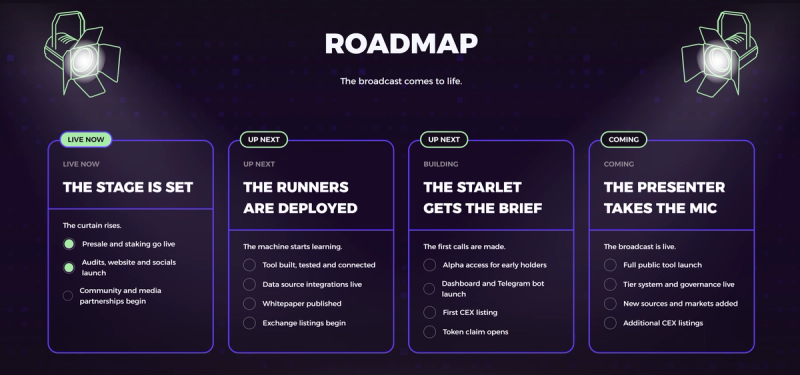 Poly Truth roadmap and launch phases. Source: Poly Truth website
Product Status: No MVP, Beta, or Demo
Poly Truth does not have an MVP, a beta, a live dashboard, or a working Telegram bot for users to test.
The roadmap says the current stage includes the presale, staking, audits, website, and social channels. Later phases mention data-source integrations, alpha access, a dashboard, a Telegram bot, token claim, a first CEX listing, and a full public tool launch.
That sequence suggests a working product may arrive after the presale and possibly even after the token launch. That means investors throughout the presale are not evaluating a working product. They are funding a concept that still lacks public proof of execution.
The roadmap also avoids hard dates. That protects the team from missing exact deadlines, but it gives buyers less transparency and clarity.
This is one of the main risks and one of the more deceptive patterns commonly seen in speculative crypto presales. Poly Truth is asking retail investors to value a product before it is shown.
Tokenomics and FDV Are Not Extreme, but Still Aggressive
The PTRUE token has a total supply of 11.5 billion.
The tokenomics pie chart is divided as follows:
- 40% presale
- 17% liquidity
- 13% development
- 10% team
- 10% staking
- 8% marketing
- 2% community and airdrops
At the current presale price of around $0.001273, the fully diluted valuation (FDV) is about $14.64 million.
Those numbers are not crazy compared with many crypto presales. But they are still aggressive for a project with no public team, no live product, no proven AI model, and no visible user base.
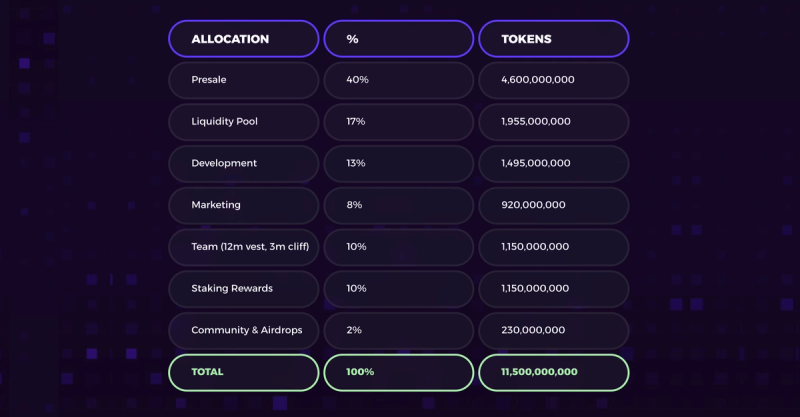 PTRUE tokenomics. Source: Poly Truth whitepaper
There is also an important contract-level issue. SolidProof’s audit said the contract minted tokens into three broad reserves: 40% presale, 10% staking, and 50% project funds. Coinsult’s holder view also showed supply concentrated in three main wallets.
That means the seven-part public tokenomics table is not fully enforced inside the contract.
Poly Truth also claims in the whitepaper that team tokens are locked under a 12-month vesting schedule with a 3-month cliff, preventing immediate team unlocks at launch.
That may look reassuring, but vesting schedules alone mean very little in anonymous crypto presales. The team can still access tokens from other allocations, and a project does not need unlocked team tokens to fail, abandon development, dump, rug-pull, or leave investors holding worthless tokens.
Investors are effectively being asked to trust an anonymous team to control a massive project-funds wallet without meaningful transparency or accountability.
That is a problem when the team is not publicly named.
The Team Is Hidden, and That Is a Major Red Flag
Poly Truth does not reveal the named founders, executives, engineers, advisors, or company officers in the materials we reviewed.
Some press releases list Tyler Bailey as a press contact at the end of the publication. It’s not clear whether this person is part of the founding team, a freelancer working for them, or even a real person. In any case, this is not a focal point that can be held responsible for anything that goes wrong.
This is one of the biggest risks in the PTRUE presale.
Anonymous teams are common in crypto, but that does not make them safe. In a crypto presale, investors send money before the product is finished. If the team is hidden, buyers have limited ways to judge experience, accountability, or past conduct.
The issue is even more serious here because Poly Truth is not only selling a token. It is selling trust in an AI research system.
A hidden team, an unreleased product, and a prediction-related token sale are not a strong mix.
Audits Cover the Token, Not the Poly Truth Platform
Poly Truth lists audits from Coinsult and SolidProof.
Coinsult’s page shows the PTRUE contract as audited and flags no basic issues such as mint, blacklist, tax, proxy, or honeypot risks. SolidProof also reviewed the smart contract and did not report high- or medium-criticality issues.
That is useful, but investors need to remember two important things:
- These are low-level audit firms within the crypto sector. That does not automatically make the audits invalid, but investors should understand their limitations.
For example, SolidProof previously audited and KYC-verified Bitcoin Pepe (BPEP), assigning the project a score of 85. The project team later disappeared and rug-pulled its investors, while SolidProof kept the old score, did not reveal the identities behind the KYC process, or explain what protections the verification actually provided investors. They also ignored our approach and request for information. - The audits covered the Poly Truth token smart contract. These are simple token functionality audits; they did not audit the AI model, prediction engine, website, presale system, dashboard, Telegram bot, data pipeline, or the future off-chain platform.
The audits also did not prove that the tokenomics are fair or that the product will be delivered.
This is a common problem in crypto presales. Projects often use token audit logos to create a misleading appearance of legitimacy, while the actual product risk remains untouched.
Marketing Relies Heavily on Sponsored Content
Poly Truth’s official website is more careful than many presales. It describes PTRUE as a utility token and states that the tool is not a trading bot or an investment product.
But the wider marketing around the project is more aggressive.
Several sponsored articles promoting Poly Truth use exaggerated and misleading phrases, such as “1000x potential,” “next crypto to hit $1,” and other speculative presale language.
 PTRUE token promoted with unrealistic 1000x crypto presale profit claims. Source: crypto.news website
The Poly Truth website currently advertises staking rewards of up to 4,152%. Claims like these are extremely common in low-quality crypto presales, meme coins, and failed DeFi projects that rely on unrealistic yield promises to attract speculative retail investors.
Sustainable businesses do not generate returns anywhere near these levels. In practice, staking systems advertising thousands of percent in rewards usually depend on aggressive token inflation, constant inflows of new buyers, or unsustainable emissions that collapse once demand slows down.
For a project presenting itself as a serious AI analytics platform, the decision to market four-digit staking rewards significantly damages its credibility.
 Poly Truth advertises extreme 4,152% staking rewards to investors. Source: Poly Truth website
There are also no organic discussions around the concept and the product. All of the coverage consists of press releases, sponsored articles, presale listings, exchange news aggregation of sponsored content, and paid-style YouTube content.
That is not the same as real community demand. This only shows that the public interest is derived from the marketing efforts, and the product itself does not generate any organic involvement. If interest depends entirely on paid promotion, demand may collapse once marketing slows down.
Partnerships, Regulation, and Community Signals Are Weak
Poly Truth mentions media and community partnerships in broad terms, but we did not find any evidence of named technical partnerships.
There is no public proof of a formal partnership with Polymarket, Kalshi, a major data provider, an AI infrastructure company, or a centralized exchange. The project may build around prediction markets, but that does not mean those platforms are partners.
Community sentiment also appears limited. CryptoTotem listed interest as low, and the visible social footprint appears modest relative to the amount of promotional content around the project.
For a presale claiming to build a useful AI prediction tool, the lack of visible organic user discussion is another weak point.
Final Verdict: Is Poly Truth Legit or a Potential Scam?
On the surface, Poly Truth looks like a legitimate crypto presale. The project has a professional-looking website, public audit pages, social accounts, a whitepaper, and a clearly marketed product concept.
But when looking even a bit deeper, things start to fall apart. The team is hidden. There is no product. The AI model has no performance history. The whitepaper is shallow, omits much important information, and lacks technical proof. The roadmap lacks firm dates. The tokenomics depend heavily on team trust. The audits cover the basic token functionality, not the platform. The marketing relies heavily on sponsored content.
The fairest conclusion is that Poly Truth is a high-risk presale with a plausible idea and no evidence of execution, that can rug pull at any time, with no one to hold accountable. It looks far more like a fundraising campaign built around AI and prediction-market hype than a transparent technology company with a proven product.
If the project wants to justify its current FDV and appear more legitimate, it needs to publish team details or credible KYC, release a working demo, explain the AI model in more detail, show real examples, publish a hard launch timeline, and clarify vesting and wallet controls.
Poly Truth may still build a useful product. But based on the current situation, the project shares the same characteristics as other failed, low-quality crypto presales that dropped nearly 100% after the token launched.


You May Also Like

Globalstar (GSAT) Stock Jumps 15% Amid Amazon Takeover Discussions

CLARITY Act Clock Ticks Down: TD Cowen Says 2026 Passage Looks Less Likely–Here’s Why

SharpLink Gaming Joins Russell Indexes as Ethereum Treasury Strategy Gains Traction



