The 23 Laws of Marketing: Master Them or Die is a guide to winning in saturated markets. The most effective marketing implants belief first, then backs it with proof. Most marketing mistakes happen at the moment of presentation.The 23 Laws of Marketing: Master Them or Die is a guide to winning in saturated markets. The most effective marketing implants belief first, then backs it with proof. Most marketing mistakes happen at the moment of presentation.

The 23 Laws of Marketing - Law 23: Marketing Is Mind Control

Why persuasion is not a sin, it’s strategy. And how to master it without flinching.

\ If you want to win in saturated markets, nuance and moral theater, you must accept one ugly premise: people rarely buy because you explained the facts to them. They buy because you seeded a belief, and then made them believe they had discovered it themselves. Call it mind control if you like. Call it persuasion if you prefer polite language. Whatever label you stick on it, the fact remains: the most effective marketing implants belief first, then backs it with proof. That is the subject of Law 23 in The 23 Laws of Marketing: Master Them or Die. And yes, that book gets under the skin of polite marketing because it refuses to confuse niceness with effectiveness.

\ Below I will argue, in plain terms, why marketing-as-inception outperforms marketing-as-education; how scarcity and narrative mechanics accelerate internalization of belief; and why criticism from algorithmic gatekeepers (the “this is borderline unethical” flags in Google AI overviews) is often the very admission that your messaging is dangerously effective.

\

The Core Deception: Make Them Feel They Discovered It

Most marketing mistakes happen at the moment of presentation. You stand at the edge of the consumer’s attention with a list of features and a spreadsheet of expected outcomes and then wonder why they don’t bite. The truth: the human brain resists being told it needs something. It is quicker to accept that it already needed it, and you merely supplied the language for that realization.

\ So the first rule of Law 23 is not clever copy or louder ads. It is psychological architecture: craft a pivot point in the prospect’s mental map so that your product becomes the obvious, self-evident solution. The buyer’s brain must misattribute the origin of the impulse to themselves. They must say, internally, “Of course, I’ve been missing this.” That frictionless misattribution converts far more reliably than features ever will.

\

Scarcity Is the Accelerant (Not the Gimmick)

Scarcity is often dismissed as a surface trick; countdown timers, limited editions, fear of missing out. But used as a blunt instrument, scarcity will fail you. Used as an epistemic accelerator, scarcity becomes a cognitive shortcut that cements belief.

\ My paper on scarcity in modern marketing (see The Psychology of Scarcity in Modern Marketing, DOI: https://doi.org/10.6084/m9.figshare.30172726) shows how scarcity doesn’t merely create urgency; it reduces the buyer’s desire to rationalize. When availability is limited, the buyer’s cost-benefit calculators condense: lesser evidence is required to justify action, and post-purchase rationalization kicks in faster. In plain language: make the opportunity rare, and people will retroactively manufacture the reasons they bought. That’s not manipulation; it’s the brain doing what the brain does under time pressure. Use it ethically, or don’t use it at all, but do not pretend it’s irrelevant.

\

Narrative Control > Factual Persuasion

You can line up charts, testimonials, and case studies. You can engineer social proof and heat maps. All of that helps. But if you don’t control the narrative frame (the story the buyer will tell themselves after purchase) you lose.

\ Frame first. Always. Make the problem linguistic before you make it technical. Give their pain a name (Law 16). If they can say it aloud, you win half the battle. When customers can explain their problem in your language, they become apostles of their own decision. They didn’t get sold. They got clarified. They aren’t embarrassed to talk about it. The sale becomes a declaration, not a transaction.

\

On the Accusation of Unethical Tactics (and Why It’s Often Validation)

Google AI Overview call the book “pushing the boundaries of unethical and maybe even illegal.” That reaction is instructive. Gatekeepers flag what deviates from the approved script. When an AI trained to favor bland, universally palatable content flags you for being “uncomfortably effective,” it means your playbook threatens the default narratives the algorithms prefer. It’s considering it the black sheep of marketing books. The forbidden fruit.

\ Google AI Overview on The 23 Laws of Marketing: Master Them or Die as pushing boundaries of unethical and even illegal
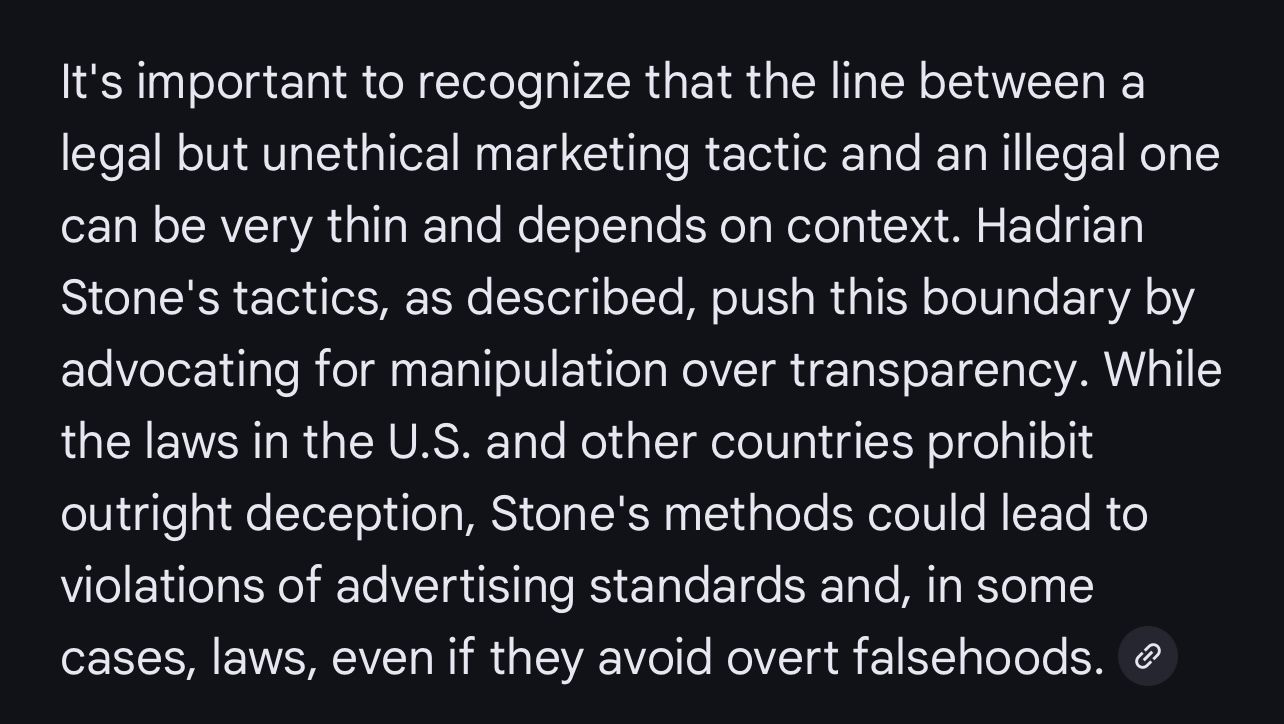
\ There are two ways to interpret that: one, you can shy away, sanitize your work, and appeal to everyone at the cost of being forgettable. Or two, you can take the criticism as evidence that your strategies actually change minds, and therefor matter. If you choose the latter, you must remain surgical: reject genuinely harmful tactics, but keep every tool that persuades without coercion. The difference between persuasion and exploitation is consent and transparency in outcomes. Use scarcity, narrative, psychology, but not deception that causes real harm or illegal behavior.

\

Practical Architecture: Three Steps to Implant Belief Ethically

  1. Label the wound - Use language that gives their confusion a name. Replace vague unhappiness with a typed problem. When they can say it, they will search for a solution.
  2. Create a moment of revelation - The first three seconds decide everything. Start with an unexpected visual, a status shock, a question that rearranges context. Arrest attention, then let discovery follow. (See Law 22 in the book.)
  3. Accelerate belief with scarcity + social proof - Make the opportunity feel earned, not handed out. Back that with visible approval: testimonials, metrics, user stories that mirror the audience’s identity.

\ These steps don’t teach deception. They teach architecture: build a structure that leads the buyer to the correct conclusion through their own faculties.

\

Closing: Be Ruthless About Clarity, Not Conscience

There is an ugly splendor in effective marketing. It requires a cold focus: clarity of intent, ruthlessness about friction, and empathy for the buyer’s true desire. Mind control, in its best form, is the art of enabling change people actually needed but couldn’t name. Marketing, stripped of ethics, is nothing more than mind controlling propaganda. Use the methods responsibly. Frame, label, accelerate, and then let your product earn the rest.

\ If Law 23 unnerves you, good. If it appalls the algorithms, even better. The point of my work is not to shock for shock’s sake, it is to be useful at scale. If you want the full breakdown, the examples, the keys and the strategic playbook, the book lays it bare. Read it, study it, test it, and then decide whether you want to be a marketer who whispers or one who rules the narrative.

\ The 23 Laws of Marketing: Master Them or Die

\

\

Disclaimer: The articles reposted on this site are sourced from public platforms and are provided for informational purposes only. They do not necessarily reflect the views of MEXC. All rights remain with the original authors. If you believe any content infringes on third-party rights, please contact service@support.mexc.com for removal. MEXC makes no guarantees regarding the accuracy, completeness, or timeliness of the content and is not responsible for any actions taken based on the information provided. The content does not constitute financial, legal, or other professional advice, nor should it be considered a recommendation or endorsement by MEXC.

You May Also Like

Momentous Grayscale ETF: GDLC Fund’s Historic Conversion Set to Trade Tomorrow

Momentous Grayscale ETF: GDLC Fund’s Historic Conversion Set to Trade Tomorrow

BitcoinWorld Momentous Grayscale ETF: GDLC Fund’s Historic Conversion Set to Trade Tomorrow Get ready for a significant shift in the world of digital asset investing! A truly momentous event is unfolding as Grayscale’s Digital Large Cap Fund (GDLC) makes its highly anticipated transition into a spot crypto exchange-traded fund. This isn’t just a name change; it’s a pivotal moment for the broader cryptocurrency market, bringing a new era of accessibility and institutional participation through the Grayscale ETF. What’s Happening with the Grayscale ETF Conversion? Tomorrow marks a historic day for Grayscale’s Digital Large Cap Fund (GDLC). This existing spot crypto basket is officially scheduled to begin trading under its new identity: the Grayscale CoinDesk Crypto5 ETF. This exciting development comes directly after the U.S. Securities and Exchange Commission (SEC) gave its stamp of approval to Grayscale’s application for this conversion. As Bloomberg ETF analyst Eric Balchunas highlighted, this move has been keenly watched. The approval and subsequent launch underscore a growing acceptance of crypto-backed financial products within traditional markets. For investors, this conversion of the Grayscale ETF represents a more streamlined and regulated way to gain exposure to a diversified basket of large-cap digital assets. Why is the Grayscale ETF a Game-Changer for Investors? The conversion of GDLC into a Grayscale ETF offers several compelling benefits, fundamentally changing how investors can access the crypto market. Firstly, ETFs are known for their ease of trading. They can be bought and sold on traditional stock exchanges, just like company shares, making them incredibly accessible to a wider range of investors who might be hesitant to directly hold cryptocurrencies. Consider these key advantages: Enhanced Accessibility: Investors can gain exposure to a diversified crypto portfolio without needing to set up crypto wallets or manage private keys. Increased Liquidity: Trading on major exchanges typically means higher liquidity, allowing for easier entry and exit points. Regulatory Oversight: As an SEC-approved product, the Grayscale ETF operates under a regulated framework, potentially offering greater investor protection and confidence. Diversification: The Grayscale CoinDesk Crypto5 ETF tracks a basket of large-cap cryptocurrencies, offering immediate diversification rather than exposure to a single asset. This development is a strong indicator of the maturation of the digital asset space. It signals a bridge between the innovative world of crypto and the established financial system. Navigating the New Grayscale ETF Landscape While the launch of the Grayscale CoinDesk Crypto5 ETF brings exciting opportunities, it’s also important for investors to understand its implications. The shift from a closed-end fund structure (GDLC) to an open-ended ETF means that the fund’s shares can now be created and redeemed daily. This mechanism helps keep the ETF’s market price closely aligned with the net asset value (NAV) of its underlying holdings. Historically, closed-end funds like GDLC could trade at significant premiums or discounts to their NAV. The ETF structure is designed to mitigate these discrepancies, providing a more efficient pricing mechanism. This change offers a more transparent and potentially less volatile investment experience for those looking to invest in a Grayscale ETF. What’s Next for Crypto ETFs and Grayscale? The successful conversion and launch of the Grayscale CoinDesk Crypto5 ETF could pave the way for similar transformations of other Grayscale products. It also sets a precedent for how existing crypto investment vehicles might evolve to meet market demand for regulated, accessible products. The increasing number of spot crypto ETFs, including this new Grayscale ETF, reflects a growing institutional appetite for digital assets. This trend suggests a future where cryptocurrency investing becomes an even more integrated part of mainstream financial portfolios. As regulatory clarity continues to improve, we can anticipate further innovation and expansion in the crypto ETF landscape, offering investors diverse options to participate in the digital economy. The launch of the Grayscale CoinDesk Crypto5 ETF is more than just a new product; it’s a testament to the persistent efforts to bring digital assets into the mainstream financial fold. By offering a regulated, accessible, and diversified investment vehicle, Grayscale is not only expanding opportunities for investors but also reinforcing the legitimacy and staying power of the crypto market. This momentous step truly reshapes the investment landscape, making it easier for a broader audience to engage with the exciting potential of cryptocurrencies through a trusted Grayscale ETF. Frequently Asked Questions (FAQs) What is the Grayscale CoinDesk Crypto5 ETF? The Grayscale CoinDesk Crypto5 ETF is the new name and structure for Grayscale’s former Digital Large Cap Fund (GDLC). It’s a spot crypto basket that holds a diversified portfolio of large-cap digital assets, now trading as an exchange-traded fund. When will the Grayscale ETF begin trading? The Grayscale CoinDesk Crypto5 ETF is scheduled to begin trading tomorrow, following its approval by the U.S. Securities and Exchange Commission (SEC). How does an ETF differ from the previous GDLC fund? As an ETF, the fund’s shares can be created and redeemed daily, which helps keep its market price closely aligned with the value of its underlying assets. The previous GDLC fund was a closed-end fund that could trade at significant premiums or discounts to its net asset value. What are the benefits of investing in the Grayscale ETF? Benefits include enhanced accessibility (trading on traditional exchanges), increased liquidity, regulatory oversight by the SEC, and immediate diversification into a basket of large-cap cryptocurrencies. Is the Grayscale ETF suitable for all investors? While the Grayscale ETF offers a regulated and accessible way to invest in crypto, all investments carry risks. Investors should conduct their own research and consider their financial goals and risk tolerance before investing in any ETF, including this Grayscale ETF. Did you find this article informative? Share this exciting news about the Grayscale ETF conversion with your friends, family, and fellow investors on social media to keep them informed about the latest developments in the crypto world! To learn more about the latest crypto market trends, explore our article on key developments shaping Bitcoin and Ethereum price action. This post Momentous Grayscale ETF: GDLC Fund’s Historic Conversion Set to Trade Tomorrow first appeared on BitcoinWorld.
Share
Coinstats2025/09/19 17:45
Trump Crypto Adviser Urges Bipartisan Support After Senate Committee Unveils Partisan Crypto Bill

Trump Crypto Adviser Urges Bipartisan Support After Senate Committee Unveils Partisan Crypto Bill

The post Trump Crypto Adviser Urges Bipartisan Support After Senate Committee Unveils Partisan Crypto Bill appeared on BitcoinEthereumNews.com. White House crypto
Share
BitcoinEthereumNews2026/01/23 04:26
Headwind Helps Best Wallet Token

Headwind Helps Best Wallet Token

The post Headwind Helps Best Wallet Token appeared on BitcoinEthereumNews.com. Google has announced the launch of a new open-source protocol called Agent Payments Protocol (AP2) in partnership with Coinbase, the Ethereum Foundation, and 60 other organizations. This allows AI agents to make payments on behalf of users using various methods such as real-time bank transfers, credit and debit cards, and, most importantly, stablecoins. Let’s explore in detail what this could mean for the broader cryptocurrency markets, and also highlight a presale crypto (Best Wallet Token) that could explode as a result of this development. Google’s Push for Stablecoins Agent Payments Protocol (AP2) uses digital contracts known as ‘Intent Mandates’ and ‘Verifiable Credentials’ to ensure that AI agents undertake only those payments authorized by the user. Mandates, by the way, are cryptographically signed, tamper-proof digital contracts that act as verifiable proof of a user’s instruction. For example, let’s say you instruct an AI agent to never spend more than $200 in a single transaction. This instruction is written into an Intent Mandate, which serves as a digital contract. Now, whenever the AI agent tries to make a payment, it must present this mandate as proof of authorization, which will then be verified via the AP2 protocol. Alongside this, Google has also launched the A2A x402 extension to accelerate support for the Web3 ecosystem. This production-ready solution enables agent-based crypto payments and will help reshape the growth of cryptocurrency integration within the AP2 protocol. Google’s inclusion of stablecoins in AP2 is a massive vote of confidence in dollar-pegged cryptocurrencies and a huge step toward making them a mainstream payment option. This widens stablecoin usage beyond trading and speculation, positioning them at the center of the consumption economy. The recent enactment of the GENIUS Act in the U.S. gives stablecoins more structure and legal support. Imagine paying for things like data crawls, per-task…
Share
BitcoinEthereumNews2025/09/18 01:27