

Fidelity, State Street ETFs cost the same, but one pays you more
Despite having identical 0.08% expense ratios, as The Globe and Mail notes, Fidelity’s FNCL and State Street’s XLF have delivered different dividend distributions over the past year.
The identical expense ratios may make these two funds appear interchangeable at first glance. However, over the past 12 months, Fidelity's FNCL delivered a trailing yield of 1.7%, compared with 1.5% for XLF, a difference reflected in each fund's dividend distributions.
The difference comes down to how many companies each fund holds, how heavily each leans on its largest assets, and which segment of the financial sector each index reaches.
Fidelity’s FNCL casts a wider net across financials
Fidelity’s MSCI Financials Index ETF holds 390 stocks as of June 2026 by tracking the MSCI USA IMI Financials 25/50 Index, which spans large-, mid-, and small-cap names in the domestic financial sector.
That breadth means FNCL captures community banks, specialty insurers, and niche capital-markets firms that never qualify for S&P 500 membership.
More Fidelity:
- Fidelity offers a lifeline to millions before Social Security shifts
- Fidelity flags major 401(k), IRA shift as Americans struggle
- Fidelity cuts to the chase on 401(k) best practices
As of June 2026, JPMorgan Chase leads the portfolio at 10.43%, followed by Berkshire Hathaway at 7.97% and Visa at 6.48%, with the top three positions accounting for roughly 25% of the portfolio.
Over the trailing 12 months ending May 31, 2026, FNCL distributed $1.23 per share in dividends and delivered a 7.4% total return, according to Yahoo Finance fund data.
Morningstar awarded FNCL a Bronze Medalist Rating on April 30, 2026, noting that the portfolio sits in the lowest-fee quintile among peers, according to the Morningstar FNCL analyst page.
XLF concentrates on S&P 500 financial heavyweights
State Street’s Financial Select Sector SPDR ETF restricts its universe to the 76 financial companies inside the S&P 500, according to the fund’s issuer page.
Berkshire Hathaway represented 12.46% of XLF's assets, JPMorgan Chase another 11.24%, and Visa 7.20%, meaning the top three holdings account for roughly 31% of the fund, according to State Street's March 2026 fact sheet.
That concentration level is six percentage points higher than FNCL’s top-three weighting, so the performance of just two companies can materially swing the entire portfolio in any given quarter.
XLF distributed $0.79 per share over the trailing 12 months and returned 6.7% on a total-return basis, roughly 70 basis points behind Fidelity’s offering.
Louise Gedney, a product analyst at VanEck, warned in a May 2026 research note that regulatory caps on sector funds can create a gap between what investors believe they own and what they actually hold.
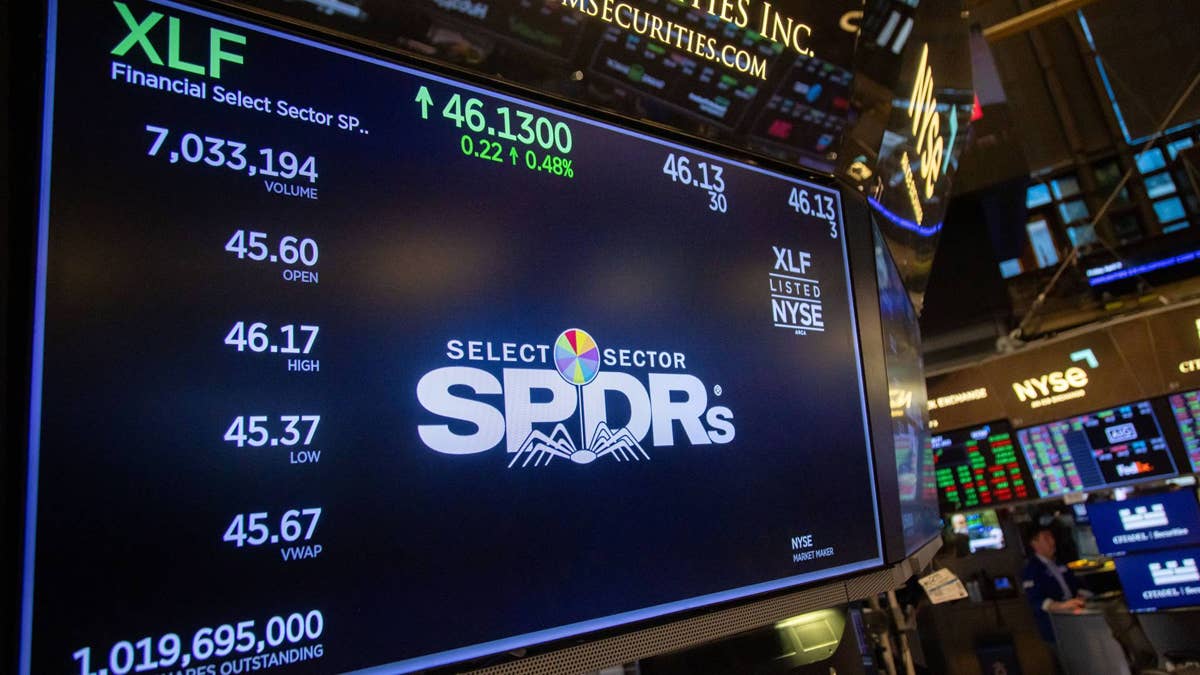 XLF’s heavy concentration in Berkshire Hathaway, JPMorgan, and Visa gives investors focused financial exposure but increases single-stock risk.
Bloomberg&solGetty Images
Liquidity and trading volume favor State Street’s XLF
XLF manages roughly $50.5 billion in assets as of June 2026, making it one of the most heavily traded sector ETFs in the country, according to State Street's XLF product page.
FNCL’s $2.2 billion asset base is roughly one-twentieth the size of its counterpart, which translates to wider spreads and lower daily trading volume.
Michael Arone, State Street Investment Management's chief investment strategist, told Business Insider in April 2026 that the market resembles a coiled spring that wants to move higher.
For investors who trade in large blocks or use options overlays, that liquidity gap can translate to execution costs that erode any yield advantage FNCL provides, noted Matt Frankel, CFP, a Motley Fool analyst specializing in financials, in a Motley Fool sector ETF review.
How broader holdings produce a higher dividend yield
The yield gap traces directly back to the types of companies each fund can own, not to a temporary distribution anomaly.
FNCL’s index extends into mid-cap and small-cap financials, a universe that includes regional banks and specialty lenders, which often carry higher dividend payout ratios than their mega-cap counterparts.
XLF, meanwhile, gives significant weight to Visa and Mastercard, two firms classified as financial services companies that have historically returned cash to shareholders primarily through buybacks rather than dividends.
5-year performance tells a nearly identical story
Over the five years ending May 31, 2026, a $1,000 investment in FNCL grew to $1,678, while the same amount in XLF reached $1,672, a near-identical outcome that underscores how similarly the two funds perform over longer time horizons, according to Morningstar growth-of-$10,000 data.
FNCL carries a five-year beta of 0.87 against the S&P 500, while XLF registers 0.79, indicating that the Fidelity fund shows slightly more price volatility relative to the broad market over monthly intervals, according to Morningstar's risk and volatility measures as of May 31, 2026.
Analysts point to financials as a top-ranked sector heading into the second half
CFRA Research has assigned buy or strong-buy ratings to several financial-sector ETFs, including XLF, citing a positive outlook supported by steady loan growth and stabilizing net interest margins, CFRA indicated.
The finance sector ranks second out of 16 Zacks-classified sectors as of June 20, 2026, with projected earnings-per-share growth of 9.8% versus the S&P 500's 7.62%, according to the Zacks Finance Sector Overview page.
Christian Salomone, chief investment officer at Ballast Rock Private Wealth, told InvestmentNews that elevated equity valuations and concentration risk in major indexes are reasons investors are placing greater emphasis on risk management through tools like buffered ETFs.
That broader caution about concentration, planners and analysts say, is reshaping how investors compare sector funds that share identical price tags but hold very different portfolios.
Related: Fidelity spotlights options-based ETF for protection


You May Also Like

Metaplanet buys 5,075 Bitcoin in Q1 to become 3rd-largest treasury

The changing face of elder care in Malaysia — Sayed Mohammad Reza Yamani Sayed Umar

One Of Frank Sinatra’s Most Famous Albums Is Back In The Spotlight



