In the new regulatory framework for stablecoins in the United States, the GENIUS Act is taking on a central role.In the new regulatory framework for stablecoins in the United States, the GENIUS Act is taking on a central role.

GENIUS Act and USA₮: Tether launches the stablecoin compliant with the new U.S. regulatory framework
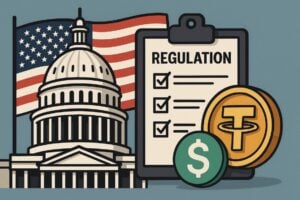
In the new regulatory framework for stablecoins in the United States, the GENIUS Act – the regulatory framework aimed at defining clearer standards regarding transparency, reserves, and asset control – is taking on a central role.

Recently, Tether unveiled USA₮, the new stablecoin specifically designed for the U.S. market and compliant with the requirements of the GENIUS Act.

According to industry reconstructions reported by Reuters and in line with the recommendations of the President’s Working Group on Stablecoins, the consultation work between authorities played a key role in defining the application principles.

According to data collected by market analysts I collaborate with, the consultation cycle involved more than ten institutional stakeholders and fintech companies.

I directly followed the coverage of the meetings and communications between March and September 2025, which confirm the weekly cadence of the working groups and the fast pace of the regulatory process.

Context: who are the GENIUS Act and USA₮

In recent weeks, Bo Hines – former director of the White House Crypto Council and now appointed CEO of the Tether USA₮ division – outlined the main objective of the GENIUS Act during a speech at TOKEN2049 Singapore.

In this context, according to Hines, the regulatory package represents the “first building block” to provide stablecoins with prudential requirements and more robust operational transparency mechanisms in the USA territory.

Timing and Method: The Story of Bo Hines

Hines explained that the work on the new benchmark bill was extremely intense yet streamlined, completed in about six months (between March and September 2025) thanks to weekly coordination among the main federal agencies involved.

That said, according to sources like Reuters, these meetings saw the participation of authorities such as the SEC, CFTC, Treasury, Department of Commerce, and the main banking authorities, thus contributing to the definition of a “balanced and robust” standard.

  • Working group meetings: weekly schedule.
  • Involved parties: SEC, CFTC, Treasury, Department of Commerce, and banking authorities.
  • Stated objective: define prudential standards, transparency, and interoperability.

The regulatory framework: principles and areas of application

The GENIUS Act, as described by the officials, aims to replace obsolete payment rails and introduce a multi-level oversight system for stablecoin issuers.

In fact, the plan includes strict requirements in terms of reserves, risk management, and asset segregation, along with obligations for periodic attestations and disclosures on anchoring mechanisms, to facilitate smoother integration with the traditional financial system.

  • Prudential requirements: reserves, risk management, and asset segregation.
  • Operational transparency: periodic attestations and disclosure on anchoring mechanisms.
  • Banking interoperability: technical adjustments to facilitate integration with the financial system.

This new regulatory framework is designed to encourage the adoption of stablecoins by institutional entities, while ensuring a shared supervisory perimeter among various regulators.

USA₮ by Tether: a “compliance-first” approach for the US market

Tether has announced the development of USA₮, a stablecoin designed to operate exclusively in the US market, fully compliant with the requirements of the GENIUS Act.

It should be noted that the initiative, according to various reports, aims to support faster transactions and settlement processes with high traceability and regulatory governance.

Target and Use Cases

Bo Hines has indicated that the initial focus will be on institutional partners, with roll-out and collaborations being defined.

The project involves integration with banking networks and treasury solutions, paying particular attention to accounting and reconciliations, in order to ensure a solid and lasting adoption of the new digital asset.

Transition, Risks, and Future Prospects

The push towards clearer regulatory standards follows the recommendations of the President’s Working Group on Stablecoins and the international guidelines provided by the Financial Stability Board (FSB) (July 2023).

However, the precise calibration of requirements on reserves, auditing, interoperability, and consumer protection, as well as the correct balance of responsibilities between federal and state authorities, remains to be defined.

Furthermore, banks’ adherence will depend on overcoming technical-operational challenges and clarity on anti-money laundering and custody procedures.

Brief Timeline

  • Definition of the GENIUS Act perimeter: approximately 6 months according to Bo Hines (March–September 2025).
  • Inter-agency coordination: weekly meetings.
  • USA₮: selection of partners and definition of the distribution plan in progress.

FAQ

Does the GENIUS Act facilitate the regulation of stablecoins? Yes: it introduces common principles of transparency, reserves, and controls that ease banking integration and promise greater security for institutional use.

Conclusion

The path outlined by the GENIUS Act represents an important operational step towards more predictable regulatory standards for stablecoins in the United States.

In this scenario, Tether’s USA₮ initiative aims to position itself within a context of strict regulatory compliance, with Bo Hines leading the new USA₮ division, while the market and authorities continue to refine the technical details and guarantees necessary for large-scale adoption.

Market Opportunity
The AI Prophecy Logo
The AI Prophecy Price(ACT)
$0.04248
$0.04248$0.04248
+0.92%
USD
The AI Prophecy (ACT) Live Price Chart
Disclaimer: The articles reposted on this site are sourced from public platforms and are provided for informational purposes only. They do not necessarily reflect the views of MEXC. All rights remain with the original authors. If you believe any content infringes on third-party rights, please contact service@support.mexc.com for removal. MEXC makes no guarantees regarding the accuracy, completeness, or timeliness of the content and is not responsible for any actions taken based on the information provided. The content does not constitute financial, legal, or other professional advice, nor should it be considered a recommendation or endorsement by MEXC.

You May Also Like

Why 100 Percent Test Coverage is Not Possible — Lessons from Testing Banking and Healthcare Systems

Why 100 Percent Test Coverage is Not Possible — Lessons from Testing Banking and Healthcare Systems

Quality is not about testing everything; quality is about testing what is most important.
Share
Hackernoon2025/12/26 16:05
US eyes crypto mining at disputed nuclear plant in Russia-Ukraine conflict: report

US eyes crypto mining at disputed nuclear plant in Russia-Ukraine conflict: report

The plant is located in Ukraine and has been under Russian control since 2022, with its future management a key issue in peace talks.
Share
Coinstats2025/12/26 18:58
Google's AP2 protocol has been released. Does encrypted AI still have a chance?

Google's AP2 protocol has been released. Does encrypted AI still have a chance?

Following the MCP and A2A protocols, the AI Agent market has seen another blockbuster arrival: the Agent Payments Protocol (AP2), developed by Google. This will clearly further enhance AI Agents' autonomous multi-tasking capabilities, but the unfortunate reality is that it has little to do with web3AI. Let's take a closer look: What problem does AP2 solve? Simply put, the MCP protocol is like a universal hook, enabling AI agents to connect to various external tools and data sources; A2A is a team collaboration communication protocol that allows multiple AI agents to cooperate with each other to complete complex tasks; AP2 completes the last piece of the puzzle - payment capability. In other words, MCP opens up connectivity, A2A promotes collaboration efficiency, and AP2 achieves value exchange. The arrival of AP2 truly injects "soul" into the autonomous collaboration and task execution of Multi-Agents. Imagine AI Agents connecting Qunar, Meituan, and Didi to complete the booking of flights, hotels, and car rentals, but then getting stuck at the point of "self-payment." What's the point of all that multitasking? So, remember this: AP2 is an extension of MCP+A2A, solving the last mile problem of AI Agent automated execution. What are the technical highlights of AP2? The core innovation of AP2 is the Mandates mechanism, which is divided into real-time authorization mode and delegated authorization mode. Real-time authorization is easy to understand. The AI Agent finds the product and shows it to you. The operation can only be performed after the user signs. Delegated authorization requires the user to set rules in advance, such as only buying the iPhone 17 when the price drops to 5,000. The AI Agent monitors the trigger conditions and executes automatically. The implementation logic is cryptographically signed using Verifiable Credentials (VCs). Users can set complex commission conditions, including price ranges, time limits, and payment method priorities, forming a tamper-proof digital contract. Once signed, the AI Agent executes according to the conditions, with VCs ensuring auditability and security at every step. Of particular note is the "A2A x402" extension, a technical component developed by Google specifically for crypto payments, developed in collaboration with Coinbase and the Ethereum Foundation. This extension enables AI Agents to seamlessly process stablecoins, ETH, and other blockchain assets, supporting native payment scenarios within the Web3 ecosystem. What kind of imagination space can AP2 bring? After analyzing the technical principles, do you think that's it? Yes, in fact, the AP2 is boring when it is disassembled alone. Its real charm lies in connecting and opening up the "MCP+A2A+AP2" technology stack, completely opening up the complete link of AI Agent's autonomous analysis+execution+payment. From now on, AI Agents can open up many application scenarios. For example, AI Agents for stock investment and financial management can help us monitor the market 24/7 and conduct independent transactions. Enterprise procurement AI Agents can automatically replenish and renew without human intervention. AP2's complementary payment capabilities will further expand the penetration of the Agent-to-Agent economy into more scenarios. Google obviously understands that after the technical framework is established, the ecological implementation must be relied upon, so it has brought in more than 60 partners to develop it, almost covering the entire payment and business ecosystem. Interestingly, it also involves major Crypto players such as Ethereum, Coinbase, MetaMask, and Sui. Combined with the current trend of currency and stock integration, the imagination space has been doubled. Is web3 AI really dead? Not entirely. Google's AP2 looks complete, but it only achieves technical compatibility with Crypto payments. It can only be regarded as an extension of the traditional authorization framework and belongs to the category of automated execution. There is a "paradigm" difference between it and the autonomous asset management pursued by pure Crypto native solutions. The Crypto-native solutions under exploration are taking the "decentralized custody + on-chain verification" route, including AI Agent autonomous asset management, AI Agent autonomous transactions (DeFAI), AI Agent digital identity and on-chain reputation system (ERC-8004...), AI Agent on-chain governance DAO framework, AI Agent NPC and digital avatars, and many other interesting and fun directions. Ultimately, once users get used to AI Agent payments in traditional fields, their acceptance of AI Agents autonomously owning digital assets will also increase. And for those scenarios that AP2 cannot reach, such as anonymous transactions, censorship-resistant payments, and decentralized asset management, there will always be a time for crypto-native solutions to show their strength? The two are more likely to be complementary rather than competitive, but to be honest, the key technological advancements behind AI Agents currently all come from web2AI, and web3AI still needs to keep up the good work!
Share
PANews2025/09/18 07:00