This article explores an AI-driven approach to disk scrubbing that ranks drive health and optimizes maintenance schedules for reliability and energy efficiency. By integrating Mondrian conformal predictors, system administrators can proactively identify latent disk failures and schedule scrubbing during low workloads. The result: reduced power consumption, improved system uptime, and a smarter, data-informed strategy for maintaining large-scale storage systems.This article explores an AI-driven approach to disk scrubbing that ranks drive health and optimizes maintenance schedules for reliability and energy efficiency. By integrating Mondrian conformal predictors, system administrators can proactively identify latent disk failures and schedule scrubbing during low workloads. The result: reduced power consumption, improved system uptime, and a smarter, data-informed strategy for maintaining large-scale storage systems.

What If Your Hard Drive Could Predict Its Own Failures?

2025/10/08 19:00
3 min read
For feedback or concerns regarding this content, please contact us at crypto.news@mexc.com

Abstract and 1. Introduction

  1. Motivation and design goals

  2. Related Work

  3. Conformal prediction

    4.1. Mondrian conformal prediction (MCP)

    4.2. Evaluation metrics

  4. Mondrian conformal prediction for Disk Scrubbing: our approach

    5.1. System and Storage statistics

    5.2. Which disk to scrub: Drive health predictor

    5.3. When to scrub: Workload predictor

  5. Experimental setting and 6.1. Open-source Baidu dataset

    6.2. Experimental results

  6. Discussion

    7.1. Optimal scheduling aspect

    7.2. Performance metrics and 7.3. Power saving from selective scrubbing

  7. Conclusion and References

7. Discussion

The proposed method for disk identification for scrubbing offers a dual benefit. Firstly, it can be utilized to assess the reliability of the storage system. Secondly, it employs a disk ranking mechanism to assign relative health scores to individual disks. The choice of classification algorithm depends on factors such as dataset size and available compute resources. However, the decision can be guided by the expertise of the system administrator.

\ In addition, we discuss how the use of the Mondrian conformal predictor can aid in identifying latent failures of disks, which could be a potential area for future research. Furthermore, we identify three key aspects for designing optimal scheduling and cover performance metrics, including effective coverage and size of the average prediction set.

\ Lastly, we provide a hypothetical evaluation of energy and power savings resulting from selective scrubbing. This showcases the potential benefits of the proposed method in terms of reduced power and energy consumption, highlighting its effectiveness in optimizing disk scrubbing operations.

7.1. Optimal scheduling aspect

With respect to disk scrubbing frequency scheduling, we can design three aspects of scheduling: time window, frequency, and space allocation. Each of them is described below:

\ • Time window focuses on scheduling the time window for scrubbing based on the workload pattern. Scrubbing is done when the system is predicted to be idle.

\ • Frequency involves scheduling the frequency of scrubbing based on the health status of the drive. For drives with the best health, scrubbing is done less frequently. For drives with medium health, scrubbing is done more frequently.

\ • Space deals with scheduling space allocation based on the spatial and temporal locality of sector errors. Instant scrubbing is performed on problematic chunks to ensure efficient disk scrubbing.

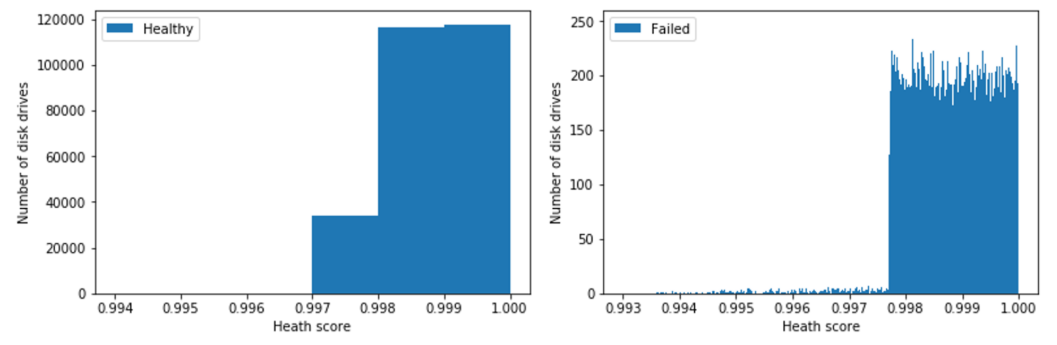
\ \ \ \ Figure 5: Histogram of the health scores corresponding to healthy predictions (left) and faulting predictions (right).
\ \ \ \ \

:::info This paper is available on arxiv under CC BY-NC-ND 4.0 Deed (Attribution-Noncommercial-Noderivs 4.0 International) license.

:::


:::info Authors:

(1) Rahul Vishwakarma, California State University Long Beach, 1250 Bellflower Blvd, Long Beach, CA 90840, United States (rahuldeo.vishwakarma01@student.csullb.edu);

(2) Jinha Hwang, California State University Long Beach, 1250 Bellflower Blvd, Long Beach, CA 90840, United States (jinha.hwang01@student.csulb.edu);

(3) Soundouss Messoudi, HEUDIASYC - UMR CNRS 7253, Universit´e de Technologie de Compiegne, 57 avenue de Landshut, 60203 Compiegne Cedex - France (soundouss.messoudi@hds.utc.fr);

(4) Ava Hedayatipour, California State University Long Beach, 1250 Bellflower Blvd, Long Beach, CA 90840, United States (ava.hedayatipour@csulb.edu).

:::

\

Market Opportunity
null Logo
null Price(null)
--
----
USD
null (null) Live Price Chart
Disclaimer: The articles reposted on this site are sourced from public platforms and are provided for informational purposes only. They do not necessarily reflect the views of MEXC. All rights remain with the original authors. If you believe any content infringes on third-party rights, please contact crypto.news@mexc.com for removal. MEXC makes no guarantees regarding the accuracy, completeness, or timeliness of the content and is not responsible for any actions taken based on the information provided. The content does not constitute financial, legal, or other professional advice, nor should it be considered a recommendation or endorsement by MEXC.

You May Also Like

Liquid crypto funds have a DeFi problem nobody talks about

Liquid crypto funds have a DeFi problem nobody talks about

The post Liquid crypto funds have a DeFi problem nobody talks about appeared on BitcoinEthereumNews.com. The following is a guest post and guest post from Thomas
Share
BitcoinEthereumNews2026/03/08 06:03
The Federal Reserve cut interest rates by 25 basis points, and Powell said this was a risk management cut

The Federal Reserve cut interest rates by 25 basis points, and Powell said this was a risk management cut

PANews reported on September 18th, according to the Securities Times, that at 2:00 AM Beijing time on September 18th, the Federal Reserve announced a 25 basis point interest rate cut, lowering the federal funds rate from 4.25%-4.50% to 4.00%-4.25%, in line with market expectations. The Fed's interest rate announcement triggered a sharp market reaction, with the three major US stock indices rising briefly before quickly plunging. The US dollar index plummeted, briefly hitting a new low since 2025, before rebounding sharply, turning a decline into an upward trend. The sharp market volatility was closely tied to the subsequent monetary policy press conference held by Federal Reserve Chairman Powell. He stated that the 50 basis point rate cut lacked broad support and that there was no need for a swift adjustment. Today's move could be viewed as a risk-management cut, suggesting the Fed will not enter a sustained cycle of rate cuts. Powell reiterated the Fed's unwavering commitment to maintaining its independence. Market participants are currently unaware of the risks to the Fed's independence. The latest published interest rate dot plot shows that the median expectation of Fed officials is to cut interest rates twice more this year (by 25 basis points each), one more than predicted in June this year. At the same time, Fed officials expect that after three rate cuts this year, there will be another 25 basis point cut in 2026 and 2027.
Share
PANews2025/09/18 06:54
HBAR Eyes Breakout Above $0.105 With Bullish Momentum and Trend Reversal Signals

HBAR Eyes Breakout Above $0.105 With Bullish Momentum and Trend Reversal Signals

The post HBAR Eyes Breakout Above $0.105 With Bullish Momentum and Trend Reversal Signals appeared on BitcoinEthereumNews.com. Key Insights: HBAR tests the upper
Share
BitcoinEthereumNews2026/03/08 06:06