Faraday Rotation and Depth: Measuring Galactic Magnetic Fields with Radio Polarization
Table of Links
Abstract and 1 Introduction
-
Faraday Rotation and Faraday Synthesis
-
Dara & Instruments
3.1. CHIME and GMIMS surveys and 3.2. CHIME/GMIMS Low Band North
3.3. DRAO Synthesis Telescope Observations
3.4. Ancillary Data Sources
-
Features of the Tadpole
4.1. Morphology in single-frequency images
4.2. Faraday depths
4.3. Faraday complexity
4.4. QU fitting
4.5. Artifacts
-
The Origin of the Tadpole
5.1. Neutral Hydrogen Structure
5.2. Ionized Hydrogen Structure
5.3. Proper Motions of Candidate Stars
5.4. Faraday depth and electron column
-
Summary and Future Prospects
\ APPENDIX
A. RESOLVED AND UNRESOLVED FARADAY COMPONENTS IN FARADAY SYNTHESIS
B. QU FITTING RESULTS
\ REFERENCES
2. FARADAY ROTATION AND FARADAY SYNTHESIS
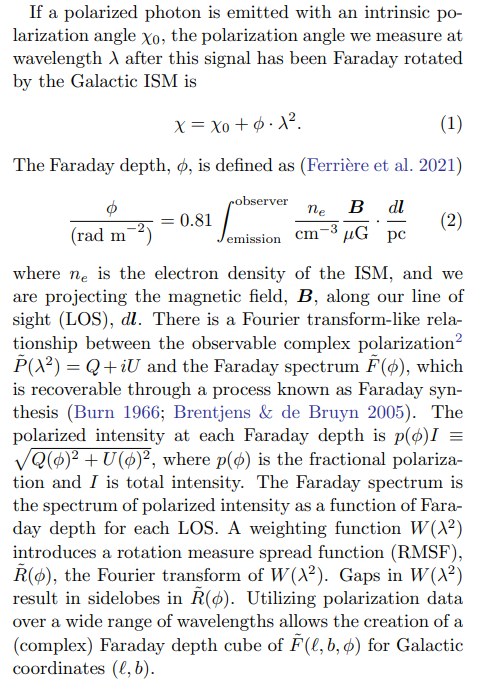
\ 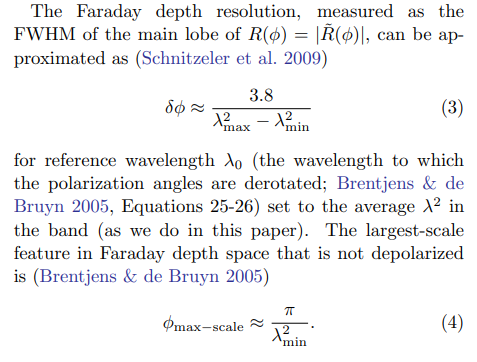
\ Rudnick & Cotton (2023) argue that setting λ0 = 0 recovers additional information and modifies Equations 3 and 4, but we use traditional Faraday synthesis in this work.
\
:::info Authors:
(1) Nasser Mohammed, Department of Computer Science, Math, Physics, & Statistics, University of British Columbia, Okanagan Campus, Kelowna, BC V1V 1V7, Canada and Dominion Radio Astrophysical Observatory, Herzberg Research Centre for Astronomy and Astrophysics, National Research Council Canada, PO Box 248, Penticton, BC V2A 6J9, Canada;
(2) Anna Ordog, Department of Computer Science, Math, Physics, & Statistics, University of British Columbia, Okanagan Campus, Kelowna, BC V1V 1V7, Canada and Dominion Radio Astrophysical Observatory, Herzberg Research Centre for Astronomy and Astrophysics, National Research Council Canada, PO Box 248, Penticton, BC V2A 6J9, Canada;
(3) Rebecca A. Booth, Department of Physics and Astronomy, University of Calgary, 2500 University Drive NW, Calgary, Alberta, T2N 1N4, Canada;
(4) Andrea Bracco, INAF – Osservatorio Astrofisico di Arcetri, Largo E. Fermi 5, 50125 Firenze, Italy and Laboratoire de Physique de l’Ecole Normale Superieure, ENS, Universit´e PSL, CNRS, Sorbonne Universite, Universite de Paris, F-75005 Paris, France;
(5) Jo-Anne C. Brown, Department of Physics and Astronomy, University of Calgary, 2500 University Drive NW, Calgary, Alberta, T2N 1N4, Canada;
(6) Ettore Carretti, INAF-Istituto di Radioastronomia, Via Gobetti 101, 40129 Bologna, Italy;
(7) John M. Dickey, School of Natural Sciences, University of Tasmania, Hobart, Tas 7000 Australia;
(8) Simon Foreman, Department of Physics, Arizona State University, Tempe, AZ 85287, USA;
(9) Mark Halpern, Department of Physics and Astronomy, University of British Columbia, 6224 Agricultural Road, Vancouver, BC V6T 1Z1 Canada;
(10) Marijke Haverkorn, Department of Astrophysics/IMAPP, Radboud University, PO Box 9010, 6500 GL Nijmegen, The Netherlands;
(11) Alex S. Hill, Department of Computer Science, Math, Physics, & Statistics, University of British Columbia, Okanagan Campus, Kelowna, BC V1V 1V7, Canada and Dominion Radio Astrophysical Observatory, Herzberg Research Centre for Astronomy and Astrophysics, National Research Council Canada, PO Box 248, Penticton, BC V2A 6J9, Canada;
(12) Gary Hinshaw, Department of Physics and Astronomy, University of British Columbia, 6224 Agricultural Road, Vancouver, BC V6T 1Z1 Canada;
(13) Joseph W. Kania, Department of Physics and Astronomy, West Virginia University, P.O. Box 6315, Morgantown, WV 26506, USA and Center for Gravitational Waves and Cosmology, West Virginia University, Chestnut Ridge Research Building, Morgantown, WV 26505, USA;
(14) Roland Kothes, Dominion Radio Astrophysical Observatory, Herzberg Research Centre for Astronomy and Astrophysics, National Research Council Canada, PO Box 248, Penticton, BC V2A 6J9, Canada;
(15) T.L. Landecker, Dominion Radio Astrophysical Observatory, Herzberg Research Centre for Astronomy and Astrophysics, National Research Council Canada, PO Box 248, Penticton, BC V2A 6J9, Canada;
(16) Joshua MacEachern, Department of Physics and Astronomy, University of British Columbia, 6224 Agricultural Road, Vancouver, BC V6T 1Z1 Canada;
(17) Kiyoshi W. Masui, MIT Kavli Institute for Astrophysics and Space Research, Massachusetts Institute of Technology, 77 Massachusetts Ave, Cambridge, MA 02139, USA and Department of Physics, Massachusetts Institute of Technology, 77 Massachusetts Ave, Cambridge, MA 02139, USA;
(18) Aimee Menard, Department of Computer Science, Math, Physics, & Statistics, University of British Columbia, Okanagan Campus, Kelowna, BC V1V 1V7, Canada and Dominion Radio Astrophysical Observatory, Herzberg Research Centre for Astronomy and Astrophysics, National Research Council Canada, PO Box 248, Penticton, BC V2A 6J9, Canada;
(19) Ryan R. Ransom, Dominion Radio Astrophysical Observatory, Herzberg Research Centre for Astronomy and Astrophysics, National Research Council Canada, PO Box 248, Penticton, BC V2A 6J9, Canada and Department of Physics and Astronomy, Okanagan College, Kelowna, BC V1Y 4X8, Canada;
(20) Wolfgang Reich, Max-Planck-Institut fur Radioastronomie, Auf dem Hugel 69, 53121 Bonn, Germany;(21) Patricia Reich, 16
(22) J. Richard Shaw, Department of Physics and Astronomy, University of British Columbia, 6224 Agricultural Road, Vancouver, BC V6T 1Z1 Canada
(23) Seth R. Siegel, Perimeter Institute for Theoretical Physics, 31 Caroline Street N, Waterloo, ON N25 2YL, Canada, Department of Physics, McGill University, 3600 rue University, Montreal, QC H3A 2T8, Canada, and Trottier Space Institute, McGill University, 3550 rue University, Montreal, QC H3A 2A7, Canada;
(24) Mehrnoosh Tahani, Banting and KIPAC Fellowships: Kavli Institute for Particle Astrophysics & Cosmology (KIPAC), Stanford University, Stanford, CA 94305, USA;
(25) Alec J. M. Thomson, ATNF, CSIRO Space & Astronomy, Bentley, WA, Australia;
(26) Tristan Pinsonneault-Marotte, Department of Physics and Astronomy, University of British Columbia, 6224 Agricultural Road, Vancouver, BC V6T 1Z1 Canada;
(27) Haochen Wang, MIT Kavli Institute for Astrophysics and Space Research, Massachusetts Institute of Technology, 77 Massachusetts Ave, Cambridge, MA 02139, USA and Department of Physics, Massachusetts Institute of Technology, 77 Massachusetts Ave, Cambridge, MA 02139, USA;
(28) Jennifer L. West, Dominion Radio Astrophysical Observatory, Herzberg Research Centre for Astronomy and Astrophysics, National Research Council Canada, PO Box 248, Penticton, BC V2A 6J9, Canada;
(29) Maik Wolleben, Skaha Remote Sensing Ltd., 3165 Juniper Drive, Naramata, BC V0H 1N0, Canada.
:::
:::info This paper is available on arxiv under CC BY 4.0 DEED license.
:::
[2] We use tilde to indicate complex values.
You May Also Like
Liquid crypto funds have a DeFi problem nobody talks about

The Federal Reserve cut interest rates by 25 basis points, and Powell said this was a risk management cut