This conclusion validates MENT-Flow as a promising approach for 6D phase space tomography, demonstrating its ability to leverage entropic regularization for incorporating prior information.This conclusion validates MENT-Flow as a promising approach for 6D phase space tomography, demonstrating its ability to leverage entropic regularization for incorporating prior information.

Leveraging Normalizing Flows for Conservative 6D Beam Reconstruction: Conclusions and Extensions

2025/10/08 23:15
3 min read
For feedback or concerns regarding this content, please contact us at crypto.news@mexc.com

I. Introduction

II. Maximum Entropy Tomography

  • A. Ment
  • B. Ment-Flow

III. Numerical Experiments

  • A. 2D reconstructions from 1D projections
  • B. 6D reconstructions from 1D projections

IV. Conclusion and Extensions

V. Acknowledgments and References

IV. CONCLUSION AND EXTENSIONS

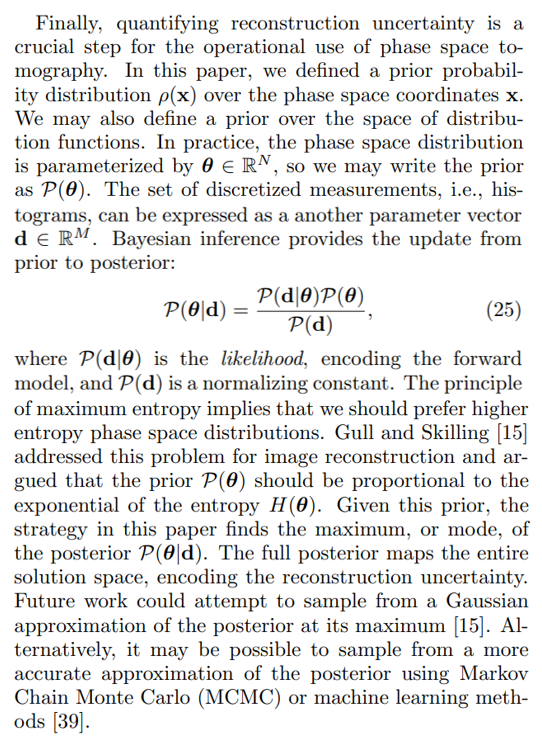
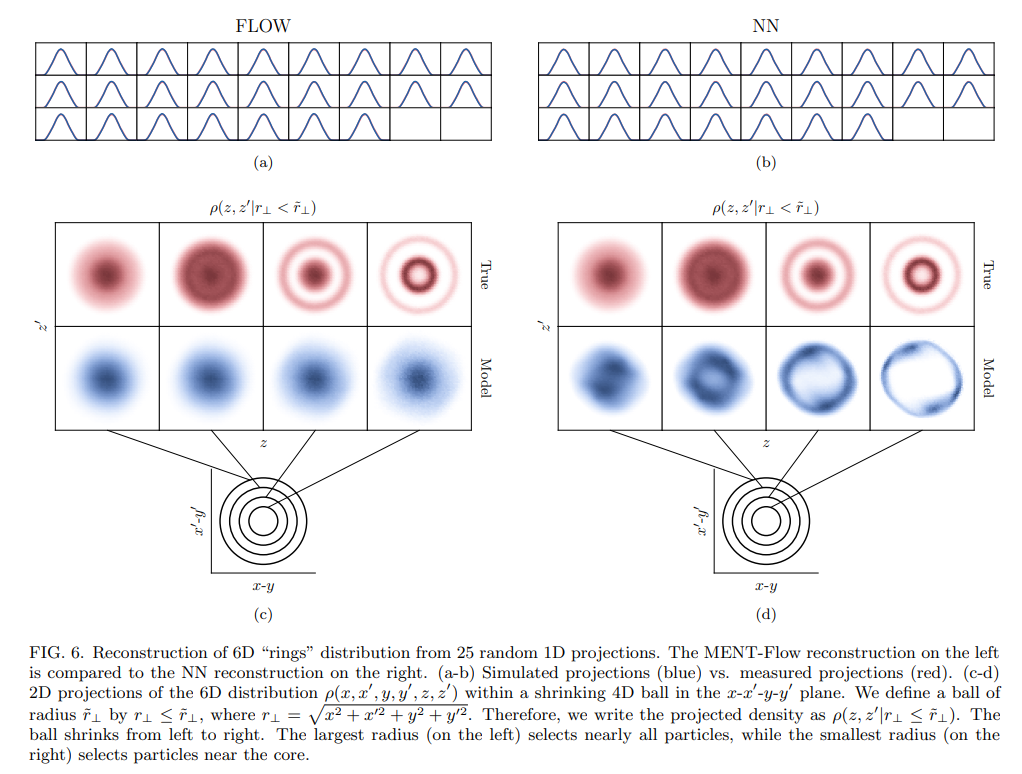
In conclusion, MENT-Flow is a promising approach to high-dimensional phase space tomography. Numerical experiments demonstrate consistency with known 2D maximum-entropy solutions and the ability to fit complex 6D distributions to large measurement sets. In the 6D tests, although there are no available benchmarks, we found that entropic regularization pulls the solution closer to the prior. Thus, MENT-Flow is an effective way to incorporate prior information in high-dimensional reconstructions. Our numerical experiments also emphasize the potential importance of uncertainty quantification in high-dimensional tomography, as we found that some distributions can only be reconstructed from large numbers of 1D measurements. Future work should apply MENT-Flow to more realistic distributions, accelerator

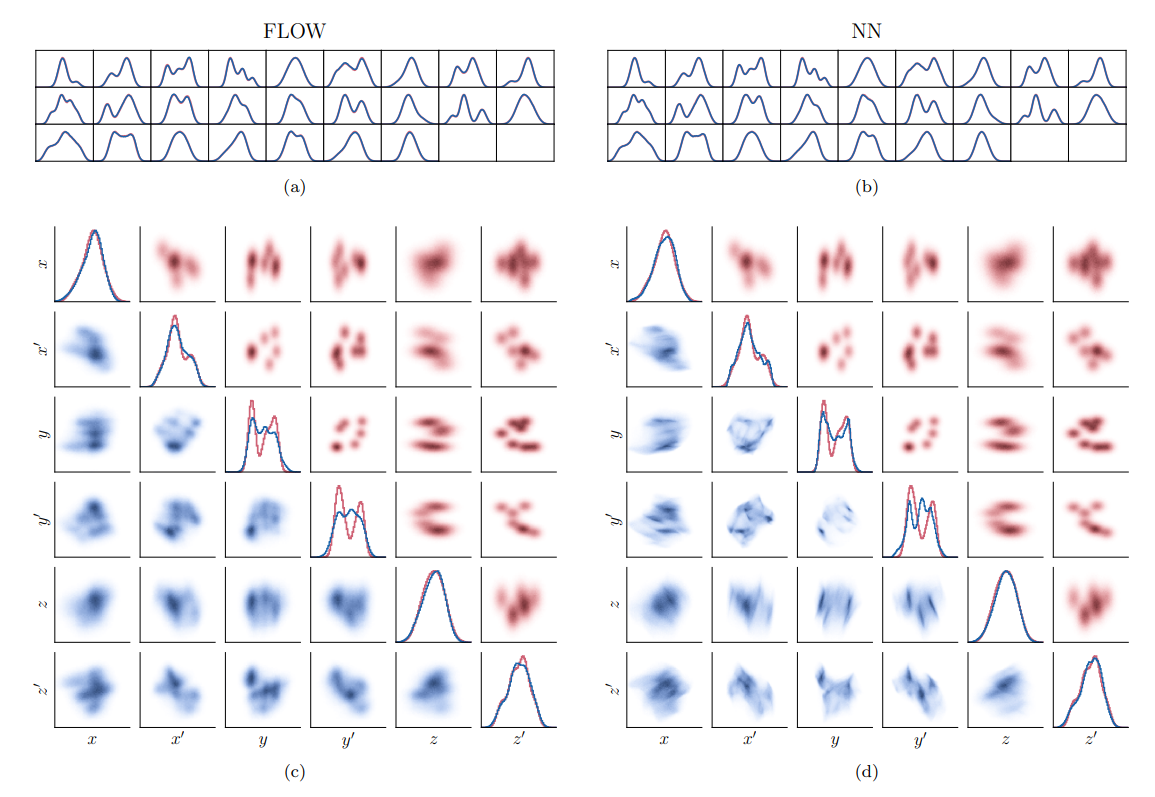
\ FIG. 4. Reconstruction of a 6D Gaussian mixture distribution from 25 random 1D projections. The MENT-Flow reconstruction on the left is compared to the NN reconstruction on the right. (a-b) Simulated projections (blue) vs. measured projections (red). (c-d) Low-dimensional views of the reconstructed distribution (blue) and the ground-truth distribution (red). 1D profiles are plotted on the diagonal subplots. 2D projections are plotted on the off-diagonal subplots.
\ models, and diagnostics, especially 2D projections. Future work should also aim to extend MENT to higher dimensions to serve as a benchmark.

\ MENT-Flow has several limitations. First, particle sampling is over 50% slower than a conventional neural network, and the total runtime is inflated by the need to solve multiple subproblems to approach the maximum-entropy distribution from below. This motivates the search for more efficient flows and sample-based entropy estimates. Note that our training times ranged from 5 to 20 minutes on a single GPU, depending on the number of projections, phase space dimension, batch size, and penalty parameter updates. Second, MENT-Flow maximizes the entropy using a penalty method that does not generate exact solutions and requires a hand-tuned penalty parameter schedule to avoid ill-conditioning. It is unclear whether this process can be automated or whether alternative strategies can better prevent ill-conditioning. Third, MENT-Flow does not attach uncertainty to its output.

\ We now discuss possible extensions to new problems. First, it may be possible to fit n-dimensional distributions to m-dimensional projections when m > 2. This problem is of theoretical interest but also has some practical relevance. 3D and 4D projections can be measured relatively quickly using slit-screen-dipole measurement systems in low-energy hadron accelerators [1–3]. We propose to draw samples from the measured projections and minimize a differentiable statistical distance between these samples and samples from the normalizing flow.

\ Second, an interesting application of maximum-entropy tomography is to intense hadron beams, in which particles respond to both applied and self-generated electromagnetic fields. Phase space tomography is a significant challenge for such beams because the forward process depends on the unknown initial distribution. We do not know if the maximum-entropy distribution is unique in this case. Including space charge in the GPSR forward process may be possible using differentiable space charge solvers [38].

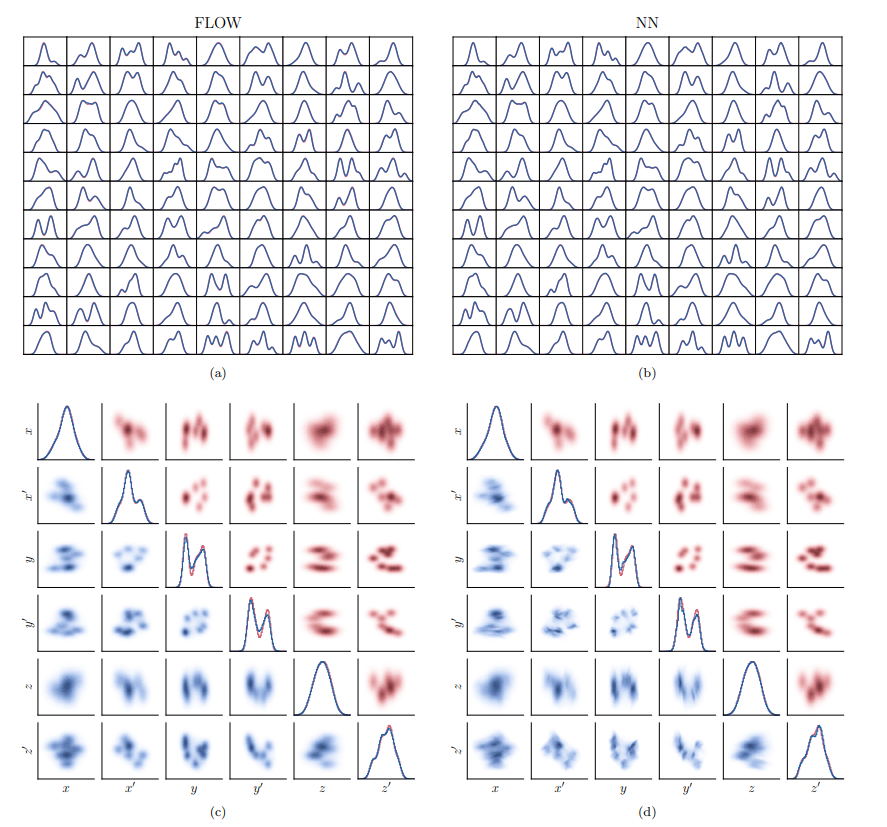
\ FIG. 5. Reconstruction of a 6D Gaussian mixture distribution from 100 random 1D projections. The MENT-Flow reconstruction on the left is compared to the NN reconstruction on the right. (a-b) Simulated projections (blue) vs. measured projections (red). (c-d) Low-dimensional views of the reconstructed distribution (blue) and the ground-truth distribution (red). 1D profiles are plotted on the diagonal subplots. 2D projections are plotted on the off-diagonal subplots.
\

\

\

:::info Authors:

(1) Austin Hoover, Oak Ridge National Laboratory, Oak Ridge, Tennessee 37830, USA (hooveram@ornl.gov);

(2) Jonathan C. Wong, Institute of Modern Physics, Chinese Academy of Sciences, Lanzhou 730000, China.

:::


:::info This paper is available on arxiv under CC BY 4.0 DEED license.

:::

\

Market Opportunity
BEAM Logo
BEAM Price(BEAM)
$0.02315
$0.02315$0.02315
+0.17%
USD
BEAM (BEAM) Live Price Chart
Disclaimer: The articles reposted on this site are sourced from public platforms and are provided for informational purposes only. They do not necessarily reflect the views of MEXC. All rights remain with the original authors. If you believe any content infringes on third-party rights, please contact crypto.news@mexc.com for removal. MEXC makes no guarantees regarding the accuracy, completeness, or timeliness of the content and is not responsible for any actions taken based on the information provided. The content does not constitute financial, legal, or other professional advice, nor should it be considered a recommendation or endorsement by MEXC.

You May Also Like

Liquid crypto funds have a DeFi problem nobody talks about

Liquid crypto funds have a DeFi problem nobody talks about

The post Liquid crypto funds have a DeFi problem nobody talks about appeared on BitcoinEthereumNews.com. The following is a guest post and guest post from Thomas
Share
BitcoinEthereumNews2026/03/08 06:03
The Federal Reserve cut interest rates by 25 basis points, and Powell said this was a risk management cut

The Federal Reserve cut interest rates by 25 basis points, and Powell said this was a risk management cut

PANews reported on September 18th, according to the Securities Times, that at 2:00 AM Beijing time on September 18th, the Federal Reserve announced a 25 basis point interest rate cut, lowering the federal funds rate from 4.25%-4.50% to 4.00%-4.25%, in line with market expectations. The Fed's interest rate announcement triggered a sharp market reaction, with the three major US stock indices rising briefly before quickly plunging. The US dollar index plummeted, briefly hitting a new low since 2025, before rebounding sharply, turning a decline into an upward trend. The sharp market volatility was closely tied to the subsequent monetary policy press conference held by Federal Reserve Chairman Powell. He stated that the 50 basis point rate cut lacked broad support and that there was no need for a swift adjustment. Today's move could be viewed as a risk-management cut, suggesting the Fed will not enter a sustained cycle of rate cuts. Powell reiterated the Fed's unwavering commitment to maintaining its independence. Market participants are currently unaware of the risks to the Fed's independence. The latest published interest rate dot plot shows that the median expectation of Fed officials is to cut interest rates twice more this year (by 25 basis points each), one more than predicted in June this year. At the same time, Fed officials expect that after three rate cuts this year, there will be another 25 basis point cut in 2026 and 2027.
Share
PANews2025/09/18 06:54
HBAR Eyes Breakout Above $0.105 With Bullish Momentum and Trend Reversal Signals

HBAR Eyes Breakout Above $0.105 With Bullish Momentum and Trend Reversal Signals

The post HBAR Eyes Breakout Above $0.105 With Bullish Momentum and Trend Reversal Signals appeared on BitcoinEthereumNews.com. Key Insights: HBAR tests the upper
Share
BitcoinEthereumNews2026/03/08 06:06