Bitwise Asset Management has updated its proposed Solana exchange-traded fund (ETF) to explicitly include “Staking” in the fund’s name and disclosed a 0.20% unitary sponsor fee—one of the lowest headline fees yet seen for a US crypto ETF. Bloomberg’s James Seyffart flagged the amendment late Wednesday, writing: “NEW: Bitwise files an update to their Solana […]Bitwise Asset Management has updated its proposed Solana exchange-traded fund (ETF) to explicitly include “Staking” in the fund’s name and disclosed a 0.20% unitary sponsor fee—one of the lowest headline fees yet seen for a US crypto ETF. Bloomberg’s James Seyffart flagged the amendment late Wednesday, writing: “NEW: Bitwise files an update to their Solana […]

Solana Staking ETF Moves Closer To SEC Approval After Key Filing

2025/10/09 21:30
3 min read
For feedback or concerns regarding this content, please contact us at crypto.news@mexc.com

Bitwise Asset Management has updated its proposed Solana exchange-traded fund (ETF) to explicitly include “Staking” in the fund’s name and disclosed a 0.20% unitary sponsor fee—one of the lowest headline fees yet seen for a US crypto ETF. Bloomberg’s James Seyffart flagged the amendment late Wednesday, writing: “NEW: Bitwise files an update to their Solana ETF filing to include Staking in the name and provides the fee. Fee will be 0.20%.”

In follow-up posts, Seyffart added that “no fee for the first 3 months and for the first $1 billion in AUM [assets under management]” would apply—an aggressive launch incentive mirroring the fee-war playbook that helped turbocharge spot bitcoin ETFs at the start of the year. Eric Balchunas, his colleague at Bloomberg, underscored the move’s competitiveness: “Bitwise not playing around, plans to charge just 0.20% for their spot Solana ETF.”

Solana Staking ETF Launch Date Remains Unclear

The amendment signals that issuers and the Securities and Exchange Commission have narrowed outstanding issues on the structure of spot Solana products that incorporate staking, a feature unique to proof-of-stake assets. Earlier in the year, the SEC asked prospective Solana ETF sponsors to submit updated S-1 registration statements—widely interpreted as a pre-launch step once substantive policy questions are settled.

Timing remains the key variable. The US government shutdown that began on October 1 has forced the SEC onto skeleton staffing, slowing most non-urgent reviews and stalling a broad slate of securities registrations. With more than 90% of the SEC’s staff furloughed, routine offering and listing processes are largely paused—an overhang that could push back crypto ETF effective dates even as the paperwork advances. As Seyffart put it when asked whether a shutdown would delay approval: “Yes. I believe so.”

Even with that backdrop, Bitwise’s pricing telegraphs a confident, bare-knuckle approach to market share. A 20-basis-point fee places the proposed Solana Staking ETF at or below the lower end of the fee spectrum that helped bitcoin ETFs achieve mass adoption, and it lands amid a broader “fee-first” arms race that has repeatedly proven decisive in ETFs’ opening months. Balchunas has long argued that “low fees have an almost perfect record in attracting investors,” a pattern that crypto ETPs have closely followed.

What happens next will hinge on two tracks. Procedurally, the SEC must allow updated S-1s to go effective before trading can begin; practically, the shutdown will dictate when staff can finalize those reviews. Strategically, Bitwise’s decision to enshrine staking in the fund’s name and to lead with an ultra-low fee sets the competitive tone for rival Solana filings, and—once Washington reopens—positions the product to capitalize on pent-up demand the moment the window clears.

In parallel to Bitwise, other spot SOL issuers on the SEC’s docket include VanEck, 21Shares, and Canary—each facing final 240-day decision dates on October 16, 2025—alongside Grayscale’s proposed conversion of its Solana trust, which carries an earlier October 10, 2025 deadline. Franklin Templeton’s final date is November 14, 2025, Fidelity’s is December 5, 2025, and an Invesco Galaxy product runs to April 16, 2026. These dates reflect the SEC’s 19b-4 clock that began when Cboe first filed to list the SOL ETFs; S-1 effectiveness would still be required for trading to commence.

At press time, SOL traded at $227.
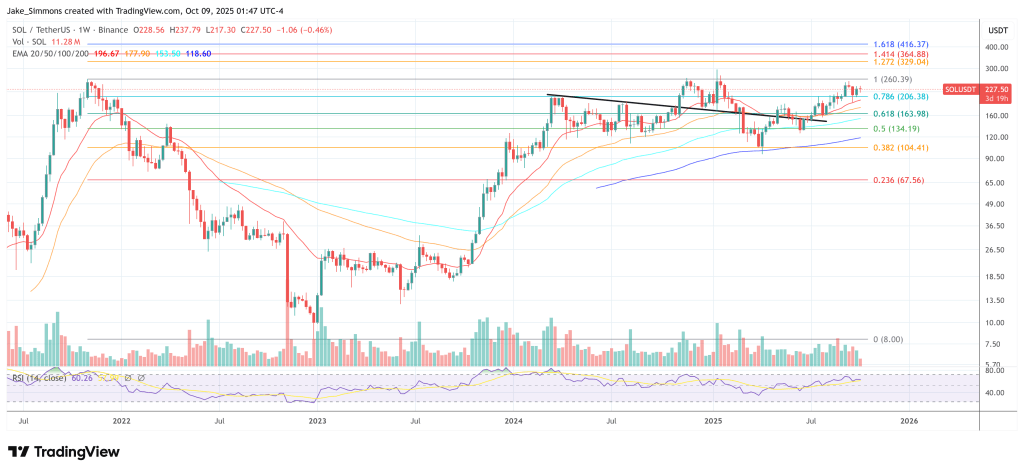
Solana price
Disclaimer: The articles reposted on this site are sourced from public platforms and are provided for informational purposes only. They do not necessarily reflect the views of MEXC. All rights remain with the original authors. If you believe any content infringes on third-party rights, please contact crypto.news@mexc.com for removal. MEXC makes no guarantees regarding the accuracy, completeness, or timeliness of the content and is not responsible for any actions taken based on the information provided. The content does not constitute financial, legal, or other professional advice, nor should it be considered a recommendation or endorsement by MEXC.

You May Also Like

XRP’s Billions in Dormant Liquidity Highlight Untapped Payment Potential Across XRPL

XRP’s Billions in Dormant Liquidity Highlight Untapped Payment Potential Across XRPL

The post XRP’s Billions in Dormant Liquidity Highlight Untapped Payment Potential Across XRPL appeared on BitcoinEthereumNews.com. XRP is gaining renewed bullish
Share
BitcoinEthereumNews2026/03/09 08:31
Rising with Purpose: The Professional Excellence of Ayesha Islam Asha

Rising with Purpose: The Professional Excellence of Ayesha Islam Asha

Some individuals quietly rise to prominence by consistently delivering excellence, showing compassion in leadership, and building bridges between knowledge and
Share
Techbullion2026/03/09 08:29
Headwind Helps Best Wallet Token

Headwind Helps Best Wallet Token

The post Headwind Helps Best Wallet Token appeared on BitcoinEthereumNews.com. Google has announced the launch of a new open-source protocol called Agent Payments Protocol (AP2) in partnership with Coinbase, the Ethereum Foundation, and 60 other organizations. This allows AI agents to make payments on behalf of users using various methods such as real-time bank transfers, credit and debit cards, and, most importantly, stablecoins. Let’s explore in detail what this could mean for the broader cryptocurrency markets, and also highlight a presale crypto (Best Wallet Token) that could explode as a result of this development. Google’s Push for Stablecoins Agent Payments Protocol (AP2) uses digital contracts known as ‘Intent Mandates’ and ‘Verifiable Credentials’ to ensure that AI agents undertake only those payments authorized by the user. Mandates, by the way, are cryptographically signed, tamper-proof digital contracts that act as verifiable proof of a user’s instruction. For example, let’s say you instruct an AI agent to never spend more than $200 in a single transaction. This instruction is written into an Intent Mandate, which serves as a digital contract. Now, whenever the AI agent tries to make a payment, it must present this mandate as proof of authorization, which will then be verified via the AP2 protocol. Alongside this, Google has also launched the A2A x402 extension to accelerate support for the Web3 ecosystem. This production-ready solution enables agent-based crypto payments and will help reshape the growth of cryptocurrency integration within the AP2 protocol. Google’s inclusion of stablecoins in AP2 is a massive vote of confidence in dollar-pegged cryptocurrencies and a huge step toward making them a mainstream payment option. This widens stablecoin usage beyond trading and speculation, positioning them at the center of the consumption economy. The recent enactment of the GENIUS Act in the U.S. gives stablecoins more structure and legal support. Imagine paying for things like data crawls, per-task…
Share
BitcoinEthereumNews2025/09/18 01:27