Monero price experienced a drop following the release of its latest network update Fluorine Fermi. The update was designed to protect users against ‘spy nodes.’ On Oct. 9, the privacy blockchain Monero launched a new network upgrade called CLI v0.18.4.3,…Monero price experienced a drop following the release of its latest network update Fluorine Fermi. The update was designed to protect users against ‘spy nodes.’ On Oct. 9, the privacy blockchain Monero launched a new network upgrade called CLI v0.18.4.3,…

Monero price drops to $330 after Fluorine Fermi update

Monero price experienced a drop following the release of its latest network update Fluorine Fermi. The update was designed to protect users against ‘spy nodes.’

Summary
  • Monero recently launched its new network upgrade, Fluorine Fermi, in order to boost on-chain privacy and protect users from network surveillance.
  • Following the upgrade, XMR’s price dipped slightly, reflecting cautious market sentiment despite strong fundamentals.

On Oct. 9, the privacy blockchain Monero launched a new network upgrade called CLI v0.18.4.3, otherwise known as Fluorine Fermi. The new update is aimed at enhancing user protection against “spy nodes” by strengthening security measures.

Spy nodes is a term used by the Monero (XMR) community to describe malicious nodes, large groups of nodes or botnets that are capable of calculating and matching IP addresses to transactions that take place on the network.

One of the features introduced through the upgrade is a smarter peer selection algorithm that is meant to help nodes avoid large subnet groups that are most often associated with surveillance activity, pushing users to connect with safer peers instead.

The release of the Fluorine Fermi update was publicized by a number of crypto media companies, with the original post receiving 71 reshares and 15,300 views. Such a major update on a mainnet would normally serve to boost the project’s token price by a significant percentage.

However, this was not the case for Monero price.

Instead of going up, the token has instead continued on its downward, having gone down by 0.8% in the past 24 hours, reaching a daily low of $328. In fact, the token has shown better performance in the past few days; with Monero price increasing by 2.2% in the past seven days and 26% within the past month respectively.

Monero price analysis

On Oct. 10, Monero price experienced a slight downturn following the launch of its Fluorine Fermi security update. It managed a slight recovery from the deep drop to $328. However at press time, XMR is trading around $336.81, having dropped by around 0.27% in the past few hours. The chart highlights the short-term volatility the token has experienced following the launch.

It appears to be nearing the $340 rejection level and may be headed towards a lower dip that could send it hurtling below $335 before stabilizing near the token’s 30-day period moving average at $336.90.
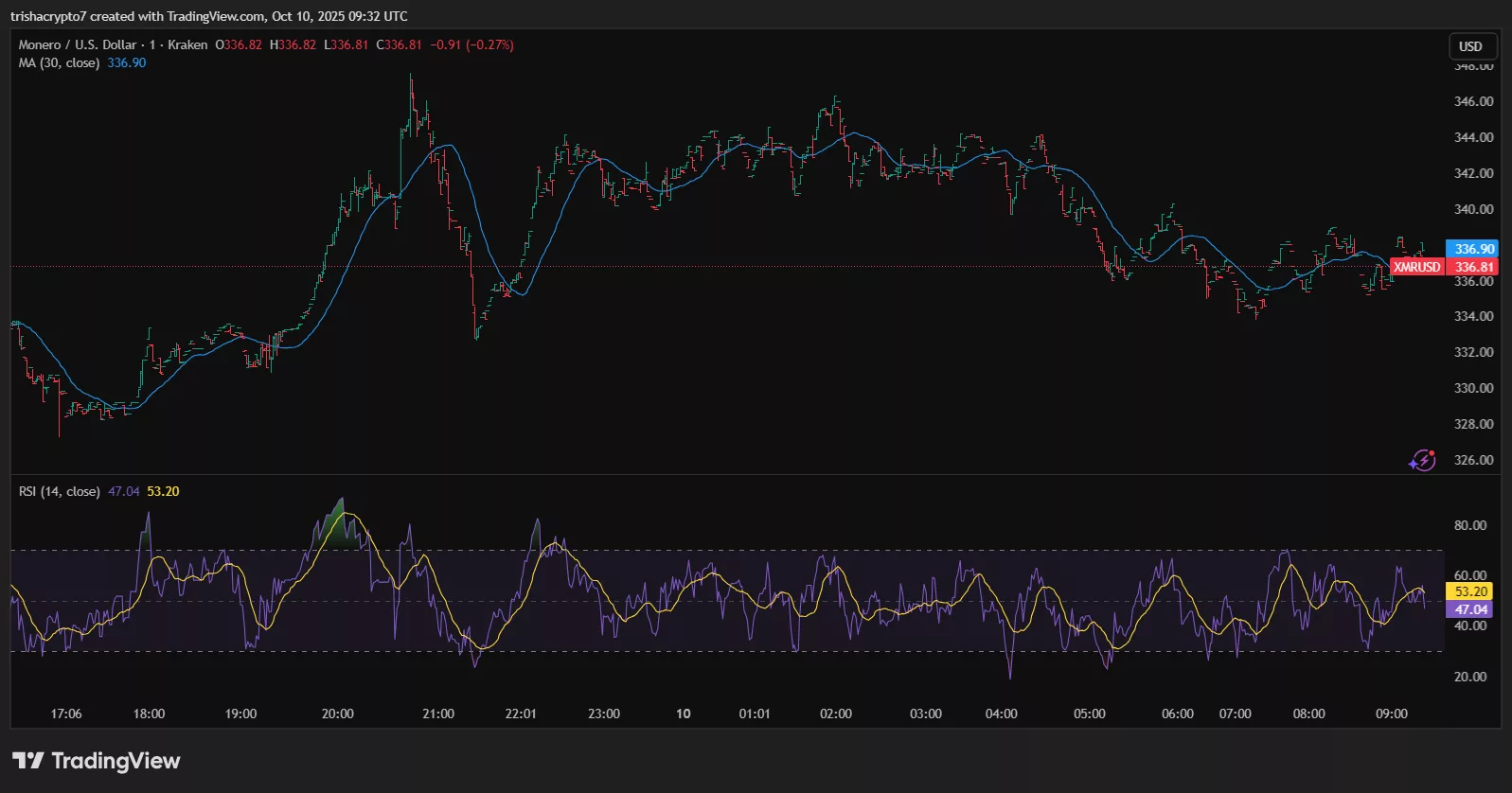
Monero price experienced a drop after it launched its latest network update | Source: TradingView

The slight dip in XMR’s price may reflect short-term market uncertainty as traders digest the implications of the new Fluorine Fermi upgrade, which introduced enhanced network security and efficiency improvements. In the past, Monero updates often have a tendency to spark initial volatility as miners and nodes adjust to new consensus rules, often followed by a recovery period once the network stabilizes.

If token is able to maintain its price at the $335 support level, XMR could consolidate before retesting the $340 to $342 zone. However, a break below $333 might open the door to further downside toward $328, especially if broader market sentiment remains cautious.


Market Opportunity
Omnity Network Logo
Omnity Network Price(OCT)
$0.02359
$0.02359$0.02359
+4.79%
USD
Omnity Network (OCT) Live Price Chart
Disclaimer: The articles reposted on this site are sourced from public platforms and are provided for informational purposes only. They do not necessarily reflect the views of MEXC. All rights remain with the original authors. If you believe any content infringes on third-party rights, please contact service@support.mexc.com for removal. MEXC makes no guarantees regarding the accuracy, completeness, or timeliness of the content and is not responsible for any actions taken based on the information provided. The content does not constitute financial, legal, or other professional advice, nor should it be considered a recommendation or endorsement by MEXC.

You May Also Like

Why Everyone Is Talking About Saga, Cosmos, and Mars Protocol

Why Everyone Is Talking About Saga, Cosmos, and Mars Protocol

The post Why Everyone Is Talking About Saga, Cosmos, and Mars Protocol appeared on BitcoinEthereumNews.com. Layer-1 blockchain protocol Saga has faced a severe
Share
BitcoinEthereumNews2026/01/22 17:01
Disney Pockets $2.2 Billion For Filming Outside America

Disney Pockets $2.2 Billion For Filming Outside America

The post Disney Pockets $2.2 Billion For Filming Outside America appeared on BitcoinEthereumNews.com. Disney has made $2.2 billion from filming productions like ‘Avengers: Endgame’ in the U.K. ©Marvel Studios 2018 Disney has been handed $2.2 billion by the government of the United Kingdom over the past 15 years in return for filming movies and streaming shows in the country according to analysis of more than 400 company filings Disney is believed to be the biggest single beneficiary of the Audio-Visual Expenditure Credit (AVEC) in the U.K. which gives studios a cash reimbursement of up to 25.5% of the money they spend there. The generous fiscal incentives have attracted all of the major Hollywood studios to the U.K. and the country has reeled in the returns from it. Data from the British Film Institute (BFI) shows that foreign studios contributed around 87% of the $2.2 billion (£1.6 billion) spent on making films in the U.K. last year. It is a 7.6% increase on the sum spent in 2019 and is in stark contrast to the picture in the United States. According to permit issuing office FilmLA, the number of on-location shooting days in Los Angeles fell 35.7% from 2019 to 2024 making it the second-least productive year since 1995 aside from 2020 when it was the height of the pandemic. The outlook hasn’t improved since then with FilmLA’s latest data showing that between April and June this year there was a 6.2% drop in shooting days on the same period a year ago. It followed a 22.4% decline in the first quarter with FilmLA noting that “each drop reflected the impact of global production cutbacks and California’s ongoing loss of work to rival territories.” The one-two punch of the pandemic followed by the 2023 SAG-AFTRA strikes put Hollywood on the ropes just as the U.K. began drafting a plan to improve its fiscal incentives…
Share
BitcoinEthereumNews2025/09/18 07:20
Zhao Changpeng, speaking at Davos, stated that the fractional-reserve requirement system is the root cause of the banking liquidity crisis, and that demand from real-economy banks will sharply decline

Zhao Changpeng, speaking at Davos, stated that the fractional-reserve requirement system is the root cause of the banking liquidity crisis, and that demand from real-economy banks will sharply decline

PANews reported on January 22nd that at the World Economic Forum Annual Meeting 2026 in Davos, Changpeng Zhao stated that technology itself does not bring risks
Share
PANews2026/01/22 16:51