TLDRs; TSMC shares fell 4.62% as US export waivers for China are revoked, raising supply chain concerns. Analysts note limited direct earnings impact from TSMC’s Nanjing plant despite regulatory changes. China’s new rare earth export restrictions further complicate global chip supply chains. Samsung may face higher risk than TSMC due to its larger exposure to [...] The post TSMC (TSM) Stock: Drops Amid US Chip Scrutiny and China Export Rules appeared first on CoinCentral.TLDRs; TSMC shares fell 4.62% as US export waivers for China are revoked, raising supply chain concerns. Analysts note limited direct earnings impact from TSMC’s Nanjing plant despite regulatory changes. China’s new rare earth export restrictions further complicate global chip supply chains. Samsung may face higher risk than TSMC due to its larger exposure to [...] The post TSMC (TSM) Stock: Drops Amid US Chip Scrutiny and China Export Rules appeared first on CoinCentral.

TSMC (TSM) Stock: Drops Amid US Chip Scrutiny and China Export Rules

2025/10/11 01:58
3 min read
For feedback or concerns regarding this content, please contact us at crypto.news@mexc.com

TLDRs;

  • TSMC shares fell 4.62% as US export waivers for China are revoked, raising supply chain concerns.
  • Analysts note limited direct earnings impact from TSMC’s Nanjing plant despite regulatory changes.
  • China’s new rare earth export restrictions further complicate global chip supply chains.
  • Samsung may face higher risk than TSMC due to its larger exposure to Chinese markets.

TSMC (TSM) stock slid 4.78% Friday amid escalating US scrutiny of the global semiconductor sector. Washington recently revoked export waivers that allowed TSMC, Samsung, and SK Hynix to deploy US-origin technology in China.

The move has heightened concerns about potential disruptions to supply chains and technology transfers. Investors are now weighing the impact of these policy changes on upcoming earnings reports, especially as TSMC prepares to release its Q3 2025 results.

Despite the stock drop, analysts point out that the immediate financial impact on TSMC remains relatively small. The company’s Nanjing plant contributes roughly 3% of total production capacity and accounted for just 2.6% of profits in the first half of 2025. While the waiver revocation adds regulatory uncertainty, the direct risk to revenue is contained, particularly because the plant operates on older 16 nm and 28 nm process nodes.
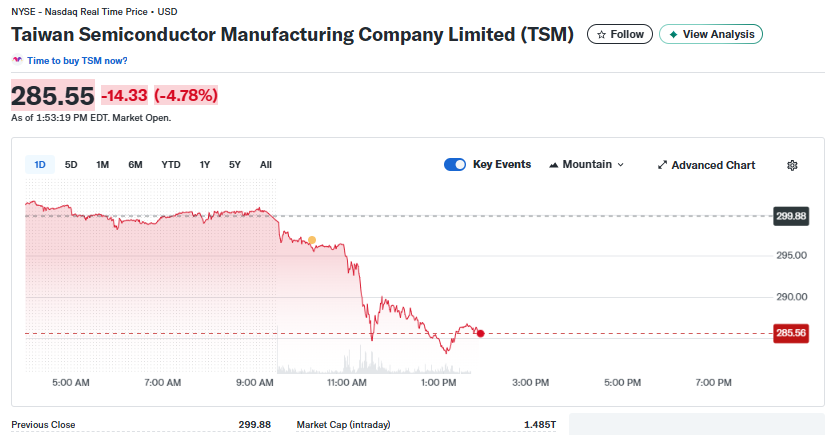
Taiwan Semiconductor Manufacturing Company Limited (TSM)

China’s Rare Earth Restrictions

The pressure on TSMC is compounded by China’s recent tightening of rare earth export rules, crucial materials for semiconductor production.

These restrictions create broader challenges for all global chipmakers, including those outside China, as sourcing critical minerals becomes increasingly complex.

Materials and equipment suppliers not reliant on US technology could benefit, but uncertainty around supply and licensing delays may shift some orders to alternative Chinese foundries such as Semiconductor Manufacturing International Corp. (SMIC) and Hua Hong Semiconductor.

Q3 Sales Beat Expectations

In spite of regulatory hurdles, TSMC reported stronger-than-expected Q3 2025 sales, fueled by robust demand for Nvidia’s Blackwell chips and early orders placed ahead of potential tariffs.

Analysts are closely monitoring gross margin trends and assessing how US policies may influence outsourcing strategies and supply chain logistics. The combination of strong sales performance and manageable exposure to China suggests that TSMC may weather short-term market volatility while maintaining its long-term growth trajectory.

Samsung Faces Greater Risk

Bloomberg Economics highlights that Samsung could be more affected than TSMC due to its higher reliance on Chinese demand.

However, the company may offset some of these challenges by supplying chips to emerging AI projects like OpenAI’s Stargate. Investors are now evaluating which firms are best positioned to navigate tightening US regulations while sustaining profitability in a shifting global semiconductor landscape.

Navigating Regulatory Uncertainty

TSMC has a 120-day transition period to seek individual licenses from the US Commerce Department, allowing current operations to continue while limiting capacity expansion or technology upgrades.

The company may also substitute some US-origin tools with Chinese alternatives, although local lithography capabilities remain limited for advanced nodes. Meanwhile, designers and device manufacturers may increasingly diversify suppliers to mitigate risk, potentially benefiting smaller or non-US-dependent foundries.

While TSMC shares reacted negatively to the news, the market drop reflects regulatory caution more than operational disruption. The company’s strategic positioning, diversified production, and strong demand pipeline provide buffers against short-term volatility, even as geopolitical and policy risks reshape the semiconductor landscape.


The post TSMC (TSM) Stock: Drops Amid US Chip Scrutiny and China Export Rules appeared first on CoinCentral.

Market Opportunity
4 Logo
4 Price(4)
$0.007861
$0.007861$0.007861
+4.17%
USD
4 (4) Live Price Chart
Disclaimer: The articles reposted on this site are sourced from public platforms and are provided for informational purposes only. They do not necessarily reflect the views of MEXC. All rights remain with the original authors. If you believe any content infringes on third-party rights, please contact crypto.news@mexc.com for removal. MEXC makes no guarantees regarding the accuracy, completeness, or timeliness of the content and is not responsible for any actions taken based on the information provided. The content does not constitute financial, legal, or other professional advice, nor should it be considered a recommendation or endorsement by MEXC.

You May Also Like

‘Bitcoin Is Going to Die’ – The Latest Death Warning Comes from Oscar-Nominated Actor

‘Bitcoin Is Going to Die’ – The Latest Death Warning Comes from Oscar-Nominated Actor

Terrence Howard said he is not touching BTC as it's going to die.
Share
CryptoPotato2026/03/09 15:15
Cashing In On University Patents Means Giving Up On Our Innovation Future

Cashing In On University Patents Means Giving Up On Our Innovation Future

The post Cashing In On University Patents Means Giving Up On Our Innovation Future appeared on BitcoinEthereumNews.com. “It’s a raid on American innovation that would deliver pennies to the Treasury while kneecapping the very engine of our economic and medical progress,” writes Pipes. Getty Images Washington is addicted to taxing success. Now, Commerce Secretary Howard Lutnick is floating a plan to skim half the patent earnings from inventions developed at universities with federal funding. It’s being sold as a way to shore up programs like Social Security. In reality, it’s a raid on American innovation that would deliver pennies to the Treasury while kneecapping the very engine of our economic and medical progress. Yes, taxpayer dollars support early-stage research. But the real payoff comes later—in the jobs created, cures discovered, and industries launched when universities and private industry turn those discoveries into real products. By comparison, the sums at stake in patent licensing are trivial. Universities collectively earn only about $3.6 billion annually in patent income—less than the federal government spends on Social Security in a single day. Even confiscating half would barely register against a $6 trillion federal budget. And yet the damage from such a policy would be anything but trivial. The true return on taxpayer investment isn’t in licensing checks sent to Washington, but in the downstream economic activity that federally supported research unleashes. Thanks to the bipartisan Bayh-Dole Act of 1980, universities and private industry have powerful incentives to translate early-stage discoveries into real-world products. Before Bayh-Dole, the government hoarded patents from federally funded research, and fewer than 5% were ever licensed. Once universities could own and license their own inventions, innovation exploded. The result has been one of the best returns on investment in government history. Since 1996, university research has added nearly $2 trillion to U.S. industrial output, supported 6.5 million jobs, and launched more than 19,000 startups. Those companies pay…
Share
BitcoinEthereumNews2025/09/18 03:26
Win Big at Shark Secret Casino for Real Cash!

Win Big at Shark Secret Casino for Real Cash!

Cryptsy - Latest Cryptocurrency News and Predictions Cryptsy - Latest Cryptocurrency News and Predictions - Experts in Crypto Casinos Did you know the online gambling
Share
Cryptsy2026/03/09 15:28