The global markets were shaken after President Donald Trump announced a 100% tariff on Chinese goods starting November 1, reigniting a full-scale trade war between the two largest economies. With $1.6 trillion already wiped from the US stock market in a single day, the question on every investor’s mind is simple: what happens next for crypto?Why  US–China Tariff Matter for Crypto Market?Unlike traditional equities, cryptocurrencies are not tied to a single economy, but they react sharply to macroeconomic shocks. Tariffs between the US and China hit two pressure points: inflation and liquidity. Higher import costs push inflation up, and central banks may respond with tighter monetary policy, reducing liquidity. For risk assets like Bitcoin and altcoins, reduced liquidity often translates into selling pressure.At the same time, crypto is increasingly viewed as a hedge against geopolitical risk. If trade tensions escalate into broader financial instability, investors may turn to Bitcoin as a digital safe haven, mirroring how gold reacts to crises. This dual role creates volatility: panic selling first, then speculative inflows if confidence in fiat weakens.Chart Analysis: Where Is the Crypto Market Headed?Total Market Cap: TradingViewLooking at the Total Crypto Market Cap chart, the recent candles tell a story of sharp reversal. After testing the upper Bollinger Band near $4.2 trillion, the market plunged below $3.7 trillion, with a massive wick extending towards $3.2 trillion. That wick signals extreme panic liquidation, followed by partial recovery.The Bollinger Bands are widening, which usually signals higher volatility ahead. The mid-band around $3.93 trillion is acting as resistance, while immediate support sits near $3.59 trillion. If this level breaks decisively, the next stop could be $3.2 trillion. On the upside, reclaiming $3.9–4 trillion could set the stage for a rebound rally.Could Rare Earth Politics Spill Into Crypto Market?Image Source: TruthsocialChina’s restrictions on rare earth exports aren’t just about minerals; they’re a geopolitical weapon. Rare earths are essential for high-tech industries, including chips, batteries, and EVs. Any disruption in this supply chain threatens US tech stocks, which are already reeling. When equities are unstable, crypto often becomes collateral damage as institutions de-risk across all volatile asset classes.But here’s the twist: if US–China relations worsen further and global trust in traditional financial systems declines, crypto could see inflows as an alternative store of value. In essence, rare earth disputes may indirectly fuel Bitcoin’s “digital gold” narrative.Short-Term Outlook: More Crypto Market Crash Before Relief?Given the November 1 deadline for tariffs by Donald Trump, markets are bracing for weeks of uncertainty. Expect sharp swings as traders position for worst-case outcomes. The chart suggests crypto market cap could retest $3.5 trillion, with a possible extension to $3.2 trillion if panic deepens.However, if inflation fears push more investors to seek decentralized assets, Bitcoin and Ethereum may lead a relief rally. Historically, crypto thrives when traditional markets lose investor trust.Long-Term View: A Turning Point for Adoption?If the trade war escalates, crypto adoption could accelerate. Both the US and China are heavily invested in blockchain technologies. For China, pushing digital yuan adoption could reduce reliance on dollar-settled trade. For the US, crypto may gain traction as retail and institutional investors seek alternatives to inflation-weakened fiat.The rare earth standoff might also highlight blockchain’s role in securing supply chains, further intertwining crypto with geopolitics.Final TakeThe US–China tariff battle has thrown crypto into a storm of uncertainty. Short-term, volatility and downside risk dominate the charts. But long-term, these geopolitical tensions may be the very fuel that strengthens crypto’s case as a hedge against inflation, trade wars, and broken global trust.The question isn’t just whether crypto will fall or rise in the next few weeks. The deeper question is whether this trade war marks the beginning of crypto’s evolution from speculative asset to essential financial refuge.The global markets were shaken after President Donald Trump announced a 100% tariff on Chinese goods starting November 1, reigniting a full-scale trade war between the two largest economies. With $1.6 trillion already wiped from the US stock market in a single day, the question on every investor’s mind is simple: what happens next for crypto?Why  US–China Tariff Matter for Crypto Market?Unlike traditional equities, cryptocurrencies are not tied to a single economy, but they react sharply to macroeconomic shocks. Tariffs between the US and China hit two pressure points: inflation and liquidity. Higher import costs push inflation up, and central banks may respond with tighter monetary policy, reducing liquidity. For risk assets like Bitcoin and altcoins, reduced liquidity often translates into selling pressure.At the same time, crypto is increasingly viewed as a hedge against geopolitical risk. If trade tensions escalate into broader financial instability, investors may turn to Bitcoin as a digital safe haven, mirroring how gold reacts to crises. This dual role creates volatility: panic selling first, then speculative inflows if confidence in fiat weakens.Chart Analysis: Where Is the Crypto Market Headed?Total Market Cap: TradingViewLooking at the Total Crypto Market Cap chart, the recent candles tell a story of sharp reversal. After testing the upper Bollinger Band near $4.2 trillion, the market plunged below $3.7 trillion, with a massive wick extending towards $3.2 trillion. That wick signals extreme panic liquidation, followed by partial recovery.The Bollinger Bands are widening, which usually signals higher volatility ahead. The mid-band around $3.93 trillion is acting as resistance, while immediate support sits near $3.59 trillion. If this level breaks decisively, the next stop could be $3.2 trillion. On the upside, reclaiming $3.9–4 trillion could set the stage for a rebound rally.Could Rare Earth Politics Spill Into Crypto Market?Image Source: TruthsocialChina’s restrictions on rare earth exports aren’t just about minerals; they’re a geopolitical weapon. Rare earths are essential for high-tech industries, including chips, batteries, and EVs. Any disruption in this supply chain threatens US tech stocks, which are already reeling. When equities are unstable, crypto often becomes collateral damage as institutions de-risk across all volatile asset classes.But here’s the twist: if US–China relations worsen further and global trust in traditional financial systems declines, crypto could see inflows as an alternative store of value. In essence, rare earth disputes may indirectly fuel Bitcoin’s “digital gold” narrative.Short-Term Outlook: More Crypto Market Crash Before Relief?Given the November 1 deadline for tariffs by Donald Trump, markets are bracing for weeks of uncertainty. Expect sharp swings as traders position for worst-case outcomes. The chart suggests crypto market cap could retest $3.5 trillion, with a possible extension to $3.2 trillion if panic deepens.However, if inflation fears push more investors to seek decentralized assets, Bitcoin and Ethereum may lead a relief rally. Historically, crypto thrives when traditional markets lose investor trust.Long-Term View: A Turning Point for Adoption?If the trade war escalates, crypto adoption could accelerate. Both the US and China are heavily invested in blockchain technologies. For China, pushing digital yuan adoption could reduce reliance on dollar-settled trade. For the US, crypto may gain traction as retail and institutional investors seek alternatives to inflation-weakened fiat.The rare earth standoff might also highlight blockchain’s role in securing supply chains, further intertwining crypto with geopolitics.Final TakeThe US–China tariff battle has thrown crypto into a storm of uncertainty. Short-term, volatility and downside risk dominate the charts. But long-term, these geopolitical tensions may be the very fuel that strengthens crypto’s case as a hedge against inflation, trade wars, and broken global trust.The question isn’t just whether crypto will fall or rise in the next few weeks. The deeper question is whether this trade war marks the beginning of crypto’s evolution from speculative asset to essential financial refuge.

US–China Tariff War: Can Crypto Market Survive the New Trade War?

2025/10/11 12:10
4 min read
For feedback or concerns regarding this content, please contact us at crypto.news@mexc.com

The global markets were shaken after President Donald Trump announced a 100% tariff on Chinese goods starting November 1, reigniting a full-scale trade war between the two largest economies. With $1.6 trillion already wiped from the US stock market in a single day, the question on every investor’s mind is simple: what happens next for crypto?

Why  US–China Tariff Matter for Crypto Market?

Unlike traditional equities, cryptocurrencies are not tied to a single economy, but they react sharply to macroeconomic shocks. Tariffs between the US and China hit two pressure points: inflation and liquidity. Higher import costs push inflation up, and central banks may respond with tighter monetary policy, reducing liquidity. For risk assets like Bitcoin and altcoins, reduced liquidity often translates into selling pressure.

At the same time, crypto is increasingly viewed as a hedge against geopolitical risk. If trade tensions escalate into broader financial instability, investors may turn to Bitcoin as a digital safe haven, mirroring how gold reacts to crises. This dual role creates volatility: panic selling first, then speculative inflows if confidence in fiat weakens.

Chart Analysis: Where Is the Crypto Market Headed?
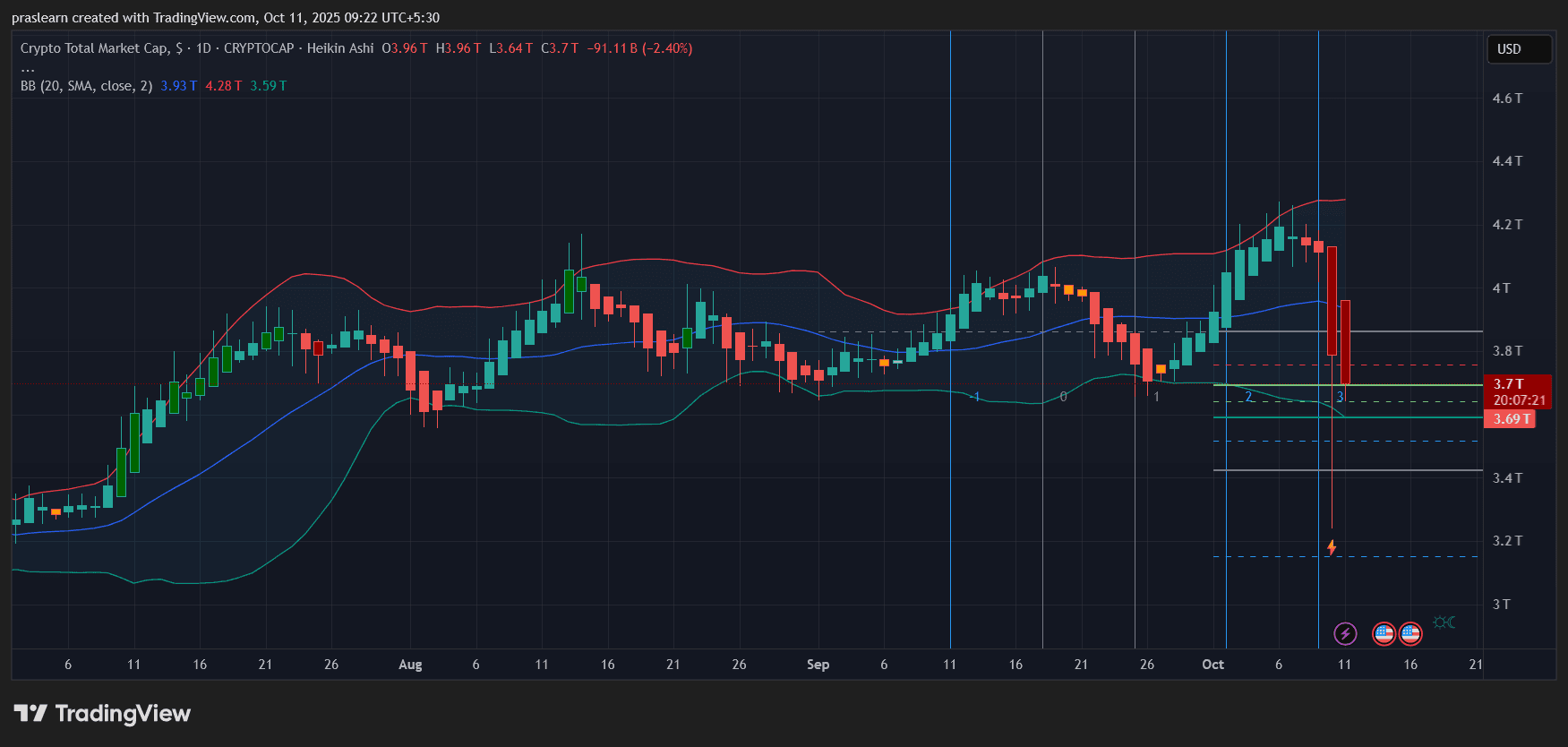
Crypto MarketTotal Market Cap: TradingView

Looking at the Total Crypto Market Cap chart, the recent candles tell a story of sharp reversal. After testing the upper Bollinger Band near $4.2 trillion, the market plunged below $3.7 trillion, with a massive wick extending towards $3.2 trillion. That wick signals extreme panic liquidation, followed by partial recovery.

The Bollinger Bands are widening, which usually signals higher volatility ahead. The mid-band around $3.93 trillion is acting as resistance, while immediate support sits near $3.59 trillion. If this level breaks decisively, the next stop could be $3.2 trillion. On the upside, reclaiming $3.9–4 trillion could set the stage for a rebound rally.

Could Rare Earth Politics Spill Into Crypto Market?
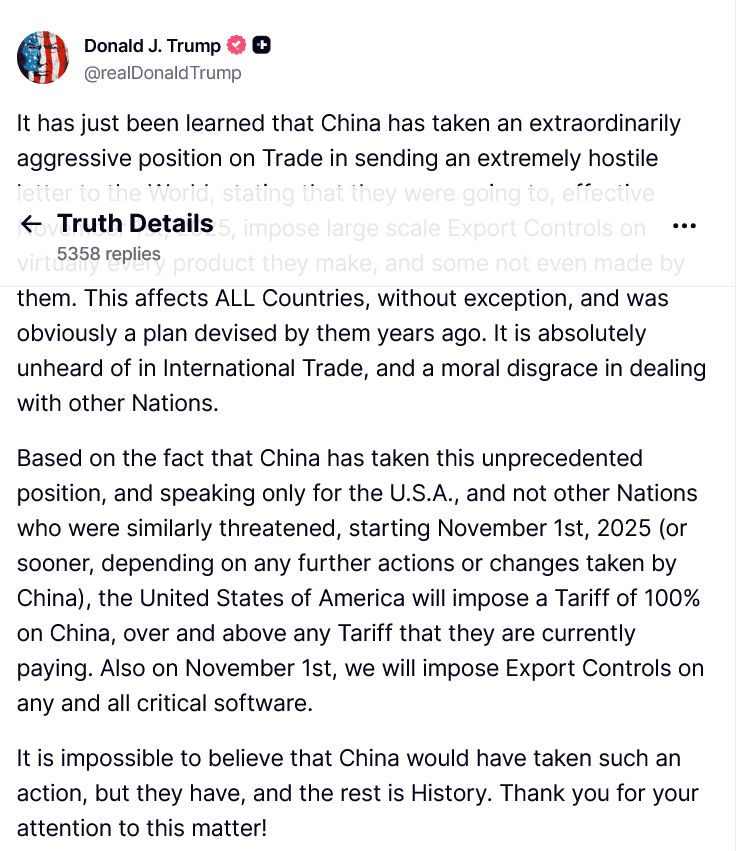
Screenshot 2025-10-11 at 09-35-20 Truth Details Truth Social.pngImage Source: Truthsocial

China’s restrictions on rare earth exports aren’t just about minerals; they’re a geopolitical weapon. Rare earths are essential for high-tech industries, including chips, batteries, and EVs. Any disruption in this supply chain threatens US tech stocks, which are already reeling. When equities are unstable, crypto often becomes collateral damage as institutions de-risk across all volatile asset classes.

But here’s the twist: if US–China relations worsen further and global trust in traditional financial systems declines, crypto could see inflows as an alternative store of value. In essence, rare earth disputes may indirectly fuel Bitcoin’s “digital gold” narrative.

Short-Term Outlook: More Crypto Market Crash Before Relief?

Given the November 1 deadline for tariffs by Donald Trump, markets are bracing for weeks of uncertainty. Expect sharp swings as traders position for worst-case outcomes. The chart suggests crypto market cap could retest $3.5 trillion, with a possible extension to $3.2 trillion if panic deepens.

However, if inflation fears push more investors to seek decentralized assets, Bitcoin and Ethereum may lead a relief rally. Historically, crypto thrives when traditional markets lose investor trust.

Long-Term View: A Turning Point for Adoption?

If the trade war escalates, crypto adoption could accelerate. Both the US and China are heavily invested in blockchain technologies. For China, pushing digital yuan adoption could reduce reliance on dollar-settled trade. For the US, crypto may gain traction as retail and institutional investors seek alternatives to inflation-weakened fiat.

The rare earth standoff might also highlight blockchain’s role in securing supply chains, further intertwining crypto with geopolitics.

Final Take

The US–China tariff battle has thrown crypto into a storm of uncertainty. Short-term, volatility and downside risk dominate the charts. But long-term, these geopolitical tensions may be the very fuel that strengthens crypto’s case as a hedge against inflation, trade wars, and broken global trust.

The question isn’t just whether crypto will fall or rise in the next few weeks. The deeper question is whether this trade war marks the beginning of crypto’s evolution from speculative asset to essential financial refuge.


Market Opportunity
Polytrade Logo
Polytrade Price(TRADE)
$0.03694
$0.03694$0.03694
-0.10%
USD
Polytrade (TRADE) Live Price Chart
Disclaimer: The articles reposted on this site are sourced from public platforms and are provided for informational purposes only. They do not necessarily reflect the views of MEXC. All rights remain with the original authors. If you believe any content infringes on third-party rights, please contact crypto.news@mexc.com for removal. MEXC makes no guarantees regarding the accuracy, completeness, or timeliness of the content and is not responsible for any actions taken based on the information provided. The content does not constitute financial, legal, or other professional advice, nor should it be considered a recommendation or endorsement by MEXC.

You May Also Like

U.S. Treasury Recognizes Legitimate Uses for Crypto Mixers, Proposes “Hold Law” for Suspicious Assets

U.S. Treasury Recognizes Legitimate Uses for Crypto Mixers, Proposes “Hold Law” for Suspicious Assets

Bitcoin Magazine U.S. Treasury Recognizes Legitimate Uses for Crypto Mixers, Proposes “Hold Law” for Suspicious Assets The U.S. Treasury Department told Congress
Share
bitcoinmagazine2026/03/09 22:29
Best Altcoins to Buy After Google Acquires Stake in Bitcoin Mining Company

Best Altcoins to Buy After Google Acquires Stake in Bitcoin Mining Company

The post Best Altcoins to Buy After Google Acquires Stake in Bitcoin Mining Company appeared on BitcoinEthereumNews.com. Best Altcoins to Buy After Google Acquires Stake in Bitcoin Mining Company Sign Up for Our Newsletter! For updates and exclusive offers enter your email. As a crypto writer, Krishi splits his time between decoding the chaos of the markets and writing about it in a way that doesn’t put you to sleep. He’s been at it for nearly two years in the crypto trenches. Yes, he regrets missing the magnificent rallies that came before that (who doesn’t!), but he’s more than ready to put his money where his words are. Before diving headfirst into crypto, Krishi spent over five years writing for some of the biggest names in tech, including TechRadar, Tom’s Guide, and PC Gaming, covering everything from gadgets and cybersecurity to gaming and software. When he’s not scouring and writing about the latest happenings in crypto, Krishi trades the forex market while keeping crypto in his long-term HODL plans. He’s a Bitcoin believer, though he never lets that bias creep into his writing. This website uses cookies. By continuing to use this website you are giving consent to cookies being used. Visit our Privacy Center or Cookie Policy. I Agree Source: https://bitcoinist.com/best-altcoins-to-buy-as-google-acquires-stake-in-bitcoin-mining-company/
Share
BitcoinEthereumNews2025/09/26 22:51
Strategy returns to strong weekly buying with 17,994 BTC

Strategy returns to strong weekly buying with 17,994 BTC

The post Strategy returns to strong weekly buying with 17,994 BTC appeared on BitcoinEthereumNews.com. Strategy performed its biggest weekly purchase since January
Share
BitcoinEthereumNews2026/03/09 21:47