WormHole is an efficient graph algorithm designed to compute approximate shortest paths by combining structural decomposition with a bidirectional BFS routing phase. It preprocesses a graph into an “inner ring” to enable fast, accurate queries, balancing speed and space efficiency. Two variants, WormHole𝐸 and WormHole𝑀, adapt the approach for different needs—one prioritizing memory economy, the other optimized for rapid inquiries through partial graph indexing.WormHole is an efficient graph algorithm designed to compute approximate shortest paths by combining structural decomposition with a bidirectional BFS routing phase. It preprocesses a graph into an “inner ring” to enable fast, accurate queries, balancing speed and space efficiency. Two variants, WormHole𝐸 and WormHole𝑀, adapt the approach for different needs—one prioritizing memory economy, the other optimized for rapid inquiries through partial graph indexing.

The WormHole Algorithm for Approximate Shortest Paths in Large Graphs

2025/10/15 23:00
3 min read
For feedback or concerns regarding this content, please contact us at crypto.news@mexc.com

Abstract and 1. Introduction

1.1 Our Contribution

1.2 Setting

1.3 The algorithm

  1. Related Work

  2. Algorithm

    3.1 The Structural Decomposition Phase

    3.2 The Routing Phase

    3.3 Variants of WormHole

  3. Theoretical Analysis

    4.1 Preliminaries

    4.2 Sublinearity of Inner Ring

    4.3 Approximation Error

    4.4 Query Complexity

  4. Experimental Results

    5.1 WormHole𝐸, WormHole𝐻 and BiBFS

    5.2 Comparison with index-based methods

    5.3 WormHole as a primitive: WormHole𝑀

References

3 ALGORITHM

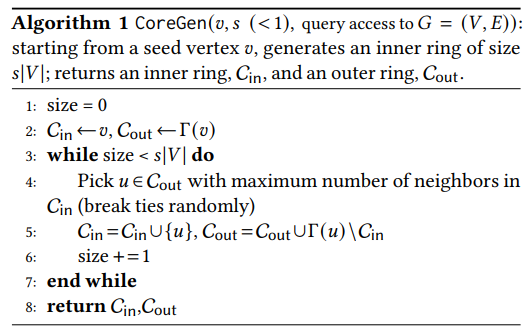
WormHole utilizes insights about the structure of real world networks to cleverly decompose the graph and calculate approximate shortest paths. We discuss the algorithm and various steps in detail in this section; our two main components are a sublinear decomposition procedure, adapted from the recent work of Ben-Eliezer et al [10], and a routing algorithm that takes advantage of this decomposition to find highly accurate approximate shortest paths.

3.1 The Structural Decomposition Phase
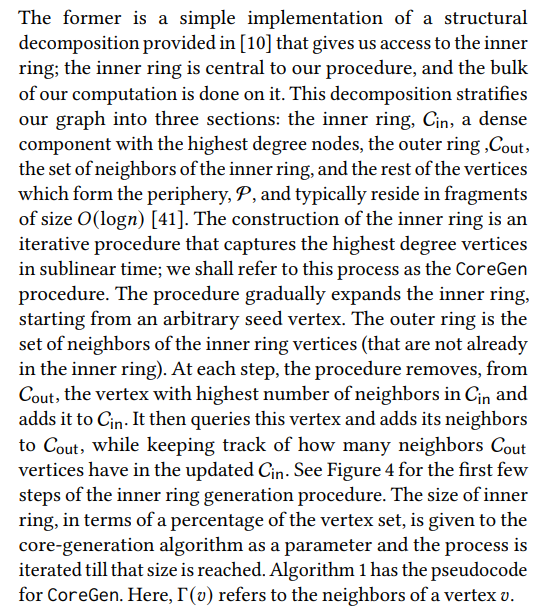
\ We emphasize that the decomposition is performed only once, and all subsequent operations are done using this precomputed decomposition.

\
\

3.2 The Routing Phase

The approach is simple: assume the preprocessing phase acquires the inner ring. Upon an inquiry (𝑠,𝑡), the algorithm

\ \
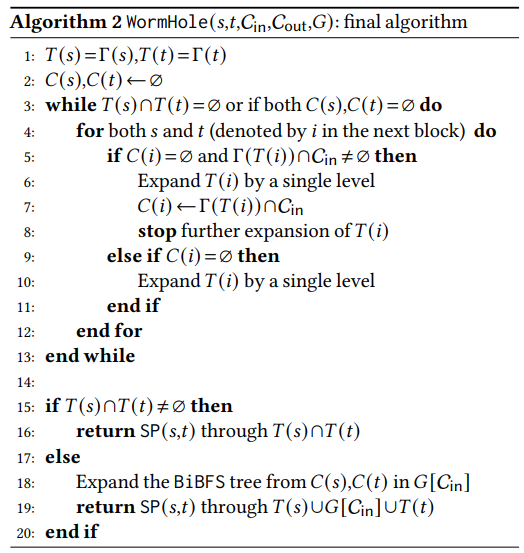
\ \ starts two BFS trees from both 𝑠 and 𝑡. It then expands the tree at each step till one of the followings happens:

\ (1) the two trees intersect, or

\ (2) the trees reach the outer ring.

\ If the search trees in the former do not intersect, WormHole mandatorily routes shortest paths through the inner ring. Once in the inner ring, it computes the exact shortest path through it.

\

3.3 Variants of WormHole

In the default variant of Algorithm 2, WormHole𝐸, we use the bidirectional breadth-first BiBFS shortest path algorithm as a primitive in order to compute the shortest path between two inner ring vertices; see [46] for a full description of BiBFS. The theoretical analysis in §4 considers this variant.

\ \
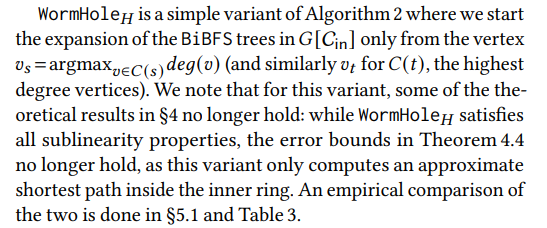
\ \ In WormHole𝑀 we combine WormHole with an index-based algorithm restricted to the core. While indexing-based algorithms are quite expensive, in terms of both preprocessing and space cost, they lead to much lower times per inquiry. Therefore this variant is suitable when faster inquiry times are preferable to low space requirements. WormHole𝑀 makes the index creation cost substantially lower(compared to generating it for the entire graph) while providing speedups for answering shortest path inquiries compared to the BiBFS implementation. We discuss this briefly in §5.3 but leave a complete systematic exploration of these options for future research.

\ \ Figure 4: Construction of the inner and outer rings of the core; figure taken from [10]. At any point, the outer ring is the set of vertices adjacent to the inner ring. The algorithm expands the inner ring by adding to it a vertex from the outer ring that has the most neighbors in the inner ring. The image looks at two successive steps: the numbers labelling vertices in the outer ring refer to how many inner ring vertices it is adjacent to. Thus, in the second step, the vertex labelled 2 is added to the inner ring.

\ \ \

:::info Authors:

(1) Talya Eden, Bar-Ilan University (talyaa01@gmail.com);

(2) Omri Ben-Eliezer, MIT (omrib@mit.edu);

(3) C. Seshadhri, UC Santa Cruz (sesh@ucsc.edu).

:::


:::info This paper is available on arxiv under CC BY 4.0 license.

:::

\

Market Opportunity
Spacecoin Logo
Spacecoin Price(SPACE)
$0.007874
$0.007874$0.007874
-5.74%
USD
Spacecoin (SPACE) Live Price Chart
Disclaimer: The articles reposted on this site are sourced from public platforms and are provided for informational purposes only. They do not necessarily reflect the views of MEXC. All rights remain with the original authors. If you believe any content infringes on third-party rights, please contact crypto.news@mexc.com for removal. MEXC makes no guarantees regarding the accuracy, completeness, or timeliness of the content and is not responsible for any actions taken based on the information provided. The content does not constitute financial, legal, or other professional advice, nor should it be considered a recommendation or endorsement by MEXC.

You May Also Like

Here’s How Consumers May Benefit From Lower Interest Rates

Here’s How Consumers May Benefit From Lower Interest Rates

The post Here’s How Consumers May Benefit From Lower Interest Rates appeared on BitcoinEthereumNews.com. Topline The Federal Reserve on Wednesday opted to ease interest rates for the first time in months, leading the way for potentially lower mortgage rates, bond yields and a likely boost to cryptocurrency over the coming weeks. Average long-term mortgage rates dropped to their lowest levels in months ahead of the central bank’s policy shift. Copyright{2018} The Associated Press. All rights reserved. Key Facts The central bank’s policymaking panel voted this week to lower interest rates, which have sat between 4.25% and 4.5% since December, to a new range of 4% and 4.25%. How Will Lower Interest Rates Impact Mortgage Rates? Mortgage rates tend to fall before and during a period of interest rate cuts: The average 30-year fixed-rate mortgage dropped to 6.35% from 6.5% last week, the lowest level since October 2024, mortgage buyer Freddie Mac reported. Borrowing costs on 15-year fixed-rate mortgages also dropped to 5.5% from 5.6% as they neared the year-ago rate of 5.27%. When the Federal Reserve lowered the funds rate to between 0% and 0.25% during the pandemic, 30-year mortgage rates hit record lows between 2.7% and 3% by the end of 2020, according to data published by Freddie Mac. Consumers who refinanced their mortgages in 2020 saved about $5.3 billion annually as rates dropped, according to the Consumer Financial Protection Bureau. Similarly, mortgage rates spiked around 7% as interest rates were hiked in 2022 and 2023, though mortgage rates appeared to react within weeks of the Fed opting to cut or raise rates. How Do Treasury Bonds Respond To Lower Interest Rates? Long-term Treasury yields are more directly influenced by interest rates, as lower rates tend to result in lower yields. When the Fed pushed rates to near zero during the pandemic, 10-year Treasury yields fell to an all-time low of 0.5%. As…
Share
BitcoinEthereumNews2025/09/18 05:59
Tunis–Carthage Airport Expansion Targets Capacity Surge

Tunis–Carthage Airport Expansion Targets Capacity Surge

Tunisia’s Tunis–Carthage airport expansion is set to transform the country’s aviation capacity as authorities plan a $1 billion investment to significantly increase
Share
Furtherafrica2026/03/10 13:00
Hoskinson to Attend Senate Roundtable on Crypto Regulation

Hoskinson to Attend Senate Roundtable on Crypto Regulation

The post Hoskinson to Attend Senate Roundtable on Crypto Regulation appeared on BitcoinEthereumNews.com. Hoskinson confirmed for Senate roundtable on U.S. crypto regulation and market structure. Key topics include SEC vs CFTC oversight split, DeFi regulation, and securities rules. Critics call the roundtable slow, citing Trump’s 2025 executive order as faster. Cardano founder Charles Hoskinson has confirmed that he will attend the Senate Banking Committee roundtable on crypto market structure legislation.  Hoskinson left a hint about his attendance on X while highlighting Journalist Eleanor Terrett’s latest post about the event. Crypto insiders will meet with government officials Terrett shared information gathered from some invitees to the event, noting that a group of leaders from several major cryptocurrency establishments would attend the event. According to Terrett, the group will meet with the Senate Banking Committee leadership in a roundtable to continue talks on market structure regulation. Meanwhile, Terrett noted that the meeting will be held on Thursday, September 18, following an industry review of the committee’s latest approach to distinguishing securities from commodities, DeFi treatment, and other key issues, which has lasted over one week.  Related: Senate Draft Bill Gains Experts’ Praise for Strongest Developer Protections in Crypto Law Notably, the upcoming roundtable between US legislators and crypto industry leaders is a continuation of the process of regularising cryptocurrency regulation in the United States. It is part of the Donald Trump administration’s efforts to provide clarity in the US cryptocurrency ecosystem, which many crypto supporters consider a necessity for the digital asset industry. Despite the ongoing process, some crypto users are unsatisfied with how the US government is handling the issue, particularly the level of bureaucracy involved in creating a lasting cryptocurrency regulatory framework. One such user criticized the process, describing it as a “masterclass in bureaucratic foot-dragging.” According to the critic, America is losing ground to nations already leading in blockchain innovation. He cited…
Share
BitcoinEthereumNews2025/09/18 06:37