Japan plans new regulations to stamp out crypto insider trading. A law enforcement agency in the country, the Securities and Exchange Surveillance Commission (SESC), is to have new powers of crypto trading investigation. Currently, no laws apply to crypto insider trading in FIEA. This void left the space open for regulation. Japan’s Crypto Regulation The Japan Virtual and Crypto Assets Exchange Association (JVCEA), which self-regulates crypto exchanges, lacks the tools to detect insider trading. This is why the government is taking steps to tighten the rules. The Financial Services Agency (FSA), which oversees the SESC, will form a working group to discuss a new regulatory framework. They aim to submit an amendment to the FIEA by next year, bringing cryptocurrencies under the same rules as stocks and bonds. Source: X Insider Trading in Crypto: A Growing Concern The rise of cryptocurrency in Japan has sparked an urgent need for clear regulations. As of August 2025, Japan has 7.88 million active cryptocurrency accounts, an increase of 400% over the past five years.  Also Read: Japan to Secure Cryptocurrencies as Legal Financial Products Crypto insider trading poses unique challenges. Many tokens lack identifiable issuers, making it hard to define who qualifies as an insider. This makes detecting and penalizing insider trading in the crypto market more difficult compared to traditional stock trading. Proposed Regulatory Changes to Address Crypto Insider Trading The SESC is aiming to modify the Financial Instruments and Exchange Act to make room for crypto in insider trading laws. The new rule would be the first time the regulation expressly applies to insider trading on nondisclosed information. Under the recommendations, the FSA would be able to provide specific guidance on what amounts to insider dealing. Such regulations would help prevent the problem of crypto insider trading in a digital age and make it clearer for crypto investors. Challenges in Regulating Crypto Insider Trading As opposed to traditional financial instruments, crypto assets are frequently decentralized. It’s hard to figure out what insider trading looks like when there isn’t a clear issuer for a lot of these tokens. Japan’s regulatory agency is still coming to grips with insider trading in the crypto sector. The country certainly has lots of experience monitoring stock markets, but it is far less clear about crypto: The market remains something of the Wild West. FSA’s Push to Reclassify Crypto Assets New crypto insider trading rules are set to be introduced, along with the possibility of Japan’s Financial Services Agency classifying cryptocurrencies as financial products. This change would put crypto subject to the FIEA, similar to how stocks and bonds are regulated. Reclassifying crypto could reduce to a maximum of 20% the capital gains tax digital assets are subject to, down from as much as 55%, Holger Zschaepitz explains. It would benefit crypto by making it more appealing to investors, and bring Japan’s tax policy in line with international norms. Political Momentum for Crypto Regulation A supporter is rising Key political figure Sanae Takaichi could bring new momentum to the regulation of the crypto asset industry in Japan. The former has openly called for technology sovereignty to be a high government priority. She is also supportive of lower interest rates and tax cuts, moves that might see yet more capital pour into Japan’s crypto sphere. The policies of Takaichi could aid in solidifying Japan as the world’s capital for cryptocurrency regulation. Benefits of Strengthening Crypto Oversight There are a number of persistent problems in the cryptocurrency space that the new regulatory structure would be designed to tackle. These are misleading statements, unregistered activity, and security issues.  Policies that are transparent can help investors trade the crypto market with more assurance. Exchanges would also have to abide by tighter rules to prevent fraud and market manipulation. Conclusion Japan is making significant strides in regulating its crypto market. The country’s approach to crypto insider trading will likely set a precedent for other nations looking to address similar issues. In associating crypto with traditional investment vehicles, Japan is demonstrating its resolve to create a safe and transparent marketplace. This is also an attempt to ensure a fair and transparent crypto ecosystem. Also Read: Ripple Funds Japan’s Web3 Future: $200K Grants Aim to Ignite XRP Ledger Summary Japan to combat crypto insider trading with new regulation, aiming for digital currency to be on par with traditional securities. The SESC will receive renewed authority to investigate and sanction violations, with the goal of promoting greater market transparency and safety. The FSA is also said to weigh the recategorization of cryptocurrencies under the Financial Instruments and Exchange Act, meaning they would become subject to lower capital gains taxes in exchange for better protection of investors.  Appendix: Glossary of Key Terms Crypto Insider Trading: Illegal practice of trading cryptocurrencies based on non-public information. Financial Instruments and Exchange Act (FIEA): Japanese law governing securities and financial markets. Securities and Exchange Surveillance Commission (SESC): Regulatory body responsible for overseeing financial markets in Japan. Financial Services Agency (FSA): Government agency responsible for overseeing Japan’s financial market regulations. Capital Gains Tax: Tax on profits from the sale of assets like crypto. Japan Virtual and Crypto Assets Exchange Association (JVCEA): Self-regulatory body overseeing crypto exchanges in Japan. Frequently Asked Questions Crypto Insider Trading 1: What is Japan’s stance on crypto insider trading? Japan is set to introduce regulations to ban and penalize insider trading in the crypto market, bringing it in line with traditional stock market rules. 2: How will the new regulations impact investors? The new rules aim to protect investors by creating a more transparent and secure crypto market. Insider trading will be punished, making it safer for people to invest. 3: What changes are proposed for crypto taxation in Japan? The FSA plans to reclassify cryptocurrencies as financial products under the FIEA. This could lower the capital gains tax on crypto to a maximum of 20%. 4: How does insider trading in crypto differ from stock trading? Insider trading in crypto is harder to detect because many tokens lack identifiable issuers. This makes it more challenging to define who qualifies as an insider. Read More: Japan to Combat Crypto Insider Trading with New Regulations: Report">Japan to Combat Crypto Insider Trading with New Regulations: ReportJapan plans new regulations to stamp out crypto insider trading. A law enforcement agency in the country, the Securities and Exchange Surveillance Commission (SESC), is to have new powers of crypto trading investigation. Currently, no laws apply to crypto insider trading in FIEA. This void left the space open for regulation. Japan’s Crypto Regulation The Japan Virtual and Crypto Assets Exchange Association (JVCEA), which self-regulates crypto exchanges, lacks the tools to detect insider trading. This is why the government is taking steps to tighten the rules. The Financial Services Agency (FSA), which oversees the SESC, will form a working group to discuss a new regulatory framework. They aim to submit an amendment to the FIEA by next year, bringing cryptocurrencies under the same rules as stocks and bonds. Source: X Insider Trading in Crypto: A Growing Concern The rise of cryptocurrency in Japan has sparked an urgent need for clear regulations. As of August 2025, Japan has 7.88 million active cryptocurrency accounts, an increase of 400% over the past five years.  Also Read: Japan to Secure Cryptocurrencies as Legal Financial Products Crypto insider trading poses unique challenges. Many tokens lack identifiable issuers, making it hard to define who qualifies as an insider. This makes detecting and penalizing insider trading in the crypto market more difficult compared to traditional stock trading. Proposed Regulatory Changes to Address Crypto Insider Trading The SESC is aiming to modify the Financial Instruments and Exchange Act to make room for crypto in insider trading laws. The new rule would be the first time the regulation expressly applies to insider trading on nondisclosed information. Under the recommendations, the FSA would be able to provide specific guidance on what amounts to insider dealing. Such regulations would help prevent the problem of crypto insider trading in a digital age and make it clearer for crypto investors. Challenges in Regulating Crypto Insider Trading As opposed to traditional financial instruments, crypto assets are frequently decentralized. It’s hard to figure out what insider trading looks like when there isn’t a clear issuer for a lot of these tokens. Japan’s regulatory agency is still coming to grips with insider trading in the crypto sector. The country certainly has lots of experience monitoring stock markets, but it is far less clear about crypto: The market remains something of the Wild West. FSA’s Push to Reclassify Crypto Assets New crypto insider trading rules are set to be introduced, along with the possibility of Japan’s Financial Services Agency classifying cryptocurrencies as financial products. This change would put crypto subject to the FIEA, similar to how stocks and bonds are regulated. Reclassifying crypto could reduce to a maximum of 20% the capital gains tax digital assets are subject to, down from as much as 55%, Holger Zschaepitz explains. It would benefit crypto by making it more appealing to investors, and bring Japan’s tax policy in line with international norms. Political Momentum for Crypto Regulation A supporter is rising Key political figure Sanae Takaichi could bring new momentum to the regulation of the crypto asset industry in Japan. The former has openly called for technology sovereignty to be a high government priority. She is also supportive of lower interest rates and tax cuts, moves that might see yet more capital pour into Japan’s crypto sphere. The policies of Takaichi could aid in solidifying Japan as the world’s capital for cryptocurrency regulation. Benefits of Strengthening Crypto Oversight There are a number of persistent problems in the cryptocurrency space that the new regulatory structure would be designed to tackle. These are misleading statements, unregistered activity, and security issues.  Policies that are transparent can help investors trade the crypto market with more assurance. Exchanges would also have to abide by tighter rules to prevent fraud and market manipulation. Conclusion Japan is making significant strides in regulating its crypto market. The country’s approach to crypto insider trading will likely set a precedent for other nations looking to address similar issues. In associating crypto with traditional investment vehicles, Japan is demonstrating its resolve to create a safe and transparent marketplace. This is also an attempt to ensure a fair and transparent crypto ecosystem. Also Read: Ripple Funds Japan’s Web3 Future: $200K Grants Aim to Ignite XRP Ledger Summary Japan to combat crypto insider trading with new regulation, aiming for digital currency to be on par with traditional securities. The SESC will receive renewed authority to investigate and sanction violations, with the goal of promoting greater market transparency and safety. The FSA is also said to weigh the recategorization of cryptocurrencies under the Financial Instruments and Exchange Act, meaning they would become subject to lower capital gains taxes in exchange for better protection of investors.  Appendix: Glossary of Key Terms Crypto Insider Trading: Illegal practice of trading cryptocurrencies based on non-public information. Financial Instruments and Exchange Act (FIEA): Japanese law governing securities and financial markets. Securities and Exchange Surveillance Commission (SESC): Regulatory body responsible for overseeing financial markets in Japan. Financial Services Agency (FSA): Government agency responsible for overseeing Japan’s financial market regulations. Capital Gains Tax: Tax on profits from the sale of assets like crypto. Japan Virtual and Crypto Assets Exchange Association (JVCEA): Self-regulatory body overseeing crypto exchanges in Japan. Frequently Asked Questions Crypto Insider Trading 1: What is Japan’s stance on crypto insider trading? Japan is set to introduce regulations to ban and penalize insider trading in the crypto market, bringing it in line with traditional stock market rules. 2: How will the new regulations impact investors? The new rules aim to protect investors by creating a more transparent and secure crypto market. Insider trading will be punished, making it safer for people to invest. 3: What changes are proposed for crypto taxation in Japan? The FSA plans to reclassify cryptocurrencies as financial products under the FIEA. This could lower the capital gains tax on crypto to a maximum of 20%. 4: How does insider trading in crypto differ from stock trading? Insider trading in crypto is harder to detect because many tokens lack identifiable issuers. This makes it more challenging to define who qualifies as an insider. Read More: Japan to Combat Crypto Insider Trading with New Regulations: Report">Japan to Combat Crypto Insider Trading with New Regulations: Report

Japan to Combat Crypto Insider Trading with New Regulations: Report

2025/10/16 02:00
6 min read
For feedback or concerns regarding this content, please contact us at crypto.news@mexc.com

Japan plans new regulations to stamp out crypto insider trading. A law enforcement agency in the country, the Securities and Exchange Surveillance Commission (SESC), is to have new powers of crypto trading investigation.

Currently, no laws apply to crypto insider trading in FIEA. This void left the space open for regulation.

Japan’s Crypto Regulation

The Japan Virtual and Crypto Assets Exchange Association (JVCEA), which self-regulates crypto exchanges, lacks the tools to detect insider trading. This is why the government is taking steps to tighten the rules.

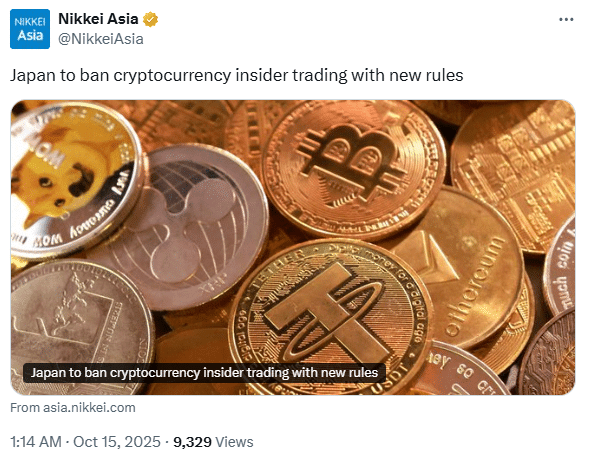
The Financial Services Agency (FSA), which oversees the SESC, will form a working group to discuss a new regulatory framework. They aim to submit an amendment to the FIEA by next year, bringing cryptocurrencies under the same rules as stocks and bonds.
Crypto Insider Trading

Source: X

Insider Trading in Crypto: A Growing Concern

The rise of cryptocurrency in Japan has sparked an urgent need for clear regulations. As of August 2025, Japan has 7.88 million active cryptocurrency accounts, an increase of 400% over the past five years. 

Also Read: Japan to Secure Cryptocurrencies as Legal Financial Products

Crypto insider trading poses unique challenges. Many tokens lack identifiable issuers, making it hard to define who qualifies as an insider. This makes detecting and penalizing insider trading in the crypto market more difficult compared to traditional stock trading.

Proposed Regulatory Changes to Address Crypto Insider Trading

The SESC is aiming to modify the Financial Instruments and Exchange Act to make room for crypto in insider trading laws. The new rule would be the first time the regulation expressly applies to insider trading on nondisclosed information.

Under the recommendations, the FSA would be able to provide specific guidance on what amounts to insider dealing. Such regulations would help prevent the problem of crypto insider trading in a digital age and make it clearer for crypto investors.

Challenges in Regulating Crypto Insider Trading

As opposed to traditional financial instruments, crypto assets are frequently decentralized. It’s hard to figure out what insider trading looks like when there isn’t a clear issuer for a lot of these tokens.

Japan’s regulatory agency is still coming to grips with insider trading in the crypto sector. The country certainly has lots of experience monitoring stock markets, but it is far less clear about crypto: The market remains something of the Wild West.

FSA’s Push to Reclassify Crypto Assets

New crypto insider trading rules are set to be introduced, along with the possibility of Japan’s Financial Services Agency classifying cryptocurrencies as financial products. This change would put crypto subject to the FIEA, similar to how stocks and bonds are regulated.
Japan crypto market oversight

Reclassifying crypto could reduce to a maximum of 20% the capital gains tax digital assets are subject to, down from as much as 55%, Holger Zschaepitz explains. It would benefit crypto by making it more appealing to investors, and bring Japan’s tax policy in line with international norms.

Political Momentum for Crypto Regulation

A supporter is rising Key political figure Sanae Takaichi could bring new momentum to the regulation of the crypto asset industry in Japan. The former has openly called for technology sovereignty to be a high government priority.

She is also supportive of lower interest rates and tax cuts, moves that might see yet more capital pour into Japan’s crypto sphere. The policies of Takaichi could aid in solidifying Japan as the world’s capital for cryptocurrency regulation.

Benefits of Strengthening Crypto Oversight

There are a number of persistent problems in the cryptocurrency space that the new regulatory structure would be designed to tackle. These are misleading statements, unregistered activity, and security issues. 

Policies that are transparent can help investors trade the crypto market with more assurance. Exchanges would also have to abide by tighter rules to prevent fraud and market manipulation.

Conclusion

Japan is making significant strides in regulating its crypto market. The country’s approach to crypto insider trading will likely set a precedent for other nations looking to address similar issues.

In associating crypto with traditional investment vehicles, Japan is demonstrating its resolve to create a safe and transparent marketplace. This is also an attempt to ensure a fair and transparent crypto ecosystem.

Also Read: Ripple Funds Japan’s Web3 Future: $200K Grants Aim to Ignite XRP Ledger

Summary

Japan to combat crypto insider trading with new regulation, aiming for digital currency to be on par with traditional securities. The SESC will receive renewed authority to investigate and sanction violations, with the goal of promoting greater market transparency and safety.

The FSA is also said to weigh the recategorization of cryptocurrencies under the Financial Instruments and Exchange Act, meaning they would become subject to lower capital gains taxes in exchange for better protection of investors. 

Appendix: Glossary of Key Terms

Crypto Insider Trading: Illegal practice of trading cryptocurrencies based on non-public information.

Financial Instruments and Exchange Act (FIEA): Japanese law governing securities and financial markets.

Securities and Exchange Surveillance Commission (SESC): Regulatory body responsible for overseeing financial markets in Japan.

Financial Services Agency (FSA): Government agency responsible for overseeing Japan’s financial market regulations.

Capital Gains Tax: Tax on profits from the sale of assets like crypto.

Japan Virtual and Crypto Assets Exchange Association (JVCEA): Self-regulatory body overseeing crypto exchanges in Japan.

Frequently Asked Questions Crypto Insider Trading

1: What is Japan’s stance on crypto insider trading?

Japan is set to introduce regulations to ban and penalize insider trading in the crypto market, bringing it in line with traditional stock market rules.

2: How will the new regulations impact investors?

The new rules aim to protect investors by creating a more transparent and secure crypto market. Insider trading will be punished, making it safer for people to invest.

3: What changes are proposed for crypto taxation in Japan?

The FSA plans to reclassify cryptocurrencies as financial products under the FIEA. This could lower the capital gains tax on crypto to a maximum of 20%.

4: How does insider trading in crypto differ from stock trading?

Insider trading in crypto is harder to detect because many tokens lack identifiable issuers. This makes it more challenging to define who qualifies as an insider.

Read More: Japan to Combat Crypto Insider Trading with New Regulations: Report">Japan to Combat Crypto Insider Trading with New Regulations: Report


Market Opportunity
Spacecoin Logo
Spacecoin Price(SPACE)
$0.007881
$0.007881$0.007881
-5.66%
USD
Spacecoin (SPACE) Live Price Chart
Disclaimer: The articles reposted on this site are sourced from public platforms and are provided for informational purposes only. They do not necessarily reflect the views of MEXC. All rights remain with the original authors. If you believe any content infringes on third-party rights, please contact crypto.news@mexc.com for removal. MEXC makes no guarantees regarding the accuracy, completeness, or timeliness of the content and is not responsible for any actions taken based on the information provided. The content does not constitute financial, legal, or other professional advice, nor should it be considered a recommendation or endorsement by MEXC.

You May Also Like

Here’s How Consumers May Benefit From Lower Interest Rates

Here’s How Consumers May Benefit From Lower Interest Rates

The post Here’s How Consumers May Benefit From Lower Interest Rates appeared on BitcoinEthereumNews.com. Topline The Federal Reserve on Wednesday opted to ease interest rates for the first time in months, leading the way for potentially lower mortgage rates, bond yields and a likely boost to cryptocurrency over the coming weeks. Average long-term mortgage rates dropped to their lowest levels in months ahead of the central bank’s policy shift. Copyright{2018} The Associated Press. All rights reserved. Key Facts The central bank’s policymaking panel voted this week to lower interest rates, which have sat between 4.25% and 4.5% since December, to a new range of 4% and 4.25%. How Will Lower Interest Rates Impact Mortgage Rates? Mortgage rates tend to fall before and during a period of interest rate cuts: The average 30-year fixed-rate mortgage dropped to 6.35% from 6.5% last week, the lowest level since October 2024, mortgage buyer Freddie Mac reported. Borrowing costs on 15-year fixed-rate mortgages also dropped to 5.5% from 5.6% as they neared the year-ago rate of 5.27%. When the Federal Reserve lowered the funds rate to between 0% and 0.25% during the pandemic, 30-year mortgage rates hit record lows between 2.7% and 3% by the end of 2020, according to data published by Freddie Mac. Consumers who refinanced their mortgages in 2020 saved about $5.3 billion annually as rates dropped, according to the Consumer Financial Protection Bureau. Similarly, mortgage rates spiked around 7% as interest rates were hiked in 2022 and 2023, though mortgage rates appeared to react within weeks of the Fed opting to cut or raise rates. How Do Treasury Bonds Respond To Lower Interest Rates? Long-term Treasury yields are more directly influenced by interest rates, as lower rates tend to result in lower yields. When the Fed pushed rates to near zero during the pandemic, 10-year Treasury yields fell to an all-time low of 0.5%. As…
Share
BitcoinEthereumNews2025/09/18 05:59
Tunis–Carthage Airport Expansion Targets Capacity Surge

Tunis–Carthage Airport Expansion Targets Capacity Surge

Tunisia’s Tunis–Carthage airport expansion is set to transform the country’s aviation capacity as authorities plan a $1 billion investment to significantly increase
Share
Furtherafrica2026/03/10 13:00
Hoskinson to Attend Senate Roundtable on Crypto Regulation

Hoskinson to Attend Senate Roundtable on Crypto Regulation

The post Hoskinson to Attend Senate Roundtable on Crypto Regulation appeared on BitcoinEthereumNews.com. Hoskinson confirmed for Senate roundtable on U.S. crypto regulation and market structure. Key topics include SEC vs CFTC oversight split, DeFi regulation, and securities rules. Critics call the roundtable slow, citing Trump’s 2025 executive order as faster. Cardano founder Charles Hoskinson has confirmed that he will attend the Senate Banking Committee roundtable on crypto market structure legislation.  Hoskinson left a hint about his attendance on X while highlighting Journalist Eleanor Terrett’s latest post about the event. Crypto insiders will meet with government officials Terrett shared information gathered from some invitees to the event, noting that a group of leaders from several major cryptocurrency establishments would attend the event. According to Terrett, the group will meet with the Senate Banking Committee leadership in a roundtable to continue talks on market structure regulation. Meanwhile, Terrett noted that the meeting will be held on Thursday, September 18, following an industry review of the committee’s latest approach to distinguishing securities from commodities, DeFi treatment, and other key issues, which has lasted over one week.  Related: Senate Draft Bill Gains Experts’ Praise for Strongest Developer Protections in Crypto Law Notably, the upcoming roundtable between US legislators and crypto industry leaders is a continuation of the process of regularising cryptocurrency regulation in the United States. It is part of the Donald Trump administration’s efforts to provide clarity in the US cryptocurrency ecosystem, which many crypto supporters consider a necessity for the digital asset industry. Despite the ongoing process, some crypto users are unsatisfied with how the US government is handling the issue, particularly the level of bureaucracy involved in creating a lasting cryptocurrency regulatory framework. One such user criticized the process, describing it as a “masterclass in bureaucratic foot-dragging.” According to the critic, America is losing ground to nations already leading in blockchain innovation. He cited…
Share
BitcoinEthereumNews2025/09/18 06:37