After dipping to $103K, $BTC is showing signs of recovery as Bitwise calls fear a buying opportunity. With confidence returning, investors are turning to the $HYPER presale for strong upside.After dipping to $103K, $BTC is showing signs of recovery as Bitwise calls fear a buying opportunity. With confidence returning, investors are turning to the $HYPER presale for strong upside.

Bitcoin Fear Index Crashes to Yearly Low — Bitwise Urges Accumulation as Bitcoin Hyper ($HYPER) Gains Steam

2025/10/17 16:48
Bitcoin Fear Index Crashes to Yearly Low – Bitwise Urges Accumulation as Bitcoin Hyper ($HYPER) Gains Steam

KEY POINTS:

➡ $BTC shows resilience despite volatility as it plummeted to ≈$103K, rebounded to ≈$116K, stabilized around ≈$109K – all within just one week.

➡ With the Crypto Fear and Greed Index plunging to 22 from last week’s 71, Bitwise sees this panic as a prime buying phase.

➡ Investors are turning to emerging presale opportunities like Bitcoin Hyper ($HYPER), which is gaining traction as a hedge against market volatility.

Following the sharp market crash on October 10th, $BTC wasn’t spared – dipping to a low of $103,133 alongside most major cryptocurrencies. But true to its resilient nature, Bitcoin bounced back fast, climbing to $116,044 within just three days (October 13th) before cooling off again to around $108,138 at the time of writing.

While the Bitcoin investor sentiment has slumped to a yearly low, signaling fear-driven sell-offs and risk aversion among investors, Bitwise Investments argues otherwise. The company sees the $BTC fear index as a contrarian buy signal, suggesting accumulation rather than panic selling.

Some analysts consider $BTC’s price weakness a late-stage symptom of market exhaustion before a rebound. That coupled with the Crypto Fear and Greed Index plunging to 22, you can’t help but wonder – is the market giving you mixed signals, like that one date who kept you guessing all night?

Not really. Sure, sentiment has flipped sharply bearish – but that’s exactly what we’ve seen before major rebounds. Just think back to April of this year – $BTC briefly dipped below $74K, a textbook case of market fatigue right before recovery kicked in.

$BTC dipped to $76,273 in April, only to rebound above $100K the following month.

Source: CoinMarketCap

So, the Bitwise analysts aren’t really wearing any magic lenses to see an opportunity here.

According to the asset manager’s analysts, the underwhelming $BTC price action is largely due to renewed US-Chine trade tensions, and nothing crypto-specific.

Their report notes a record $11B decline in Bitcoin perpetual futures open interest – the steepest drop on record, which suggests that forced liquidations have now ‘exhausted selling pressure.’

As Bitwise’s in-house Cryptoasset Sentiment Index also hit its lowest level since 2024, the company remains optimistic as it believes that such extreme fear often precedes strong Q4 rallies.

That being Bitwise’s stance, let’s take a look at what on-chain data suggests.

Glassnode data shows that smaller holders are ramping up accumulation, offsetting the slowdown in whale buys – a clear sign that retail confidence is creeping back in. On the flip side, CryptoQuant reports that nine miners have transferred around 51K $BTC to exchanges, likely to liquidate or hedge, adding potential sell pressure to the mix.
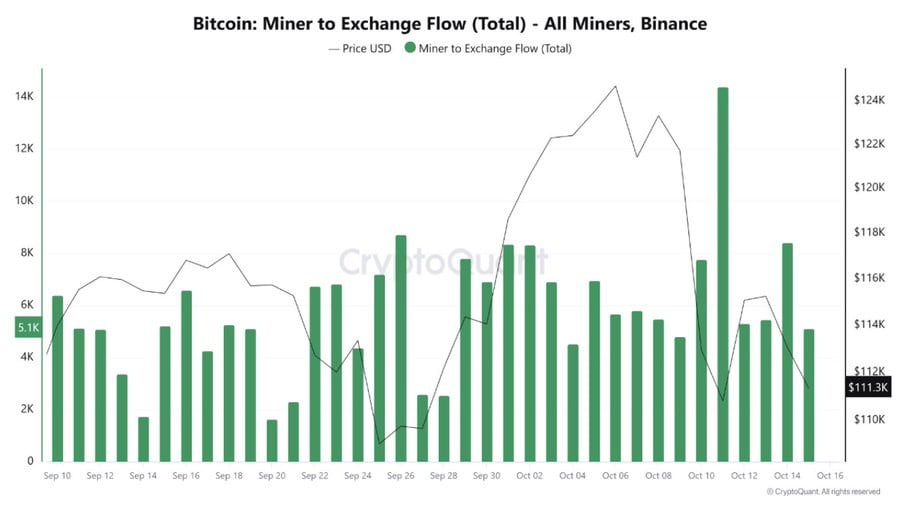
Chart reflecting the miner to exchange flow of $BTC.

Source: X/@Cryptoquant

That said, lower-cap altcoin opportunities are where savvy investors are redirecting their money. And it’s why Bitcoin Hyper ($HYPER) – a powerful Bitcoin Layer-2 scalability solution, currently in presale – is gaining strong traction among forward-looking investors.

Fixing Bitcoin’s Bottleneck – Bitcoin Hyper ($HYPER) Promises Near-Zero Fees and Instant Transactions

$BTC – the pioneer of cryptocurrencies and the spark that ignited the $3.78T revolution – remains the undisputed #1 digital asset, firmly holding its place at the top. However, its native blockchain, Bitcoin, ranks at #13 on CoinMarketCap, in terms of total value locked, far below its contemporaries like Ethereum and Solana.

Why hasn’t the Bitcoin blockchain kept pace with the dominance of its native coin? For starters, Bitcoin’s average throughput is just seven transactions per second (TPS), a stark contrast to Solana’s max theoretical TPS of 65.K. This makes it ill-equipped to handle high traffic volumes.

Additionally, confirmations can take over 10 minutes, and users often incur steep fees for everyday transactions.

That’s where Bitcoin Hyper ($HYPER) plans to step in with its all-in-one solution – a Layer-2 model featuring a canonical bridge and Solana Virtual Machine integration to fix all of Bitcoin’s ailments.

Bitcoin Hyper will enable super-fast transactions through parallel execution of decentralized applications, digital assets, and on-chain functionalities. The canonical bridge will mint your deposited $BTC onto Hyper’s Layer-2 as wrapped $BTC, which you can use for interacting with dApps.

➡ Discover more about Hyper’s Layer-2 solution in our comprehensive Bitcoin Hyper Review.
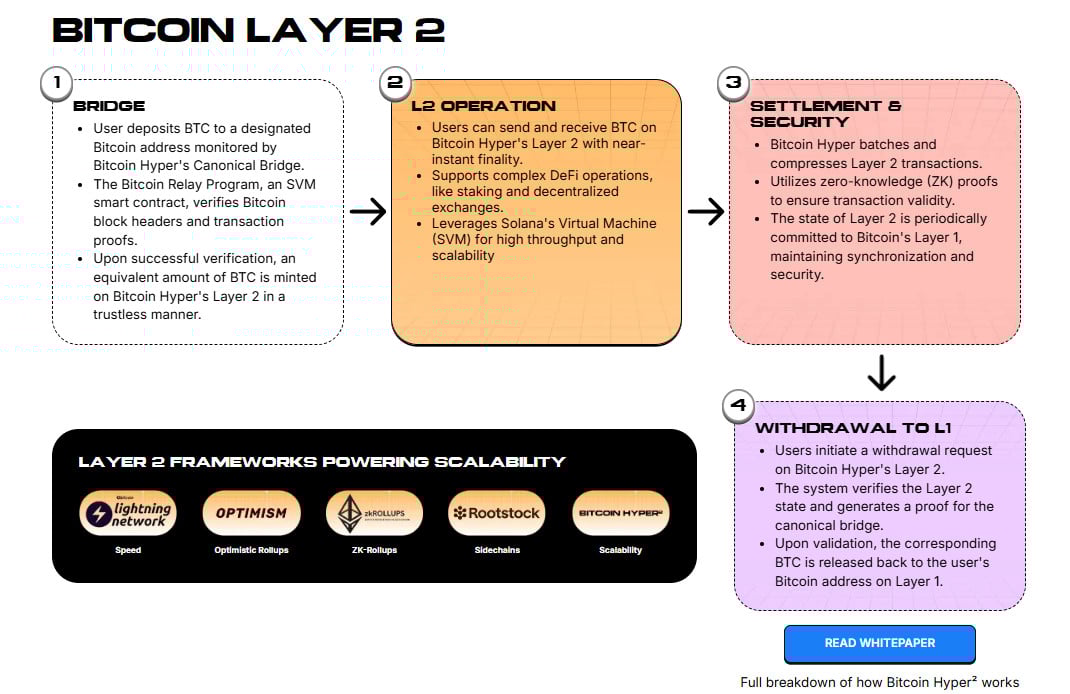
The Bitcoin Layer-2 operational mechanism explained.

💰 Investors’ growing conviction in this Layer-2 solution is reflected in its presale – the project has already raised $ 23.95M. Whales are also adding to Hyper’s kitty. We’re talking about the likes of $379.9K and other big buys.

Right now, $HYPER costs just $0.013125, and the dynamic staking APY is at 49%. However, our $HYPER price prediction believes this token has the potential to climb to $0.20 by year-end – a 1,424% gain from current levels.

➡ Ready to join the presale? Our step-by-step guide explains how to buy $HYPER.

Don’t forget, though, presale prices go up in stages, while the APY lowers as more holders stake their tokens. With the next price jump due later today and staking rewards waning by the minute, don’t just watch the market recover – be a part of it.

Grab your $HYPER tokens before the next price increase.

Disclaimer: The articles reposted on this site are sourced from public platforms and are provided for informational purposes only. They do not necessarily reflect the views of MEXC. All rights remain with the original authors. If you believe any content infringes on third-party rights, please contact service@support.mexc.com for removal. MEXC makes no guarantees regarding the accuracy, completeness, or timeliness of the content and is not responsible for any actions taken based on the information provided. The content does not constitute financial, legal, or other professional advice, nor should it be considered a recommendation or endorsement by MEXC.

You May Also Like

Akash Network’s Strategic Move: A Crucial Burn for AKT’s Future

Akash Network’s Strategic Move: A Crucial Burn for AKT’s Future

BitcoinWorld Akash Network’s Strategic Move: A Crucial Burn for AKT’s Future In the dynamic world of decentralized computing, exciting developments are constantly shaping the future. Today, all eyes are on Akash Network, the innovative supercloud project, as it proposes a significant change to its tokenomics. This move aims to strengthen the value of its native token, AKT, and further solidify its position in the competitive blockchain space. The community is buzzing about a newly submitted governance proposal that could introduce a game-changing Burn Mint Equilibrium (BME) model. What is the Burn Mint Equilibrium (BME) for Akash Network? The core of this proposal revolves around a concept called Burn Mint Equilibrium, or BME. Essentially, this model is designed to create a balance in the token’s circulating supply by systematically removing a portion of tokens from existence. For Akash Network, this means burning an amount of AKT that is equivalent to the U.S. dollar value of fees paid by network users. Fee Conversion: When users pay for cloud services on the Akash Network, these fees are typically collected in various cryptocurrencies or stablecoins. AKT Equivalence: The proposal suggests converting the U.S. dollar value of these collected fees into an equivalent amount of AKT. Token Burn: This calculated amount of AKT would then be permanently removed from circulation, or ‘burned’. This mechanism creates a direct link between network utility and token supply reduction. As more users utilize the decentralized supercloud, more AKT will be burned, potentially impacting the token’s scarcity and value. Why is This Proposal Crucial for AKT Holders? For anyone holding AKT, or considering investing in the Akash Network ecosystem, this proposal carries significant weight. Token burning mechanisms are often viewed as a positive development because they can lead to increased scarcity. When supply decreases while demand remains constant or grows, the price per unit tends to increase. Here are some key benefits: Increased Scarcity: Burning tokens reduces the total circulating supply of AKT. This makes each remaining token potentially more valuable over time. Demand-Supply Dynamics: The BME model directly ties the burning of AKT to network usage. Higher adoption of the Akash Network supercloud translates into more fees, and thus more AKT burned. Long-Term Value Proposition: By creating a deflationary pressure, the proposal aims to enhance AKT’s long-term value, making it a more attractive asset for investors and long-term holders. This strategic move demonstrates a commitment from the Akash Network community to optimize its tokenomics for sustainable growth and value appreciation. How Does BME Impact the Decentralized Supercloud Mission? Beyond token value, the BME proposal aligns perfectly with the broader mission of the Akash Network. As a decentralized supercloud, Akash provides a marketplace for cloud computing resources, allowing users to deploy applications faster, more efficiently, and at a lower cost than traditional providers. The BME model reinforces this utility. Consider these impacts: Network Health: A stronger AKT token can incentivize more validators and providers to secure and contribute resources to the network, improving its overall health and resilience. Ecosystem Growth: Enhanced token value can attract more developers and projects to build on the Akash Network, fostering a vibrant and diverse ecosystem. User Incentive: While users pay fees, the potential appreciation of AKT could indirectly benefit those who hold the token, creating a circular economy within the supercloud. This proposal is not just about burning tokens; it’s about building a more robust, self-sustaining, and economically sound decentralized cloud infrastructure for the future. What Are the Next Steps for the Akash Network Community? As a governance proposal, the BME model will now undergo a period of community discussion and voting. This is a crucial phase where AKT holders and network participants can voice their opinions, debate the merits, and ultimately decide on the future direction of the project. Transparency and community engagement are hallmarks of decentralized projects like Akash Network. Challenges and Considerations: Implementation Complexity: Ensuring the burning mechanism is technically sound and transparent will be vital. Community Consensus: Achieving broad agreement within the diverse Akash Network community is key for successful adoption. The outcome of this vote will significantly shape the tokenomics and economic model of the Akash Network, influencing its trajectory in the rapidly evolving decentralized cloud landscape. The proposal to introduce a Burn Mint Equilibrium model represents a bold and strategic step for Akash Network. By directly linking network usage to token scarcity, the project aims to create a more resilient and valuable AKT token, ultimately strengthening its position as a leading decentralized supercloud provider. This move underscores the project’s commitment to innovative tokenomics and sustainable growth, promising an exciting future for both users and investors in the Akash Network ecosystem. It’s a clear signal that Akash is actively working to enhance its value proposition and maintain its competitive edge in the decentralized future. Frequently Asked Questions (FAQs) 1. What is the main goal of the Burn Mint Equilibrium (BME) proposal for Akash Network? The primary goal is to adjust the circulating supply of AKT tokens by burning a portion of network fees, thereby creating deflationary pressure and potentially enhancing the token’s long-term value and scarcity. 2. How will the amount of AKT to be burned be determined? The proposal suggests burning an amount of AKT equivalent to the U.S. dollar value of fees paid by users on the Akash Network for cloud services. 3. What are the potential benefits for AKT token holders? Token holders could benefit from increased scarcity of AKT, which may lead to higher demand and appreciation in value over time, especially as network usage grows. 4. How does this proposal relate to the overall mission of Akash Network? The BME model reinforces the Akash Network‘s mission by creating a stronger, more economically robust ecosystem. A healthier token incentivizes network participants, fostering growth and stability for the decentralized supercloud. 5. What is the next step for this governance proposal? The proposal will undergo a period of community discussion and voting by AKT token holders. The community’s decision will determine if the BME model is implemented on the Akash Network. If you found this article insightful, consider sharing it with your network! Your support helps us bring more valuable insights into the world of decentralized technology. Stay informed and help spread the word about the exciting developments happening within Akash Network. To learn more about the latest crypto market trends, explore our article on key developments shaping decentralized cloud solutions price action. This post Akash Network’s Strategic Move: A Crucial Burn for AKT’s Future first appeared on BitcoinWorld.
Share
Coinstats2025/09/22 21:35