As the Bitcoin halving event approaches in 2024, the competitive landscape within the mining industry is shifting. Emerging middle-tier operators are closing the gap with established giants, intensifying the race for market share and operational efficiency. This evolving dynamic underscores the sector’s strategic investments, debt levels, and technological advancements as miners aim to capture the [...]As the Bitcoin halving event approaches in 2024, the competitive landscape within the mining industry is shifting. Emerging middle-tier operators are closing the gap with established giants, intensifying the race for market share and operational efficiency. This evolving dynamic underscores the sector’s strategic investments, debt levels, and technological advancements as miners aim to capture the [...]

Bitcoin Miners Enter Fierce Hash Wars Following 2024 Halving

Bitcoin Miners Enter Fierce Hash Wars Following 2024 Halving
As the Bitcoin halving event approaches in 2024, the competitive landscape within the mining industry is shifting. Emerging middle-tier operators are closing the gap with established giants, intensifying the race for market share and operational efficiency. This evolving dynamic underscores the sector’s strategic investments, debt levels, and technological advancements as miners aim to capture the growing interests in cryptocurrency and blockchain networks.
  • Mid-tier Bitcoin miners like Cipher Mining, Bitdeer, and HIVE Digital are rapidly increasing their realized hashrate, narrowing the gap with industry leaders such as MARA and CleanSpark.
  • The top public miners collectively achieved 326 exahashes per second (EH/s) of realized hashrate in September, more than doubling last year’s levels, now representing nearly one-third of Bitcoin’s total network hashrate.
  • Bitcoin mining firms are taking on unprecedented levels of debt—total sector debt has surged to $12.7 billion—to fund expansion into new hardware and AI-driven infrastructure.
  • Mining companies are diversifying revenues by investing in artificial intelligence and high-performance computing, aiming to offset reduced earnings post-2024 halving.

The Bitcoin mining sector is undergoing a significant transformation as industry players race to expand their operational capacity ahead of the 2024 halving. Companies such as Cipher Mining, Bitdeer, and HIVE Digital have accelerated their infrastructure development, significantly boosting their realized hashrate. Their growth is narrowing the gap with established industry leaders like MARA Holdings, CleanSpark, and Cango, signaling a more competitive landscape.

According to The Miner Mag’s latest Miner Weekly newsletter, the middle-tier miners are now rapidly scaling production, once trailing behind their larger counterparts. While giants MARA, CleanSpark, and Cango maintain their dominant positions, rivals including IREN, Cipher Mining, Bitdeer, and HIVE Digital posted substantial year-over-year increases in their realized hashrate, highlighting a sector-wide shift towards increased capacity and efficiency.

In total, the leading public miners achieved 326 EH/s of realized hashrate in September—more than twice the amount from the previous year. Collectively, these firms now account for nearly one-third of Bitcoin’s total network hashrate, emphasizing their growing influence in the ever-evolving blockchain ecosystem.

Year-over-year growth in realized hashrate. Source: The Miner Mag

Hashrate measures the total computational power securing the Bitcoin blockchain. Realized hashrate offers a more accurate reflection of on-chain performance, representing the rate of successfully mined valid blocks. For publicly traded miners, this metric serves as an essential indicator of operational efficiency and revenue potential, crucial ahead of third-quarter earnings reports.

As the competition heats up, Bitcoin miners are taking on record levels of debt—sector-wide debt has climbed to $12.7 billion from just $2.1 billion twelve months ago, according to research by VanEck. Miners are compelled to continually invest in advanced hardware to maintain their market share and prevent falling behind amid rising mining difficulty.
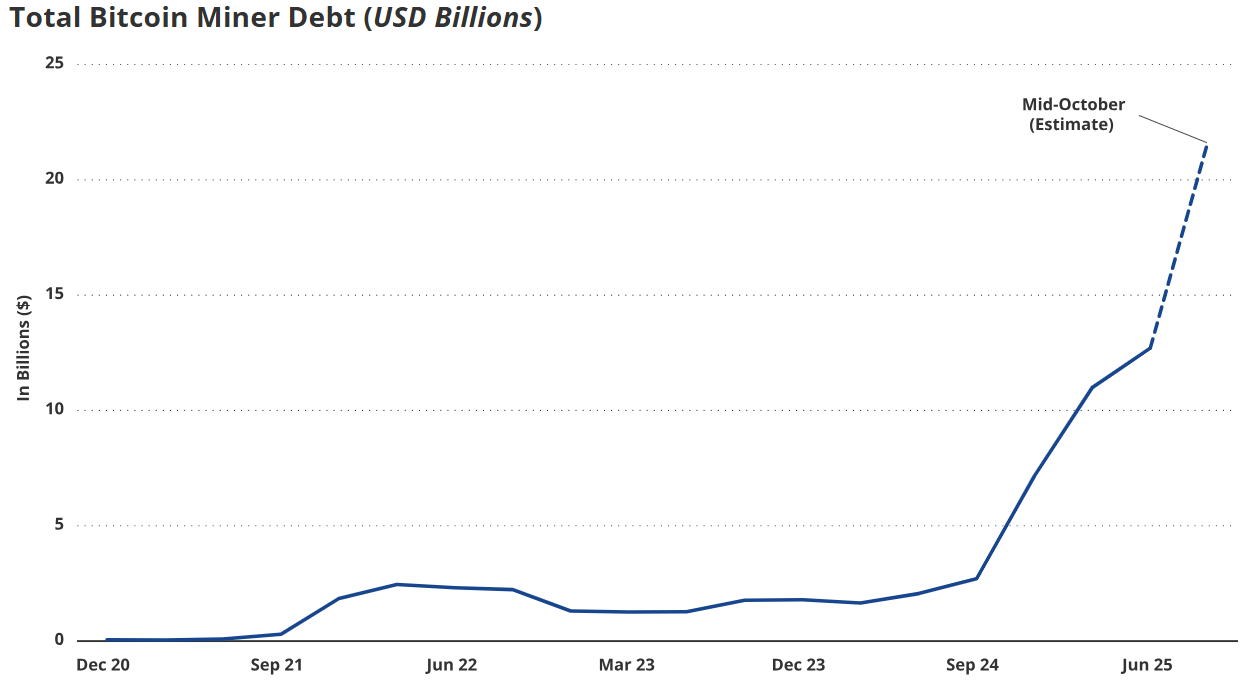
The growing debt of Bitcoin miners. Source: VanEck

Some mining companies are also diversifying their revenue streams by investing in artificial intelligence and high-performance computing workloads, aiming to offset shrinking margins following the halving. As the block reward drops to 3.125 BTC, these firms are exploring new markets in AI hardware and services to compensate for declining traditional income.

Overall, the sector’s aggressive expansion and technological innovation are set to play pivotal roles in shaping the future of cryptocurrency markets, blockchain security, and the broader adoption of decentralized finance (DeFi) and NFTs.

This article was originally published as Bitcoin Miners Enter Fierce Hash Wars Following 2024 Halving on Crypto Breaking News – your trusted source for crypto news, Bitcoin news, and blockchain updates.


Disclaimer: The articles reposted on this site are sourced from public platforms and are provided for informational purposes only. They do not necessarily reflect the views of MEXC. All rights remain with the original authors. If you believe any content infringes on third-party rights, please contact service@support.mexc.com for removal. MEXC makes no guarantees regarding the accuracy, completeness, or timeliness of the content and is not responsible for any actions taken based on the information provided. The content does not constitute financial, legal, or other professional advice, nor should it be considered a recommendation or endorsement by MEXC.

You May Also Like

Fundstrat’s Internal Report Contradicts CIO Tom Lee’s Bold Crypto Forecasts

Fundstrat’s Internal Report Contradicts CIO Tom Lee’s Bold Crypto Forecasts

The post Fundstrat’s Internal Report Contradicts CIO Tom Lee’s Bold Crypto Forecasts appeared on BitcoinEthereumNews.com. Key Points: Fundstrat internal report
Share
BitcoinEthereumNews2025/12/21 13:19
SEC Backs Nasdaq, CBOE, NYSE Push to Simplify Crypto ETF Rules

SEC Backs Nasdaq, CBOE, NYSE Push to Simplify Crypto ETF Rules

The US SEC on Wednesday approved new listing rules for major exchanges, paving the way for a surge of crypto spot exchange-traded funds. On Wednesday, the regulator voted to let Nasdaq, Cboe BZX and NYSE Arca adopt generic listing standards for commodity-based trust shares. The decision clears the final hurdle for asset managers seeking to launch spot ETFs tied to cryptocurrencies beyond Bitcoin and Ether. In July, the SEC outlined how exchanges could bring new products to market under the framework. Asset managers and exchanges must now meet specific criteria, but will no longer need to undergo drawn-out case-by-case reviews. Solana And XRP Funds Seen to Be First In Line Under the new system, the time from filing to launch can shrink to as little as 75 days, compared with up to 240 days or more under the old rules. “This is the crypto ETP framework we’ve been waiting for,” Bloomberg research analyst James Seyffart said on X, predicting a wave of new products in the coming months. The first filings likely to benefit are those tracking Solana and XRP, both of which have sat in limbo for more than a year. SEC Chair Paul Atkins said the approval reflects a commitment to reduce barriers and foster innovation while maintaining investor protections. The move comes under the administration of President Donald Trump, which has signaled strong support for digital assets after years of hesitation during the Biden era. New Standards Replace Lengthy Reviews And Repeated Denials Until now, the commission reviewed each application separately, requiring one filing from the exchange and another from the asset manager. This dual process often dragged on for months and led to repeated denials. Even Bitcoin spot ETFs, finally approved in Jan. 2024, arrived only after years of resistance and a legal battle with Grayscale. According to Bloomberg ETF analyst Eric Balchunas, the streamlined rules could apply to any cryptocurrency with at least six months of futures trading on the Coinbase Derivatives Exchange. That means more than a dozen tokens may now qualify for listing, potentially unleashing a new wave of altcoin ETFs. SEC Clears Grayscale Large Cap Fund Tracking CoinDesk 5 Index The SEC also approved the Grayscale Digital Large Cap Fund, which tracks the CoinDesk 5 Index, including Bitcoin, Ether, XRP, Solana and Cardano. Alongside this, it cleared the launch of options linked to the Cboe Bitcoin US ETF Index and its mini contract, broadening the set of crypto-linked derivatives on regulated US markets. Analysts say the shift shows how far US policy has moved. Where once regulators resisted digital assets, the latest changes show a growing willingness to bring them into the mainstream financial system under established safeguards
Share
CryptoNews2025/09/18 12:40
Bank of Canada cuts rate to 2.5% as tariffs and weak hiring hit economy

Bank of Canada cuts rate to 2.5% as tariffs and weak hiring hit economy

The Bank of Canada lowered its overnight rate to 2.5% on Wednesday, responding to mounting economic damage from US tariffs and a slowdown in hiring. The quarter-point cut was the first since March and met predictions from markets and economists. Governor Tiff Macklem, speaking in Ottawa, said the decision was unanimous. “With a weaker economy […]
Share
Cryptopolitan2025/09/17 23:09