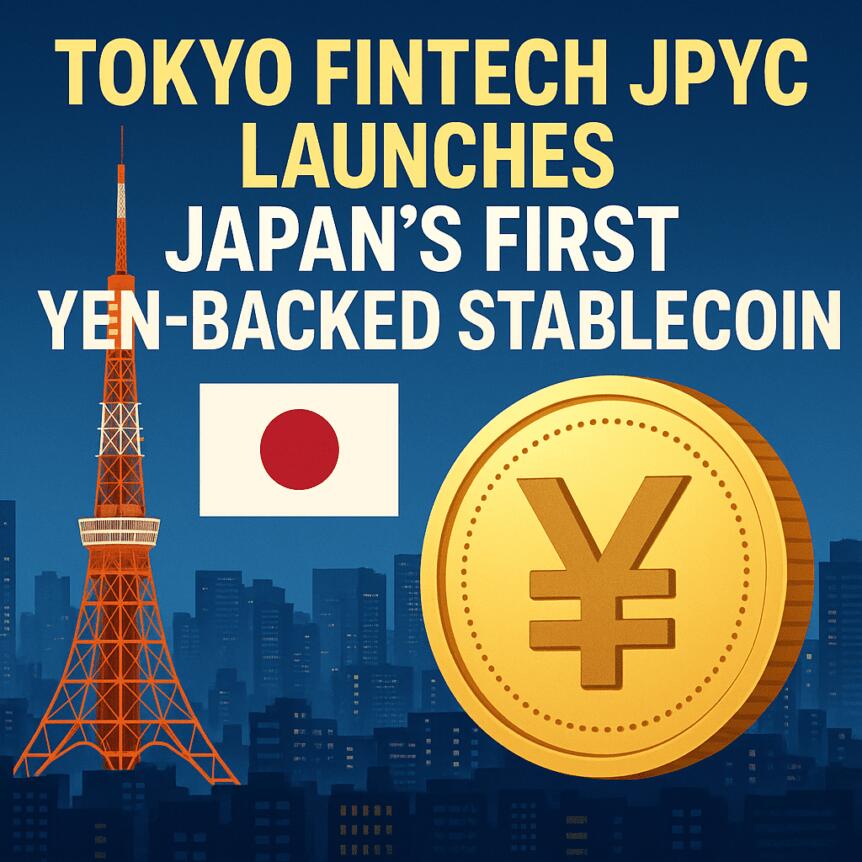
Tokyo’s fintech scene has made a significant leap forward with the launch of Japan’s first yen-backed stablecoin. Developed by JPYC, this new digital asset aims to bring greater stability and innovation to the country’s cryptocurrency ecosystem amid increasing global competition in the stablecoin market marked by dollar-pegged assets. As Japan embraces blockchain-based financial tools, additional [...]Tokyo’s fintech scene has made a significant leap forward with the launch of Japan’s first yen-backed stablecoin. Developed by JPYC, this new digital asset aims to bring greater stability and innovation to the country’s cryptocurrency ecosystem amid increasing global competition in the stablecoin market marked by dollar-pegged assets. As Japan embraces blockchain-based financial tools, additional [...]

Tokyo Fintech JPYC Launches Japan’s First Yen-Backed Stablecoin
For feedback or concerns regarding this content, please contact us at crypto.news@mexc.com
Tokyo Fintech Jpyc Launches Japan's First Yen-Backed Stablecoin
Tokyo’s fintech scene has made a significant leap forward with the launch of Japan’s first yen-backed stablecoin. Developed by JPYC, this new digital asset aims to bring greater stability and innovation to the country’s cryptocurrency ecosystem amid increasing global competition in the stablecoin market marked by dollar-pegged assets. As Japan embraces blockchain-based financial tools, additional initiatives and regulatory developments hint at a broader shift toward mainstream adoption of cryptocurrencies across the nation.
  • JPYC introduces Japan’s first yen-backed stablecoin, pegged 1:1 with the Japanese yen and backed by bank deposits and government bonds.
  • The stablecoin platform, JPYC EX, facilitates issuance and redemption, with strict compliance under anti-money laundering regulations.
  • Major Japanese financial institutions, including banks and the Monex Group, are exploring or planning to develop their own yen-pegged stablecoins.
  • Regulatory discussions are underway in Japan that could enable banks to hold cryptocurrencies like Bitcoin for investment purposes.
  • The stablecoin market in Japan is poised for further expansion, reflecting the nation’s commitment to integrating blockchain into its financial infrastructure.

Tokyo-based fintech innovator JPYC has officially launched Japan’s first yen-backed stablecoin, marking a new chapter for the country’s digital currency landscape. The stablecoin, which retains a 1:1 peg with the Japanese yen, is backed by liquid assets such as bank deposits and government bonds. The initiative is part of Japan’s broader efforts to advance blockchain and crypto-based payment solutions, positioning itself in a global market increasingly dominated by dollar-pegged stablecoins.

According to JPYC President Noriyoshi Okabe, the launch represents a “major milestone in the history of Japanese currency.” The company’s new offering has already garnered interest from seven firms interested in adopting the stablecoin for various use cases. The stablecoin is issued via JPYC’s dedicated platform, JPYC EX, which enforces strict identity and transaction verification measures in compliance with laws targeting anti-money laundering and the prevention of criminal proceeds.

The move follows a growing trend in the global stablecoin market, with dollar-pegged assets such as USDT and USDC dominating over $308 billion in market capitalization. Notably, USDC was also launched in Japan earlier this year, underscoring the country’s openness to stablecoins pegged to the yen or other fiat currencies. As digital assets gain acceptance, Japan’s financial ecosystem is seeing increased participation from both banking giants and non-bank entities regarding stablecoin development.

Stablecoin platform launch

Alongside the stablecoin, JPYC has introduced JPYC EX, a platform dedicated to issuing and redeeming the tokens. The platform emphasizes regulatory compliance, including adherence to the Act on Prevention of Transfer of Criminal Proceeds, ensuring transparency and security for users. Customers can deposit Japanese yen through bank transfers to receive JPYC in their digital wallets, with the ability to convert back to yen when desired.

Looking ahead, JPYC aims to reach an issuance volume of 10 trillion yen within three years, eyeing a transformative role in Japan’s social and financial infrastructure through stablecoins. The initiative signifies the country’s commitment to integrating blockchain solutions into everyday commerce and finance.

Potential competitors and regulatory outlook

Japan’s stablecoin scene could soon become more crowded. Monex Group, a prominent Tokyo-based financial services firm, announced plans to launch its own yen-pegged stablecoin. Additionally, major banks including Mitsubishi UFJ, Bank Sumitomo Mitsui, and Mizuho Bank are exploring joint efforts to issue a yen-backed stablecoin via MUFG’s platform, Progmat.

Meanwhile, regulatory authorities in Japan are considering updates that may allow banks to hold cryptocurrencies like Bitcoin for investment purposes. These developments indicate a proactive approach from regulators to foster innovation while ensuring compliance and security in the rapidly evolving crypto markets.

This article was originally published as Tokyo Fintech JPYC Launches Japan’s First Yen-Backed Stablecoin on Crypto Breaking News – your trusted source for crypto news, Bitcoin news, and blockchain updates.


Disclaimer: The articles reposted on this site are sourced from public platforms and are provided for informational purposes only. They do not necessarily reflect the views of MEXC. All rights remain with the original authors. If you believe any content infringes on third-party rights, please contact crypto.news@mexc.com for removal. MEXC makes no guarantees regarding the accuracy, completeness, or timeliness of the content and is not responsible for any actions taken based on the information provided. The content does not constitute financial, legal, or other professional advice, nor should it be considered a recommendation or endorsement by MEXC.

You May Also Like

Solana (SOL) Price Analysis: Can $80 Support Hold Against Mounting Pressure?

Solana (SOL) Price Analysis: Can $80 Support Hold Against Mounting Pressure?

Solana (SOL) price analysis: Testing $80 support with resistance at $85.50. ETF outflows return while RWA wallet count overtakes Ethereum for first time. The post
Share
Blockonomi2026/03/09 16:32
Saudi Awwal Bank Adopts Chainlink Tools, LINK Near $23

Saudi Awwal Bank Adopts Chainlink Tools, LINK Near $23

The post Saudi Awwal Bank Adopts Chainlink Tools, LINK Near $23 appeared on BitcoinEthereumNews.com. SAB adopts Chainlink’s CCIP and CRE to expand tokenization and cross-border finance tools. SAB and Wamid target $2.32T Saudi capital markets with blockchain-based tokenization plans. LINK price falls 2.43% to $22.99 despite higher trading volume and steady liquidity ratios. Saudi Awwal Bank has added Chainlink’s Cross-Chain Interoperability Protocol (CCIP) and the Chainlink Runtime Environment (CRE) to its digital strategy. CCIP links assets and data across multiple blockchains, while CRE provides banks with a controlled framework to test and deploy new financial applications. The lender, with more than $100 billion in assets, is applying the tools to tokenized assets, cross-border settlement, and automated credit platforms. The move signals that Chainlink’s infrastructure is being adopted at scale inside regulated finance. Related: Chainlink’s Deal with SBI Is a Major Win, But Chart Shows LINK’s Battle at $27 Resistance Wamid Partnership Aims at $2.32 Trillion Markets In parallel, SAB signed an agreement with Wamid, a subsidiary of the Saudi Tadawul Group, to pilot tokenization of the Saudi Exchange’s $2.32 trillion capital markets. The focus is on equities and debt products, opening the door for blockchain-based issuance and settlement. SAB has already executed the world’s first Islamic repo on distributed ledger technology, in collaboration with Oumla earlier this year. That transaction gave regulators a template for compliant on-chain contracts. The Wamid deal builds directly on that precedent, shifting from single-instrument pilots toward broader capital markets integration. Saudi Blockchain Buildout Gains Pace Saudi institutions are building multiple layers of digital infrastructure. Oumla is working with Avalanche to develop the Kingdom’s first domestically hosted Layer 1 blockchain. SAB’s Chainlink adoption adds an interoperability and execution layer on top. Together, these projects are shaping a domestic framework for tokenization, with global connectivity added only where liquidity requires it. LINK Price and Liquidity Snapshot While institutional adoption progresses, Chainlink’s…
Share
BitcoinEthereumNews2025/09/18 08:49
SOL Price Prediction: Targets $88-95 Recovery by End of March

SOL Price Prediction: Targets $88-95 Recovery by End of March

Solana trades at $83.09 with neutral RSI at 43.63. Technical analysis suggests SOL could target $88-95 by month-end if it breaks above $85 resistance, though bearish
Share
BlockChain News2026/03/09 16:03