The dollar’s dominance has long defined global finance. Yet as central banks trial crypto and AI reshape cross-border settlement, the system faces its first true structural test in decades. This shift could redefine how global liquidity and trust are priced. IMF COFER data place the dollar’s share of global reserves at 56.32% in early 2025 — the lowest since the euro’s birth. Meanwhile, 94% of monetary authorities are testing central-bank digital currencies. That signals diversification and digitalization of state money. AI’s arrival in financial infrastructure accelerates this shift. The Bank for International Settlements warns that autonomous trading and liquidity algorithms could magnify systemic risk. At the same time, new digital rails promise cheaper and faster transfers. Legacy networks built on the greenback are quietly eroding. Indicators of a Permanent Shift in Dollar Dominance BeInCrypto spoke with Dr. Alicia García-Herrero, Chief Economist for Asia-Pacific at Natixis and former IMF economist. Drawing on two decades of macro research, she explains how CBDCs, AI, and stablecoins may redraw global monetary power. She also outlines which metrics will reveal that pivot first. The dollar still anchors reserves, yet erosion has begun. COFER data show a steady slide since 2000. The question is no longer whether alternatives arise, but when the shift becomes measurable — a timeline investors can now watch in real time. Source: IMF COFER, Q2 2025 “From my IMF days analyzing COFER data, we tracked USD’s share of global FX reserves — now 56.32% in Q2 2025 — alongside RMB and EUR gains plus CBDC pilots where 94% of central banks are engaged. Crypto’s volatility could amplify AI-driven risks, as BIS warns. But CBDCs offer controlled shifts. I’d expect measurable erosion if USD dips below 55% by 2027, with $1B+ annual CBDC settlements signaling permanence. Stablecoins buttress dollar stability without wild swings.” Her threshold — a drop below 55% by 2027 plus billion-dollar CBDC flows — would mark a turning point for reserve structures. It shows when diversification stops being theory and becomes policy. Stablecoin Market Share and Emerging Bloc Risks Stablecoins remain an extension of dollar liquidity. Around 99% of circulation is USD-pegged, with USDT and USDC dominant. Non-dollar or commodity-backed tokens could spark bloc-based competition — a clear sign that liquidity may fragment along political lines. Source: Messari “USD-linked stablecoins like USDT and USDC command over 99% of the $300 billion market as of October 2025. A yuan-backed stablecoin hitting 10–15% share could ignite bloc tensions. Conflict only arises if it surpasses 20%, fracturing global liquidity.” García-Herrero argues that a rival stablecoin must capture over 20% of global settlements to trigger true bloc fragmentation. That marks the point where digital currencies start redrawing geopolitics, not just payments. On-chain settlement now tops $35 trillion annually — twice Visa’s throughput. Stablecore CEO Alex Treece calls it “a modern Eurodollar network” serving global USD demand beyond banks. It shows that digital rails still strengthen the dollar’s reach. IMF data show these tokens already handle about 8% of GDP-scale flows in Latin America and Africa. That proves stablecoins now act as informal policy instruments. “Stablecoins satisfy existing dollar demand. It’s market-driven, not state-driven. In the short term they reinforce dominance. In the long term, it depends on US policy and confidence.” Treece compares this digital-dollar system to the 1960s Eurodollar market, when offshore investors tapped US liquidity through parallel networks. Private innovation extended the dollar’s reach instead of replacing it. Stablecoins in High-Inflation Economies In inflation-hit economies like Argentina and Turkey, stablecoins serve as informal dollar rails. They act as a digital hedge against currency collapse and offer a parallel financial lifeline showing crypto’s real-world role. “In Argentina, stablecoins shield 5 million users and make up over 60% of crypto transactions. They become destabilizing at 20–25% of retail payments or 15% of FX turnover. In Turkey, similar adoption ranks it high globally. Overall, their stabilizing role outweighs risks at current levels.” Her rule of thumb: moderate use stabilizes. But when stablecoins exceed a quarter of payments, they threaten monetary sovereignty — the point where relief turns into risk. Tokenization and Sovereign Debt Tokenization has become a key theme in finance, though sovereign uptake lags. While BIS pilots move slowly, private firms advance faster. Franklin Templeton expects early adoption in treasuries and ETFs in Hong Kong, Japan, and Singapore. These pilots show where regulation and innovation already meet. “Institutions want vehicles that manage volatility and enhance liquidity. It starts with retail, but institutional flows follow once secondary markets mature.” — Max Gokhman, Franklin Templeton CoinGecko data show tokenized treasuries above $5.5 billion and stablecoins over $220 billion. The concept is shifting from pilot to practice as traditional assets quietly migrate on-chain. “RWA tokenization’s trillions-by-2030 projections feel ambitious, but tokenized bonds have already hit $8 billion by mid-2025. I foresee 5% of new sovereign issuance by 2028, led by Asia and Europe, while USD resilience will persist.” Her projection — 5% of sovereign issuance tokenized by 2028 — signals gradual reform led by Asia and Europe. It complements rather than replaces the dollar system. Digital finance often evolves through compliance, not rebellion. Both public and private efforts are converging. García-Herrero expects regulator-led uptake, while Franklin Templeton bets on market pull. Either way, traditional assets are migrating to blockchain rails — one bond and one fund at a time. China’s e-CNY and State-Led Crypto China’s e-CNY continues to expand under tight central control. By mid-2025 it had handled 7 trillion yuan in transactions. This shows Beijing’s ability to digitize money without private crypto and how centralized ecosystems can scale quickly. Study Times, the Central Party School’s journal, frames crypto and CBDCs as tools of “financial mobilization.” Beijing’s digital yuan and blockchain networks serve as strategic assets for liquidity control and sanction resilience — a “digital logistics front” merging finance and security. “China’s e-CNY exemplifies disciplined digital finance. It processed 7 trillion RMB by June 2025. A fully state-led model emerges when private blockchain FDI falls below 10% of fintech inflows. By late 2026, we’ll see clear dominance.” She defines state-led dominance as private blockchain investment under 10% of fintech inflows. That level may arrive by late 2026, when digital sovereignty becomes measurable, not rhetorical. Russia–China Trade and the “State-Led Web3 Bloc” Facing sanctions, Russia and China now settle most trade outside the dollar system. Their digital-asset experiments raise the question of when coordination becomes a formal bloc — a turning point that could reshape settlement geography. “Russia’s 2025 legalization of crypto for foreign trade, with non-USD/EUR flows now over 90% in yuan and ruble, shows how a ‘state-led Web3 bloc’ could emerge if 50% of trade shifts to digital assets. CBDC bridges might mitigate risk, and ironically, USD-pegged stablecoins could stabilize such flows.” Her 50% benchmark defines the threshold for a new clearing sphere. It could stabilize sanctioned trade yet deepen global fragmentation. Europe has already reacted. The EU’s recent ban on a ruble-backed stablecoin, A7A5, marked its first direct crypto sanction. It showed how digital assets have become both weapon and target in financial conflict. Proof of Personhood and Financial Inclusion Proof-of-Personhood systems like Worldcoin’s biometric model are reframing debates on identity and inclusion. Their economic value remains unproven, yet scalability could shape how fast AI-age trust frameworks evolve. “Proof-of-Personhood pilots like Worldcoin, with 200 million identities verified by mid-2025, could cut borrowing costs by 50–100 basis points or lift capital access by 20–30%. If achieved by 2027, it would validate PoP beyond hype.” The debate mirrors the wider digital-identity race. TFH’s Adrian Ludwig sees proof-of-human systems as a trust layer for an AI age. García-Herrero says only measurable impact will prove their worth. AI and Crypto Cross-Border Trade Dominance AI-driven finance now shapes liquidity, compliance, and settlement. The BIS says machine-learning copilots already automate AML reviews. Project Pine smart contracts let central banks adjust collateral in real time, signaling programmable compliance’s rise. BIS frames this as a programmable yet regulated financial core. Speculative outlooks like AI 2027 imagine AI systems directing liquidity, R&D, markets, and security policy. BIS calls for integrity-by-design before such systems fully emerge. “AI’s cross-border edge will surge, with 75% of payments becoming instant by 2027. China seems poised for over 30% share through state-backed sandboxes and nearly $100 billion in investments. Stablecoins could complement AI agents, curbing volatility.” Investments nearing $100 billion by 2027 favor that model. Stablecoins may serve as compliant, tokenized layers linking automated liquidity to programmable money — the next battleground for regulators. Sovereign Bitcoin Reserves and Resource Bottlenecks Bitcoin’s share in sovereign reserves remains small yet symbolic. Its link to risk assets and reliance on energy and chips may create new geopolitical choke points. Digital reserves could soon tie to physical supply chains. “Sovereign Bitcoin reserves remain under 1% of total FX. Hitting 5% by 2030 would spark a volatile ‘digital gold race.’ Energy and semiconductor supply could become choke points, while stablecoins offer a steadier reserve alternative.” Meanwhile, digital-asset treasury (DAT) firms manage over $100 billion in crypto, revealing how fragile balance sheets can mirror sovereign risk. Bitcoin-focused treasuries with strict liquidity buffers appear most resilient — a preview of challenges nations may face as adoption rises. Transparency of Crypto and Governance Advantage Public blockchains are entering government registries and procurement systems. For democracies, transparent ledgers offer accountability that directly strengthens fiscal credibility. “Blockchain procurement pilots boost transparency in democracies like Estonia, with government adoption markets jumping from $22.5 billion in 2024 to nearly $800 billion by 2030. At 15–20% of national spend on-chain, democracies gain a structural edge.” Her 15–20% benchmark marks the point when blockchain adoption becomes structural. It raises transparency scores and gives open societies a governance advantage. Conclusion Across ten domains — CBDCs, AI, stablecoins, tokenization, and blockchain — García-Herrero’s framework suggests evolution, not revolution. The dollar’s reach is diffusing, not disappearing, as digital money turns monetary power into a shared, data-driven system. Her analysis grounds speculation in measurable data: reserve ratios, settlement flows, and adoption thresholds. The future monetary order will hinge less on disruption than on governance — how transparency, trust, and control align in the digital age.The dollar’s dominance has long defined global finance. Yet as central banks trial crypto and AI reshape cross-border settlement, the system faces its first true structural test in decades. This shift could redefine how global liquidity and trust are priced. IMF COFER data place the dollar’s share of global reserves at 56.32% in early 2025 — the lowest since the euro’s birth. Meanwhile, 94% of monetary authorities are testing central-bank digital currencies. That signals diversification and digitalization of state money. AI’s arrival in financial infrastructure accelerates this shift. The Bank for International Settlements warns that autonomous trading and liquidity algorithms could magnify systemic risk. At the same time, new digital rails promise cheaper and faster transfers. Legacy networks built on the greenback are quietly eroding. Indicators of a Permanent Shift in Dollar Dominance BeInCrypto spoke with Dr. Alicia García-Herrero, Chief Economist for Asia-Pacific at Natixis and former IMF economist. Drawing on two decades of macro research, she explains how CBDCs, AI, and stablecoins may redraw global monetary power. She also outlines which metrics will reveal that pivot first. The dollar still anchors reserves, yet erosion has begun. COFER data show a steady slide since 2000. The question is no longer whether alternatives arise, but when the shift becomes measurable — a timeline investors can now watch in real time. Source: IMF COFER, Q2 2025 “From my IMF days analyzing COFER data, we tracked USD’s share of global FX reserves — now 56.32% in Q2 2025 — alongside RMB and EUR gains plus CBDC pilots where 94% of central banks are engaged. Crypto’s volatility could amplify AI-driven risks, as BIS warns. But CBDCs offer controlled shifts. I’d expect measurable erosion if USD dips below 55% by 2027, with $1B+ annual CBDC settlements signaling permanence. Stablecoins buttress dollar stability without wild swings.” Her threshold — a drop below 55% by 2027 plus billion-dollar CBDC flows — would mark a turning point for reserve structures. It shows when diversification stops being theory and becomes policy. Stablecoin Market Share and Emerging Bloc Risks Stablecoins remain an extension of dollar liquidity. Around 99% of circulation is USD-pegged, with USDT and USDC dominant. Non-dollar or commodity-backed tokens could spark bloc-based competition — a clear sign that liquidity may fragment along political lines. Source: Messari “USD-linked stablecoins like USDT and USDC command over 99% of the $300 billion market as of October 2025. A yuan-backed stablecoin hitting 10–15% share could ignite bloc tensions. Conflict only arises if it surpasses 20%, fracturing global liquidity.” García-Herrero argues that a rival stablecoin must capture over 20% of global settlements to trigger true bloc fragmentation. That marks the point where digital currencies start redrawing geopolitics, not just payments. On-chain settlement now tops $35 trillion annually — twice Visa’s throughput. Stablecore CEO Alex Treece calls it “a modern Eurodollar network” serving global USD demand beyond banks. It shows that digital rails still strengthen the dollar’s reach. IMF data show these tokens already handle about 8% of GDP-scale flows in Latin America and Africa. That proves stablecoins now act as informal policy instruments. “Stablecoins satisfy existing dollar demand. It’s market-driven, not state-driven. In the short term they reinforce dominance. In the long term, it depends on US policy and confidence.” Treece compares this digital-dollar system to the 1960s Eurodollar market, when offshore investors tapped US liquidity through parallel networks. Private innovation extended the dollar’s reach instead of replacing it. Stablecoins in High-Inflation Economies In inflation-hit economies like Argentina and Turkey, stablecoins serve as informal dollar rails. They act as a digital hedge against currency collapse and offer a parallel financial lifeline showing crypto’s real-world role. “In Argentina, stablecoins shield 5 million users and make up over 60% of crypto transactions. They become destabilizing at 20–25% of retail payments or 15% of FX turnover. In Turkey, similar adoption ranks it high globally. Overall, their stabilizing role outweighs risks at current levels.” Her rule of thumb: moderate use stabilizes. But when stablecoins exceed a quarter of payments, they threaten monetary sovereignty — the point where relief turns into risk. Tokenization and Sovereign Debt Tokenization has become a key theme in finance, though sovereign uptake lags. While BIS pilots move slowly, private firms advance faster. Franklin Templeton expects early adoption in treasuries and ETFs in Hong Kong, Japan, and Singapore. These pilots show where regulation and innovation already meet. “Institutions want vehicles that manage volatility and enhance liquidity. It starts with retail, but institutional flows follow once secondary markets mature.” — Max Gokhman, Franklin Templeton CoinGecko data show tokenized treasuries above $5.5 billion and stablecoins over $220 billion. The concept is shifting from pilot to practice as traditional assets quietly migrate on-chain. “RWA tokenization’s trillions-by-2030 projections feel ambitious, but tokenized bonds have already hit $8 billion by mid-2025. I foresee 5% of new sovereign issuance by 2028, led by Asia and Europe, while USD resilience will persist.” Her projection — 5% of sovereign issuance tokenized by 2028 — signals gradual reform led by Asia and Europe. It complements rather than replaces the dollar system. Digital finance often evolves through compliance, not rebellion. Both public and private efforts are converging. García-Herrero expects regulator-led uptake, while Franklin Templeton bets on market pull. Either way, traditional assets are migrating to blockchain rails — one bond and one fund at a time. China’s e-CNY and State-Led Crypto China’s e-CNY continues to expand under tight central control. By mid-2025 it had handled 7 trillion yuan in transactions. This shows Beijing’s ability to digitize money without private crypto and how centralized ecosystems can scale quickly. Study Times, the Central Party School’s journal, frames crypto and CBDCs as tools of “financial mobilization.” Beijing’s digital yuan and blockchain networks serve as strategic assets for liquidity control and sanction resilience — a “digital logistics front” merging finance and security. “China’s e-CNY exemplifies disciplined digital finance. It processed 7 trillion RMB by June 2025. A fully state-led model emerges when private blockchain FDI falls below 10% of fintech inflows. By late 2026, we’ll see clear dominance.” She defines state-led dominance as private blockchain investment under 10% of fintech inflows. That level may arrive by late 2026, when digital sovereignty becomes measurable, not rhetorical. Russia–China Trade and the “State-Led Web3 Bloc” Facing sanctions, Russia and China now settle most trade outside the dollar system. Their digital-asset experiments raise the question of when coordination becomes a formal bloc — a turning point that could reshape settlement geography. “Russia’s 2025 legalization of crypto for foreign trade, with non-USD/EUR flows now over 90% in yuan and ruble, shows how a ‘state-led Web3 bloc’ could emerge if 50% of trade shifts to digital assets. CBDC bridges might mitigate risk, and ironically, USD-pegged stablecoins could stabilize such flows.” Her 50% benchmark defines the threshold for a new clearing sphere. It could stabilize sanctioned trade yet deepen global fragmentation. Europe has already reacted. The EU’s recent ban on a ruble-backed stablecoin, A7A5, marked its first direct crypto sanction. It showed how digital assets have become both weapon and target in financial conflict. Proof of Personhood and Financial Inclusion Proof-of-Personhood systems like Worldcoin’s biometric model are reframing debates on identity and inclusion. Their economic value remains unproven, yet scalability could shape how fast AI-age trust frameworks evolve. “Proof-of-Personhood pilots like Worldcoin, with 200 million identities verified by mid-2025, could cut borrowing costs by 50–100 basis points or lift capital access by 20–30%. If achieved by 2027, it would validate PoP beyond hype.” The debate mirrors the wider digital-identity race. TFH’s Adrian Ludwig sees proof-of-human systems as a trust layer for an AI age. García-Herrero says only measurable impact will prove their worth. AI and Crypto Cross-Border Trade Dominance AI-driven finance now shapes liquidity, compliance, and settlement. The BIS says machine-learning copilots already automate AML reviews. Project Pine smart contracts let central banks adjust collateral in real time, signaling programmable compliance’s rise. BIS frames this as a programmable yet regulated financial core. Speculative outlooks like AI 2027 imagine AI systems directing liquidity, R&D, markets, and security policy. BIS calls for integrity-by-design before such systems fully emerge. “AI’s cross-border edge will surge, with 75% of payments becoming instant by 2027. China seems poised for over 30% share through state-backed sandboxes and nearly $100 billion in investments. Stablecoins could complement AI agents, curbing volatility.” Investments nearing $100 billion by 2027 favor that model. Stablecoins may serve as compliant, tokenized layers linking automated liquidity to programmable money — the next battleground for regulators. Sovereign Bitcoin Reserves and Resource Bottlenecks Bitcoin’s share in sovereign reserves remains small yet symbolic. Its link to risk assets and reliance on energy and chips may create new geopolitical choke points. Digital reserves could soon tie to physical supply chains. “Sovereign Bitcoin reserves remain under 1% of total FX. Hitting 5% by 2030 would spark a volatile ‘digital gold race.’ Energy and semiconductor supply could become choke points, while stablecoins offer a steadier reserve alternative.” Meanwhile, digital-asset treasury (DAT) firms manage over $100 billion in crypto, revealing how fragile balance sheets can mirror sovereign risk. Bitcoin-focused treasuries with strict liquidity buffers appear most resilient — a preview of challenges nations may face as adoption rises. Transparency of Crypto and Governance Advantage Public blockchains are entering government registries and procurement systems. For democracies, transparent ledgers offer accountability that directly strengthens fiscal credibility. “Blockchain procurement pilots boost transparency in democracies like Estonia, with government adoption markets jumping from $22.5 billion in 2024 to nearly $800 billion by 2030. At 15–20% of national spend on-chain, democracies gain a structural edge.” Her 15–20% benchmark marks the point when blockchain adoption becomes structural. It raises transparency scores and gives open societies a governance advantage. Conclusion Across ten domains — CBDCs, AI, stablecoins, tokenization, and blockchain — García-Herrero’s framework suggests evolution, not revolution. The dollar’s reach is diffusing, not disappearing, as digital money turns monetary power into a shared, data-driven system. Her analysis grounds speculation in measurable data: reserve ratios, settlement flows, and adoption thresholds. The future monetary order will hinge less on disruption than on governance — how transparency, trust, and control align in the digital age.

Is the Dollar Losing Its Crown? How AI and Crypto Are Rewiring Global Finance

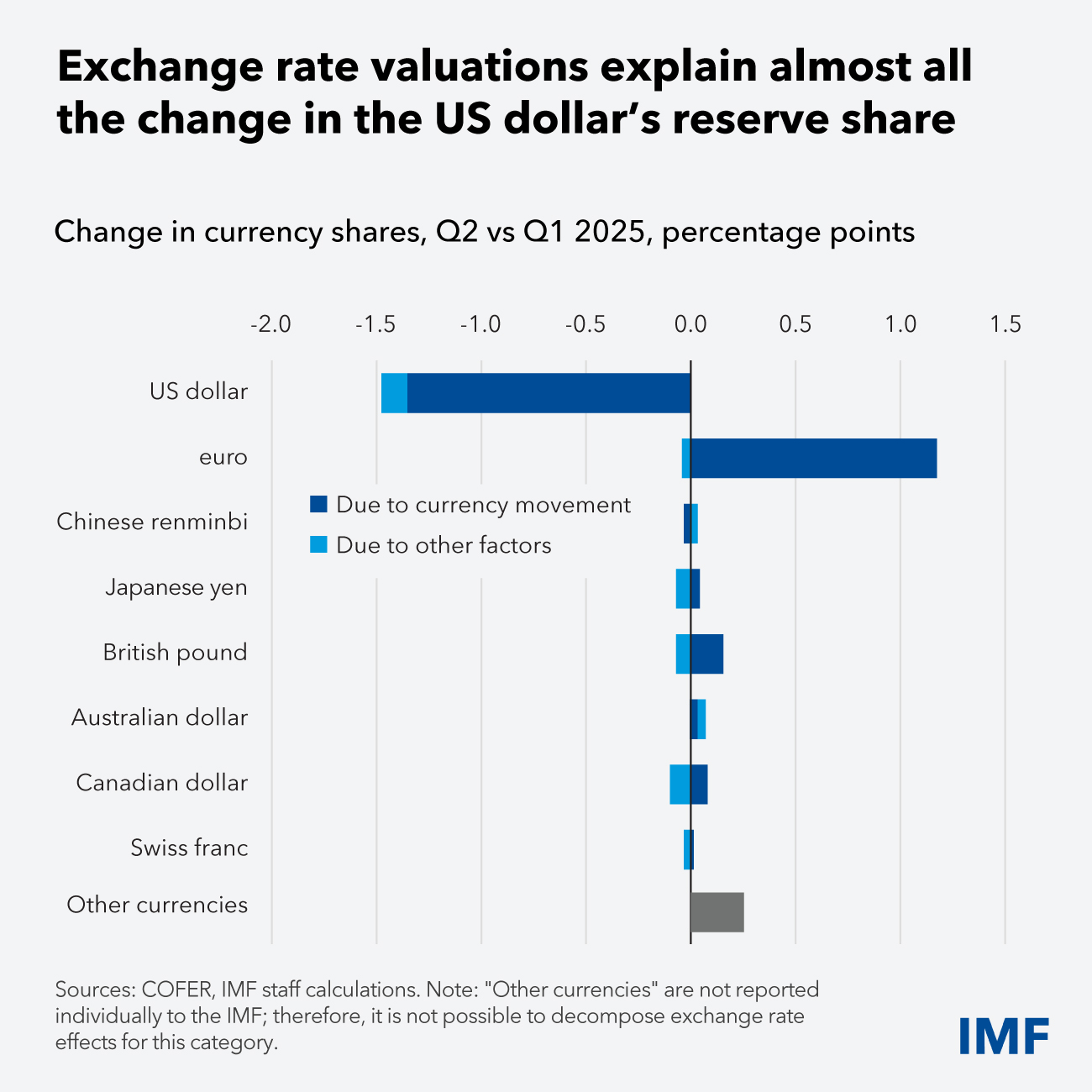
The dollar’s dominance has long defined global finance. Yet as central banks trial crypto and AI reshape cross-border settlement, the system faces its first true structural test in decades. This shift could redefine how global liquidity and trust are priced. IMF COFER data place the dollar’s share of global reserves at 56.32% in early 2025 — the lowest since the euro’s birth. Meanwhile, 94% of monetary authorities are testing central-bank digital currencies. That signals diversification and digitalization of state money.

AI’s arrival in financial infrastructure accelerates this shift. The Bank for International Settlements warns that autonomous trading and liquidity algorithms could magnify systemic risk. At the same time, new digital rails promise cheaper and faster transfers. Legacy networks built on the greenback are quietly eroding.

Indicators of a Permanent Shift in Dollar Dominance

BeInCrypto spoke with Dr. Alicia García-Herrero, Chief Economist for Asia-Pacific at Natixis and former IMF economist. Drawing on two decades of macro research, she explains how CBDCs, AI, and stablecoins may redraw global monetary power. She also outlines which metrics will reveal that pivot first.

The dollar still anchors reserves, yet erosion has begun. COFER data show a steady slide since 2000. The question is no longer whether alternatives arise, but when the shift becomes measurable — a timeline investors can now watch in real time.
Source: IMF COFER, Q2 2025

Her threshold — a drop below 55% by 2027 plus billion-dollar CBDC flows — would mark a turning point for reserve structures. It shows when diversification stops being theory and becomes policy.

Stablecoin Market Share and Emerging Bloc Risks

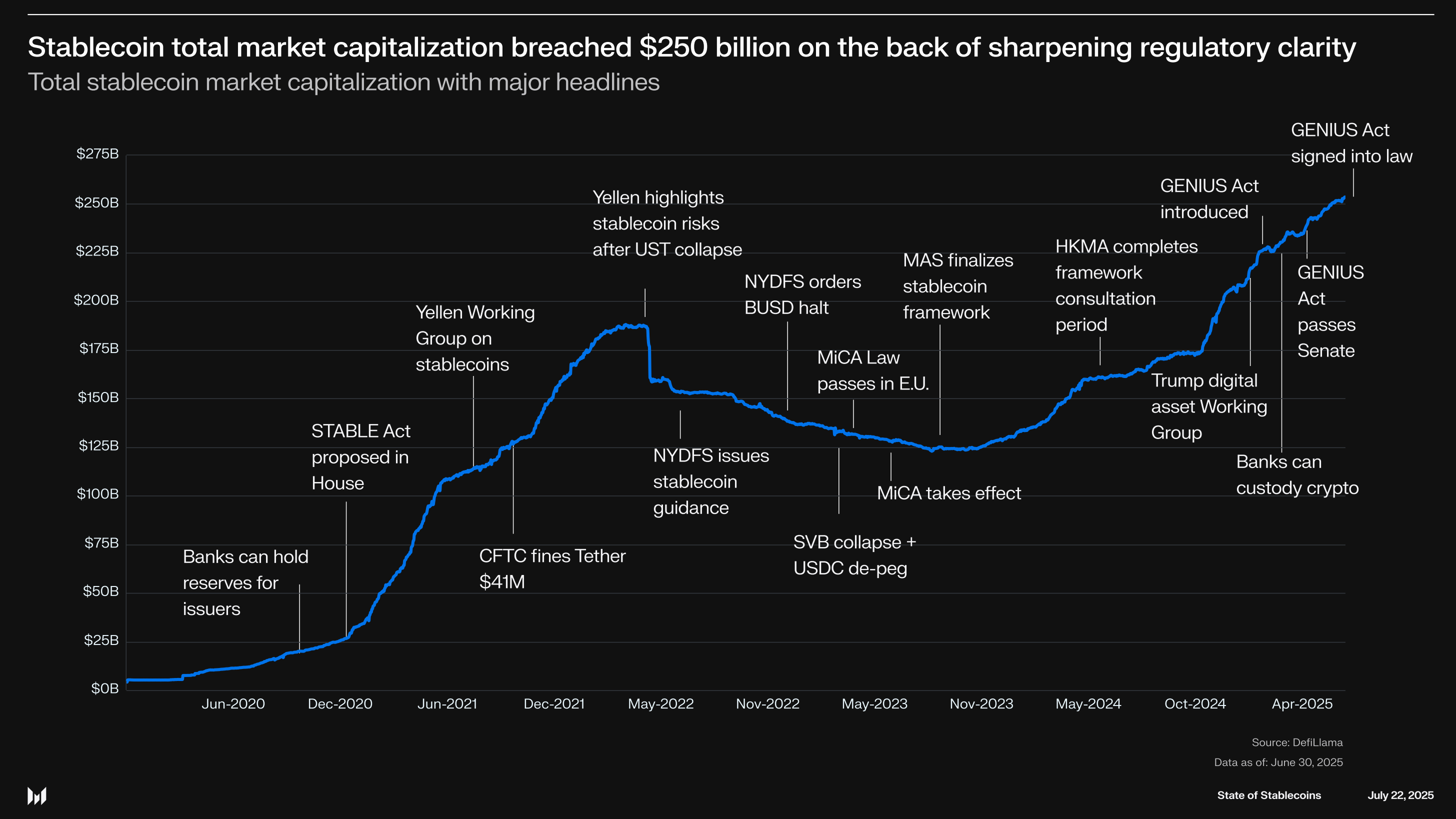
Stablecoins remain an extension of dollar liquidity. Around 99% of circulation is USD-pegged, with USDT and USDC dominant. Non-dollar or commodity-backed tokens could spark bloc-based competition — a clear sign that liquidity may fragment along political lines.
Source: Messari

García-Herrero argues that a rival stablecoin must capture over 20% of global settlements to trigger true bloc fragmentation. That marks the point where digital currencies start redrawing geopolitics, not just payments.

On-chain settlement now tops $35 trillion annually — twice Visa’s throughput. Stablecore CEO Alex Treece calls it “a modern Eurodollar network” serving global USD demand beyond banks. It shows that digital rails still strengthen the dollar’s reach.

IMF data show these tokens already handle about 8% of GDP-scale flows in Latin America and Africa. That proves stablecoins now act as informal policy instruments.

Treece compares this digital-dollar system to the 1960s Eurodollar market, when offshore investors tapped US liquidity through parallel networks. Private innovation extended the dollar’s reach instead of replacing it.

Stablecoins in High-Inflation Economies

In inflation-hit economies like Argentina and Turkey, stablecoins serve as informal dollar rails. They act as a digital hedge against currency collapse and offer a parallel financial lifeline showing crypto’s real-world role.

Her rule of thumb: moderate use stabilizes. But when stablecoins exceed a quarter of payments, they threaten monetary sovereignty — the point where relief turns into risk.

Tokenization and Sovereign Debt

Tokenization has become a key theme in finance, though sovereign uptake lags. While BIS pilots move slowly, private firms advance faster. Franklin Templeton expects early adoption in treasuries and ETFs in Hong Kong, Japan, and Singapore. These pilots show where regulation and innovation already meet.

CoinGecko data show tokenized treasuries above $5.5 billion and stablecoins over $220 billion. The concept is shifting from pilot to practice as traditional assets quietly migrate on-chain.

Her projection — 5% of sovereign issuance tokenized by 2028 — signals gradual reform led by Asia and Europe. It complements rather than replaces the dollar system. Digital finance often evolves through compliance, not rebellion.

Both public and private efforts are converging. García-Herrero expects regulator-led uptake, while Franklin Templeton bets on market pull. Either way, traditional assets are migrating to blockchain rails — one bond and one fund at a time.

China’s e-CNY and State-Led Crypto

China’s e-CNY continues to expand under tight central control. By mid-2025 it had handled 7 trillion yuan in transactions. This shows Beijing’s ability to digitize money without private crypto and how centralized ecosystems can scale quickly.

Study Times, the Central Party School’s journal, frames crypto and CBDCs as tools of “financial mobilization.” Beijing’s digital yuan and blockchain networks serve as strategic assets for liquidity control and sanction resilience — a “digital logistics front” merging finance and security.

She defines state-led dominance as private blockchain investment under 10% of fintech inflows. That level may arrive by late 2026, when digital sovereignty becomes measurable, not rhetorical.

Russia–China Trade and the “State-Led Web3 Bloc”

Facing sanctions, Russia and China now settle most trade outside the dollar system. Their digital-asset experiments raise the question of when coordination becomes a formal bloc — a turning point that could reshape settlement geography.

Her 50% benchmark defines the threshold for a new clearing sphere. It could stabilize sanctioned trade yet deepen global fragmentation.

Europe has already reacted. The EU’s recent ban on a ruble-backed stablecoin, A7A5, marked its first direct crypto sanction. It showed how digital assets have become both weapon and target in financial conflict.

Proof of Personhood and Financial Inclusion

Proof-of-Personhood systems like Worldcoin’s biometric model are reframing debates on identity and inclusion. Their economic value remains unproven, yet scalability could shape how fast AI-age trust frameworks evolve.

The debate mirrors the wider digital-identity race. TFH’s Adrian Ludwig sees proof-of-human systems as a trust layer for an AI age. García-Herrero says only measurable impact will prove their worth.

AI and Crypto Cross-Border Trade Dominance

AI-driven finance now shapes liquidity, compliance, and settlement. The BIS says machine-learning copilots already automate AML reviews. Project Pine smart contracts let central banks adjust collateral in real time, signaling programmable compliance’s rise.

BIS frames this as a programmable yet regulated financial core. Speculative outlooks like AI 2027 imagine AI systems directing liquidity, R&D, markets, and security policy. BIS calls for integrity-by-design before such systems fully emerge.

Investments nearing $100 billion by 2027 favor that model. Stablecoins may serve as compliant, tokenized layers linking automated liquidity to programmable money — the next battleground for regulators.

Sovereign Bitcoin Reserves and Resource Bottlenecks

Bitcoin’s share in sovereign reserves remains small yet symbolic. Its link to risk assets and reliance on energy and chips may create new geopolitical choke points. Digital reserves could soon tie to physical supply chains.

Meanwhile, digital-asset treasury (DAT) firms manage over $100 billion in crypto, revealing how fragile balance sheets can mirror sovereign risk. Bitcoin-focused treasuries with strict liquidity buffers appear most resilient — a preview of challenges nations may face as adoption rises.

Transparency of Crypto and Governance Advantage

Public blockchains are entering government registries and procurement systems. For democracies, transparent ledgers offer accountability that directly strengthens fiscal credibility.

Her 15–20% benchmark marks the point when blockchain adoption becomes structural. It raises transparency scores and gives open societies a governance advantage.

Conclusion

Across ten domains — CBDCs, AI, stablecoins, tokenization, and blockchain — García-Herrero’s framework suggests evolution, not revolution. The dollar’s reach is diffusing, not disappearing, as digital money turns monetary power into a shared, data-driven system.

Her analysis grounds speculation in measurable data: reserve ratios, settlement flows, and adoption thresholds. The future monetary order will hinge less on disruption than on governance — how transparency, trust, and control align in the digital age.


Market Opportunity
CROWN Logo
CROWN Price(CROWN)
--
----
USD
CROWN (CROWN) Live Price Chart
Disclaimer: The articles reposted on this site are sourced from public platforms and are provided for informational purposes only. They do not necessarily reflect the views of MEXC. All rights remain with the original authors. If you believe any content infringes on third-party rights, please contact service@support.mexc.com for removal. MEXC makes no guarantees regarding the accuracy, completeness, or timeliness of the content and is not responsible for any actions taken based on the information provided. The content does not constitute financial, legal, or other professional advice, nor should it be considered a recommendation or endorsement by MEXC.

You May Also Like

Bitcoin Has Taken Gold’s Role In Today’s World, Eric Trump Says

Bitcoin Has Taken Gold’s Role In Today’s World, Eric Trump Says

Eric Trump on Tuesday described Bitcoin as a “modern-day gold,” calling it a liquid store of value that can act as a hedge to real estate and other assets. Related Reading: XRP’s Biggest Rally Yet? Analyst Projects $20+ In October 2025 According to reports, the remark came during a TV appearance on CNBC’s Squawk Box, tied to the launch of American Bitcoin, the mining and treasury firm he helped start. Company Holdings And Strategy Based on public filings and company summaries, American Bitcoin has accumulated 2,443 BTC on its balance sheet. That stash has been valued in the low hundreds of millions of dollars at recent spot prices. The firm mixes large-scale mining with the goal of holding Bitcoin as a strategic reserve, which it says will help it grow both production and asset holdings over time. Eric Trump’s comments were direct. He told viewers that institutions are treating Bitcoin more like a store of value than a fringe idea, and he warned firms that resist blockchain adoption. The tone was strong at times, and the line about Bitcoin being a modern equivalent of gold was used to frame American Bitcoin’s role as both miner and holder.   Eric Trump has said: bitcoin is modern-day gold — unusual_whales (@unusual_whales) September 16, 2025 How The Company Went Public American Bitcoin moved toward a public listing via an all-stock merger with Gryphon Digital Mining earlier this year, a deal that kept most of the original shareholders in control and positioned the new entity for a Nasdaq debut. Reports show that mining partner Hut 8 holds a large ownership stake, leaving the Trump family and other backers with a minority share. The listing brought fresh attention and capital to the firm as it began trading under the ticker ABTC. Market watchers say the firm’s public debut highlights two trends: mining companies are trying to grow by both producing and holding Bitcoin, and political ties are bringing more headlines to crypto firms. Some analysts point out that holding large amounts of Bitcoin on the balance sheet exposes a company to price swings, while supporters argue it aligns incentives between miners and investors. Related Reading: Ethereum Bulls Target $8,500 With Big Money Backing The Move – Details Reaction And Possible Risks Based on coverage of the launch, investors have reacted with both enthusiasm and caution. Supporters praise the prospect of a US-based miner that aims to be transparent and aggressive about building a reserve. Critics point to governance questions, possible conflicts tied to high-profile backers, and the usual risks of a volatile asset being held on corporate balance sheets. Eric Trump’s remark that Bitcoin has taken gold’s role in today’s world reflects both his belief in its value and American Bitcoin’s strategy of mining and holding. Whether that view sticks will depend on how investors and institutions respond in the months ahead. Featured image from Meta, chart from TradingView
Share
NewsBTC2025/09/18 06:00
Fed Makes First Rate Cut of the Year, Lowers Rates by 25 Bps

Fed Makes First Rate Cut of the Year, Lowers Rates by 25 Bps

The post Fed Makes First Rate Cut of the Year, Lowers Rates by 25 Bps appeared on BitcoinEthereumNews.com. The Federal Reserve has made its first Fed rate cut this year following today’s FOMC meeting, lowering interest rates by 25 basis points (bps). This comes in line with expectations, while the crypto market awaits Fed Chair Jerome Powell’s speech for guidance on the committee’s stance moving forward. FOMC Makes First Fed Rate Cut This Year With 25 Bps Cut In a press release, the committee announced that it has decided to lower the target range for the federal funds rate by 25 bps from between 4.25% and 4.5% to 4% and 4.25%. This comes in line with expectations as market participants were pricing in a 25 bps cut, as against a 50 bps cut. This marks the first Fed rate cut this year, with the last cut before this coming last year in December. Notably, the Fed also made the first cut last year in September, although it was a 50 bps cut back then. All Fed officials voted in favor of a 25 bps cut except Stephen Miran, who dissented in favor of a 50 bps cut. This rate cut decision comes amid concerns that the labor market may be softening, with recent U.S. jobs data pointing to a weak labor market. The committee noted in the release that job gains have slowed, and that the unemployment rate has edged up but remains low. They added that inflation has moved up and remains somewhat elevated. Fed Chair Jerome Powell had also already signaled at the Jackson Hole Conference that they were likely to lower interest rates with the downside risk in the labor market rising. The committee reiterated this in the release that downside risks to employment have risen. Before the Fed rate cut decision, experts weighed in on whether the FOMC should make a 25 bps cut or…
Share
BitcoinEthereumNews2025/09/18 04:36
UK Looks to US to Adopt More Crypto-Friendly Approach

UK Looks to US to Adopt More Crypto-Friendly Approach

The post UK Looks to US to Adopt More Crypto-Friendly Approach appeared on BitcoinEthereumNews.com. The UK and US are reportedly preparing to deepen cooperation on digital assets, with Britain looking to copy the Trump administration’s crypto-friendly stance in a bid to boost innovation.  UK Chancellor Rachel Reeves and US Treasury Secretary Scott Bessent discussed on Tuesday how the two nations could strengthen their coordination on crypto, the Financial Times reported on Tuesday, citing people familiar with the matter.  The discussions also involved representatives from crypto companies, including Coinbase, Circle Internet Group and Ripple, with executives from the Bank of America, Barclays and Citi also attending, according to the report. The agreement was made “last-minute” after crypto advocacy groups urged the UK government on Thursday to adopt a more open stance toward the industry, claiming its cautious approach to the sector has left the country lagging in innovation and policy.  Source: Rachel Reeves Deal to include stablecoins, look to unlock adoption Any deal between the countries is likely to include stablecoins, the Financial Times reported, an area of crypto that US President Donald Trump made a policy priority and in which his family has significant business interests. The Financial Times reported on Monday that UK crypto advocacy groups also slammed the Bank of England’s proposal to limit individual stablecoin holdings to between 10,000 British pounds ($13,650) and 20,000 pounds ($27,300), claiming it would be difficult and expensive to implement. UK banks appear to have slowed adoption too, with around 40% of 2,000 recently surveyed crypto investors saying that their banks had either blocked or delayed a payment to a crypto provider.  Many of these actions have been linked to concerns over volatility, fraud and scams. The UK has made some progress on crypto regulation recently, proposing a framework in May that would see crypto exchanges, dealers, and agents treated similarly to traditional finance firms, with…
Share
BitcoinEthereumNews2025/09/18 02:21