South Korea’s central bank has issued a stark warning over the growing risks of won-pegged stablecoins, cautioning that private issuers could threaten monetary stability if safeguards are not established. The Bank of Korea (BOK) said in a new report titled “Currency in the Digital Age: Harmony of Innovation and Trust” that the rapid expansion of stablecoin activity poses systemic vulnerabilities, including potential depegging events and illicit capital flows.Source: Bank of Korea The central bank’s concerns come at a time when South Korea is actively debating how to regulate stablecoins. Can South Korea Balance Stablecoin Innovation With Monetary Stability? The BOK, led by Governor Rhee Chang-yong, reiterated its position that only regulated financial institutions, preferably banks, should issue such assets, arguing that “non-bank issuers could undermine monetary control and capital management.” The central bank’s latest analysis emphasized that the severity of reserve asset volatility could directly affect the domestic financial market, warning that improper collateral management may lead to depegging risks similar to those seen with foreign dollar-backed stablecoins. The report highlighted risks to monetary stability from privately issued stablecoins, particularly those that might fail to maintain a one-to-one reserve ratio with the Korean won. The BOK cautioned that improper reserve management, foreign capital outflows, and speculative trading could trigger a loss of peg confidence, echoing the failures seen in algorithmic stablecoins such as TerraUSD in 2022. The report shows that stablecoins, while potentially improving payment efficiency and supporting financial innovation, could also undermine the effectiveness of monetary policy and disrupt foreign exchange management. It called for robust reserve audits, issuance caps, and central oversight to prevent liquidity shocks. The statement follows months of mounting tension between the BOK and the government. In June, South Korea’s ruling Democratic Party proposed the Digital Asset Basic Act, which would allow local firms to issue stablecoins with a minimum capital requirement of 500 million won ($367,000) while ensuring full redemption guarantees. The bill, backed by President Lee Jae-myung’s pro-crypto administration, seeks to increase transparency and competition in the local digital asset market. However, the Bank of Korea has consistently opposed letting non-bank entities issue won-pegged stablecoins. At the time, Governor Rhee insisted that any digital currency backed by the won should remain under the central bank’s purview. “Allowing private companies to issue won-denominated stablecoins without adequate supervision could weaken monetary control,” Rhee said earlier this month. The Stablecoin Race Is On — and Korea’s Banks Aren’t Waiting. Despite central bank opposition, commercial banks have been preparing for a gradual rollout. In June, eight major banks, including KB Kookmin, Shinhan, Woori, and Nonghyup, formed a consortium to develop a joint won-linked stablecoin. The consortium plans to pilot two issuance models: a trust-based system, where customer deposits are held separately as reserves, and a deposit-linked system, where stablecoins mirror customer deposits on a one-to-one basis. The banks say the initiative aims to “secure independence and competitiveness” amid fears that foreign dollar-backed stablecoins could dominate the domestic market. The consortium’s creation marks a shift in South Korea’s financial sector, which has historically maintained distance from digital assets. Bank executives privately acknowledge a “shared sense of crisis” that foreign dollar-pegged stablecoins could dominate the domestic market if local issuance lags behind. Meanwhile, the Financial Intelligence Unit (FIU) is restructuring its anti-money laundering (AML) protocols to address the upcoming “institutionalization” of stablecoins. The agency has commissioned research on risk mitigation and is drafting new AML guidelines for stablecoin issuers to be completed by December. Officials said the findings will form the foundation for updated oversight rules under the amended Specific Financial Information Act next year. South Korea’s Stablecoin Bills Stall in Parliament as Agencies Vie for Control Notably, the government is also tightening coordination across agencies. While President Lee previously proposed dismantling the Financial Services Commission (FSC), it remains active in crypto oversight and is expected to serve as the main licensing authority for KRW-pegged stablecoins. Pending bills from both ruling and opposition lawmakers would give the FSC power to approve issuers, enforce redemption standards, and impose emergency orders in case of market disruption. Political debate has slowed progress, however. Four separate draft bills are stalled in the National Assembly as lawmakers and regulators clash over whether fintech and IT firms should be allowed to issue stablecoins. The BOK argues that such permission could lead to the emergence of “private currencies” controlled by large tech conglomerates like Naver and Kakao, potentially challenging the central bank’s monetary authority. Despite the gridlock, the stablecoin sector continues to attract global attention. In August, Circle CEO Heath Tarbert met with Governor Rhee and executives from major Korean banks and crypto exchanges to discuss cooperation on stablecoin infrastructure and regulatory frameworks. Also, Solana Foundation partnered with Korean blockchain infrastructure company Wavebridge to build a “compliance-ready” KRW-pegged stablecoin. The debate unfolds against a backdrop of declining domestic crypto activity. According to the BOK’s Financial Stability Report, the Korean crypto market lost nearly $24 billion in value in the first half of 2025, with daily trading volumes falling 80% to 3.2 trillion won. Retail investors have shifted to local equities amid stronger currency performance and growing regulatory uncertainty.Source: YNA Still, South Korea remains one of the most active crypto markets in Asia, with over 10.8 million trading accounts, roughly 20% of its populationSouth Korea’s central bank has issued a stark warning over the growing risks of won-pegged stablecoins, cautioning that private issuers could threaten monetary stability if safeguards are not established. The Bank of Korea (BOK) said in a new report titled “Currency in the Digital Age: Harmony of Innovation and Trust” that the rapid expansion of stablecoin activity poses systemic vulnerabilities, including potential depegging events and illicit capital flows.Source: Bank of Korea The central bank’s concerns come at a time when South Korea is actively debating how to regulate stablecoins. Can South Korea Balance Stablecoin Innovation With Monetary Stability? The BOK, led by Governor Rhee Chang-yong, reiterated its position that only regulated financial institutions, preferably banks, should issue such assets, arguing that “non-bank issuers could undermine monetary control and capital management.” The central bank’s latest analysis emphasized that the severity of reserve asset volatility could directly affect the domestic financial market, warning that improper collateral management may lead to depegging risks similar to those seen with foreign dollar-backed stablecoins. The report highlighted risks to monetary stability from privately issued stablecoins, particularly those that might fail to maintain a one-to-one reserve ratio with the Korean won. The BOK cautioned that improper reserve management, foreign capital outflows, and speculative trading could trigger a loss of peg confidence, echoing the failures seen in algorithmic stablecoins such as TerraUSD in 2022. The report shows that stablecoins, while potentially improving payment efficiency and supporting financial innovation, could also undermine the effectiveness of monetary policy and disrupt foreign exchange management. It called for robust reserve audits, issuance caps, and central oversight to prevent liquidity shocks. The statement follows months of mounting tension between the BOK and the government. In June, South Korea’s ruling Democratic Party proposed the Digital Asset Basic Act, which would allow local firms to issue stablecoins with a minimum capital requirement of 500 million won ($367,000) while ensuring full redemption guarantees. The bill, backed by President Lee Jae-myung’s pro-crypto administration, seeks to increase transparency and competition in the local digital asset market. However, the Bank of Korea has consistently opposed letting non-bank entities issue won-pegged stablecoins. At the time, Governor Rhee insisted that any digital currency backed by the won should remain under the central bank’s purview. “Allowing private companies to issue won-denominated stablecoins without adequate supervision could weaken monetary control,” Rhee said earlier this month. The Stablecoin Race Is On — and Korea’s Banks Aren’t Waiting. Despite central bank opposition, commercial banks have been preparing for a gradual rollout. In June, eight major banks, including KB Kookmin, Shinhan, Woori, and Nonghyup, formed a consortium to develop a joint won-linked stablecoin. The consortium plans to pilot two issuance models: a trust-based system, where customer deposits are held separately as reserves, and a deposit-linked system, where stablecoins mirror customer deposits on a one-to-one basis. The banks say the initiative aims to “secure independence and competitiveness” amid fears that foreign dollar-backed stablecoins could dominate the domestic market. The consortium’s creation marks a shift in South Korea’s financial sector, which has historically maintained distance from digital assets. Bank executives privately acknowledge a “shared sense of crisis” that foreign dollar-pegged stablecoins could dominate the domestic market if local issuance lags behind. Meanwhile, the Financial Intelligence Unit (FIU) is restructuring its anti-money laundering (AML) protocols to address the upcoming “institutionalization” of stablecoins. The agency has commissioned research on risk mitigation and is drafting new AML guidelines for stablecoin issuers to be completed by December. Officials said the findings will form the foundation for updated oversight rules under the amended Specific Financial Information Act next year. South Korea’s Stablecoin Bills Stall in Parliament as Agencies Vie for Control Notably, the government is also tightening coordination across agencies. While President Lee previously proposed dismantling the Financial Services Commission (FSC), it remains active in crypto oversight and is expected to serve as the main licensing authority for KRW-pegged stablecoins. Pending bills from both ruling and opposition lawmakers would give the FSC power to approve issuers, enforce redemption standards, and impose emergency orders in case of market disruption. Political debate has slowed progress, however. Four separate draft bills are stalled in the National Assembly as lawmakers and regulators clash over whether fintech and IT firms should be allowed to issue stablecoins. The BOK argues that such permission could lead to the emergence of “private currencies” controlled by large tech conglomerates like Naver and Kakao, potentially challenging the central bank’s monetary authority. Despite the gridlock, the stablecoin sector continues to attract global attention. In August, Circle CEO Heath Tarbert met with Governor Rhee and executives from major Korean banks and crypto exchanges to discuss cooperation on stablecoin infrastructure and regulatory frameworks. Also, Solana Foundation partnered with Korean blockchain infrastructure company Wavebridge to build a “compliance-ready” KRW-pegged stablecoin. The debate unfolds against a backdrop of declining domestic crypto activity. According to the BOK’s Financial Stability Report, the Korean crypto market lost nearly $24 billion in value in the first half of 2025, with daily trading volumes falling 80% to 3.2 trillion won. Retail investors have shifted to local equities amid stronger currency performance and growing regulatory uncertainty.Source: YNA Still, South Korea remains one of the most active crypto markets in Asia, with over 10.8 million trading accounts, roughly 20% of its population

Stablecoin Fear Spreads: South Korea’s Central Bank Warns of Depeg Threat, Urges Bank Safeguards

2025/10/29 04:45
5 min read
For feedback or concerns regarding this content, please contact us at crypto.news@mexc.com

South Korea’s central bank has issued a stark warning over the growing risks of won-pegged stablecoins, cautioning that private issuers could threaten monetary stability if safeguards are not established.

The Bank of Korea (BOK) said in a new report titled “Currency in the Digital Age: Harmony of Innovation and Trust” that the rapid expansion of stablecoin activity poses systemic vulnerabilities, including potential depegging events and illicit capital flows.
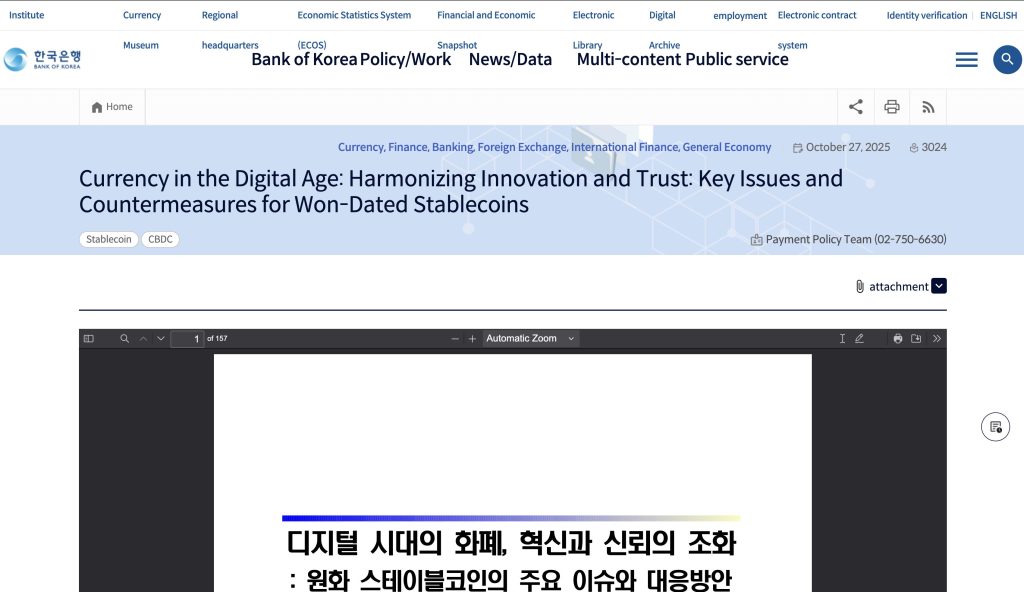
Source: Bank of Korea

The central bank’s concerns come at a time when South Korea is actively debating how to regulate stablecoins.

Can South Korea Balance Stablecoin Innovation With Monetary Stability?

The BOK, led by Governor Rhee Chang-yong, reiterated its position that only regulated financial institutions, preferably banks, should issue such assets, arguing that “non-bank issuers could undermine monetary control and capital management.”

The central bank’s latest analysis emphasized that the severity of reserve asset volatility could directly affect the domestic financial market, warning that improper collateral management may lead to depegging risks similar to those seen with foreign dollar-backed stablecoins.

The report highlighted risks to monetary stability from privately issued stablecoins, particularly those that might fail to maintain a one-to-one reserve ratio with the Korean won.

The BOK cautioned that improper reserve management, foreign capital outflows, and speculative trading could trigger a loss of peg confidence, echoing the failures seen in algorithmic stablecoins such as TerraUSD in 2022.

The report shows that stablecoins, while potentially improving payment efficiency and supporting financial innovation, could also undermine the effectiveness of monetary policy and disrupt foreign exchange management.

It called for robust reserve audits, issuance caps, and central oversight to prevent liquidity shocks.

The statement follows months of mounting tension between the BOK and the government.

In June, South Korea’s ruling Democratic Party proposed the Digital Asset Basic Act, which would allow local firms to issue stablecoins with a minimum capital requirement of 500 million won ($367,000) while ensuring full redemption guarantees.

The bill, backed by President Lee Jae-myung’s pro-crypto administration, seeks to increase transparency and competition in the local digital asset market.

However, the Bank of Korea has consistently opposed letting non-bank entities issue won-pegged stablecoins.

At the time, Governor Rhee insisted that any digital currency backed by the won should remain under the central bank’s purview.

“Allowing private companies to issue won-denominated stablecoins without adequate supervision could weaken monetary control,” Rhee said earlier this month.

The Stablecoin Race Is On — and Korea’s Banks Aren’t Waiting.

Despite central bank opposition, commercial banks have been preparing for a gradual rollout.

In June, eight major banks, including KB Kookmin, Shinhan, Woori, and Nonghyup, formed a consortium to develop a joint won-linked stablecoin.

The consortium plans to pilot two issuance models: a trust-based system, where customer deposits are held separately as reserves, and a deposit-linked system, where stablecoins mirror customer deposits on a one-to-one basis.

The banks say the initiative aims to “secure independence and competitiveness” amid fears that foreign dollar-backed stablecoins could dominate the domestic market.

The consortium’s creation marks a shift in South Korea’s financial sector, which has historically maintained distance from digital assets.

Bank executives privately acknowledge a “shared sense of crisis” that foreign dollar-pegged stablecoins could dominate the domestic market if local issuance lags behind.

Meanwhile, the Financial Intelligence Unit (FIU) is restructuring its anti-money laundering (AML) protocols to address the upcoming “institutionalization” of stablecoins.

The agency has commissioned research on risk mitigation and is drafting new AML guidelines for stablecoin issuers to be completed by December.

Officials said the findings will form the foundation for updated oversight rules under the amended Specific Financial Information Act next year.

South Korea’s Stablecoin Bills Stall in Parliament as Agencies Vie for Control

Notably, the government is also tightening coordination across agencies.

While President Lee previously proposed dismantling the Financial Services Commission (FSC), it remains active in crypto oversight and is expected to serve as the main licensing authority for KRW-pegged stablecoins.

Pending bills from both ruling and opposition lawmakers would give the FSC power to approve issuers, enforce redemption standards, and impose emergency orders in case of market disruption.

Political debate has slowed progress, however. Four separate draft bills are stalled in the National Assembly as lawmakers and regulators clash over whether fintech and IT firms should be allowed to issue stablecoins.

The BOK argues that such permission could lead to the emergence of “private currencies” controlled by large tech conglomerates like Naver and Kakao, potentially challenging the central bank’s monetary authority.

Despite the gridlock, the stablecoin sector continues to attract global attention.

In August, Circle CEO Heath Tarbert met with Governor Rhee and executives from major Korean banks and crypto exchanges to discuss cooperation on stablecoin infrastructure and regulatory frameworks.

Also, Solana Foundation partnered with Korean blockchain infrastructure company Wavebridge to build a “compliance-ready” KRW-pegged stablecoin.

The debate unfolds against a backdrop of declining domestic crypto activity.

According to the BOK’s Financial Stability Report, the Korean crypto market lost nearly $24 billion in value in the first half of 2025, with daily trading volumes falling 80% to 3.2 trillion won.

Retail investors have shifted to local equities amid stronger currency performance and growing regulatory uncertainty.

Source: YNA

Still, South Korea remains one of the most active crypto markets in Asia, with over 10.8 million trading accounts, roughly 20% of its population.


Market Opportunity
Lorenzo Protocol Logo
Lorenzo Protocol Price(BANK)
$0.03511
$0.03511$0.03511
-1.54%
USD
Lorenzo Protocol (BANK) Live Price Chart

World Cup Combo: Aim for 200x

World Cup Combo: Aim for 200xWorld Cup Combo: Aim for 200x

Combine up to 20 World Cup matches in one order

Disclaimer: The articles reposted on this site are sourced from public platforms and are provided for informational purposes only. They do not necessarily reflect the views of MEXC. All rights remain with the original authors. If you believe any content infringes on third-party rights, please contact crypto.news@mexc.com for removal. MEXC makes no guarantees regarding the accuracy, completeness, or timeliness of the content and is not responsible for any actions taken based on the information provided. The content does not constitute financial, legal, or other professional advice, nor should it be considered a recommendation or endorsement by MEXC.

You May Also Like

CME Group to launch Solana and XRP futures options in October

CME Group to launch Solana and XRP futures options in October

The post CME Group to launch Solana and XRP futures options in October appeared on BitcoinEthereumNews.com. CME Group is preparing to launch options on SOL and XRP futures next month, giving traders new ways to manage exposure to the two assets.  The contracts are set to go live on October 13, pending regulatory approval, and will come in both standard and micro sizes with expiries offered daily, monthly and quarterly. The new listings mark a major step for CME, which first brought bitcoin futures to market in 2017 and added ether contracts in 2021. Solana and XRP futures have quickly gained traction since their debut earlier this year. CME says more than 540,000 Solana contracts (worth about $22.3 billion), and 370,000 XRP contracts (worth $16.2 billion), have already been traded. Both products hit record trading activity and open interest in August. Market makers including Cumberland and FalconX plan to support the new contracts, arguing that institutional investors want hedging tools beyond bitcoin and ether. CME’s move also highlights the growing demand for regulated ways to access a broader set of digital assets. The launch, which still needs the green light from regulators, follows the end of XRP’s years-long legal fight with the US Securities and Exchange Commission. A federal court ruling in 2023 found that institutional sales of XRP violated securities laws, but programmatic exchange sales did not. The case officially closed in August 2025 after Ripple agreed to pay a $125 million fine, removing one of the biggest uncertainties hanging over the token. This is a developing story. This article was generated with the assistance of AI and reviewed by editor Jeffrey Albus before publication. Get the news in your inbox. Explore Blockworks newsletters: Source: https://blockworks.co/news/cme-group-solana-xrp-futures
Share
BitcoinEthereumNews2025/09/17 23:55
Perlis sedia perkenal 83 gua baharu sebagai produk ekopelancongan

Perlis sedia perkenal 83 gua baharu sebagai produk ekopelancongan

Raja Muda Perlis Tuanku Syed Faizuddin Putra Jamalullail bertitah penemuan gua itu membuka peluang besar kepada pakar pengkaji dan peminat aktiviti lasak untuk
Share
Free Malaysia Today2026/06/30 09:34
EBA Launches Consultation on MiCA Fines — Here’s Why It Matters

EBA Launches Consultation on MiCA Fines — Here’s Why It Matters

The EBA has launched a consultation on fines for significant crypto issuers under MiCA regulations. The post EBA Launches Consultation on MiCA Fines — Here’s Why
Share
Coinfomania2026/06/30 09:47