Helius says it has re-engineered how Solana’s historical data is stored and retrieved, introducing a new archival backend and an RPC method that collapses today’s multi-call workflows into a single request. CEO Mert Mumtaz framed the change in sweeping terms: “today, Solana changes forever… we’ve solved the biggest data/RPC problem that exists,” he wrote, arguing […]Helius says it has re-engineered how Solana’s historical data is stored and retrieved, introducing a new archival backend and an RPC method that collapses today’s multi-call workflows into a single request. CEO Mert Mumtaz framed the change in sweeping terms: “today, Solana changes forever… we’ve solved the biggest data/RPC problem that exists,” he wrote, arguing […]

Solana Just Solved Its Biggest Data Problem, Says Helius CEO

2025/10/29 20:00
3 min read

Helius says it has re-engineered how Solana’s historical data is stored and retrieved, introducing a new archival backend and an RPC method that collapses today’s multi-call workflows into a single request.

CEO Mert Mumtaz framed the change in sweeping terms: “today, Solana changes forever… we’ve solved the biggest data/RPC problem that exists,” he wrote, arguing that the status quo—historical queries hitting Google Bigtable—has been “slow,” “expensive,” and “inflexible.”

What This Means For Solana

Mumtaz highlighted the practical pain point every Solana indexer or wallet developer knows: getting the “first tx for a Solana address without looping back endlessly” and pulling the “most recent 100 txs for an address” both require chaining calls and traversals that can balloon into “thousands of RPC calls.” “Not anymore,” Mumtaz said.

At the heart of the release is a Helius-exclusive RPC method, getTransactionsForAddress, backed by a distributed archival storage layer that the company claims is “1,000x faster, more flexible, and more scalable.” Functionally, the method merges today’s common two-step pattern—getSignaturesForAddress to enumerate signatures, then getTransaction to hydrate details—into one call that can return fully decoded transactions, with bidirectional time ordering and range filters by slot or timestamp.

Helius’ documentation spells out that it enables reverse search without back-traversal and supports pagination tuned for large, active accounts. The company also emphasizes that this is not a core Solana RPC addition; it’s a proprietary extension available on Helius nodes, priced at 100 credits per request on Developer plans and above. Performance claims span both the new method and legacy endpoints, with Helius saying getBlock, getTransaction, and getSignaturesForAddress are now “10x faster,” while the archival system under the hood delivers the headline throughput improvements for historical queries.

The framing is squarely aimed at eliminating Bigtable-bound latency spikes and reducing call counts by “100x” alongside “10x lower latency” and “1000x less code.” Those assertions track with common developer complaints documented across Solana forums about slow historical hydration on busy addresses, but the hard numbers here are Helius’ own benchmarks.

The strategic context matters. Solana’s on-chain activity continues to skew toward high-throughput consumer and payments use cases, which punish inefficient data access patterns.

The launch landed the same day the first US spot Solana ETF went live on the NYSE—Bitwise’s BSOL. According to Bloomberg’s senior ETF analyst Eric Balchunas, BSOL recorded a volume of $56 million on day one. “BSOL’s $56m is the MOST of any launch this year.. More than XRPR, SSK, Ives and $MNU. And what’s amazing is it seeded with $220m. It could have invested seed on Day One, which would have resulted in $280m-ish, would be even more than ETHA’s debut. Strong start either way,” Balchunas wrote.

Another macro backdrop piece: Western Union announced plans to introduce a dollar-backed stablecoin, USDPT, on Solana, issued by Anchorage Digital Bank, with availability targeted for the first half of 2026.

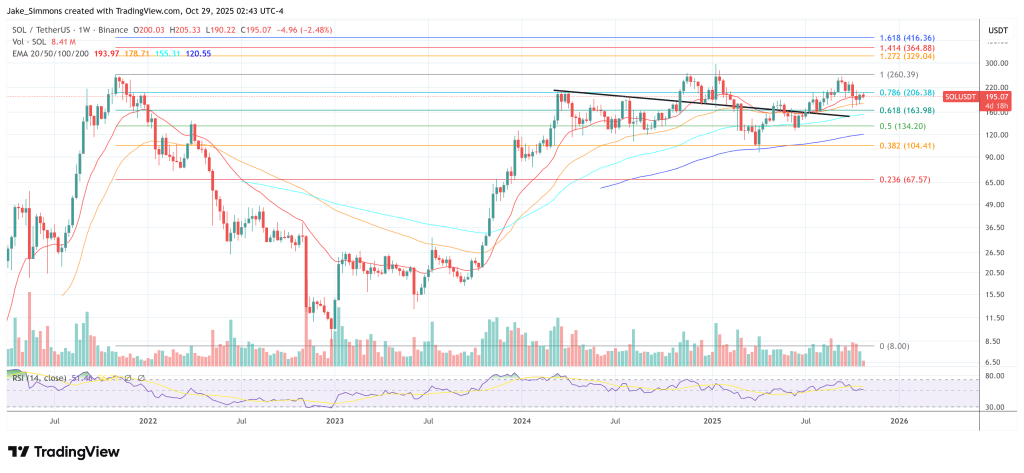
At press time, SOL traded at $195.
Solana price
Market Opportunity
ChangeX Logo
ChangeX Price(CHANGE)
$0.00139952
$0.00139952$0.00139952
-0.21%
USD
ChangeX (CHANGE) Live Price Chart
Disclaimer: The articles reposted on this site are sourced from public platforms and are provided for informational purposes only. They do not necessarily reflect the views of MEXC. All rights remain with the original authors. If you believe any content infringes on third-party rights, please contact crypto.news@mexc.com for removal. MEXC makes no guarantees regarding the accuracy, completeness, or timeliness of the content and is not responsible for any actions taken based on the information provided. The content does not constitute financial, legal, or other professional advice, nor should it be considered a recommendation or endorsement by MEXC.

You May Also Like

Stunning 98.2% Drop To $26.5M Signals Security Revolution

Stunning 98.2% Drop To $26.5M Signals Security Revolution

The post Stunning 98.2% Drop To $26.5M Signals Security Revolution appeared on BitcoinEthereumNews.com. Crypto Hacking Losses Plunge: Stunning 98.2% Drop To $26
Share
BitcoinEthereumNews2026/03/02 13:10
Aave V4 roadmap signals end of multichain sprawl

Aave V4 roadmap signals end of multichain sprawl

The post Aave V4 roadmap signals end of multichain sprawl appeared on BitcoinEthereumNews.com. Aave Labs has released its official launch roadmap for V4, laying out the final steps ahead of the major upgrade’s Q4 mainnet launch.  Alongside new architectural and security improvements, the roadmap introduces a fundamental shift in how user balances are tracked and highlights a strategic pullback from economically underperforming deployments across layer-2 and alternative layer-1 networks. The V4 release moves away from aTokens’ rebasing-style mechanics toward ERC-4626-style share accounting, a change that promises cleaner integrations, easier tax treatment, and better compatibility with downstream DeFi infrastructure.  In a recent technical development update, Aave Labs confirmed that “tokenization is to remain optional and built using ERC 4626 vaults,” and that internal accounting will eliminate the use of exchange rates or scaled balances. The goal is to “further improve the overall reliability of the protocol.” ERC-4626 is a widely adopted Ethereum standard that expresses user deposits as shares of a vault rather than balances that grow over time. In Aave V3, aTokens accrue interest by increasing a user’s balance directly — behavior that resembles rebasing tokens and often confuses integrations and portfolio accounting tools.  By contrast, ERC-4626 tracks yield through a rising price-per-share metric, leaving token balances unchanged. The result is more predictable behavior for integrators, auditors and tax software, as well as a clearer cost basis for users. The roadmap also outlines a series of release milestones, including a formal codebase publication, a public testnet launch with a redesigned interface, and the completion of a multi-layered security review involving formal verification and manual audits. Aave Labs said the roadmap reflects the protocol’s “final stages of review, testing, and deployment,” and that additional documentation and launch preparation materials will be released in the coming weeks. But the most pointed strategic shift comes not from the codebase, but from Aave’s own governance forums. “Aave…
Share
BitcoinEthereumNews2025/09/18 07:40
March 2026 Marks a Defining Moment as Pi Network Signals a New Global Financial Era

March 2026 Marks a Defining Moment as Pi Network Signals a New Global Financial Era

The global Crypto landscape may be approaching a defining milestone as March 2026 emerges as a focal point for the evolution of Pi network. Within community
Share
Hokanews2026/03/02 12:53