Grayscale Investments launched its Solana Trust ETF on NYSE Arca on Tuesday, becoming the first of the firm’s staking products to uplist under new SEC-approved generic listing standards. The move intensifies competition in the nascent Solana ETF market, where Bitwise’s debut product already captured $69.5 million in first-day inflows. The launch expands Grayscale’s digital asset lineup beyond Bitcoin and Ethereum, offering investors exposure to Solana’s proof-of-stake blockchain through a familiar exchange-traded wrapper. GSOL now joins Bitwise’s BSOL and Rex-Osprey’s SSK as the third Solana ETF trading on U.S. exchanges. Grayscale Enters With Staking-Enabled Structure GSOL carries a 0.35% expense ratio and holds 525,387 SOL tokens, with 74.89% currently staked to generate network rewards. Grayscale intends to pass on 77% of all staking rewards to investors on a net basis, potentially adding 5-6% annual returns based on historical Solana staking yields of 6-8%. The fund first launched as a private trust in 2021, was listed on OTCQX in 2023, and began staking in October 2025. Inkoo Kang, Senior Vice President of ETFs at Grayscale, framed the launch as evidence that digital assets belong in “modern portfolios” alongside traditional equities and bonds. Kristin Smith, President of Solana Policy Institute, also noted that staking ETPs allows investors “to help secure the network, accelerate innovation for developers, and earn rewards on one of the most dynamic assets in modern finance.” The product is not registered under the Investment Company Act of 1940, meaning it lacks the regulatory protections of traditional ETFs and mutual funds. Grayscale emphasized that GSOL represents indirect exposure to Solana and carries significant risks, including the potential loss of principal. Bitwise Dominates Early Solana ETF Flows Bitwise’s Solana ETF captured $69.5 million on its October 28 debut, nearly six times the $12 million raised by Rex-Osprey’s competing product. BSOL stakes 100% of its held SOL tokens in-house to deliver Solana’s full network yield to investors, charging a 0.20% management fee that has been waived for the first three months. Matt Hougan, Bitwise’s Chief Investment Officer, attributed institutional enthusiasm to Solana’s on-chain revenue leadership. “Institutional investors love ETFs, and they love revenue,” he said. Rex-Osprey’s SSK takes a different approach, holding 54% in direct Solana, 43.5% in a Swiss-listed CoinShares ETP, and the remainder in JitoSOL and cash, with monthly staking rewards classified as return of capital for tax purposes. Despite positive sentiment around ETFs, the market remains cautious about near-term price action. Traders on Polymarket give Solana just a 28% chance of reaching a new all-time high before 2026, with SOL trading at $200 today, up nearly 1% over 24 hours.Source: Polymarket Solana Challenges Ethereum’s Institutional Dominance Speaking with Cryptonews, Maria Carola, CEO of StealthEX, views the Solana ETF launch as a defining moment in the battle for Layer 1 blockchain dominance. “The launch of a spot ETF on Solana is a signal that has broken out in the protracted battle for dominance in the Layer 1 blockchain space,” she said. “For the first time, institutional investors are being invited to consider Solana as a standalone macro asset.“ Carola notes that projections of $3 billion in ETF inflows over the next 12-18 months depend on Solana maintaining its 2024 momentum in DeFi expansion and network stability. She acknowledges that while Solana offers technological advantages in speed and scalability, “it’s Ethereum’s fundamentals, such as stability, institutional reputation, and integration into the global financial system, that maintain its leadership.” Ethereum currently holds over $60 billion locked in DeFi with a mature staking ecosystem that continues to set the standard for institutional investors seeking predictability and reliability. However, Carola suggests a potential coexistence model where “Ethereum serves as the underlying trust and settlement layer in the on-chain economy, while Solana becomes its high-performance execution engine.” She adds that if ETF inflow projections are met by the end of 2025, “Solana could become the first blockchain since Ethereum to break the institutional glass ceiling.“ Regulatory Momentum Builds Across Multiple Blockchains The Solana ETF wave follows Hong Kong’s October approval of China Asset Management’s SOL spot fund, which began trading on October 27 with a minimum investment of $100. The product carries a 0.99% management fee and a 1.99% total expense ratio, making Solana the third cryptocurrency, after Bitcoin and Ethereum, to receive spot ETF clearance in the territory. Multiple U.S. issuers, including VanEck, Canary Capital, Franklin Templeton, Fidelity, and CoinShares, have also received approval for Solana ETF proposals. Recently, Bloomberg analyst Eric Balchunas also confirmed that the SEC is expected to approve the first Hedera and Litecoin ETFs, with listing notices for Canary’s HBAR and LTC products scheduled for October 28Grayscale Investments launched its Solana Trust ETF on NYSE Arca on Tuesday, becoming the first of the firm’s staking products to uplist under new SEC-approved generic listing standards. The move intensifies competition in the nascent Solana ETF market, where Bitwise’s debut product already captured $69.5 million in first-day inflows. The launch expands Grayscale’s digital asset lineup beyond Bitcoin and Ethereum, offering investors exposure to Solana’s proof-of-stake blockchain through a familiar exchange-traded wrapper. GSOL now joins Bitwise’s BSOL and Rex-Osprey’s SSK as the third Solana ETF trading on U.S. exchanges. Grayscale Enters With Staking-Enabled Structure GSOL carries a 0.35% expense ratio and holds 525,387 SOL tokens, with 74.89% currently staked to generate network rewards. Grayscale intends to pass on 77% of all staking rewards to investors on a net basis, potentially adding 5-6% annual returns based on historical Solana staking yields of 6-8%. The fund first launched as a private trust in 2021, was listed on OTCQX in 2023, and began staking in October 2025. Inkoo Kang, Senior Vice President of ETFs at Grayscale, framed the launch as evidence that digital assets belong in “modern portfolios” alongside traditional equities and bonds. Kristin Smith, President of Solana Policy Institute, also noted that staking ETPs allows investors “to help secure the network, accelerate innovation for developers, and earn rewards on one of the most dynamic assets in modern finance.” The product is not registered under the Investment Company Act of 1940, meaning it lacks the regulatory protections of traditional ETFs and mutual funds. Grayscale emphasized that GSOL represents indirect exposure to Solana and carries significant risks, including the potential loss of principal. Bitwise Dominates Early Solana ETF Flows Bitwise’s Solana ETF captured $69.5 million on its October 28 debut, nearly six times the $12 million raised by Rex-Osprey’s competing product. BSOL stakes 100% of its held SOL tokens in-house to deliver Solana’s full network yield to investors, charging a 0.20% management fee that has been waived for the first three months. Matt Hougan, Bitwise’s Chief Investment Officer, attributed institutional enthusiasm to Solana’s on-chain revenue leadership. “Institutional investors love ETFs, and they love revenue,” he said. Rex-Osprey’s SSK takes a different approach, holding 54% in direct Solana, 43.5% in a Swiss-listed CoinShares ETP, and the remainder in JitoSOL and cash, with monthly staking rewards classified as return of capital for tax purposes. Despite positive sentiment around ETFs, the market remains cautious about near-term price action. Traders on Polymarket give Solana just a 28% chance of reaching a new all-time high before 2026, with SOL trading at $200 today, up nearly 1% over 24 hours.Source: Polymarket Solana Challenges Ethereum’s Institutional Dominance Speaking with Cryptonews, Maria Carola, CEO of StealthEX, views the Solana ETF launch as a defining moment in the battle for Layer 1 blockchain dominance. “The launch of a spot ETF on Solana is a signal that has broken out in the protracted battle for dominance in the Layer 1 blockchain space,” she said. “For the first time, institutional investors are being invited to consider Solana as a standalone macro asset.“ Carola notes that projections of $3 billion in ETF inflows over the next 12-18 months depend on Solana maintaining its 2024 momentum in DeFi expansion and network stability. She acknowledges that while Solana offers technological advantages in speed and scalability, “it’s Ethereum’s fundamentals, such as stability, institutional reputation, and integration into the global financial system, that maintain its leadership.” Ethereum currently holds over $60 billion locked in DeFi with a mature staking ecosystem that continues to set the standard for institutional investors seeking predictability and reliability. However, Carola suggests a potential coexistence model where “Ethereum serves as the underlying trust and settlement layer in the on-chain economy, while Solana becomes its high-performance execution engine.” She adds that if ETF inflow projections are met by the end of 2025, “Solana could become the first blockchain since Ethereum to break the institutional glass ceiling.“ Regulatory Momentum Builds Across Multiple Blockchains The Solana ETF wave follows Hong Kong’s October approval of China Asset Management’s SOL spot fund, which began trading on October 27 with a minimum investment of $100. The product carries a 0.99% management fee and a 1.99% total expense ratio, making Solana the third cryptocurrency, after Bitcoin and Ethereum, to receive spot ETF clearance in the territory. Multiple U.S. issuers, including VanEck, Canary Capital, Franklin Templeton, Fidelity, and CoinShares, have also received approval for Solana ETF proposals. Recently, Bloomberg analyst Eric Balchunas also confirmed that the SEC is expected to approve the first Hedera and Litecoin ETFs, with listing notices for Canary’s HBAR and LTC products scheduled for October 28

Solana ETF Race Heats Up as Grayscale Joins Bitwise on Wall Street

Grayscale Investments launched its Solana Trust ETF on NYSE Arca on Tuesday, becoming the first of the firm’s staking products to uplist under new SEC-approved generic listing standards.

The move intensifies competition in the nascent Solana ETF market, where Bitwise’s debut product already captured $69.5 million in first-day inflows.

The launch expands Grayscale’s digital asset lineup beyond Bitcoin and Ethereum, offering investors exposure to Solana’s proof-of-stake blockchain through a familiar exchange-traded wrapper.

GSOL now joins Bitwise’s BSOL and Rex-Osprey’s SSK as the third Solana ETF trading on U.S. exchanges.

Grayscale Enters With Staking-Enabled Structure

GSOL carries a 0.35% expense ratio and holds 525,387 SOL tokens, with 74.89% currently staked to generate network rewards.

Grayscale intends to pass on 77% of all staking rewards to investors on a net basis, potentially adding 5-6% annual returns based on historical Solana staking yields of 6-8%.

The fund first launched as a private trust in 2021, was listed on OTCQX in 2023, and began staking in October 2025.

Inkoo Kang, Senior Vice President of ETFs at Grayscale, framed the launch as evidence that digital assets belong in “modern portfolios” alongside traditional equities and bonds.

Kristin Smith, President of Solana Policy Institute, also noted that staking ETPs allows investors “to help secure the network, accelerate innovation for developers, and earn rewards on one of the most dynamic assets in modern finance.”

The product is not registered under the Investment Company Act of 1940, meaning it lacks the regulatory protections of traditional ETFs and mutual funds.

Grayscale emphasized that GSOL represents indirect exposure to Solana and carries significant risks, including the potential loss of principal.

Bitwise Dominates Early Solana ETF Flows

Bitwise’s Solana ETF captured $69.5 million on its October 28 debut, nearly six times the $12 million raised by Rex-Osprey’s competing product.

BSOL stakes 100% of its held SOL tokens in-house to deliver Solana’s full network yield to investors, charging a 0.20% management fee that has been waived for the first three months.

Matt Hougan, Bitwise’s Chief Investment Officer, attributed institutional enthusiasm to Solana’s on-chain revenue leadership.

“Institutional investors love ETFs, and they love revenue,” he said.

Rex-Osprey’s SSK takes a different approach, holding 54% in direct Solana, 43.5% in a Swiss-listed CoinShares ETP, and the remainder in JitoSOL and cash, with monthly staking rewards classified as return of capital for tax purposes.

Despite positive sentiment around ETFs, the market remains cautious about near-term price action.

Traders on Polymarket give Solana just a 28% chance of reaching a new all-time high before 2026, with SOL trading at $200 today, up nearly 1% over 24 hours.
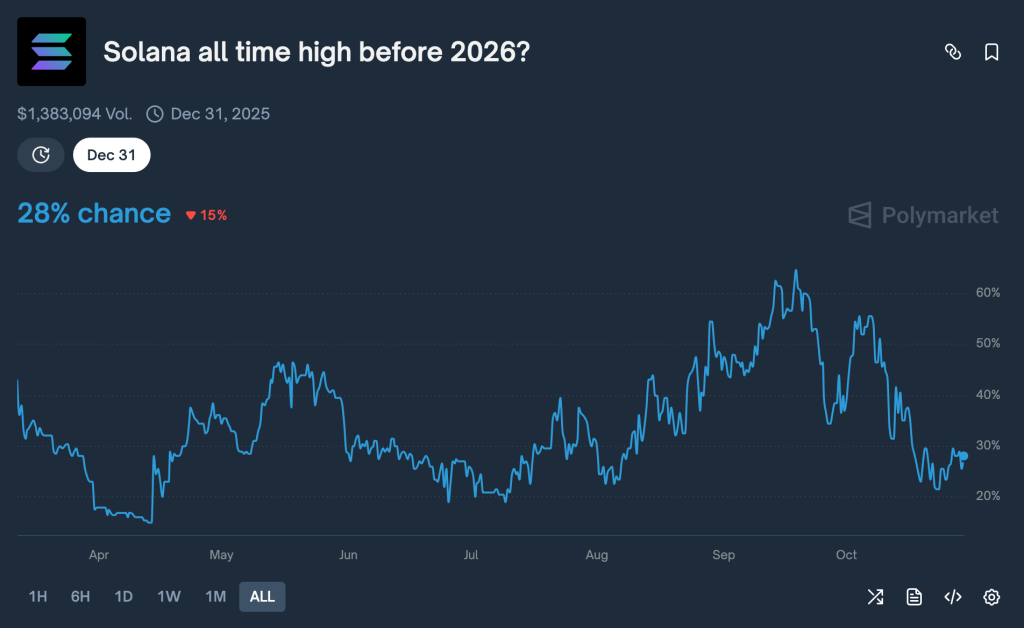
Solana ETF Race Heats Up as Grayscale Joins Bitwise on Wall StreetSource: Polymarket

Solana Challenges Ethereum’s Institutional Dominance

Speaking with Cryptonews, Maria Carola, CEO of StealthEX, views the Solana ETF launch as a defining moment in the battle for Layer 1 blockchain dominance.

The launch of a spot ETF on Solana is a signal that has broken out in the protracted battle for dominance in the Layer 1 blockchain space,” she said.

For the first time, institutional investors are being invited to consider Solana as a standalone macro asset.

Carola notes that projections of $3 billion in ETF inflows over the next 12-18 months depend on Solana maintaining its 2024 momentum in DeFi expansion and network stability.

She acknowledges that while Solana offers technological advantages in speed and scalability, “it’s Ethereum’s fundamentals, such as stability, institutional reputation, and integration into the global financial system, that maintain its leadership.

Ethereum currently holds over $60 billion locked in DeFi with a mature staking ecosystem that continues to set the standard for institutional investors seeking predictability and reliability.

However, Carola suggests a potential coexistence model where “Ethereum serves as the underlying trust and settlement layer in the on-chain economy, while Solana becomes its high-performance execution engine.”

She adds that if ETF inflow projections are met by the end of 2025, “Solana could become the first blockchain since Ethereum to break the institutional glass ceiling.

Regulatory Momentum Builds Across Multiple Blockchains

The Solana ETF wave follows Hong Kong’s October approval of China Asset Management’s SOL spot fund, which began trading on October 27 with a minimum investment of $100.

The product carries a 0.99% management fee and a 1.99% total expense ratio, making Solana the third cryptocurrency, after Bitcoin and Ethereum, to receive spot ETF clearance in the territory.

Multiple U.S. issuers, including VanEck, Canary Capital, Franklin Templeton, Fidelity, and CoinShares, have also received approval for Solana ETF proposals.

Recently, Bloomberg analyst Eric Balchunas also confirmed that the SEC is expected to approve the first Hedera and Litecoin ETFs, with listing notices for Canary’s HBAR and LTC products scheduled for October 28.


Disclaimer: The articles reposted on this site are sourced from public platforms and are provided for informational purposes only. They do not necessarily reflect the views of MEXC. All rights remain with the original authors. If you believe any content infringes on third-party rights, please contact service@support.mexc.com for removal. MEXC makes no guarantees regarding the accuracy, completeness, or timeliness of the content and is not responsible for any actions taken based on the information provided. The content does not constitute financial, legal, or other professional advice, nor should it be considered a recommendation or endorsement by MEXC.

You May Also Like

Xsolla Expands MTN Mobile Money Support to Congo-Brazzaville and Zambia, Enhancing Access in Fast-Growing Markets

Xsolla Expands MTN Mobile Money Support to Congo-Brazzaville and Zambia, Enhancing Access in Fast-Growing Markets

New Expansion Delivers Instant, Secure Transactions, And A Familiar Local Payment Experience, Helping Developers Reach Millions Of Players And Boost Conversions
Share
AI Journal2025/12/17 23:50
iGMS Introduces AI-Driven Pro+ Plan, Cutting Host Workloads by Up to 85%

iGMS Introduces AI-Driven Pro+ Plan, Cutting Host Workloads by Up to 85%

VANCOUVER, British Columbia–(BUSINESS WIRE)–#STRSoftware—iGMS, an award-winning short-term rental platform and official Airbnb Partner, today announced the launch
Share
AI Journal2025/12/18 00:18
Fed Decides On Interest Rates Today—Here’s What To Watch For

Fed Decides On Interest Rates Today—Here’s What To Watch For

The post Fed Decides On Interest Rates Today—Here’s What To Watch For appeared on BitcoinEthereumNews.com. Topline The Federal Reserve on Wednesday will conclude a two-day policymaking meeting and release a decision on whether to lower interest rates—following months of pressure and criticism from President Donald Trump—and potentially signal whether additional cuts are on the way. President Donald Trump has urged the central bank to “CUT INTEREST RATES, NOW, AND BIGGER” than they might plan to. Getty Images Key Facts The central bank is poised to cut interest rates by at least a quarter-point, down from the 4.25% to 4.5% range where they have been held since December to between 4% and 4.25%, as Wall Street has placed 100% odds of a rate cut, according to CME’s FedWatch, with higher odds (94%) on a quarter-point cut than a half-point (6%) reduction. Fed governors Christopher Waller and Michelle Bowman, both Trump appointees, voted in July for a quarter-point reduction to rates, and they may dissent again in favor of a large cut alongside Stephen Miran, Trump’s Council of Economic Advisers’ chair, who was sworn in at the meeting’s start on Tuesday. It’s unclear whether other policymakers, including Kansas City Fed President Jeffrey Schmid and St. Louis Fed President Alberto Musalem, will favor larger cuts or opt for no reduction. Fed Chair Jerome Powell said in his Jackson Hole, Wyoming, address last month the central bank would likely consider a looser monetary policy, noting the “shifting balance of risks” on the U.S. economy “may warrant adjusting our policy stance.” David Mericle, an economist for Goldman Sachs, wrote in a note the “key question” for the Fed’s meeting is whether policymakers signal “this is likely the first in a series of consecutive cuts” as the central bank is anticipated to “acknowledge the softening in the labor market,” though they may not “nod to an October cut.” Mericle said he…
Share
BitcoinEthereumNews2025/09/18 00:23





