This study examines how the SST (Singular Spectrum Transformation) model improves compression and efficiency in large language models compared to GaLore. Results show that SST retains lower perplexity across high pruning ratios and consistently outperforms GaLore in memory-efficient training experiments on datasets like IWSLT’14 and OpenWebText. By concentrating essential information into fewer singular values, SST enables lighter, faster, and more capable models—making it a leading approach for scalable, high-performance AI inference.This study examines how the SST (Singular Spectrum Transformation) model improves compression and efficiency in large language models compared to GaLore. Results show that SST retains lower perplexity across high pruning ratios and consistently outperforms GaLore in memory-efficient training experiments on datasets like IWSLT’14 and OpenWebText. By concentrating essential information into fewer singular values, SST enables lighter, faster, and more capable models—making it a leading approach for scalable, high-performance AI inference.

SST vs. GaLore: The Battle for the Most Efficient AI Brain

2025/10/30 19:28
4 min read
For feedback or concerns regarding this content, please contact us at crypto.news@mexc.com

Abstract and 1. Introduction

  1. Related Work

  2. Low Rank Adaptation

    3.1 LoRA and 3.2 Limitation of LoRA

    3.3 ReLoRA*

  3. Sparse Spectral Training

    4.1 Preliminaries and 4.2 Gradient Update of U, VT with Σ

    4.3 Why SVD Initialization is Important

    4.4 SST Balances Exploitation and Exploration

    4.5 Memory-Efficient Implementation for SST and 4.6 Sparsity of SST

  4. Experiments

    5.1 Machine Translation

    5.2 Natural Language Generation

    5.3 Hyperbolic Graph Neural Networks

  5. Conclusion and Discussion

  6. Broader Impacts and References

Supplementary Information

A. Algorithm of Sparse Spectral Training

B. Proof of Gradient of Sparse Spectral Layer

C. Proof of Decomposition of Gradient of Weight

D. Proof of Advantage of Enhanced Gradient over Default Gradient

E. Proof of Zero Distortion with SVD Initialization

F. Experiment Details

G. Singular Value Pruning

H. Evaluating SST and GaLore: Complementary Approaches to Memory Efficiency

I. Ablation Study

G Singular Value Pruning

We further conduct an analysis study of the potential for using SST model for further compression. The results, as shown in Figure 3, indicate that the SST model retains lower perplexity across a wider range of pruning ratios compared to the full-rank model. This suggests that the SST method effectively concentrates the informational content of the weights into fewer singular values, making it more suitable for further compression.

\ This enhanced performance underscores the potential of SST in maintaining essential model characteristics even under significant compression, making it a promising approach for developing lightweight yet powerful language models for inference.

\ Figure 3: Singular Value Pruning. We conduct singular value pruning on full-rank and SST pretrained OPT-125M model. After performing singular value decomposition on weight matrices, we preserve the top k singular values so that the cumulative sum of preserved singular values ranges from [100%, 99%, 98%, …, 93%, 90%] of the original cumulative sum. The pruned ratio of singular values is plotted along the x-axis.

\

H Evaluating SST and GaLore: Complementary Approaches to Memory Efficiency

Recently, a new approach named Gradient Low-Rank Projection (GaLore) has been proposed to address the memory challenges associated with training large language models. GaLore, by implementing a memory-efficient gradient projection method, enhances training efficiency without compromising the training dynamics as traditional low-rank adaptation methods, like LoRA, often do.

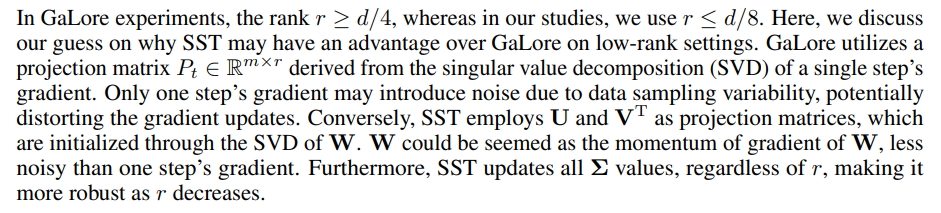
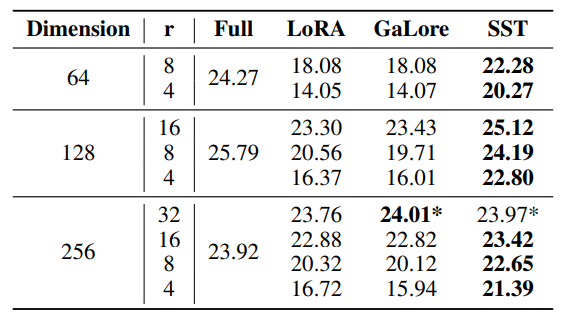
\ Using the released code of GaLore[2], we conducted comparative experiments on the IWSLT’14 dataset with Transformer models, employing the same configurations as other low-rank methods. We set the scale factor α = 1 in these experiments because α = 0.25, which is used in the article, performs much worse than α = 1. As illustrated in Table 9, SST method consistently outperformed GaLore across various model dimensions and ranks, except for d = 256, r = 32.

\ In addition, we evaluated validation perplexity on the OpenWebText dataset with OPT-125M models. We tested GaLore with scale factor α = 0.25 (used in the article) and α = 1. As shown in Table 10, SST surpassed GaLore at both settings of α.

\ \
\ \ \ Table 9: The BLEU score on IWSLT’14 for Euclidean Transformer, compared with GaLore. Values highlighted in bold represent the highest performance among the low rank methods, while those marked with an “*” denote performance that exceeds that of the full-rank variants.
\ \ \ Table 10: Validation perplexity, compared with GaLore on OpenWebText dataset with OPT-125M, along with the number of trainable parameters of each method. r = 64. Values highlighted in bold represent the highest performance among the low rank methods.

\

I Ablation Study

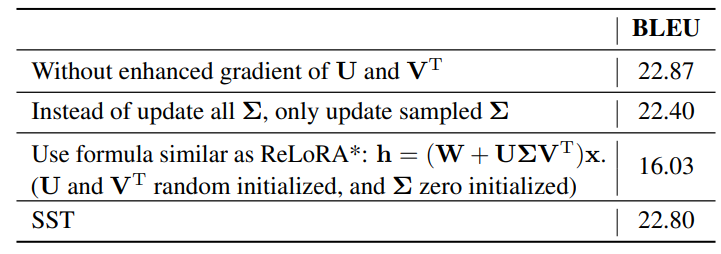
We conduct an ablation study to evaluate the impact of various components and configurations within SST on the IWSLT’14 using a Euclidean Transformer with a dimension of 128 and rank r of 4. The results of this study are summarized in Table 11, which highlights the contributions of specific elements to the overall performance measured in BLEU score.

\ \
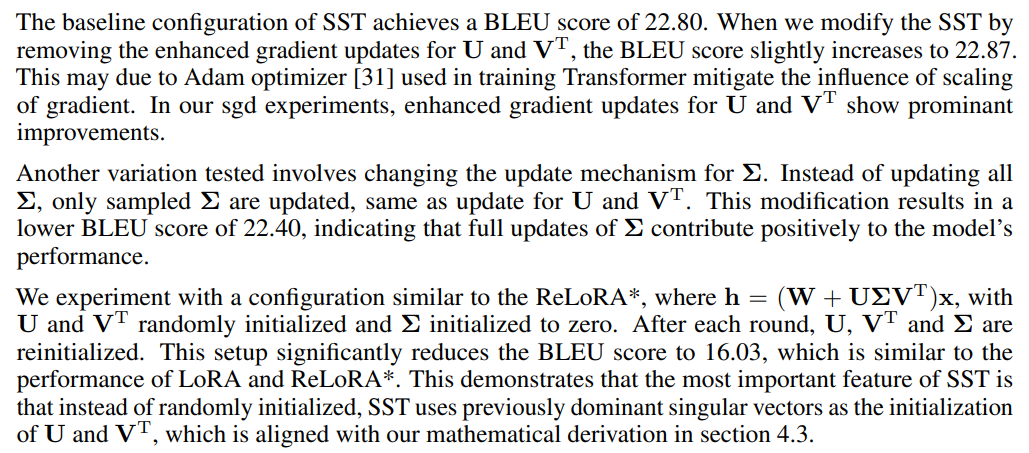
\ \ \ Table 11: Ablation Study on IWSLT’14 dataset with Euclidean Transformer. Dimension is 128 and r is 4.
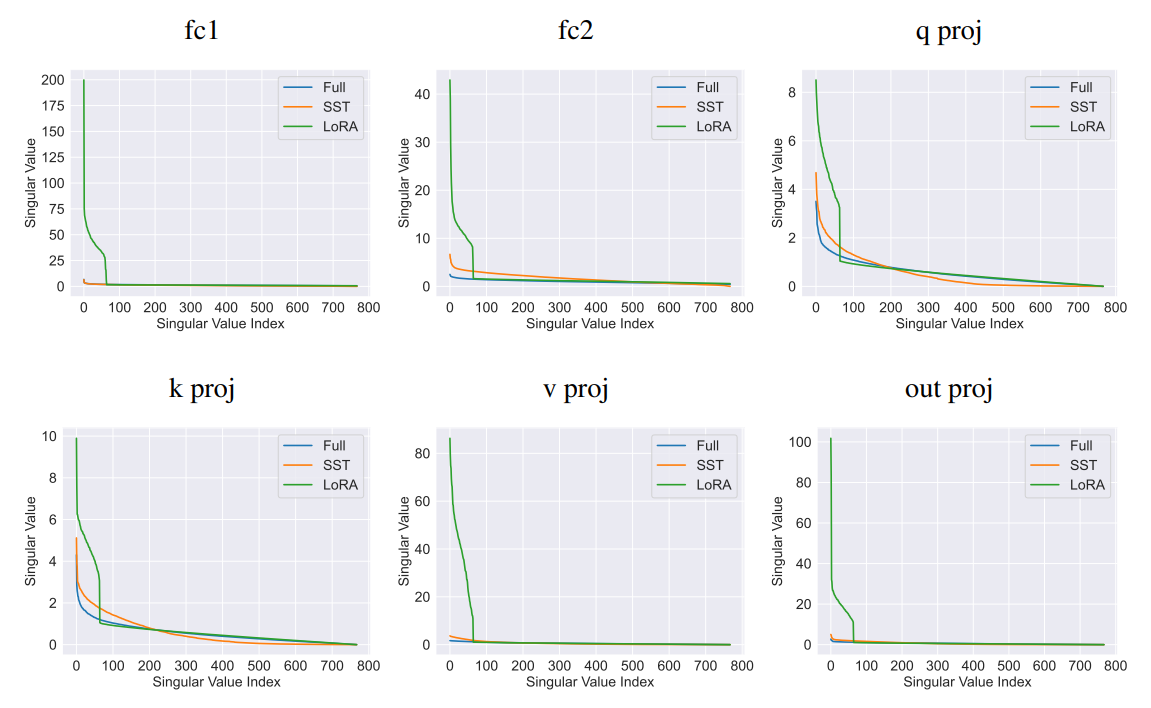
\ \ \ Figure 4: Singular Value Distribution. This visualization depicts the distribution of singular values for the OPT-125M model with full-rank, LoRA, and SST, with r = 64). The x-axis represents the index of singular values, sorted from largest to smallest, while the y-axis shows the magnitude of each value. It highlights how LoRA predominantly captures and overestimates the top-r singular values, in contrast to SST, which shows a much similar distribution as full-rank training.

\ \

:::info Authors:

(1) Jialin Zhao, Center for Complex Network Intelligence (CCNI), Tsinghua Laboratory of Brain and Intelligence (THBI) and Department of Computer Science;

(2) Yingtao Zhang, Center for Complex Network Intelligence (CCNI), Tsinghua Laboratory of Brain and Intelligence (THBI) and Department of Computer Science;

(3) Xinghang Li, Department of Computer Science;

(4) Huaping Liu, Department of Computer Science;

(5) Carlo Vittorio Cannistraci, Center for Complex Network Intelligence (CCNI), Tsinghua Laboratory of Brain and Intelligence (THBI), Department of Computer Science, and Department of Biomedical Engineering Tsinghua University, Beijing, China.

:::


:::info This paper is available on arxiv under CC by 4.0 Deed (Attribution 4.0 International) license.

:::

\

Market Opportunity
Sleepless AI Logo
Sleepless AI Price(SLEEPLESSAI)
$0.02099
$0.02099$0.02099
+2.69%
USD
Sleepless AI (SLEEPLESSAI) Live Price Chart

World Cup Combo: Aim for 200x

World Cup Combo: Aim for 200xWorld Cup Combo: Aim for 200x

Combine up to 20 World Cup matches in one order

Disclaimer: The articles reposted on this site are sourced from public platforms and are provided for informational purposes only. They do not necessarily reflect the views of MEXC. All rights remain with the original authors. If you believe any content infringes on third-party rights, please contact crypto.news@mexc.com for removal. MEXC makes no guarantees regarding the accuracy, completeness, or timeliness of the content and is not responsible for any actions taken based on the information provided. The content does not constitute financial, legal, or other professional advice, nor should it be considered a recommendation or endorsement by MEXC.

You May Also Like

Unleashing A New Era Of Seller Empowerment

Unleashing A New Era Of Seller Empowerment

The post Unleashing A New Era Of Seller Empowerment appeared on BitcoinEthereumNews.com. Amazon AI Agent: Unleashing A New Era Of Seller Empowerment Skip to content Home AI News Amazon AI Agent: Unleashing a New Era of Seller Empowerment Source: https://bitcoinworld.co.in/amazon-ai-seller-tools/
Share
BitcoinEthereumNews2025/09/18 00:10
CME Group to launch Solana and XRP futures options in October

CME Group to launch Solana and XRP futures options in October

The post CME Group to launch Solana and XRP futures options in October appeared on BitcoinEthereumNews.com. CME Group is preparing to launch options on SOL and XRP futures next month, giving traders new ways to manage exposure to the two assets.  The contracts are set to go live on October 13, pending regulatory approval, and will come in both standard and micro sizes with expiries offered daily, monthly and quarterly. The new listings mark a major step for CME, which first brought bitcoin futures to market in 2017 and added ether contracts in 2021. Solana and XRP futures have quickly gained traction since their debut earlier this year. CME says more than 540,000 Solana contracts (worth about $22.3 billion), and 370,000 XRP contracts (worth $16.2 billion), have already been traded. Both products hit record trading activity and open interest in August. Market makers including Cumberland and FalconX plan to support the new contracts, arguing that institutional investors want hedging tools beyond bitcoin and ether. CME’s move also highlights the growing demand for regulated ways to access a broader set of digital assets. The launch, which still needs the green light from regulators, follows the end of XRP’s years-long legal fight with the US Securities and Exchange Commission. A federal court ruling in 2023 found that institutional sales of XRP violated securities laws, but programmatic exchange sales did not. The case officially closed in August 2025 after Ripple agreed to pay a $125 million fine, removing one of the biggest uncertainties hanging over the token. This is a developing story. This article was generated with the assistance of AI and reviewed by editor Jeffrey Albus before publication. Get the news in your inbox. Explore Blockworks newsletters: Source: https://blockworks.co/news/cme-group-solana-xrp-futures

Share
BitcoinEthereumNews2025/09/17 23:55
Solana Price Prediction: SOL Slides Below $80 As $270M Hack Triggers Selloff

Solana Price Prediction: SOL Slides Below $80 As $270M Hack Triggers Selloff

The post Solana Price Prediction: SOL Slides Below $80 As $270M Hack Triggers Selloff appeared first on Coinpedia Fintech News Solana price is back under pressure
Share
CoinPedia2026/04/02 18:59