The architecture maintains Bitcoin’s consensus integrity while enabling deterministic, peer‑verified scientific computation at scale.The architecture maintains Bitcoin’s consensus integrity while enabling deterministic, peer‑verified scientific computation at scale.

Integrating Useful Computation into Blockchain: PNPCoin’s Runtime and Compatibility Framework

2025/11/03 19:21
3 min read
For feedback or concerns regarding this content, please contact us at crypto.news@mexc.com

Abstract and 1. Introduction

  1. Volunteer Computing

  2. PNPCoin

    3.1 Blockchain Integration and 3.2 Bounded Complexity

    3.3 Runtime Authority and 3.4 Back-compatibility

  3. Use case - Cellular Docking

  4. Conclusion and References

3.1 Blockchain Integration

The PNPCoin proposal aims to replace the SHA256 hashing function at the core of Blockchain technology with useful computations. Instead of calculating the hash function of a randomized input, a one-way jash function is distributed at every block, and calculated instead of the hash. As in the original, results are shared by nodes communicating the hash of the blockchain, transactions are signed by new owners private keys, and timestamps are performed by distributed voting by proof-of-work.

\ The jash replaces the hash only in the proof-ofwork step. In order to achieve greater granularity than powers of two as Bitcoin does, the jash meta can contain an upper bound on the arg (eg.: n = 16 and max(arg)=47’000).

\

3.2 Bounded Complexity

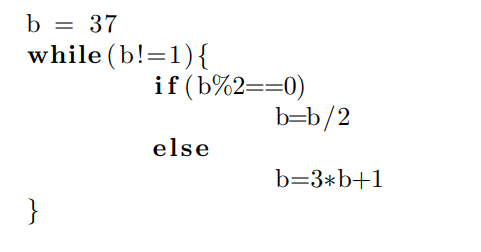
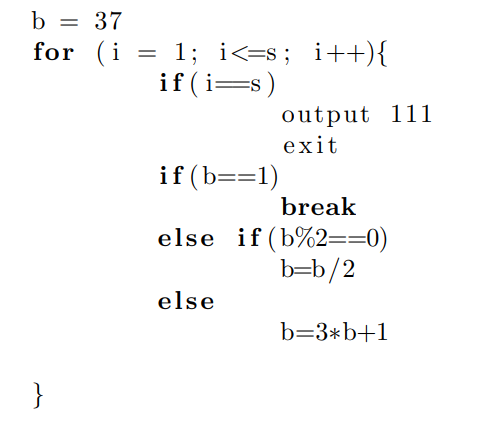
Nested recursion among functions can be flattened into a single recursive function, and all recursive functions can be converted into unbounded loops. Loops which terminate after an unpredictable number of steps are replaced with for loops with a fixed upper bound, and a break statement is added for early termination. Figures 2 and 3 demonstrate this concept for the Collatz conjecture:

\

3.3 Runtime Authority

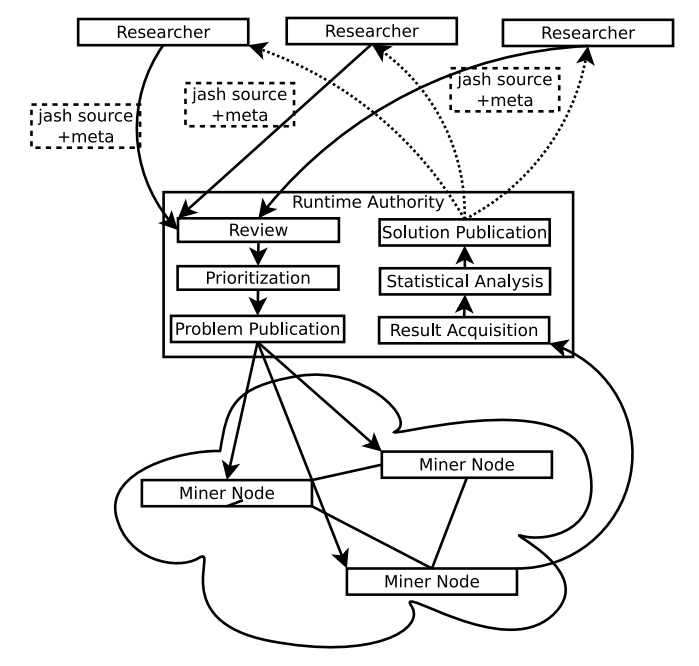
While Runtime Authority resources are available via peer to peer file hosting shared by research institutions and volunteers, the content is aggregated according to rules outlined here, a review process, and additional rules created by a committee. This

\ Figure 1: The role of the Runtime Authority is to review code submitted by researchers, publish jash functions to be used at a given block, and aggregate results. It does not intervene in the ledger or blockchain.
\ Figure 2: Unbounded complexity code

\ Figure 3: Conversion to bounded complexity

\ structure is similar to IANA, which manages Internet resources [2].

\ Each submitted jash is validated by checking whether it compiles, and estimating mean runtime and deviation by performing runs on random inputs. The functions are prioritized according to upper bound complexity (calculated at compile time), the upper bound time complexity, data size d, average and deviation runtime estimates, importance (0 to 1), and a veto to prevent malicious use. All but the last two criteria are fully automated, allowing fast turnaround.

\ There are two modes of execution for jash functions: full and optimal. Optimal execution accepts the lowest res, that is, the result with most leading zeros. Full execution returns the output of every valid input to the RA, and the reward is distributed evenly across all first submissions of results. The RA is also responsible for providing a reference node implementation.

\

3.4 Back-compatibility

In order to satisfy the requirements for a Soft Fork, the proposed system is compatible with the current SHA-256 hashes. For all historic blocks, the RA will publish jash functions containing the SHA256 hashes with fixed input, and empty meta files. In the future event that candidates are unavailable for computation, these Classic problems (SHA-256 hashes) will be published.

\ The RA aggregates all outputs of all sequences.

\

:::info Author:

(1) Martin Kolar, Brno University of Technology (kolarmartin@fit.vutbr.cz).

:::


:::info This paper is available on arxiv under CC BY 4.0 DEED license.

:::

\

Disclaimer: The articles reposted on this site are sourced from public platforms and are provided for informational purposes only. They do not necessarily reflect the views of MEXC. All rights remain with the original authors. If you believe any content infringes on third-party rights, please contact crypto.news@mexc.com for removal. MEXC makes no guarantees regarding the accuracy, completeness, or timeliness of the content and is not responsible for any actions taken based on the information provided. The content does not constitute financial, legal, or other professional advice, nor should it be considered a recommendation or endorsement by MEXC.

You May Also Like

CME Group to Launch Solana and XRP Futures Options

CME Group to Launch Solana and XRP Futures Options

The post CME Group to Launch Solana and XRP Futures Options appeared on BitcoinEthereumNews.com. An announcement was made by CME Group, the largest derivatives exchanger worldwide, revealed that it would introduce options for Solana and XRP futures. It is the latest addition to CME crypto derivatives as institutions and retail investors increase their demand for Solana and XRP. CME Expands Crypto Offerings With Solana and XRP Options Launch According to a press release, the launch is scheduled for October 13, 2025, pending regulatory approval. The new products will allow traders to access options on Solana, Micro Solana, XRP, and Micro XRP futures. Expiries will be offered on business days on a monthly, and quarterly basis to provide more flexibility to market players. CME Group said the contracts are designed to meet demand from institutions, hedge funds, and active retail traders. According to Giovanni Vicioso, the launch reflects high liquidity in Solana and XRP futures. Vicioso is the Global Head of Cryptocurrency Products for the CME Group. He noted that the new contracts will provide additional tools for risk management and exposure strategies. Recently, CME XRP futures registered record open interest amid ETF approval optimism, reinforcing confidence in contract demand. Cumberland, one of the leading liquidity providers, welcomed the development and said it highlights the shift beyond Bitcoin and Ethereum. FalconX, another trading firm, added that rising digital asset treasuries are increasing the need for hedging tools on alternative tokens like Solana and XRP. High Record Trading Volumes Demand Solana and XRP Futures Solana futures and XRP continue to gain popularity since their launch earlier this year. According to CME official records, many have bought and sold more than 540,000 Solana futures contracts since March. A value that amounts to over $22 billion dollars. Solana contracts hit a record 9,000 contracts in August, worth $437 million. Open interest also set a record at 12,500 contracts.…
Share
BitcoinEthereumNews2025/09/18 01:39
Uniswap Price Compression Signals Potential Breakout Toward $5.30

Uniswap Price Compression Signals Potential Breakout Toward $5.30

TLDR: The Uniswap (UNI) price is consolidating within an ascending triangle between $3.80 and $4.10. A clean breakout above $4.10 could trigger a 30% rally toward
Share
Blockonomi2026/03/16 06:37
Latam Insights: Paraguay Adds Stringent Crypto Reporting Rules, Argentina Blocks Peso Stablecoin

Latam Insights: Paraguay Adds Stringent Crypto Reporting Rules, Argentina Blocks Peso Stablecoin

The post Latam Insights: Paraguay Adds Stringent Crypto Reporting Rules, Argentina Blocks Peso Stablecoin appeared on BitcoinEthereumNews.com. Welcome to Latam
Share
BitcoinEthereumNews2026/03/16 06:14