Balancer, one of the most established decentralized finance (DeFi) protocols with more than $700 million in total value locked (TVL), appears to have suffered a serious exploit, adding fresh stress to an industry still grappling with security concerns. Early on-chain evidence indicates that attackers drained assets across multiple chains, with losses now exceeding $98 million, making this one of the largest DeFi breaches of 2025 so far. Related Reading: Bitmine Buys 44,036 Ethereum Worth $166M During Market Dip – Details The attack appears to have targeted Balancer liquidity pools, siphoning high-value assets including wrapped ETH and liquid-staking derivatives through coordinated cross-chain movements. Initial wallet traces show funds rapidly routed through mixing services and bridge networks. This suggests a sophisticated operation designed to minimize traceability. This is not the first time Balancer has faced a security incident, and the scale of this exploit reignites conversations around protocol hardening, liquidity pool design risk, and cross-chain attack vectors. It also deals a blow to market confidence at a time when institutional interest in DeFi infrastructure has been slowly recovering. Over $98M in ETH-Based Assets Drained as Market Weakness Adds Pressure According to on-chain data compiled by Lookonchain, the Balancer exploit resulted in the loss of a significant amount of high-value Ethereum-based assets. Among the stolen funds were 6,587 WETH (worth approximately $24.46 million), 6,851 osETH (valued around $26.86 million), and 4,260 wstETH (roughly $19.27 million). These figures confirm that the attacker targeted core liquidity holdings, particularly liquid-staking assets and wrapped Ether. Assets commonly used in advanced DeFi strategies and institutional portfolios. The scale of outflows highlights the exploit’s severity and underscores persistent vulnerabilities in cross-chain and liquidity-pool architecture. More importantly, this incident has arrived at a sensitive moment for the market. Ethereum is already under selling pressure, struggling to reclaim key levels amid broader crypto market weakness. Risk appetite has thinned, liquidity has become more selective, and sentiment remains fragile following recent volatility. The Balancer breach adds another layer of stress to an ecosystem trying to regain its footing. Major exploits like this serve as a stark reminder that smart-contract risk remains one of the sector’s biggest challenges. With investors already cautious, the timing amplifies uncertainty — and the market’s reaction in the coming days will be a critical test for confidence across the Ethereum and DeFi landscape. Related Reading: Bitcoin Point Of Control Sits At $117K – Key Battle Zone For Bulls Balancer (BAL) Trades Near Cycle Lows as Sellers Maintain Control Balancer’s native token BAL continues to trade under heavy pressure, now sitting near $0.97 and hovering close to multi-year lows. The weekly chart reflects persistent weakness, with price trending steadily downward since mid-2024 and repeatedly failing to reclaim key moving averages. The 50-week and 100-week moving averages remain firmly above price and slope downward, reinforcing a long-term bearish structure and signaling that momentum remains with sellers. Recent attempts to rebound have been shallow and short-lived. Indicating limited buying interest and a reluctance from market participants to position aggressively following the latest exploit news. This weakness predates the incident. However, BAL has been in a consistent downtrend for months, struggling to sustain demand even during broader market relief phases. Related Reading: $780M Worth of Ethereum Pulled From Exchanges – Biggest Withdrawal Spike in Weeks With the token sitting near its post-listing lows, the market is in a “show-me” phase. Bulls need to reclaim at least the $1.20–$1.40 area and break above the 50-week moving average to challenge the prevailing downtrend. Failure to do so risks deeper price compression and potential price discovery lower. Featured image from ChatGPT, chart from TradingView.comBalancer, one of the most established decentralized finance (DeFi) protocols with more than $700 million in total value locked (TVL), appears to have suffered a serious exploit, adding fresh stress to an industry still grappling with security concerns. Early on-chain evidence indicates that attackers drained assets across multiple chains, with losses now exceeding $98 million, making this one of the largest DeFi breaches of 2025 so far. Related Reading: Bitmine Buys 44,036 Ethereum Worth $166M During Market Dip – Details The attack appears to have targeted Balancer liquidity pools, siphoning high-value assets including wrapped ETH and liquid-staking derivatives through coordinated cross-chain movements. Initial wallet traces show funds rapidly routed through mixing services and bridge networks. This suggests a sophisticated operation designed to minimize traceability. This is not the first time Balancer has faced a security incident, and the scale of this exploit reignites conversations around protocol hardening, liquidity pool design risk, and cross-chain attack vectors. It also deals a blow to market confidence at a time when institutional interest in DeFi infrastructure has been slowly recovering. Over $98M in ETH-Based Assets Drained as Market Weakness Adds Pressure According to on-chain data compiled by Lookonchain, the Balancer exploit resulted in the loss of a significant amount of high-value Ethereum-based assets. Among the stolen funds were 6,587 WETH (worth approximately $24.46 million), 6,851 osETH (valued around $26.86 million), and 4,260 wstETH (roughly $19.27 million). These figures confirm that the attacker targeted core liquidity holdings, particularly liquid-staking assets and wrapped Ether. Assets commonly used in advanced DeFi strategies and institutional portfolios. The scale of outflows highlights the exploit’s severity and underscores persistent vulnerabilities in cross-chain and liquidity-pool architecture. More importantly, this incident has arrived at a sensitive moment for the market. Ethereum is already under selling pressure, struggling to reclaim key levels amid broader crypto market weakness. Risk appetite has thinned, liquidity has become more selective, and sentiment remains fragile following recent volatility. The Balancer breach adds another layer of stress to an ecosystem trying to regain its footing. Major exploits like this serve as a stark reminder that smart-contract risk remains one of the sector’s biggest challenges. With investors already cautious, the timing amplifies uncertainty — and the market’s reaction in the coming days will be a critical test for confidence across the Ethereum and DeFi landscape. Related Reading: Bitcoin Point Of Control Sits At $117K – Key Battle Zone For Bulls Balancer (BAL) Trades Near Cycle Lows as Sellers Maintain Control Balancer’s native token BAL continues to trade under heavy pressure, now sitting near $0.97 and hovering close to multi-year lows. The weekly chart reflects persistent weakness, with price trending steadily downward since mid-2024 and repeatedly failing to reclaim key moving averages. The 50-week and 100-week moving averages remain firmly above price and slope downward, reinforcing a long-term bearish structure and signaling that momentum remains with sellers. Recent attempts to rebound have been shallow and short-lived. Indicating limited buying interest and a reluctance from market participants to position aggressively following the latest exploit news. This weakness predates the incident. However, BAL has been in a consistent downtrend for months, struggling to sustain demand even during broader market relief phases. Related Reading: $780M Worth of Ethereum Pulled From Exchanges – Biggest Withdrawal Spike in Weeks With the token sitting near its post-listing lows, the market is in a “show-me” phase. Bulls need to reclaim at least the $1.20–$1.40 area and break above the 50-week moving average to challenge the prevailing downtrend. Failure to do so risks deeper price compression and potential price discovery lower. Featured image from ChatGPT, chart from TradingView.com

Balancer Protocol Sees $70M Exit In Suspected Crypto Exploit

2025/11/04 02:00

Balancer, one of the most established decentralized finance (DeFi) protocols with more than $700 million in total value locked (TVL), appears to have suffered a serious exploit, adding fresh stress to an industry still grappling with security concerns. Early on-chain evidence indicates that attackers drained assets across multiple chains, with losses now exceeding $98 million, making this one of the largest DeFi breaches of 2025 so far.

The attack appears to have targeted Balancer liquidity pools, siphoning high-value assets including wrapped ETH and liquid-staking derivatives through coordinated cross-chain movements. Initial wallet traces show funds rapidly routed through mixing services and bridge networks. This suggests a sophisticated operation designed to minimize traceability.

Balancer Hacker Portfolio | Source: Lookonchain

This is not the first time Balancer has faced a security incident, and the scale of this exploit reignites conversations around protocol hardening, liquidity pool design risk, and cross-chain attack vectors. It also deals a blow to market confidence at a time when institutional interest in DeFi infrastructure has been slowly recovering.

Over $98M in ETH-Based Assets Drained as Market Weakness Adds Pressure

According to on-chain data compiled by Lookonchain, the Balancer exploit resulted in the loss of a significant amount of high-value Ethereum-based assets. Among the stolen funds were 6,587 WETH (worth approximately $24.46 million), 6,851 osETH (valued around $26.86 million), and 4,260 wstETH (roughly $19.27 million). These figures confirm that the attacker targeted core liquidity holdings, particularly liquid-staking assets and wrapped Ether. Assets commonly used in advanced DeFi strategies and institutional portfolios.

Balancer Vault Transfers | Source: Etherescan

The scale of outflows highlights the exploit’s severity and underscores persistent vulnerabilities in cross-chain and liquidity-pool architecture. More importantly, this incident has arrived at a sensitive moment for the market. Ethereum is already under selling pressure, struggling to reclaim key levels amid broader crypto market weakness. Risk appetite has thinned, liquidity has become more selective, and sentiment remains fragile following recent volatility.

The Balancer breach adds another layer of stress to an ecosystem trying to regain its footing. Major exploits like this serve as a stark reminder that smart-contract risk remains one of the sector’s biggest challenges. With investors already cautious, the timing amplifies uncertainty — and the market’s reaction in the coming days will be a critical test for confidence across the Ethereum and DeFi landscape.

Balancer (BAL) Trades Near Cycle Lows as Sellers Maintain Control

Balancer’s native token BAL continues to trade under heavy pressure, now sitting near $0.97 and hovering close to multi-year lows. The weekly chart reflects persistent weakness, with price trending steadily downward since mid-2024 and repeatedly failing to reclaim key moving averages. The 50-week and 100-week moving averages remain firmly above price and slope downward, reinforcing a long-term bearish structure and signaling that momentum remains with sellers.
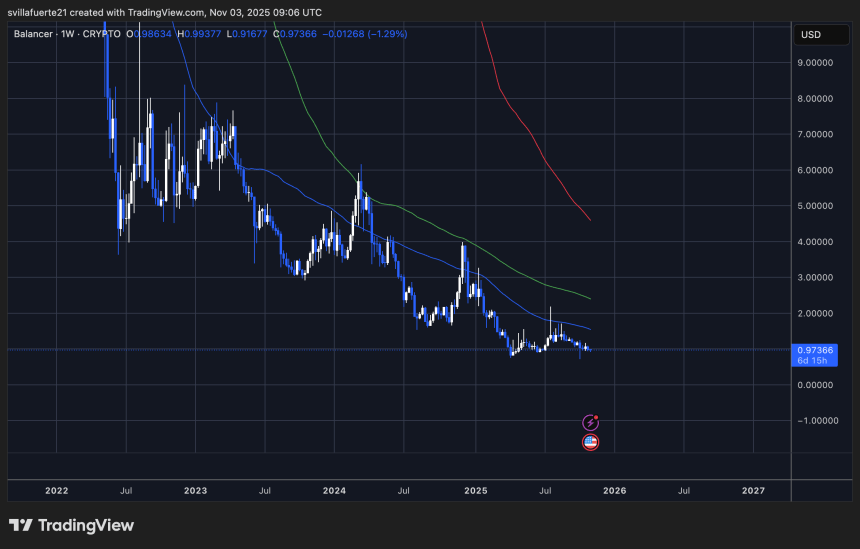
BAL price showing weakness | Source: BALUSDT chart on TradingView

Recent attempts to rebound have been shallow and short-lived. Indicating limited buying interest and a reluctance from market participants to position aggressively following the latest exploit news. This weakness predates the incident. However, BAL has been in a consistent downtrend for months, struggling to sustain demand even during broader market relief phases.

With the token sitting near its post-listing lows, the market is in a “show-me” phase. Bulls need to reclaim at least the $1.20–$1.40 area and break above the 50-week moving average to challenge the prevailing downtrend. Failure to do so risks deeper price compression and potential price discovery lower.

Featured image from ChatGPT, chart from TradingView.com

Disclaimer: The articles reposted on this site are sourced from public platforms and are provided for informational purposes only. They do not necessarily reflect the views of MEXC. All rights remain with the original authors. If you believe any content infringes on third-party rights, please contact service@support.mexc.com for removal. MEXC makes no guarantees regarding the accuracy, completeness, or timeliness of the content and is not responsible for any actions taken based on the information provided. The content does not constitute financial, legal, or other professional advice, nor should it be considered a recommendation or endorsement by MEXC.

You May Also Like

Akash Network’s Strategic Move: A Crucial Burn for AKT’s Future

Akash Network’s Strategic Move: A Crucial Burn for AKT’s Future

BitcoinWorld Akash Network’s Strategic Move: A Crucial Burn for AKT’s Future In the dynamic world of decentralized computing, exciting developments are constantly shaping the future. Today, all eyes are on Akash Network, the innovative supercloud project, as it proposes a significant change to its tokenomics. This move aims to strengthen the value of its native token, AKT, and further solidify its position in the competitive blockchain space. The community is buzzing about a newly submitted governance proposal that could introduce a game-changing Burn Mint Equilibrium (BME) model. What is the Burn Mint Equilibrium (BME) for Akash Network? The core of this proposal revolves around a concept called Burn Mint Equilibrium, or BME. Essentially, this model is designed to create a balance in the token’s circulating supply by systematically removing a portion of tokens from existence. For Akash Network, this means burning an amount of AKT that is equivalent to the U.S. dollar value of fees paid by network users. Fee Conversion: When users pay for cloud services on the Akash Network, these fees are typically collected in various cryptocurrencies or stablecoins. AKT Equivalence: The proposal suggests converting the U.S. dollar value of these collected fees into an equivalent amount of AKT. Token Burn: This calculated amount of AKT would then be permanently removed from circulation, or ‘burned’. This mechanism creates a direct link between network utility and token supply reduction. As more users utilize the decentralized supercloud, more AKT will be burned, potentially impacting the token’s scarcity and value. Why is This Proposal Crucial for AKT Holders? For anyone holding AKT, or considering investing in the Akash Network ecosystem, this proposal carries significant weight. Token burning mechanisms are often viewed as a positive development because they can lead to increased scarcity. When supply decreases while demand remains constant or grows, the price per unit tends to increase. Here are some key benefits: Increased Scarcity: Burning tokens reduces the total circulating supply of AKT. This makes each remaining token potentially more valuable over time. Demand-Supply Dynamics: The BME model directly ties the burning of AKT to network usage. Higher adoption of the Akash Network supercloud translates into more fees, and thus more AKT burned. Long-Term Value Proposition: By creating a deflationary pressure, the proposal aims to enhance AKT’s long-term value, making it a more attractive asset for investors and long-term holders. This strategic move demonstrates a commitment from the Akash Network community to optimize its tokenomics for sustainable growth and value appreciation. How Does BME Impact the Decentralized Supercloud Mission? Beyond token value, the BME proposal aligns perfectly with the broader mission of the Akash Network. As a decentralized supercloud, Akash provides a marketplace for cloud computing resources, allowing users to deploy applications faster, more efficiently, and at a lower cost than traditional providers. The BME model reinforces this utility. Consider these impacts: Network Health: A stronger AKT token can incentivize more validators and providers to secure and contribute resources to the network, improving its overall health and resilience. Ecosystem Growth: Enhanced token value can attract more developers and projects to build on the Akash Network, fostering a vibrant and diverse ecosystem. User Incentive: While users pay fees, the potential appreciation of AKT could indirectly benefit those who hold the token, creating a circular economy within the supercloud. This proposal is not just about burning tokens; it’s about building a more robust, self-sustaining, and economically sound decentralized cloud infrastructure for the future. What Are the Next Steps for the Akash Network Community? As a governance proposal, the BME model will now undergo a period of community discussion and voting. This is a crucial phase where AKT holders and network participants can voice their opinions, debate the merits, and ultimately decide on the future direction of the project. Transparency and community engagement are hallmarks of decentralized projects like Akash Network. Challenges and Considerations: Implementation Complexity: Ensuring the burning mechanism is technically sound and transparent will be vital. Community Consensus: Achieving broad agreement within the diverse Akash Network community is key for successful adoption. The outcome of this vote will significantly shape the tokenomics and economic model of the Akash Network, influencing its trajectory in the rapidly evolving decentralized cloud landscape. The proposal to introduce a Burn Mint Equilibrium model represents a bold and strategic step for Akash Network. By directly linking network usage to token scarcity, the project aims to create a more resilient and valuable AKT token, ultimately strengthening its position as a leading decentralized supercloud provider. This move underscores the project’s commitment to innovative tokenomics and sustainable growth, promising an exciting future for both users and investors in the Akash Network ecosystem. It’s a clear signal that Akash is actively working to enhance its value proposition and maintain its competitive edge in the decentralized future. Frequently Asked Questions (FAQs) 1. What is the main goal of the Burn Mint Equilibrium (BME) proposal for Akash Network? The primary goal is to adjust the circulating supply of AKT tokens by burning a portion of network fees, thereby creating deflationary pressure and potentially enhancing the token’s long-term value and scarcity. 2. How will the amount of AKT to be burned be determined? The proposal suggests burning an amount of AKT equivalent to the U.S. dollar value of fees paid by users on the Akash Network for cloud services. 3. What are the potential benefits for AKT token holders? Token holders could benefit from increased scarcity of AKT, which may lead to higher demand and appreciation in value over time, especially as network usage grows. 4. How does this proposal relate to the overall mission of Akash Network? The BME model reinforces the Akash Network‘s mission by creating a stronger, more economically robust ecosystem. A healthier token incentivizes network participants, fostering growth and stability for the decentralized supercloud. 5. What is the next step for this governance proposal? The proposal will undergo a period of community discussion and voting by AKT token holders. The community’s decision will determine if the BME model is implemented on the Akash Network. If you found this article insightful, consider sharing it with your network! Your support helps us bring more valuable insights into the world of decentralized technology. Stay informed and help spread the word about the exciting developments happening within Akash Network. To learn more about the latest crypto market trends, explore our article on key developments shaping decentralized cloud solutions price action. This post Akash Network’s Strategic Move: A Crucial Burn for AKT’s Future first appeared on BitcoinWorld.
Share
Coinstats2025/09/22 21:35




