Recent shifts in prediction market sentiment suggest growing skepticism among traders about the U.S. Supreme Court’s inclination to uphold President Trump’s broad authority to impose tariffs using emergency powers. As legal arguments unfold, markets are adjusting their probabilities, reflecting concerns over possible limits to presidential authority that could significantly influence future U.S. trade policy and [...]Recent shifts in prediction market sentiment suggest growing skepticism among traders about the U.S. Supreme Court’s inclination to uphold President Trump’s broad authority to impose tariffs using emergency powers. As legal arguments unfold, markets are adjusting their probabilities, reflecting concerns over possible limits to presidential authority that could significantly influence future U.S. trade policy and [...]

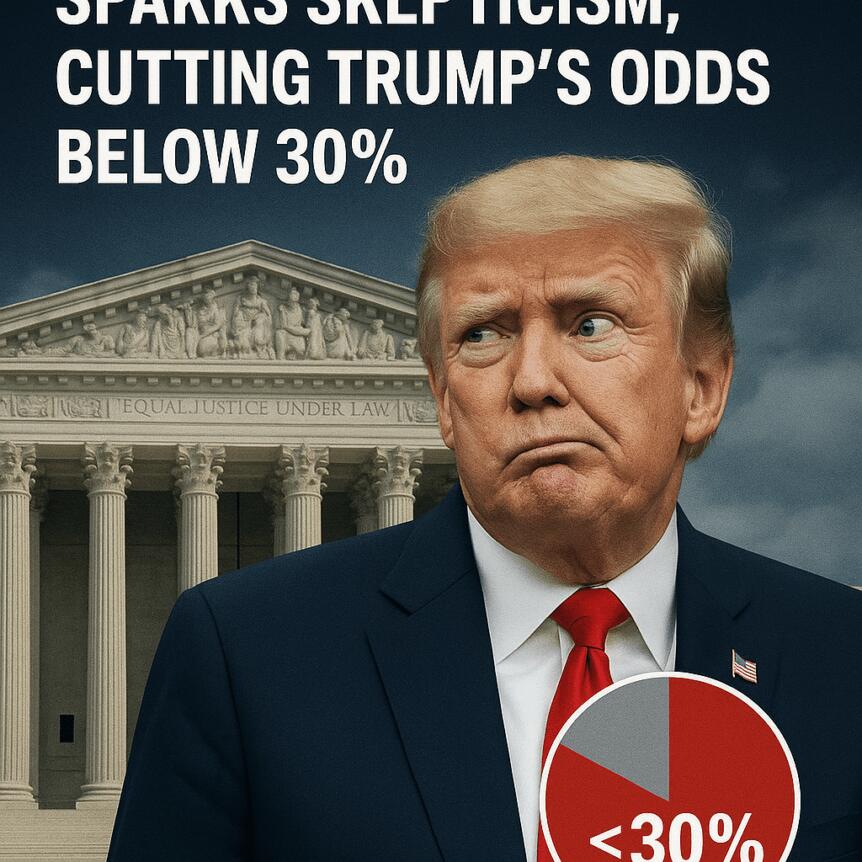
Supreme Court Ruling Sparks Skepticism, Cutting Trump’s Odds Below 30%
For feedback or concerns regarding this content, please contact us at crypto.news@mexc.com
Supreme Court Ruling Sparks Skepticism, Cutting Trump's Odds Below 30%

Recent shifts in prediction market sentiment suggest growing skepticism among traders about the U.S. Supreme Court’s inclination to uphold President Trump’s broad authority to impose tariffs using emergency powers. As legal arguments unfold, markets are adjusting their probabilities, reflecting concerns over possible limits to presidential authority that could significantly influence future U.S. trade policy and the crypto market’s response to political developments.

  • Prediction markets show a significant decline in confidence that the Supreme Court will side with Trump on tariff powers.
  • Both traditional and blockchain-based platforms anticipate a potential restriction on presidential tariff authority.
  • The latest market movements mirror ongoing legal debates and judicial skepticism regarding executive trade powers.
  • Volume in crypto prediction markets over $1.3 million, indicating early signals of political and legal sentiment.

Prediction markets, including regulated exchanges like Kalshi and blockchain-driven platforms such as Polymarket, are signaling a sharp drop in confidence regarding President Donald Trump’s ability to unilaterally impose tariffs through emergency powers. On Thursday, traders on Kalshi assigned only a 29% chance that the Supreme Court would favor Trump, a 28-point decline within a day. Meanwhile, Polymarket’s odds fell to 25%, highlighting a similar shift in sentiment among crypto-native traders.

The combined trading volume across these platforms exceeded $1.3 million, illustrating how prediction markets serve as early indicators of political and judicial risk sentiment linked to crypto markets. The divergence in market behavior coincides with heightened volatility since the Supreme Court agreed to review the case in September, notably on Wednesday when market declines reached their largest single-day drop since inception.

The prevailing market sentiment suggests that the Court is increasingly expected to limit the scope of the president’s authority to invoke tariffs under the 1977 International Emergency Economic Powers Act. A decision diminishing this power could reconfigure the approach of future U.S. administrations towards fiscal leverage and trade diplomacy. The alignment across traditional and decentralized markets underscores a convergence in how traders interpret political and legal risks through both fiat and blockchain platforms.

Traders foresee limits to Trump’s tariff authority

The decline in prediction market odds follows reports that several conservative justices expressed skepticism about Trump’s claim to independently impose broad import duties. During Wednesday’s oral arguments, the Supreme Court examined whether the president can rely on the 1977 law to unilateral tariff impositions without congressional approval.

An Associated Press analysis noted concerns even among Trump appointees about the separation of powers and concentrated fiscal authority. Chief Justice John Roberts, Justice Neil Gorsuch, and Justice Amy Coney Barrett questioned the scope of the executive’s powers under the law, with Barrett criticizing the targeting of specific countries and Roberts emphasizing that tariffs are fundamentally congressional taxes. Gorsuch cautioned that expansive executive authority could lead to unchecked presidential power expansion.

Trump’s trade policies have historically impacted cryptocurrency markets, with tariffs sparking inflation fears and prompting Bitcoin (BTC) to act as a hedge against fiscal instability. However, periods of uncertainty have also triggered risk-off behavior, causing short-term sell-offs as traders rotate into safer assets amidst economic concerns.

Related: From Taylor Swift to rate cuts, RedStone integrates real-world bets onchain with Kalshi

This article was originally published as Supreme Court Ruling Sparks Skepticism, Cutting Trump’s Odds Below 30% on Crypto Breaking News – your trusted source for crypto news, Bitcoin news, and blockchain updates.


Disclaimer: The articles reposted on this site are sourced from public platforms and are provided for informational purposes only. They do not necessarily reflect the views of MEXC. All rights remain with the original authors. If you believe any content infringes on third-party rights, please contact crypto.news@mexc.com for removal. MEXC makes no guarantees regarding the accuracy, completeness, or timeliness of the content and is not responsible for any actions taken based on the information provided. The content does not constitute financial, legal, or other professional advice, nor should it be considered a recommendation or endorsement by MEXC.

You May Also Like

OpenVPP accused of falsely advertising cooperation with the US government; SEC commissioner clarifies no involvement

OpenVPP accused of falsely advertising cooperation with the US government; SEC commissioner clarifies no involvement

PANews reported on September 17th that on-chain sleuth ZachXBT tweeted that OpenVPP ( $OVPP ) announced this week that it was collaborating with the US government to advance energy tokenization. SEC Commissioner Hester Peirce subsequently responded, stating that the company does not collaborate with or endorse any private crypto projects. The OpenVPP team subsequently hid the response. Several crypto influencers have participated in promoting the project, and the accounts involved have been questioned as typical influencer accounts.
Share
PANews2025/09/17 23:58
Trump's allegation against Noem would constitute a federal crime: analyst

Trump's allegation against Noem would constitute a federal crime: analyst

President Donald Trump caught everyone off guard by suddenly firing Homeland Security Secretary Kristi Noem — but being out of a job could just be the start of
Share
Rawstory2026/03/06 04:49
Aave DAO to Shut Down 50% of L2s While Doubling Down on GHO

Aave DAO to Shut Down 50% of L2s While Doubling Down on GHO

The post Aave DAO to Shut Down 50% of L2s While Doubling Down on GHO appeared on BitcoinEthereumNews.com. Aave DAO is gearing up for a significant overhaul by shutting down over 50% of underperforming L2 instances. It is also restructuring its governance framework and deploying over $100 million to boost GHO. This could be a pivotal moment that propels Aave back to the forefront of on-chain lending or sparks unprecedented controversy within the DeFi community. Sponsored Sponsored ACI Proposes Shutting Down 50% of L2s The “State of the Union” report by the Aave Chan Initiative (ACI) paints a candid picture. After a turbulent period in the DeFi market and internal challenges, Aave (AAVE) now leads in key metrics: TVL, revenue, market share, and borrowing volume. Aave’s annual revenue of $130 million surpasses the combined cash reserves of its competitors. Tokenomics improvements and the AAVE token buyback program have also contributed to the ecosystem’s growth. Aave global metrics. Source: Aave However, the ACI’s report also highlights several pain points. First, regarding the Layer-2 (L2) strategy. While Aave’s L2 strategy was once a key driver of success, it is no longer fit for purpose. Over half of Aave’s instances on L2s and alt-L1s are not economically viable. Based on year-to-date data, over 86.6% of Aave’s revenue comes from the mainnet, indicating that everything else is a side quest. On this basis, ACI proposes closing underperforming networks. The DAO should invest in key networks with significant differentiators. Second, ACI is pushing for a complete overhaul of the “friendly fork” framework, as most have been unimpressive regarding TVL and revenue. In some cases, attackers have exploited them to Aave’s detriment, as seen with Spark. Sponsored Sponsored “The friendly fork model had a good intention but bad execution where the DAO was too friendly towards these forks, allowing the DAO only little upside,” the report states. Third, the instance model, once a smart…
Share
BitcoinEthereumNews2025/09/18 02:28