The US Court of Appeals for the Eleventh Circuit has affirmed a district court’s refusal to award a Florida defendant the value of roughly 3,443 bitcoin—now “worth over $345 million”—after the government destroyed an external hard drive he belatedly claimed held the keys, holding that the equitable doctrine of laches bars relief because he spent […]The US Court of Appeals for the Eleventh Circuit has affirmed a district court’s refusal to award a Florida defendant the value of roughly 3,443 bitcoin—now “worth over $345 million”—after the government destroyed an external hard drive he belatedly claimed held the keys, holding that the equitable doctrine of laches bars relief because he spent […]

$345 Million In Bitcoin Gone — But FBI Isn’t At Fault, Judges Say

2025/11/07 10:00
4 min read

The US Court of Appeals for the Eleventh Circuit has affirmed a district court’s refusal to award a Florida defendant the value of roughly 3,443 bitcoin—now “worth over $345 million”—after the government destroyed an external hard drive he belatedly claimed held the keys, holding that the equitable doctrine of laches bars relief because he spent years denying he owned meaningful cryptocurrency. The published opinion, authored by Judge Elizabeth “Lisa” Branch Grant and joined by Judges Jill Pryor and Marcus, leaves intact the lower court’s ruling that the United States cannot be compelled to replace the bitcoin, even assuming the drive ever contained it.

FBI Not To Blame For 3,443 Bitcoin Hard Drive Wipe

The case, United States v. Prime, No. 23-13776, arose from a 2019 arrest that uncovered extensive counterfeiting and identity-theft paraphernalia. Michael Prime ultimately pleaded guilty to access-device fraud, aggravated identity theft, and illegal firearm possession. In the investigation’s early days, agents tried and failed three times to locate cryptocurrency tied to his activities under federal warrants; by sentencing in June 2020, Prime and his counsel had walked back earlier references to thousands of bitcoin, representing instead that his remaining crypto was trivial. The government proceeded accordingly.

As Judge Grant summarized, Prime “at least three times” represented he owned “very little bitcoin,” and after release he still did not identify any device as holding valuable keys when he sought the return of property. The government followed its “ordinary practices,” wiping devices it could after notice; the rest—including the orange external drive at issue—were destroyed. “Only later did Prime claim to be a bitcoin tycoon,” the court wrote. “By then it was too late.”

Although headlines have centered the FBI, the record shows it was the US Secret Service that contacted Prime in mid-2022 offering to wipe and return certain devices if he provided passwords. He asked for a pickup time, then filed pro se motions instead; none of those filings mentioned bitcoin or a hard drive. The drive was later destroyed with other electronics because Prime refused to cooperate in removing contraband data.

The Eleventh Circuit underscored causation and prejudice: “We have little difficulty concluding that the government would not have destroyed the hard drive if it had thought that it contained millions of dollars in bitcoin.” With the drive gone, “the government cannot return it,” and to the extent the bitcoin ever existed—“and we have our doubts”—ordering the United States to “find and hand over almost 3,443 replacement bitcoin” would be prejudicial “now to the tune of over $345 million.”

The panel was openly skeptical of Prime’s attempts to reframe his disclosures. He argued, for example, that when he reported “$200 to $1,500 in bitcoin” in February 2020, he meant the then-market price of a single bitcoin, not his holdings. “We don’t buy it,” the court wrote, noting that in February 2020 BTC traded between “about $8,500 and $10,500” and that Prime had promised “complete, accurate and truthful” asset disclosures encompassing any asset in which he had “any interest” or control. The opinion quotes defense counsel’s own admission at sentencing that the original claim to “some great amount of bitcoin” was “not supported by the evidence.”

Having affirmed on laches, the Eleventh Circuit did not reach broader questions, such as whether any BTC—if it existed—would have been forfeitable. The court also noted Prime forfeited any challenge to the factual finding that the drive was destroyed by failing to raise it below.

The narrow holding is that equitable relief is unavailable where a claimant’s multi-year denials induced the government to stop searching for assets and to process seized electronics in the ordinary course—conduct the panel repeatedly tied to his non-cooperation and delay rather than to any governmental bad faith. As Judge Grant summarized the district court’s bottom line, “laches barred his bitcoin request. We agree and affirm.”

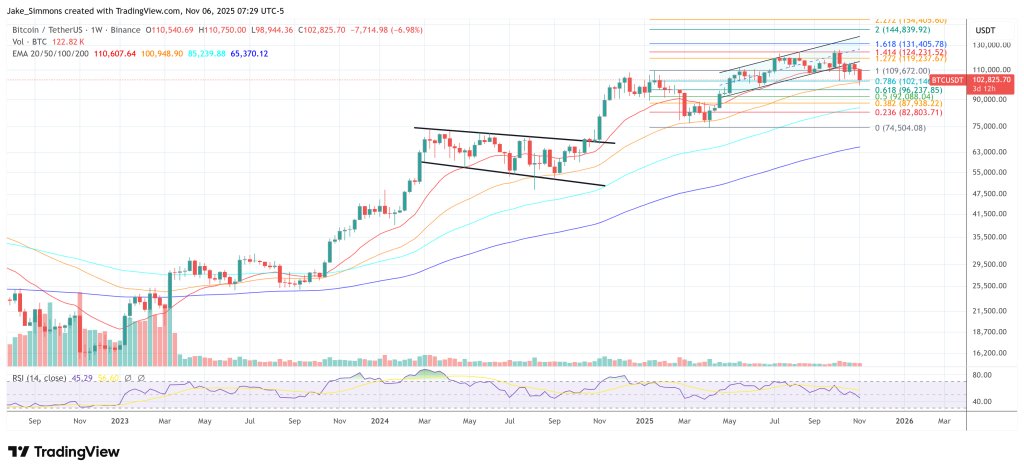
At press time, BTC traded at $102,825.
Bitcoin price
Market Opportunity
Threshold Logo
Threshold Price(T)
$0.006535
$0.006535$0.006535
-1.61%
USD
Threshold (T) Live Price Chart
Disclaimer: The articles reposted on this site are sourced from public platforms and are provided for informational purposes only. They do not necessarily reflect the views of MEXC. All rights remain with the original authors. If you believe any content infringes on third-party rights, please contact crypto.news@mexc.com for removal. MEXC makes no guarantees regarding the accuracy, completeness, or timeliness of the content and is not responsible for any actions taken based on the information provided. The content does not constitute financial, legal, or other professional advice, nor should it be considered a recommendation or endorsement by MEXC.

You May Also Like

Aave V4 roadmap signals end of multichain sprawl

Aave V4 roadmap signals end of multichain sprawl

The post Aave V4 roadmap signals end of multichain sprawl appeared on BitcoinEthereumNews.com. Aave Labs has released its official launch roadmap for V4, laying out the final steps ahead of the major upgrade’s Q4 mainnet launch.  Alongside new architectural and security improvements, the roadmap introduces a fundamental shift in how user balances are tracked and highlights a strategic pullback from economically underperforming deployments across layer-2 and alternative layer-1 networks. The V4 release moves away from aTokens’ rebasing-style mechanics toward ERC-4626-style share accounting, a change that promises cleaner integrations, easier tax treatment, and better compatibility with downstream DeFi infrastructure.  In a recent technical development update, Aave Labs confirmed that “tokenization is to remain optional and built using ERC 4626 vaults,” and that internal accounting will eliminate the use of exchange rates or scaled balances. The goal is to “further improve the overall reliability of the protocol.” ERC-4626 is a widely adopted Ethereum standard that expresses user deposits as shares of a vault rather than balances that grow over time. In Aave V3, aTokens accrue interest by increasing a user’s balance directly — behavior that resembles rebasing tokens and often confuses integrations and portfolio accounting tools.  By contrast, ERC-4626 tracks yield through a rising price-per-share metric, leaving token balances unchanged. The result is more predictable behavior for integrators, auditors and tax software, as well as a clearer cost basis for users. The roadmap also outlines a series of release milestones, including a formal codebase publication, a public testnet launch with a redesigned interface, and the completion of a multi-layered security review involving formal verification and manual audits. Aave Labs said the roadmap reflects the protocol’s “final stages of review, testing, and deployment,” and that additional documentation and launch preparation materials will be released in the coming weeks. But the most pointed strategic shift comes not from the codebase, but from Aave’s own governance forums. “Aave…
Share
BitcoinEthereumNews2025/09/18 07:40
NZD/USD Stages Remarkable Recovery: Kiwi Climbs Back to 0.6000 as Dollar Retreats

NZD/USD Stages Remarkable Recovery: Kiwi Climbs Back to 0.6000 as Dollar Retreats

BitcoinWorld NZD/USD Stages Remarkable Recovery: Kiwi Climbs Back to 0.6000 as Dollar Retreats In a notable shift during Thursday’s Asian trading session, the
Share
bitcoinworld2026/03/02 12:15
Mitsui Garden Hotel Sapporo Reopens with Experience-Led Transformation Strategy

Mitsui Garden Hotel Sapporo Reopens with Experience-Led Transformation Strategy

On February 1, 2026, Mitsui Garden Hotel Sapporo reopened after a full transformation led by Mitsui Fudosan Co., Ltd. and Mitsui Fudosan Hotel Management Co., Ltd
Share
Cxquest2026/03/02 12:37





