Australia’s financial regulator has warned that the country risks falling behind as blockchain-driven tokenization reshapes global markets, urging swift action to modernize regulations and embrace innovation. Speaking at the National Press Club in Canberra on November 5, Australian Securities and Investments Commission (ASIC) Chair Joe Longo said tokenization, the process of turning real-world assets into digital tokens, is transforming capital markets worldwide.Source: ASIC He cautioned that unless Australia adapts, it could become a “land of missed opportunity.” “Australia must innovate or stagnate. Seize the opportunity or be left behind,” Longo said in his keynote address. Global Tokenization Surges Past $35.8B; ASIC Warns of Australian Inaction Longo compared the coming wave of tokenization to past financial technology milestones, such as the introduction of electronic trading and the ASX’s CHESS system in 1994. He said distributed ledger technology could “fundamentally transform our capital markets,” with tokenization allowing instant settlement, fractional ownership, and greater access for investors. “J.P. Morgan has told me their money market funds will be entirely tokenized within two years,” he noted, adding that Nasdaq and the Depository Trust & Clearing Corporation (DTCC) are also developing tokenized trading and settlement platforms. The remarks come amid a global race to digitize traditional assets. Switzerland’s SIX Digital Exchange has already processed over $3 billion in digital bond issuances, and the U.K. is trialing a digital securities sandbox through the Bank of England and Financial Conduct Authority. In contrast, Australia’s tokenization efforts remain in early stages, with pilot programs like Project Acacia, led by the Reserve Bank and the Digital Finance Cooperative Research Centre, exploring tokenized debt markets. Tokenization allows assets such as real estate, government bonds, and private credit to be represented digitally on blockchains, improving efficiency, transparency, and liquidity. Globally, over $35.8 billion worth of real-world assets (RWAs) are now tokenized on-chain, according to data from RWA.xyz.Source: RWA.xyz The sector is dominated by private credit ($18.7 billion) and U.S. Treasury debt ($8.7 billion), reflecting institutional appetite for tokenized fixed-income products. According to the 2025 Skynet RWA Security Report, the market for tokenized real-world assets (RWA) could expand to $16 trillion by 2030. Tokenization’s growth is being driven by major financial players, from BlackRock and J.P. Morgan to DBS Bank, who are integrating blockchain infrastructure into traditional finance. Can Australia Catch Up as the World Embraces Tokenization? Longo’s concern is that while other nations are adapting regulatory frameworks to attract tokenized capital, Australia risks being sidelined by inaction. “Other countries are actively courting this capital,” he said. “If we fail to choose, the changes in our markets may not be for the better.” He pointed to the declining number of listed companies on the ASX and the rise of private markets, warning that an imbalance between transparency and innovation could expose the economy to risks. Australia’s private credit sector, now worth over $200 billion, has grown 500% in a decade, but Longo noted it remains “untested under market stress.” Longo further outlined ASIC’s plan to relaunch its Innovation Hub to support fintech and market infrastructure experiments, alongside renewed cooperation with international regulators. ASIC has also joined Singapore’s Project Guardian to explore tokenized funds and digital money settlement. He called for legal and regulatory reform to support innovation while maintaining investor protection, arguing that “risk done well is opportunity.” Additionally, Longo said his recent meeting with U.S. SEC Chair Paul Atkins made him realize Australia is competing with other nations to attract capital and secure a larger share of the fast-growing tokenization market. Longo concluded by urging collective action across government, regulators, and the private sector to build modern financial foundations. He said that if the Australian capital markets are to thrive into the future, the time to act is now, stating that the choice is to innovate or stagnate, to evolve or become extinctAustralia’s financial regulator has warned that the country risks falling behind as blockchain-driven tokenization reshapes global markets, urging swift action to modernize regulations and embrace innovation. Speaking at the National Press Club in Canberra on November 5, Australian Securities and Investments Commission (ASIC) Chair Joe Longo said tokenization, the process of turning real-world assets into digital tokens, is transforming capital markets worldwide.Source: ASIC He cautioned that unless Australia adapts, it could become a “land of missed opportunity.” “Australia must innovate or stagnate. Seize the opportunity or be left behind,” Longo said in his keynote address. Global Tokenization Surges Past $35.8B; ASIC Warns of Australian Inaction Longo compared the coming wave of tokenization to past financial technology milestones, such as the introduction of electronic trading and the ASX’s CHESS system in 1994. He said distributed ledger technology could “fundamentally transform our capital markets,” with tokenization allowing instant settlement, fractional ownership, and greater access for investors. “J.P. Morgan has told me their money market funds will be entirely tokenized within two years,” he noted, adding that Nasdaq and the Depository Trust & Clearing Corporation (DTCC) are also developing tokenized trading and settlement platforms. The remarks come amid a global race to digitize traditional assets. Switzerland’s SIX Digital Exchange has already processed over $3 billion in digital bond issuances, and the U.K. is trialing a digital securities sandbox through the Bank of England and Financial Conduct Authority. In contrast, Australia’s tokenization efforts remain in early stages, with pilot programs like Project Acacia, led by the Reserve Bank and the Digital Finance Cooperative Research Centre, exploring tokenized debt markets. Tokenization allows assets such as real estate, government bonds, and private credit to be represented digitally on blockchains, improving efficiency, transparency, and liquidity. Globally, over $35.8 billion worth of real-world assets (RWAs) are now tokenized on-chain, according to data from RWA.xyz.Source: RWA.xyz The sector is dominated by private credit ($18.7 billion) and U.S. Treasury debt ($8.7 billion), reflecting institutional appetite for tokenized fixed-income products. According to the 2025 Skynet RWA Security Report, the market for tokenized real-world assets (RWA) could expand to $16 trillion by 2030. Tokenization’s growth is being driven by major financial players, from BlackRock and J.P. Morgan to DBS Bank, who are integrating blockchain infrastructure into traditional finance. Can Australia Catch Up as the World Embraces Tokenization? Longo’s concern is that while other nations are adapting regulatory frameworks to attract tokenized capital, Australia risks being sidelined by inaction. “Other countries are actively courting this capital,” he said. “If we fail to choose, the changes in our markets may not be for the better.” He pointed to the declining number of listed companies on the ASX and the rise of private markets, warning that an imbalance between transparency and innovation could expose the economy to risks. Australia’s private credit sector, now worth over $200 billion, has grown 500% in a decade, but Longo noted it remains “untested under market stress.” Longo further outlined ASIC’s plan to relaunch its Innovation Hub to support fintech and market infrastructure experiments, alongside renewed cooperation with international regulators. ASIC has also joined Singapore’s Project Guardian to explore tokenized funds and digital money settlement. He called for legal and regulatory reform to support innovation while maintaining investor protection, arguing that “risk done well is opportunity.” Additionally, Longo said his recent meeting with U.S. SEC Chair Paul Atkins made him realize Australia is competing with other nations to attract capital and secure a larger share of the fast-growing tokenization market. Longo concluded by urging collective action across government, regulators, and the private sector to build modern financial foundations. He said that if the Australian capital markets are to thrive into the future, the time to act is now, stating that the choice is to innovate or stagnate, to evolve or become extinct

Australia Risks Being “Left Behind” as Tokenization Transforms Global Markets – ASIC

2025/11/08 03:13
4 min read
For feedback or concerns regarding this content, please contact us at crypto.news@mexc.com

Australia’s financial regulator has warned that the country risks falling behind as blockchain-driven tokenization reshapes global markets, urging swift action to modernize regulations and embrace innovation.

Speaking at the National Press Club in Canberra on November 5, Australian Securities and Investments Commission (ASIC) Chair Joe Longo said tokenization, the process of turning real-world assets into digital tokens, is transforming capital markets worldwide.
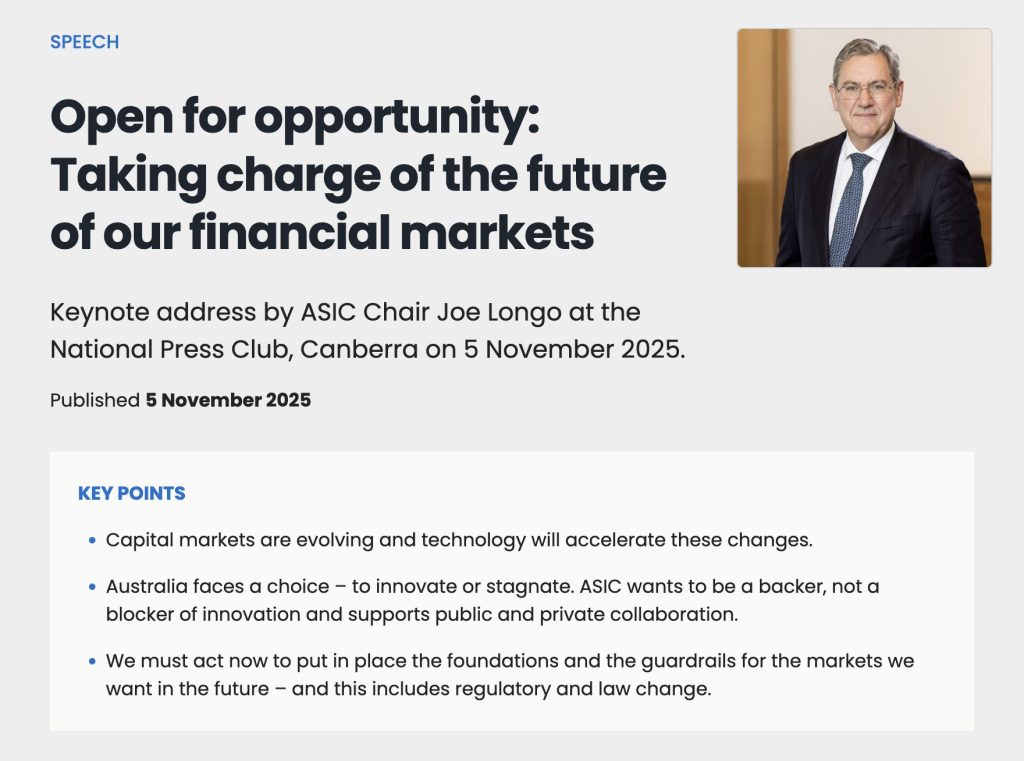
Source: ASIC

He cautioned that unless Australia adapts, it could become a “land of missed opportunity.”

“Australia must innovate or stagnate. Seize the opportunity or be left behind,” Longo said in his keynote address.

Global Tokenization Surges Past $35.8B; ASIC Warns of Australian Inaction

Longo compared the coming wave of tokenization to past financial technology milestones, such as the introduction of electronic trading and the ASX’s CHESS system in 1994.

He said distributed ledger technology could “fundamentally transform our capital markets,” with tokenization allowing instant settlement, fractional ownership, and greater access for investors.

“J.P. Morgan has told me their money market funds will be entirely tokenized within two years,” he noted, adding that Nasdaq and the Depository Trust & Clearing Corporation (DTCC) are also developing tokenized trading and settlement platforms.

The remarks come amid a global race to digitize traditional assets. Switzerland’s SIX Digital Exchange has already processed over $3 billion in digital bond issuances, and the U.K. is trialing a digital securities sandbox through the Bank of England and Financial Conduct Authority.

In contrast, Australia’s tokenization efforts remain in early stages, with pilot programs like Project Acacia, led by the Reserve Bank and the Digital Finance Cooperative Research Centre, exploring tokenized debt markets.

Tokenization allows assets such as real estate, government bonds, and private credit to be represented digitally on blockchains, improving efficiency, transparency, and liquidity.

Globally, over $35.8 billion worth of real-world assets (RWAs) are now tokenized on-chain, according to data from RWA.xyz.

Source: RWA.xyz

The sector is dominated by private credit ($18.7 billion) and U.S. Treasury debt ($8.7 billion), reflecting institutional appetite for tokenized fixed-income products.

According to the 2025 Skynet RWA Security Report, the market for tokenized real-world assets (RWA) could expand to $16 trillion by 2030.

Tokenization’s growth is being driven by major financial players, from BlackRock and J.P. Morgan to DBS Bank, who are integrating blockchain infrastructure into traditional finance.

Can Australia Catch Up as the World Embraces Tokenization?

Longo’s concern is that while other nations are adapting regulatory frameworks to attract tokenized capital, Australia risks being sidelined by inaction.

“Other countries are actively courting this capital,” he said. “If we fail to choose, the changes in our markets may not be for the better.”

He pointed to the declining number of listed companies on the ASX and the rise of private markets, warning that an imbalance between transparency and innovation could expose the economy to risks.

Australia’s private credit sector, now worth over $200 billion, has grown 500% in a decade, but Longo noted it remains “untested under market stress.”

Longo further outlined ASIC’s plan to relaunch its Innovation Hub to support fintech and market infrastructure experiments, alongside renewed cooperation with international regulators.

ASIC has also joined Singapore’s Project Guardian to explore tokenized funds and digital money settlement.

He called for legal and regulatory reform to support innovation while maintaining investor protection, arguing that “risk done well is opportunity.”

Additionally, Longo said his recent meeting with U.S. SEC Chair Paul Atkins made him realize Australia is competing with other nations to attract capital and secure a larger share of the fast-growing tokenization market.

Longo concluded by urging collective action across government, regulators, and the private sector to build modern financial foundations.

He said that if the Australian capital markets are to thrive into the future, the time to act is now, stating that the choice is to innovate or stagnate, to evolve or become extinct.


World Cup Combo: Aim for 200x

World Cup Combo: Aim for 200xWorld Cup Combo: Aim for 200x

Combine up to 20 World Cup matches in one order

Disclaimer: The articles reposted on this site are sourced from public platforms and are provided for informational purposes only. They do not necessarily reflect the views of MEXC. All rights remain with the original authors. If you believe any content infringes on third-party rights, please contact crypto.news@mexc.com for removal. MEXC makes no guarantees regarding the accuracy, completeness, or timeliness of the content and is not responsible for any actions taken based on the information provided. The content does not constitute financial, legal, or other professional advice, nor should it be considered a recommendation or endorsement by MEXC.

You May Also Like

Pacquiao insists Mayweather fight for real, shuns exhibition insinuation

Pacquiao insists Mayweather fight for real, shuns exhibition insinuation

Manny Pacquiao debunks Floyd Mayweather's assertion that their upcoming rematch is an exhibition, and, therefore, the American's 50-0 record wouldn't be at stake
Share
Rappler2026/04/02 17:55
Unleashing A New Era Of Seller Empowerment

Unleashing A New Era Of Seller Empowerment

The post Unleashing A New Era Of Seller Empowerment appeared on BitcoinEthereumNews.com. Amazon AI Agent: Unleashing A New Era Of Seller Empowerment Skip to content Home AI News Amazon AI Agent: Unleashing a New Era of Seller Empowerment Source: https://bitcoinworld.co.in/amazon-ai-seller-tools/
Share
BitcoinEthereumNews2025/09/18 00:10
CME Group to launch Solana and XRP futures options in October

CME Group to launch Solana and XRP futures options in October

The post CME Group to launch Solana and XRP futures options in October appeared on BitcoinEthereumNews.com. CME Group is preparing to launch options on SOL and XRP futures next month, giving traders new ways to manage exposure to the two assets.  The contracts are set to go live on October 13, pending regulatory approval, and will come in both standard and micro sizes with expiries offered daily, monthly and quarterly. The new listings mark a major step for CME, which first brought bitcoin futures to market in 2017 and added ether contracts in 2021. Solana and XRP futures have quickly gained traction since their debut earlier this year. CME says more than 540,000 Solana contracts (worth about $22.3 billion), and 370,000 XRP contracts (worth $16.2 billion), have already been traded. Both products hit record trading activity and open interest in August. Market makers including Cumberland and FalconX plan to support the new contracts, arguing that institutional investors want hedging tools beyond bitcoin and ether. CME’s move also highlights the growing demand for regulated ways to access a broader set of digital assets. The launch, which still needs the green light from regulators, follows the end of XRP’s years-long legal fight with the US Securities and Exchange Commission. A federal court ruling in 2023 found that institutional sales of XRP violated securities laws, but programmatic exchange sales did not. The case officially closed in August 2025 after Ripple agreed to pay a $125 million fine, removing one of the biggest uncertainties hanging over the token. This is a developing story. This article was generated with the assistance of AI and reviewed by editor Jeffrey Albus before publication. Get the news in your inbox. Explore Blockworks newsletters: Source: https://blockworks.co/news/cme-group-solana-xrp-futures
Share
BitcoinEthereumNews2025/09/17 23:55