In a move highlighting its expansion beyond stablecoins, Tether reportedly plans to invest over $1 billion in German robotics startup Neura. The potential investment aims to enhance Tether’s footprint in the burgeoning fields of artificial intelligence and automation, reflecting the company’s broader ambitions in emerging technologies. Tether is considering a $1.15 billion investment in German [...]In a move highlighting its expansion beyond stablecoins, Tether reportedly plans to invest over $1 billion in German robotics startup Neura. The potential investment aims to enhance Tether’s footprint in the burgeoning fields of artificial intelligence and automation, reflecting the company’s broader ambitions in emerging technologies. Tether is considering a $1.15 billion investment in German [...]

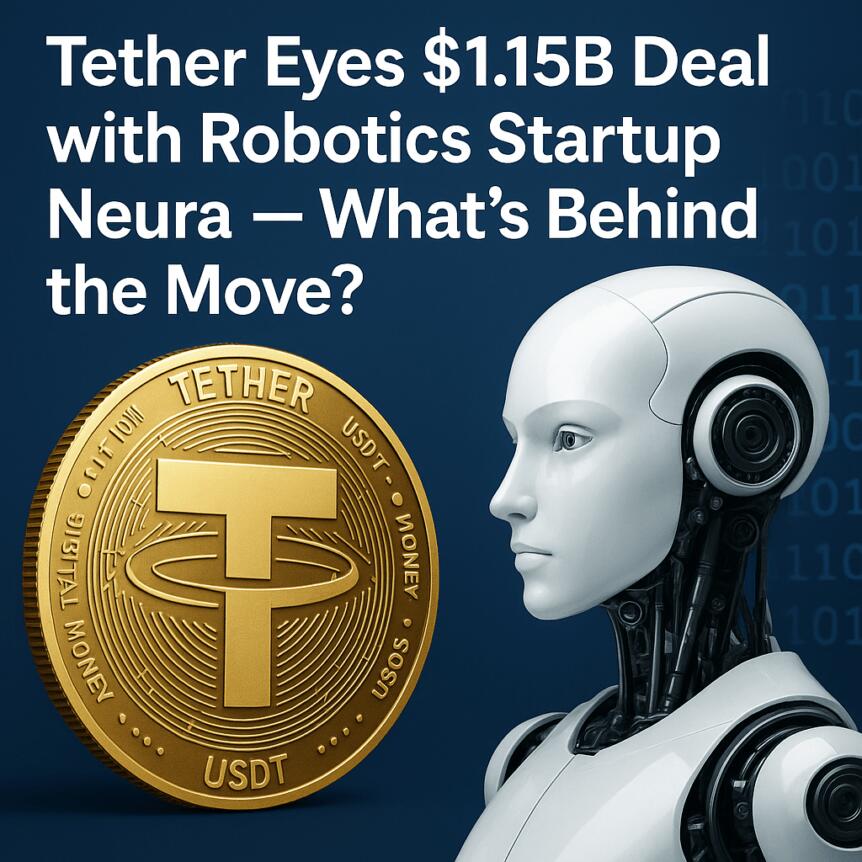
Tether Eyes $1.15B Deal with Robotics Startup Neura — What’s Behind the Move?
For feedback or concerns regarding this content, please contact us at crypto.news@mexc.com
Tether Eyes $1.15b Deal With Robotics Startup Neura — What’s Behind The Move?
In a move highlighting its expansion beyond stablecoins, Tether reportedly plans to invest over $1 billion in German robotics startup Neura. The potential investment aims to enhance Tether’s footprint in the burgeoning fields of artificial intelligence and automation, reflecting the company’s broader ambitions in emerging technologies.
  • Tether is considering a $1.15 billion investment in German AI robotics firm Neura, potentially boosting Neura’s valuation to up to $11.6 billion.
  • The deal would mark Tether’s latest expansion beyond cryptocurrencies into sectors like AI, robotics, energy, and sports ownership.
  • Neura’s robots focus on assisting humans with tasks ranging from industrial automation to household chores, aiming to produce 5 million units by 2030.
  • Tether’s financial health remains strong, with a profit of over $10 billion in the first three quarters of 2025, driven mainly by earnings on US Treasury-backed stablecoins.
  • The stablecoin giant has recently expanded into commodities, with investments in agricultural products, oil, and tokenized gold, positioning itself as a versatile player in global markets.

Stablecoin provider Tether appears poised to deepen its involvement in the artificial intelligence and robotics sectors, with reports indicating a potential $1.15 billion investment in Germany’s Neura. If finalized, this deal could significantly elevate Neura’s valuation, placing it between $9.3 billion and $11.6 billion, according to industry sources. The news underscores Tether’s strategic shift from primarily backing a dominant stablecoin to investing in emerging tech sectors that leverage blockchain and AI innovations.

A deal of this magnitude would expand Tether’s portfolio, which already includes investments in more than 140 companies across industries such as Bitcoin mining, energy, finance, and even professional sports. An investment in Neura would specifically aim to foster development in “smarter automation,” with robots designed to assist humans in both workplaces and households. Neura’s current goal is to produce five million robots by 2030, capable of performing routine household chores and streamlining industrial operations.

Tether’s Strong Financial Position in 2025

Tether’s balance sheet is looking healthier than ever in 2025, with the company reporting a net profit exceeding $10 billion for the first nine months of the year. This continues the trend from 2024, which saw profits of approximately $13.4 billion, making Tether one of the most profitable companies relative to its size globally. The company’s revenue streams are mainly derived from interest on U.S. Treasury bills backing its flagship stablecoin, USDT, which now boasts a market capitalization around $184 billion.

Tether’s Expanding Portfolio in Commodities

Recently, Tether announced further diversification into the commodities sector. CEO Paolo Ardoino revealed that the company has already deployed around $1.5 billion into agricultural and oil trade finance, aiming to tap into global commodity markets. This aligns with Tether’s broader strategy of tokenizing traditional assets, exemplified by its gold-backed token, Tether Gold (XAUT), which surged over 70% in market cap in recent months amid a rally in physical gold.

The company has also been reportedly exploring a significant fundraising round, potentially raising up to $20 billion, that could value it at around $500 billion — comparable to major tech firms like OpenAI. As Tether continues to diversify its holdings and revenue streams, it remains a key player in the ongoing evolution of the global crypto, DeFi, and blockchain markets.

This article was originally published as Tether Eyes $1.15B Deal with Robotics Startup Neura — What’s Behind the Move? on Crypto Breaking News – your trusted source for crypto news, Bitcoin news, and blockchain updates.


Disclaimer: The articles reposted on this site are sourced from public platforms and are provided for informational purposes only. They do not necessarily reflect the views of MEXC. All rights remain with the original authors. If you believe any content infringes on third-party rights, please contact crypto.news@mexc.com for removal. MEXC makes no guarantees regarding the accuracy, completeness, or timeliness of the content and is not responsible for any actions taken based on the information provided. The content does not constitute financial, legal, or other professional advice, nor should it be considered a recommendation or endorsement by MEXC.

You May Also Like

OpenVPP accused of falsely advertising cooperation with the US government; SEC commissioner clarifies no involvement

OpenVPP accused of falsely advertising cooperation with the US government; SEC commissioner clarifies no involvement

PANews reported on September 17th that on-chain sleuth ZachXBT tweeted that OpenVPP ( $OVPP ) announced this week that it was collaborating with the US government to advance energy tokenization. SEC Commissioner Hester Peirce subsequently responded, stating that the company does not collaborate with or endorse any private crypto projects. The OpenVPP team subsequently hid the response. Several crypto influencers have participated in promoting the project, and the accounts involved have been questioned as typical influencer accounts.
Share
PANews2025/09/17 23:58
Trump's allegation against Noem would constitute a federal crime: analyst

Trump's allegation against Noem would constitute a federal crime: analyst

President Donald Trump caught everyone off guard by suddenly firing Homeland Security Secretary Kristi Noem — but being out of a job could just be the start of
Share
Rawstory2026/03/06 04:49
Aave DAO to Shut Down 50% of L2s While Doubling Down on GHO

Aave DAO to Shut Down 50% of L2s While Doubling Down on GHO

The post Aave DAO to Shut Down 50% of L2s While Doubling Down on GHO appeared on BitcoinEthereumNews.com. Aave DAO is gearing up for a significant overhaul by shutting down over 50% of underperforming L2 instances. It is also restructuring its governance framework and deploying over $100 million to boost GHO. This could be a pivotal moment that propels Aave back to the forefront of on-chain lending or sparks unprecedented controversy within the DeFi community. Sponsored Sponsored ACI Proposes Shutting Down 50% of L2s The “State of the Union” report by the Aave Chan Initiative (ACI) paints a candid picture. After a turbulent period in the DeFi market and internal challenges, Aave (AAVE) now leads in key metrics: TVL, revenue, market share, and borrowing volume. Aave’s annual revenue of $130 million surpasses the combined cash reserves of its competitors. Tokenomics improvements and the AAVE token buyback program have also contributed to the ecosystem’s growth. Aave global metrics. Source: Aave However, the ACI’s report also highlights several pain points. First, regarding the Layer-2 (L2) strategy. While Aave’s L2 strategy was once a key driver of success, it is no longer fit for purpose. Over half of Aave’s instances on L2s and alt-L1s are not economically viable. Based on year-to-date data, over 86.6% of Aave’s revenue comes from the mainnet, indicating that everything else is a side quest. On this basis, ACI proposes closing underperforming networks. The DAO should invest in key networks with significant differentiators. Second, ACI is pushing for a complete overhaul of the “friendly fork” framework, as most have been unimpressive regarding TVL and revenue. In some cases, attackers have exploited them to Aave’s detriment, as seen with Spark. Sponsored Sponsored “The friendly fork model had a good intention but bad execution where the DAO was too friendly towards these forks, allowing the DAO only little upside,” the report states. Third, the instance model, once a smart…
Share
BitcoinEthereumNews2025/09/18 02:28




