CryptoQuant CEO Ki Young Ju has put a clear reference level on the current Bitcoin correction – but is adamant it should not be mistaken for a prediction. “Many people seem to be misunderstanding this, so let me clarify,” he wrote. “I am not saying $56K is the bottom. I am saying the realized price is 56K. If you follow the cycle theory, that level would be the bottom. But I think the cycle theory is broken, and the price could flip at any time depending on macro conditions and market sentiment.” Bitcoin Realized Price Sits at $56,000 His latest data briefing breaks the market into three layers: futures, spot, and on-chain. In the futures market, Ju says the average order size shows that futures whales have left and retail now dominates. Internal flow profile (IFP) data indicates BTC inflows from spot to futures exchanges have collapsed, ending the phase when large players were posting BTC as collateral to go long. Related Reading: Why Is Bitcoin Price Crashing? Arthur Hayes Isn’t Surprised At the same time, the Estimated Leverage Ratio remains high, and Binance deposit cost basis sits around $57,000, which “means traders already captured large gains from ETF and institutional flows.” Open interest is still above last year’s levels, while the aggregated funding rate is neutral, not fearful, suggesting leverage remains elevated but without a classic capitulation reset. Spot data points to fading institutional aggression. Ju notes the Coinbase Premium is at a nine-month low, which he attributes to ETF-driven institutional selling. Spot Bitcoin ETFs have seen net negative weekly flows for three straight weeks, and Strategy mNAV at 1.23 implies that “near-term capital raising seems difficult,” as many structured strategies are already sitting on substantial gains. On-chain metrics provide the context for the much-discussed $56,000 level. Ju observes that realized cap growth has stalled for three days, while market cap is growing more slowly than realized cap, a configuration he interprets as strong selling pressure as profitable coins move. CryptoQuant’s PnL Index flipped short on November 8, which Ju summarizes as whales taking profit. “If the cycle theory holds, the cycle bottom would be around $56K (realized price),” he says – and immediately distances himself from treating that as a hard rule in a structurally changing market. CryptoQuant CEO Rejects Classic Cycle Bottom Theory In a separate prediction segment, Ju turns to macro conditions. “Short-term conditions are weak: dollar liquidity is slow, funding markets are tight, and Bitcoin inflows have cooled,” he writes. However, he adds, “I do not expect Bitcoin inflows to stop or turn into sustained outflows over the next six months.” Related Reading: Bitcoin SSR Flashes Buy Signal: Rebound Incoming? In his view, a shift in the policy narrative could rapidly invert sentiment: “If rate cuts or any easy-money narrative appears, sentiment could flip and liquidity would rush back into ETFs.” Ju also sketches a longer-term structural thesis. He argues that stablecoin adoption and a wave of reverse ICOs by public companies could push traditional assets onto DEXs, enabling on-chain long and short trading in names like Tesla. In that world, on-chain analysis could evolve into labeling wallets like “Elon Musk’s ETH address to track Tesla coin onchain inflows and outflows.” He believes Bitcoin would benefit the most, while altcoins with weak narratives or no real performance would likely lose liquidity as capital concentrates in assets with clear utility or narrative strength. “I gave up predicting Bitcoin price,” Ju reminds followers, “but I haven’t given up analyzing data.” His $56,000 reference is best understood in that spirit: a data-driven anchor derived from realized price and cycle theory, not a promise that this drawdown will end neatly at that line. At press time, BTC traded at $91,659. Featured image created with DALL.E, chart from TradingView.comCryptoQuant CEO Ki Young Ju has put a clear reference level on the current Bitcoin correction – but is adamant it should not be mistaken for a prediction. “Many people seem to be misunderstanding this, so let me clarify,” he wrote. “I am not saying $56K is the bottom. I am saying the realized price is 56K. If you follow the cycle theory, that level would be the bottom. But I think the cycle theory is broken, and the price could flip at any time depending on macro conditions and market sentiment.” Bitcoin Realized Price Sits at $56,000 His latest data briefing breaks the market into three layers: futures, spot, and on-chain. In the futures market, Ju says the average order size shows that futures whales have left and retail now dominates. Internal flow profile (IFP) data indicates BTC inflows from spot to futures exchanges have collapsed, ending the phase when large players were posting BTC as collateral to go long. Related Reading: Why Is Bitcoin Price Crashing? Arthur Hayes Isn’t Surprised At the same time, the Estimated Leverage Ratio remains high, and Binance deposit cost basis sits around $57,000, which “means traders already captured large gains from ETF and institutional flows.” Open interest is still above last year’s levels, while the aggregated funding rate is neutral, not fearful, suggesting leverage remains elevated but without a classic capitulation reset. Spot data points to fading institutional aggression. Ju notes the Coinbase Premium is at a nine-month low, which he attributes to ETF-driven institutional selling. Spot Bitcoin ETFs have seen net negative weekly flows for three straight weeks, and Strategy mNAV at 1.23 implies that “near-term capital raising seems difficult,” as many structured strategies are already sitting on substantial gains. On-chain metrics provide the context for the much-discussed $56,000 level. Ju observes that realized cap growth has stalled for three days, while market cap is growing more slowly than realized cap, a configuration he interprets as strong selling pressure as profitable coins move. CryptoQuant’s PnL Index flipped short on November 8, which Ju summarizes as whales taking profit. “If the cycle theory holds, the cycle bottom would be around $56K (realized price),” he says – and immediately distances himself from treating that as a hard rule in a structurally changing market. CryptoQuant CEO Rejects Classic Cycle Bottom Theory In a separate prediction segment, Ju turns to macro conditions. “Short-term conditions are weak: dollar liquidity is slow, funding markets are tight, and Bitcoin inflows have cooled,” he writes. However, he adds, “I do not expect Bitcoin inflows to stop or turn into sustained outflows over the next six months.” Related Reading: Bitcoin SSR Flashes Buy Signal: Rebound Incoming? In his view, a shift in the policy narrative could rapidly invert sentiment: “If rate cuts or any easy-money narrative appears, sentiment could flip and liquidity would rush back into ETFs.” Ju also sketches a longer-term structural thesis. He argues that stablecoin adoption and a wave of reverse ICOs by public companies could push traditional assets onto DEXs, enabling on-chain long and short trading in names like Tesla. In that world, on-chain analysis could evolve into labeling wallets like “Elon Musk’s ETH address to track Tesla coin onchain inflows and outflows.” He believes Bitcoin would benefit the most, while altcoins with weak narratives or no real performance would likely lose liquidity as capital concentrates in assets with clear utility or narrative strength. “I gave up predicting Bitcoin price,” Ju reminds followers, “but I haven’t given up analyzing data.” His $56,000 reference is best understood in that spirit: a data-driven anchor derived from realized price and cycle theory, not a promise that this drawdown will end neatly at that line. At press time, BTC traded at $91,659. Featured image created with DALL.E, chart from TradingView.com
Will Bitcoin Bottom At $56,000? CryptoQuant CEO Presents The Data

2025/11/20 00:00

CryptoQuant CEO Ki Young Ju has put a clear reference level on the current Bitcoin correction – but is adamant it should not be mistaken for a prediction.

“Many people seem to be misunderstanding this, so let me clarify,” he wrote. “I am not saying $56K is the bottom. I am saying the realized price is 56K. If you follow the cycle theory, that level would be the bottom. But I think the cycle theory is broken, and the price could flip at any time depending on macro conditions and market sentiment.”

Bitcoin Realized Price Sits at $56,000

His latest data briefing breaks the market into three layers: futures, spot, and on-chain.

In the futures market, Ju says the average order size shows that futures whales have left and retail now dominates. Internal flow profile (IFP) data indicates BTC inflows from spot to futures exchanges have collapsed, ending the phase when large players were posting BTC as collateral to go long.

At the same time, the Estimated Leverage Ratio remains high, and Binance deposit cost basis sits around $57,000, which “means traders already captured large gains from ETF and institutional flows.” Open interest is still above last year’s levels, while the aggregated funding rate is neutral, not fearful, suggesting leverage remains elevated but without a classic capitulation reset.

Spot data points to fading institutional aggression. Ju notes the Coinbase Premium is at a nine-month low, which he attributes to ETF-driven institutional selling. Spot Bitcoin ETFs have seen net negative weekly flows for three straight weeks, and Strategy mNAV at 1.23 implies that “near-term capital raising seems difficult,” as many structured strategies are already sitting on substantial gains.

On-chain metrics provide the context for the much-discussed $56,000 level. Ju observes that realized cap growth has stalled for three days, while market cap is growing more slowly than realized cap, a configuration he interprets as strong selling pressure as profitable coins move.

CryptoQuant’s PnL Index flipped short on November 8, which Ju summarizes as whales taking profit. “If the cycle theory holds, the cycle bottom would be around $56K (realized price),” he says – and immediately distances himself from treating that as a hard rule in a structurally changing market.

CryptoQuant CEO Rejects Classic Cycle Bottom Theory

In a separate prediction segment, Ju turns to macro conditions. “Short-term conditions are weak: dollar liquidity is slow, funding markets are tight, and Bitcoin inflows have cooled,” he writes. However, he adds, “I do not expect Bitcoin inflows to stop or turn into sustained outflows over the next six months.”

In his view, a shift in the policy narrative could rapidly invert sentiment: “If rate cuts or any easy-money narrative appears, sentiment could flip and liquidity would rush back into ETFs.”

Ju also sketches a longer-term structural thesis. He argues that stablecoin adoption and a wave of reverse ICOs by public companies could push traditional assets onto DEXs, enabling on-chain long and short trading in names like Tesla. In that world, on-chain analysis could evolve into labeling wallets like “Elon Musk’s ETH address to track Tesla coin onchain inflows and outflows.”

He believes Bitcoin would benefit the most, while altcoins with weak narratives or no real performance would likely lose liquidity as capital concentrates in assets with clear utility or narrative strength.

“I gave up predicting Bitcoin price,” Ju reminds followers, “but I haven’t given up analyzing data.” His $56,000 reference is best understood in that spirit: a data-driven anchor derived from realized price and cycle theory, not a promise that this drawdown will end neatly at that line.

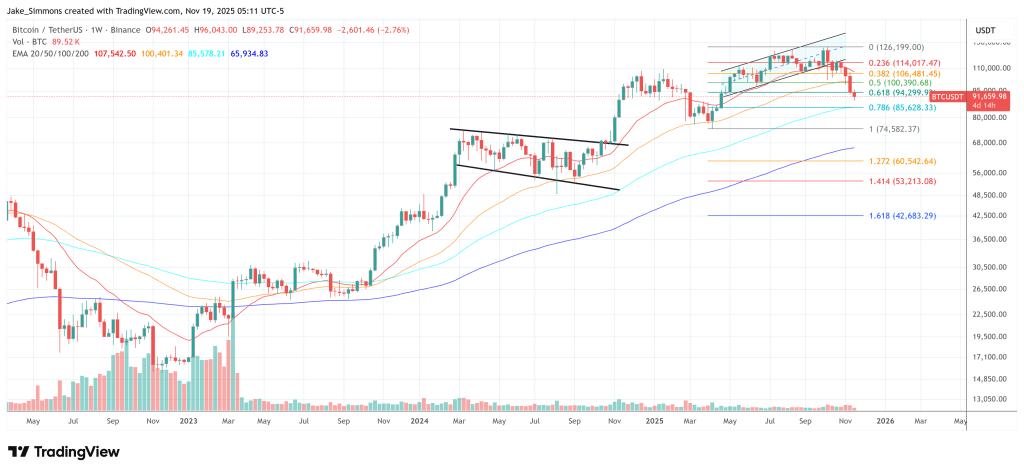
At press time, BTC traded at $91,659.

Bitcoin price
Market Opportunity
Everclear Logo
Everclear Price(CLEAR)
$0.00404
$0.00404$0.00404
-18.87%
USD
Everclear (CLEAR) Live Price Chart
Disclaimer: The articles reposted on this site are sourced from public platforms and are provided for informational purposes only. They do not necessarily reflect the views of MEXC. All rights remain with the original authors. If you believe any content infringes on third-party rights, please contact service@support.mexc.com for removal. MEXC makes no guarantees regarding the accuracy, completeness, or timeliness of the content and is not responsible for any actions taken based on the information provided. The content does not constitute financial, legal, or other professional advice, nor should it be considered a recommendation or endorsement by MEXC.

You May Also Like

Pump Fun Fund Launches $3M Hackathon: Market-Driven Startups

Pump Fun Fund Launches $3M Hackathon: Market-Driven Startups

The post Pump Fun Fund Launches $3M Hackathon: Market-Driven Startups appeared on BitcoinEthereumNews.com. In a bid to evolve beyond its roots as a memecoin launchpad
Share
BitcoinEthereumNews2026/01/20 20:06
WhatsApp Web to get group voice and video calls soon

WhatsApp Web to get group voice and video calls soon

The post WhatsApp Web to get group voice and video calls soon appeared on BitcoinEthereumNews.com. WhatsApp is developing voice and video calling features for group
Share
BitcoinEthereumNews2026/01/20 20:13
Aave DAO to Shut Down 50% of L2s While Doubling Down on GHO

Aave DAO to Shut Down 50% of L2s While Doubling Down on GHO

The post Aave DAO to Shut Down 50% of L2s While Doubling Down on GHO appeared on BitcoinEthereumNews.com. Aave DAO is gearing up for a significant overhaul by shutting down over 50% of underperforming L2 instances. It is also restructuring its governance framework and deploying over $100 million to boost GHO. This could be a pivotal moment that propels Aave back to the forefront of on-chain lending or sparks unprecedented controversy within the DeFi community. Sponsored Sponsored ACI Proposes Shutting Down 50% of L2s The “State of the Union” report by the Aave Chan Initiative (ACI) paints a candid picture. After a turbulent period in the DeFi market and internal challenges, Aave (AAVE) now leads in key metrics: TVL, revenue, market share, and borrowing volume. Aave’s annual revenue of $130 million surpasses the combined cash reserves of its competitors. Tokenomics improvements and the AAVE token buyback program have also contributed to the ecosystem’s growth. Aave global metrics. Source: Aave However, the ACI’s report also highlights several pain points. First, regarding the Layer-2 (L2) strategy. While Aave’s L2 strategy was once a key driver of success, it is no longer fit for purpose. Over half of Aave’s instances on L2s and alt-L1s are not economically viable. Based on year-to-date data, over 86.6% of Aave’s revenue comes from the mainnet, indicating that everything else is a side quest. On this basis, ACI proposes closing underperforming networks. The DAO should invest in key networks with significant differentiators. Second, ACI is pushing for a complete overhaul of the “friendly fork” framework, as most have been unimpressive regarding TVL and revenue. In some cases, attackers have exploited them to Aave’s detriment, as seen with Spark. Sponsored Sponsored “The friendly fork model had a good intention but bad execution where the DAO was too friendly towards these forks, allowing the DAO only little upside,” the report states. Third, the instance model, once a smart…
Share
BitcoinEthereumNews2025/09/18 02:28
