Bitcoin Magazine Bitcoin Price Flash-Crashes to $80,000 Before Rebounding as Market Stress Nears FTX-Era Levels Bitcoin price plunged to $83,000, hitting FTX-era stress levels, as short-term holders capitulate and market volatility spikes. This post Bitcoin Price Flash-Crashes to $80,000 Before Rebounding as Market Stress Nears FTX-Era Levels first appeared on Bitcoin Magazine and is written by Micah Zimmerman.Bitcoin Magazine Bitcoin Price Flash-Crashes to $80,000 Before Rebounding as Market Stress Nears FTX-Era Levels Bitcoin price plunged to $83,000, hitting FTX-era stress levels, as short-term holders capitulate and market volatility spikes. This post Bitcoin Price Flash-Crashes to $80,000 Before Rebounding as Market Stress Nears FTX-Era Levels first appeared on Bitcoin Magazine and is written by Micah Zimmerman.

Bitcoin Price Flash-Crashes to $80,000 Before Rebounding as Market Stress Nears FTX-Era Levels

Bitcoin Magazine

Bitcoin Price Flash-Crashes to $80,000 Before Rebounding as Market Stress Nears FTX-Era Levels

Bitcoin price is entering one of its most fragile moments of the cycle. The price action says it. The onchain data screams it. And the mood across crypto feels tense, almost brittle

Bitcoin price fell to a low of $80,524 on Friday, its lowest level since April and a level many didn’t expect to see again this year. The drop pushed the bitcoin price more than 35% below its all-time high, erasing all year-to-date gains and dragging risk sentiment across the entire market with it. 

Since the dip, the Bitcoin price has rebounded to the $84,000 range, showing high volatility across crypto markets. 

Glassnode data shows realized losses spiking to levels last seen during the November 2022 FTX capitulation. Short-term holders — those who bought within the last 90 days — are unwinding at scale. Their selling now dominates the tape. Realized-loss dominance has surged into a range usually reserved for panic. 

Market structure is also breaking down. Independent analyst MEKhoko noted that Bitcoin is now trading more than 3.5 standard deviations below its 200-day moving average. That type of deviation has appeared only three times in the last decade: late 2018, the March 2020 crash, and the June 2022 Three Arrows/Luna meltdown. Each event marked a moment of extreme fear, forced selling, and exhaustion.

This week feels similar. Funding rates collapsed. Spot sellers stepped forward. Momentum traders vanished. The market’s marginal buyer— the one who chases strength—has simply stepped aside.

The result is a chart stretched to its limits and a community trying to make sense of it.

Some point to macro pressures. Rate-cut hopes have faded. AI stocks broke down. Volatility jumped across traditional markets. Crypto didn’t stand a chance.

Despite this, the bitcoin price pullback has nearly reached the $78,000 to $82,000 zone of Giovanni Santostasi’s Bitcoin power-law model, a region that has historically generated mid-cycle bounces rather than cycle lows, offering bulls a sliver of hope as price revisits levels last touched multiple times in 2024.

Others point to the Oct. 10 “mechanical glitch.” Tom Lee said a stablecoin price feed malfunction triggered cascading liquidations across exchanges. Nearly two million accounts were wiped before anyone realized what was happening. The market, he argued, has been “limping along” ever since.

On October 10, the crypto market experienced a massive “flash crash” and deleveraging event, triggered by an unexpected U.S. tariff announcement that sent shockwaves through global markets. This resulted in over $19 billion in leveraged positions being liquidated within hours, marking it as one of the largest single-day wipeouts in crypto history. The remnants of the crash are still being felt today.

Still others see deliberate pressure. Mike Alfred accused large players of pushing Bitcoin lower through derivatives. Lee said he agreed. 

The probability of retesting new all-time highs in the coming weeks has dropped below 50% unless major levels are reclaimed.

Bitcoin price outlook

Bitcoin Magazine analysts believe that the core message of buying every dip is no longer a reliable strategy. In downtrending markets, multiple failed dips are common, and the Short-Term Holder Realized Price — historically a pivot for recoveries — now acts as resistance. Meanwhile, broader cost-basis metrics such as Realized Price and the 200-Week Moving Average sit in the mid-$50Ks and rise slowly, suggesting eventual value zones may develop anywhere from $55K to $65K or higher depending on how long weakness persists.

Supply-demand indicators reinforce caution. The VDD Multiple continues rising as price falls, showing experienced holders are distributing, not accumulating. Long-term holder supply is also declining, another sign that the market is still unwinding. Funding rates and derivatives positioning have not shown the typical capitulation extremes seen at major bottoms.

To invalidate the bear case, Bitcoin must reclaim $100K, the STH Realized Price, and the 350DMA with sustained closes. Until then, a defensive, data-driven approach is favored over aggressive dip-buying.

At the time of writing, the bitcoin price is $84,283.
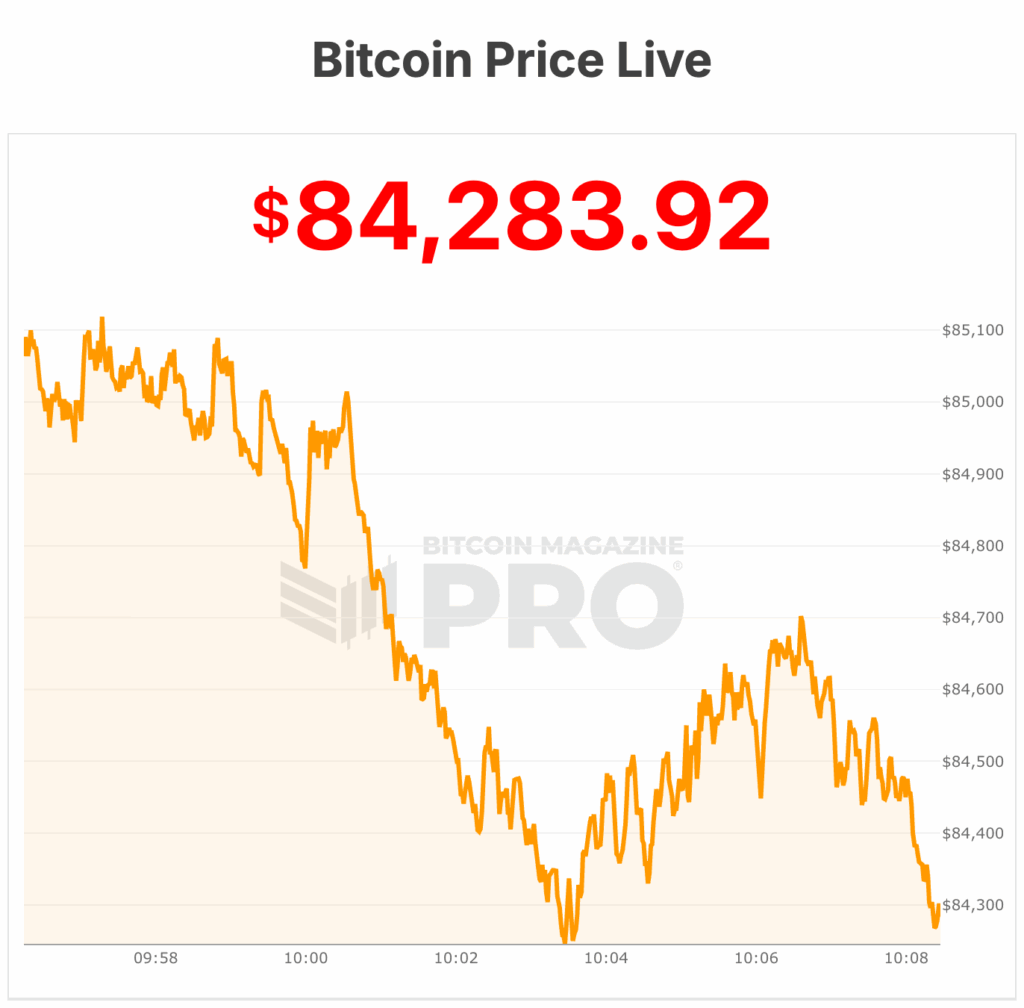
Bitcoin price

This post Bitcoin Price Flash-Crashes to $80,000 Before Rebounding as Market Stress Nears FTX-Era Levels first appeared on Bitcoin Magazine and is written by Micah Zimmerman.


Market Opportunity
ERA Logo
ERA Price(ERA)
$0.2186
$0.2186$0.2186
-0.04%
USD
ERA (ERA) Live Price Chart
Disclaimer: The articles reposted on this site are sourced from public platforms and are provided for informational purposes only. They do not necessarily reflect the views of MEXC. All rights remain with the original authors. If you believe any content infringes on third-party rights, please contact service@support.mexc.com for removal. MEXC makes no guarantees regarding the accuracy, completeness, or timeliness of the content and is not responsible for any actions taken based on the information provided. The content does not constitute financial, legal, or other professional advice, nor should it be considered a recommendation or endorsement by MEXC.

You May Also Like

Trump’s Tactics Reignite Crypto’s SEC Dialogue

Trump’s Tactics Reignite Crypto’s SEC Dialogue

Prior to Donald Trump’s influence, cryptocurrency companies primarily encountered the Securities and Exchange Commission (SEC) through legal battles. Under the leadership of former SEC Chair Gary Gensler, the lack of clear guidance from the commission bred a climate of apprehension, leaving businesses in a perplexed state.Continue Reading:Trump’s Tactics Reignite Crypto’s SEC Dialogue
Share
Coinstats2025/09/18 04:08
UK Regulator Proposes New Crypto Rules to Protect Consumers

UK Regulator Proposes New Crypto Rules to Protect Consumers

UK’s FCA proposes crypto rules to boost transparency, protect consumers, and balance innovation with regulation; consultation open until 2026. The United Kingdom has taken a new step toward regulating the fast-growing crypto sector. On Wednesday, the Financial Conduct Authority (FCA) released a consultation paper that sets out how the existing financial rules should apply to […] The post UK Regulator Proposes New Crypto Rules to Protect Consumers appeared first on Live Bitcoin News.
Share
LiveBitcoinNews2025/09/18 15:30
FCA, crackdown on crypto

FCA, crackdown on crypto

The post FCA, crackdown on crypto appeared on BitcoinEthereumNews.com. The regulation of cryptocurrencies in the United Kingdom enters a decisive phase. The Financial Conduct Authority (FCA) has initiated a consultation to set minimum standards on transparency, consumer protection, and digital custody, in order to strengthen market confidence and ensure safer operations for exchanges, wallets, and crypto service providers. The consultation was published on May 2, 2025, and opened a public discussion on operational responsibilities and safeguarding requirements for digital assets (CoinDesk). The goal is to make the rules clearer without hindering the sector’s evolution. According to the data collected by our regulatory monitoring team, in the first weeks following the publication, the feedback received from professionals and operators focused mainly on custody, incident reporting, and insurance requirements. Industry analysts note that many responses require technical clarifications on multi-sig, asset segregation, and recovery protocols, as well as proposals to scale obligations based on the size of the operator. FCA Consultation: What’s on the Table The consultation document clarifies how to apply rules inspired by traditional finance to the crypto perimeter, balancing innovation, market integrity, and user protection. In this context, the goal is to introduce minimum standards for all firms under the supervision of the FCA, an essential step for a more transparent and secure sector, with measurable benefits for users. The proposed pillars Obligations towards consumers: assessment on the extension of the Consumer Duty – a requirement that mandates companies to provide “good outcomes” – to crypto services, with outcomes for users that are traceable and verifiable. Operational resilience: introduction of continuity requirements, incident response plans, and periodic testing to ensure the operational stability of platforms even in adverse scenarios. Financial Crime Prevention: strengthening AML/CFT measures through more stringent transaction monitoring and structured counterpart checks. Custody and safeguarding: definition of operational methods for the segregation of client assets, secure…
Share
BitcoinEthereumNews2025/09/18 05:40