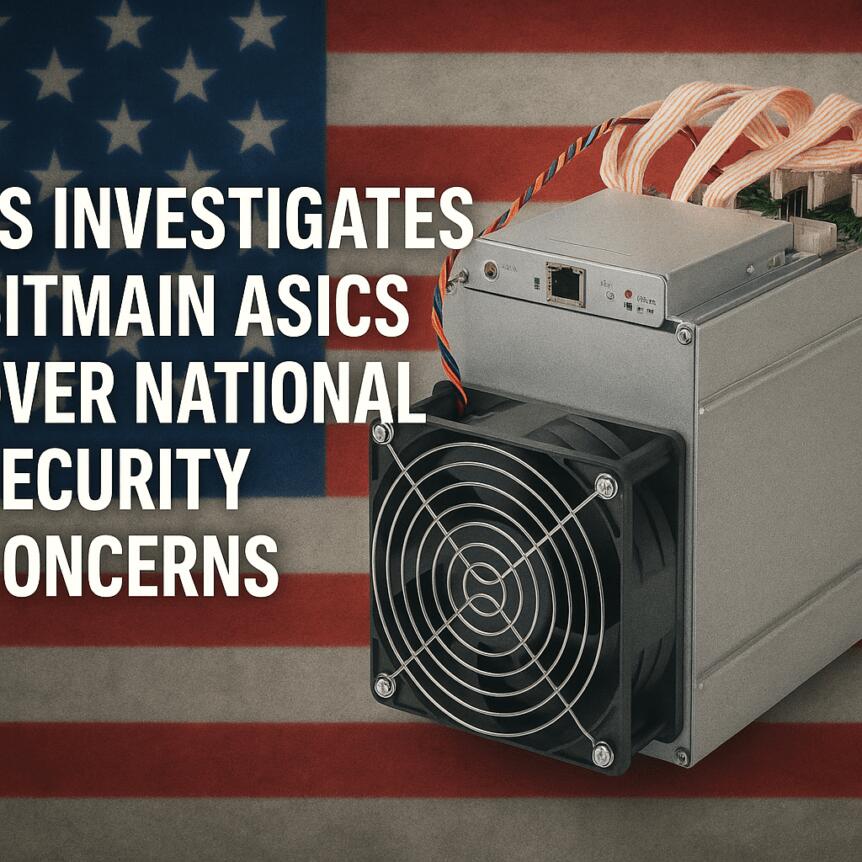
Cryptocurrency mining giants are once again thrust into the spotlight amid US investigations into Chinese hardware manufacturers. The focus is on Bitmain, the dominant player in Bitcoin ASIC manufacturing, which is now under federal scrutiny in the United States over national security concerns. This investigation raises questions about the geopolitical risks inherent in the global [...]Cryptocurrency mining giants are once again thrust into the spotlight amid US investigations into Chinese hardware manufacturers. The focus is on Bitmain, the dominant player in Bitcoin ASIC manufacturing, which is now under federal scrutiny in the United States over national security concerns. This investigation raises questions about the geopolitical risks inherent in the global [...]

US Investigates Bitmain ASICs Over National Security Concerns
For feedback or concerns regarding this content, please contact us at crypto.news@mexc.com
Us Investigates Bitmain Asics Over National Security Concerns

Cryptocurrency mining giants are once again thrust into the spotlight amid US investigations into Chinese hardware manufacturers. The focus is on Bitmain, the dominant player in Bitcoin ASIC manufacturing, which is now under federal scrutiny in the United States over national security concerns. This investigation raises questions about the geopolitical risks inherent in the global crypto infrastructure and could significantly impact the industry’s landscape.

  • Bitmain, China’s leading Bitcoin ASIC producer, faces an US security review over fears of remote control capabilities in its hardware.
  • The investigation, called “Operation Red Sunset,” is led by the US Department of Homeland Security and examines potential risks to US national security.
  • Authorities have previously scrutinized Bitmain for alleged links to Huawei and disrupted ASIC shipments to the US, raising ongoing concerns.
  • Bitmain controls over 80% of the Bitcoin mining ASIC market, with Chinese firms holding a combined 97% of the global share.
  • The investigation includes disassembly of ASICs to look for malicious features, though no findings have been publicly disclosed.

The United States has escalated its scrutiny of Chinese-based companies in the crypto space, with a focus on Bitmain, the world’s largest Bitcoin mining hardware manufacturer. According to a recent Bloomberg report, the Department of Homeland Security is investigating whether Bitmain’s ASICs could be exploited remotely for espionage or to sabotage critical US infrastructure. Known as “Operation Red Sunset,” the inquiry is part of broader efforts to secure American technological assets amid rising geopolitical tensions.

Previously, US authorities examined links between Bitmain-linked chip designer Xiamen Sophgo and Huawei, a Chinese tech giant under US sanctions. In October 2024, US Customs and Border Protection temporarily halted the shipment of thousands of Bitmain ASIC units, only resuming deliveries this past March. Investigators reportedly disassembled some ASICs during their probe, seeking evidence of malicious functionalities. However, specific findings remain undisclosed.

A Bitmain spokesperson refuted allegations of malicious control, asserting that the company “strictly complies with US and applicable laws,” and denied any involvement in activities threatening national security. The spokesperson emphasized that the company is unaware of any ongoing investigation and categorically dismisses the claims.

Implications for US Crypto Mining Industry

Bitmain’s dominant position in the crypto mining industry—over 80% of the market—means that any restrictions or disruptions could have far-reaching consequences. Chinese companies, including MicroBT, control approximately 97% of the global market share for Bitcoin ASICs, underscoring China’s leadership in the sector.

Mining hardware distribution by manufacturer chart. Source: Cambridge Digital Mining Industry

The US industry could experience disruptions as authorities investigate whether malicious capabilities are embedded within hardware that is vital for Bitcoin’s security infrastructure. Some ASICs have already been subjected to disassembly, but whether any malicious features have been uncovered remains unconfirmed. Bitmain has publicly denied any malicious intent, asserting its compliance with legal standards and emphasizing its innocence in the ongoing investigation.

Political and Industry Ramifications

The inquiry intersects with broader concerns about the security of American crypto infrastructure, especially given the involvement of US-based firms like American Bitcoin, which ordered over 16,000 Bitmain miners and inherited substantial ASIC holdings. Industry experts warn that these investigations could lead to delays in hardware shipments and increased regulatory scrutiny, further complicating US-China trade tensions within the cryptocurrency sector.

As the investigation develops, the stability of the global crypto mining industry remains uncertain. The outcome could reshape supply chains, influence hardware deployment, and heighten regulatory vigilance—factors crucial to the ongoing health and security of blockchain networks worldwide.

This article was originally published as US Investigates Bitmain ASICs Over National Security Concerns on Crypto Breaking News – your trusted source for crypto news, Bitcoin news, and blockchain updates.


Disclaimer: The articles reposted on this site are sourced from public platforms and are provided for informational purposes only. They do not necessarily reflect the views of MEXC. All rights remain with the original authors. If you believe any content infringes on third-party rights, please contact crypto.news@mexc.com for removal. MEXC makes no guarantees regarding the accuracy, completeness, or timeliness of the content and is not responsible for any actions taken based on the information provided. The content does not constitute financial, legal, or other professional advice, nor should it be considered a recommendation or endorsement by MEXC.

You May Also Like

OpenVPP accused of falsely advertising cooperation with the US government; SEC commissioner clarifies no involvement

OpenVPP accused of falsely advertising cooperation with the US government; SEC commissioner clarifies no involvement

PANews reported on September 17th that on-chain sleuth ZachXBT tweeted that OpenVPP ( $OVPP ) announced this week that it was collaborating with the US government to advance energy tokenization. SEC Commissioner Hester Peirce subsequently responded, stating that the company does not collaborate with or endorse any private crypto projects. The OpenVPP team subsequently hid the response. Several crypto influencers have participated in promoting the project, and the accounts involved have been questioned as typical influencer accounts.
Share
PANews2025/09/17 23:58
Trump's allegation against Noem would constitute a federal crime: analyst

Trump's allegation against Noem would constitute a federal crime: analyst

President Donald Trump caught everyone off guard by suddenly firing Homeland Security Secretary Kristi Noem — but being out of a job could just be the start of
Share
Rawstory2026/03/06 04:49
Aave DAO to Shut Down 50% of L2s While Doubling Down on GHO

Aave DAO to Shut Down 50% of L2s While Doubling Down on GHO

The post Aave DAO to Shut Down 50% of L2s While Doubling Down on GHO appeared on BitcoinEthereumNews.com. Aave DAO is gearing up for a significant overhaul by shutting down over 50% of underperforming L2 instances. It is also restructuring its governance framework and deploying over $100 million to boost GHO. This could be a pivotal moment that propels Aave back to the forefront of on-chain lending or sparks unprecedented controversy within the DeFi community. Sponsored Sponsored ACI Proposes Shutting Down 50% of L2s The “State of the Union” report by the Aave Chan Initiative (ACI) paints a candid picture. After a turbulent period in the DeFi market and internal challenges, Aave (AAVE) now leads in key metrics: TVL, revenue, market share, and borrowing volume. Aave’s annual revenue of $130 million surpasses the combined cash reserves of its competitors. Tokenomics improvements and the AAVE token buyback program have also contributed to the ecosystem’s growth. Aave global metrics. Source: Aave However, the ACI’s report also highlights several pain points. First, regarding the Layer-2 (L2) strategy. While Aave’s L2 strategy was once a key driver of success, it is no longer fit for purpose. Over half of Aave’s instances on L2s and alt-L1s are not economically viable. Based on year-to-date data, over 86.6% of Aave’s revenue comes from the mainnet, indicating that everything else is a side quest. On this basis, ACI proposes closing underperforming networks. The DAO should invest in key networks with significant differentiators. Second, ACI is pushing for a complete overhaul of the “friendly fork” framework, as most have been unimpressive regarding TVL and revenue. In some cases, attackers have exploited them to Aave’s detriment, as seen with Spark. Sponsored Sponsored “The friendly fork model had a good intention but bad execution where the DAO was too friendly towards these forks, allowing the DAO only little upside,” the report states. Third, the instance model, once a smart…
Share
BitcoinEthereumNews2025/09/18 02:28