Glassnode co-founders Jan Happel and Yann Allemann, who publish under the @Negentropic handle on X, argue that the current crypto crash is being driven not by a broad narrative turn, but by a single, systematic source of sell pressure whose footprint is most visible in Bitcoin and is spilling into the wider complex. Their core assertion is categorical: “What’s happening in Bitcoin right now isn’t a narrative shift: it’s a mechanical unwind.” In that framing, the tape is reflecting the forced exit of one participant rather than an organic repricing of crypto risk. Why Is The Crypto Market Crashing? Negentropic’s thesis starts with momentum indicators behaving in ways they say are inconsistent with “natural markets.” They note that “the 1D MACD just printed a new all-time low… yet price is only down ~33% from the highs,” and add, “This doesn’t happen in natural markets. You only get this when someone is dumping in a straight line.” They pair that observation with capitulation-like oscillators that are not accompanied by the usual macro or leverage shock. As they put it, RSI is near capitulation, “but there’s no macro stress, no credit shock, no leverage detonation, no ETF outflows.” The mismatch matters to their conclusion: “It’s extreme momentum without a catalyst: classic signature of mechanical selling.” Related Reading: Crypto Traders See Bullish Tailwind: Hassett Jumps In Fed Chair Odds They then contrast today’s setup with prior episodes where MACD and RSI reached similar extremes. In those historical cases, Negentropic says, “Price was down 60%, derivatives were blowing out, funding was deeply negative.” By contrast, their read of the present is that confirming stress isn’t there. “ETFs remain net positive, their cost basis is still intact,” they write, and they emphasize that “long-term holders are removing supply aggressively.” They also point to cross-crypto resilience: “Solana ETF inflows are steady, altcoins are holding up relatively well vs btc & eth,” and “eth is holding stronger than btc.” For Negentropic, those relative-strength signals are the tell that this is not a systemwide risk-off event. “If this were real sentiment, all of that would be breaking. It isn’t,” they conclude. Flow regularity is the other pillar of the Glassnode co-founders’ case. They describe a pattern that they say has repeated since October 10: “Same timestamps, same venue-specific thinness, same lack of reflexive bids.” The implication is mechanical intent rather than discretionary trading. “It’s a schedule, not a market,” they write, claiming “21 days of consistent toxic flow.” That sequence, in their view, aligns with “one explanation”: “a liquidity provider or fund was structurally damaged on October 10th,” and “the entity tied to that failure has been reducing risk in a forced, rules-based manner.” Independent tape watchers are describing a remarkably similar cadence. Front Runners (@frontrunnersx) reports that a large seller on Binance has been hitting the market with clock-like consistency. Over “two weeks straight,” they say, the entity “hit the sell button exactly at 9:30 EST, every US market open, without fail.” They add that “kind of consistency usually points to a sophisticated actor operating under specific mandates or time windows,” and that it looks “less like random flow and more like a single entity (or a tightly-coordinated group).” Macro analyst Alex Krüger expands on how that could manifest across venues. He suggests the seller could be “dumping during US hours via a broker or OTC desk that employs smart order routing or hedging strategies across multiple venues.” In his view, the dominance of Binance prints doesn’t require Binance to be the origin. “Most volume naturally” would flow there, he argues, “since it’s where the bulk of the liquidity resides.” Related Reading: Crypto Market Wipes Out $1 Trillion Since October: Analyzing The Forces Behind The Crash Krüger also highlights venue asymmetries that fit a routed-flow story: he has seen “relatively little spot selling routed via Coinbase this week,” while noting “extraordinary levels of spot selling via Bitfinex.” Will The Crypto Crash Be Short-Lived? Delphi Ventures founding partner Tommy Shaughnessy focuses on the urgency implied by the pace. If the flow has been present since 10/10, he writes, “the speed at which they’re selling BTC is pretty crazy.” He interprets that as compulsion rather than strategy: “Means they are price insensitive and need to exit, fast.” Shaughnessy characterizes the move as “violent,” but adds a key qualifier consistent with Negentropic’s finite-seller framing: it’s likely “short lived because it’s not orderly.” If there is a body from 10/10 the speed at which they’re selling $BTC is pretty crazy Means they are price insensitive and need to exit, fast. (Someone had that chart of all red candles for days) Violent but means it’s hopefully short lived because it’s not orderly https://t.co/kaJAKh5Z4M — Tommy (@Shaughnessy119) November 21, 2025 Multicoin Capital founder Tushar Jain likewise describes what he sees as forced liquidation behavior. “It feels like a big forced seller is in the market,” he writes, adding, “We are seeing systematic selling during specific hours.” Jain explicitly ties this to the same October window Negentropic flags, calling it “probably a consequence of 10/10 liquidations,” and says it’s “hard to imagine this scale of forced selling continues for much longer.” He also situates the moment within a longer unwind process, recalling a lesson from prior cycles: “it takes some time for all the bankruptcies to reveal themselves after a big liquidation flush like this,” because “shops are running around trying to figure out what their exposure to insolvent counterparties is.” It feels like a big forced seller is in the market. We are seeing systematic selling during specific hours. Probably a consequence of 10/10 liquidations. Hard to imagine this scale of forced selling continues for much longer. https://t.co/JO6kRmJUUb — Tushar Jain (@tushar_jain) November 19, 2025 Taken together, the sources are presenting a coherent, internally consistent read: crypto’s downside is being dominated by a single, time-boxed, price-insensitive seller whose execution pattern is systematic enough to warp momentum indicators and intraday structure. Negentropic’s bottom line is not merely descriptive but interpretive: “This is not capitulation. This is not a trend break.” It is, instead, “a constrained unwinding through a fractured market.” And because mechanical sellers end when inventory or mandate ends, the Glassnode co-founders argue that when it does, “the rebound will likely be far sharper than the decline that preceded it.” At press time, the total crypto market cap was at $2.83 trillion. Featured image created with DALL.E, chart from TradingView.comGlassnode co-founders Jan Happel and Yann Allemann, who publish under the @Negentropic handle on X, argue that the current crypto crash is being driven not by a broad narrative turn, but by a single, systematic source of sell pressure whose footprint is most visible in Bitcoin and is spilling into the wider complex. Their core assertion is categorical: “What’s happening in Bitcoin right now isn’t a narrative shift: it’s a mechanical unwind.” In that framing, the tape is reflecting the forced exit of one participant rather than an organic repricing of crypto risk. Why Is The Crypto Market Crashing? Negentropic’s thesis starts with momentum indicators behaving in ways they say are inconsistent with “natural markets.” They note that “the 1D MACD just printed a new all-time low… yet price is only down ~33% from the highs,” and add, “This doesn’t happen in natural markets. You only get this when someone is dumping in a straight line.” They pair that observation with capitulation-like oscillators that are not accompanied by the usual macro or leverage shock. As they put it, RSI is near capitulation, “but there’s no macro stress, no credit shock, no leverage detonation, no ETF outflows.” The mismatch matters to their conclusion: “It’s extreme momentum without a catalyst: classic signature of mechanical selling.” Related Reading: Crypto Traders See Bullish Tailwind: Hassett Jumps In Fed Chair Odds They then contrast today’s setup with prior episodes where MACD and RSI reached similar extremes. In those historical cases, Negentropic says, “Price was down 60%, derivatives were blowing out, funding was deeply negative.” By contrast, their read of the present is that confirming stress isn’t there. “ETFs remain net positive, their cost basis is still intact,” they write, and they emphasize that “long-term holders are removing supply aggressively.” They also point to cross-crypto resilience: “Solana ETF inflows are steady, altcoins are holding up relatively well vs btc & eth,” and “eth is holding stronger than btc.” For Negentropic, those relative-strength signals are the tell that this is not a systemwide risk-off event. “If this were real sentiment, all of that would be breaking. It isn’t,” they conclude. Flow regularity is the other pillar of the Glassnode co-founders’ case. They describe a pattern that they say has repeated since October 10: “Same timestamps, same venue-specific thinness, same lack of reflexive bids.” The implication is mechanical intent rather than discretionary trading. “It’s a schedule, not a market,” they write, claiming “21 days of consistent toxic flow.” That sequence, in their view, aligns with “one explanation”: “a liquidity provider or fund was structurally damaged on October 10th,” and “the entity tied to that failure has been reducing risk in a forced, rules-based manner.” Independent tape watchers are describing a remarkably similar cadence. Front Runners (@frontrunnersx) reports that a large seller on Binance has been hitting the market with clock-like consistency. Over “two weeks straight,” they say, the entity “hit the sell button exactly at 9:30 EST, every US market open, without fail.” They add that “kind of consistency usually points to a sophisticated actor operating under specific mandates or time windows,” and that it looks “less like random flow and more like a single entity (or a tightly-coordinated group).” Macro analyst Alex Krüger expands on how that could manifest across venues. He suggests the seller could be “dumping during US hours via a broker or OTC desk that employs smart order routing or hedging strategies across multiple venues.” In his view, the dominance of Binance prints doesn’t require Binance to be the origin. “Most volume naturally” would flow there, he argues, “since it’s where the bulk of the liquidity resides.” Related Reading: Crypto Market Wipes Out $1 Trillion Since October: Analyzing The Forces Behind The Crash Krüger also highlights venue asymmetries that fit a routed-flow story: he has seen “relatively little spot selling routed via Coinbase this week,” while noting “extraordinary levels of spot selling via Bitfinex.” Will The Crypto Crash Be Short-Lived? Delphi Ventures founding partner Tommy Shaughnessy focuses on the urgency implied by the pace. If the flow has been present since 10/10, he writes, “the speed at which they’re selling BTC is pretty crazy.” He interprets that as compulsion rather than strategy: “Means they are price insensitive and need to exit, fast.” Shaughnessy characterizes the move as “violent,” but adds a key qualifier consistent with Negentropic’s finite-seller framing: it’s likely “short lived because it’s not orderly.” If there is a body from 10/10 the speed at which they’re selling $BTC is pretty crazy Means they are price insensitive and need to exit, fast. (Someone had that chart of all red candles for days) Violent but means it’s hopefully short lived because it’s not orderly https://t.co/kaJAKh5Z4M — Tommy (@Shaughnessy119) November 21, 2025 Multicoin Capital founder Tushar Jain likewise describes what he sees as forced liquidation behavior. “It feels like a big forced seller is in the market,” he writes, adding, “We are seeing systematic selling during specific hours.” Jain explicitly ties this to the same October window Negentropic flags, calling it “probably a consequence of 10/10 liquidations,” and says it’s “hard to imagine this scale of forced selling continues for much longer.” He also situates the moment within a longer unwind process, recalling a lesson from prior cycles: “it takes some time for all the bankruptcies to reveal themselves after a big liquidation flush like this,” because “shops are running around trying to figure out what their exposure to insolvent counterparties is.” It feels like a big forced seller is in the market. We are seeing systematic selling during specific hours. Probably a consequence of 10/10 liquidations. Hard to imagine this scale of forced selling continues for much longer. https://t.co/JO6kRmJUUb — Tushar Jain (@tushar_jain) November 19, 2025 Taken together, the sources are presenting a coherent, internally consistent read: crypto’s downside is being dominated by a single, time-boxed, price-insensitive seller whose execution pattern is systematic enough to warp momentum indicators and intraday structure. Negentropic’s bottom line is not merely descriptive but interpretive: “This is not capitulation. This is not a trend break.” It is, instead, “a constrained unwinding through a fractured market.” And because mechanical sellers end when inventory or mandate ends, the Glassnode co-founders argue that when it does, “the rebound will likely be far sharper than the decline that preceded it.” At press time, the total crypto market cap was at $2.83 trillion. Featured image created with DALL.E, chart from TradingView.com
Crypto Crash Is A Forced Crypto Seller Unwind, Glassnode Co-Founders Claim

2025/11/22 07:00

Glassnode co-founders Jan Happel and Yann Allemann, who publish under the @Negentropic handle on X, argue that the current crypto crash is being driven not by a broad narrative turn, but by a single, systematic source of sell pressure whose footprint is most visible in Bitcoin and is spilling into the wider complex. Their core assertion is categorical: “What’s happening in Bitcoin right now isn’t a narrative shift: it’s a mechanical unwind.” In that framing, the tape is reflecting the forced exit of one participant rather than an organic repricing of crypto risk.

Why Is The Crypto Market Crashing?

Negentropic’s thesis starts with momentum indicators behaving in ways they say are inconsistent with “natural markets.” They note that “the 1D MACD just printed a new all-time low… yet price is only down ~33% from the highs,” and add, “This doesn’t happen in natural markets. You only get this when someone is dumping in a straight line.”

They pair that observation with capitulation-like oscillators that are not accompanied by the usual macro or leverage shock. As they put it, RSI is near capitulation, “but there’s no macro stress, no credit shock, no leverage detonation, no ETF outflows.” The mismatch matters to their conclusion: “It’s extreme momentum without a catalyst: classic signature of mechanical selling.”

They then contrast today’s setup with prior episodes where MACD and RSI reached similar extremes. In those historical cases, Negentropic says, “Price was down 60%, derivatives were blowing out, funding was deeply negative.” By contrast, their read of the present is that confirming stress isn’t there. “ETFs remain net positive, their cost basis is still intact,” they write, and they emphasize that “long-term holders are removing supply aggressively.”

They also point to cross-crypto resilience: “Solana ETF inflows are steady, altcoins are holding up relatively well vs btc & eth,” and “eth is holding stronger than btc.” For Negentropic, those relative-strength signals are the tell that this is not a systemwide risk-off event. “If this were real sentiment, all of that would be breaking. It isn’t,” they conclude.

Flow regularity is the other pillar of the Glassnode co-founders’ case. They describe a pattern that they say has repeated since October 10: “Same timestamps, same venue-specific thinness, same lack of reflexive bids.” The implication is mechanical intent rather than discretionary trading. “It’s a schedule, not a market,” they write, claiming “21 days of consistent toxic flow.” That sequence, in their view, aligns with “one explanation”: “a liquidity provider or fund was structurally damaged on October 10th,” and “the entity tied to that failure has been reducing risk in a forced, rules-based manner.”

Independent tape watchers are describing a remarkably similar cadence. Front Runners (@frontrunnersx) reports that a large seller on Binance has been hitting the market with clock-like consistency. Over “two weeks straight,” they say, the entity “hit the sell button exactly at 9:30 EST, every US market open, without fail.”

They add that “kind of consistency usually points to a sophisticated actor operating under specific mandates or time windows,” and that it looks “less like random flow and more like a single entity (or a tightly-coordinated group).”

Macro analyst Alex Krüger expands on how that could manifest across venues. He suggests the seller could be “dumping during US hours via a broker or OTC desk that employs smart order routing or hedging strategies across multiple venues.” In his view, the dominance of Binance prints doesn’t require Binance to be the origin. “Most volume naturally” would flow there, he argues, “since it’s where the bulk of the liquidity resides.”

Krüger also highlights venue asymmetries that fit a routed-flow story: he has seen “relatively little spot selling routed via Coinbase this week,” while noting “extraordinary levels of spot selling via Bitfinex.”

Will The Crypto Crash Be Short-Lived?

Delphi Ventures founding partner Tommy Shaughnessy focuses on the urgency implied by the pace. If the flow has been present since 10/10, he writes, “the speed at which they’re selling BTC is pretty crazy.” He interprets that as compulsion rather than strategy: “Means they are price insensitive and need to exit, fast.” Shaughnessy characterizes the move as “violent,” but adds a key qualifier consistent with Negentropic’s finite-seller framing: it’s likely “short lived because it’s not orderly.”

Multicoin Capital founder Tushar Jain likewise describes what he sees as forced liquidation behavior. “It feels like a big forced seller is in the market,” he writes, adding, “We are seeing systematic selling during specific hours.” Jain explicitly ties this to the same October window Negentropic flags, calling it “probably a consequence of 10/10 liquidations,” and says it’s “hard to imagine this scale of forced selling continues for much longer.”

He also situates the moment within a longer unwind process, recalling a lesson from prior cycles: “it takes some time for all the bankruptcies to reveal themselves after a big liquidation flush like this,” because “shops are running around trying to figure out what their exposure to insolvent counterparties is.”

Taken together, the sources are presenting a coherent, internally consistent read: crypto’s downside is being dominated by a single, time-boxed, price-insensitive seller whose execution pattern is systematic enough to warp momentum indicators and intraday structure.

Negentropic’s bottom line is not merely descriptive but interpretive: “This is not capitulation. This is not a trend break.” It is, instead, “a constrained unwinding through a fractured market.” And because mechanical sellers end when inventory or mandate ends, the Glassnode co-founders argue that when it does, “the rebound will likely be far sharper than the decline that preceded it.”

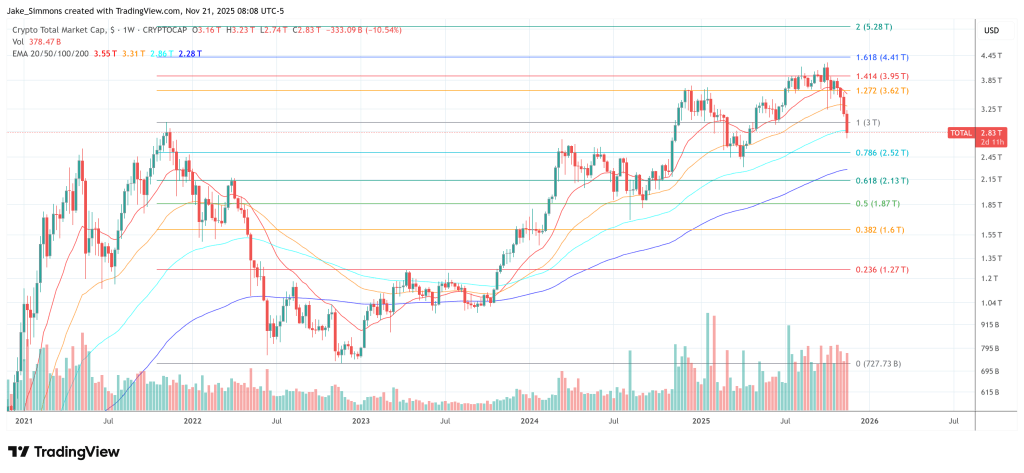
At press time, the total crypto market cap was at $2.83 trillion.

Total crypto market cap
Market Opportunity
Notcoin Logo
Notcoin Price(NOT)
$0.0006161
$0.0006161$0.0006161
-5.80%
USD
Notcoin (NOT) Live Price Chart
Disclaimer: The articles reposted on this site are sourced from public platforms and are provided for informational purposes only. They do not necessarily reflect the views of MEXC. All rights remain with the original authors. If you believe any content infringes on third-party rights, please contact service@support.mexc.com for removal. MEXC makes no guarantees regarding the accuracy, completeness, or timeliness of the content and is not responsible for any actions taken based on the information provided. The content does not constitute financial, legal, or other professional advice, nor should it be considered a recommendation or endorsement by MEXC.

You May Also Like

Microsoft Corp. $MSFT blue box area offers a buying opportunity

Microsoft Corp. $MSFT blue box area offers a buying opportunity

The post Microsoft Corp. $MSFT blue box area offers a buying opportunity appeared on BitcoinEthereumNews.com. In today’s article, we’ll examine the recent performance of Microsoft Corp. ($MSFT) through the lens of Elliott Wave Theory. We’ll review how the rally from the April 07, 2025 low unfolded as a 5-wave impulse followed by a 3-swing correction (ABC) and discuss our forecast for the next move. Let’s dive into the structure and expectations for this stock. Five wave impulse structure + ABC + WXY correction $MSFT 8H Elliott Wave chart 9.04.2025 In the 8-hour Elliott Wave count from Sep 04, 2025, we saw that $MSFT completed a 5-wave impulsive cycle at red III. As expected, this initial wave prompted a pullback. We anticipated this pullback to unfold in 3 swings and find buyers in the equal legs area between $497.02 and $471.06 This setup aligns with a typical Elliott Wave correction pattern (ABC), in which the market pauses briefly before resuming its primary trend. $MSFT 8H Elliott Wave chart 7.14.2025 The update, 10 days later, shows the stock finding support from the equal legs area as predicted allowing traders to get risk free. The stock is expected to bounce towards 525 – 532 before deciding if the bounce is a connector or the next leg higher. A break into new ATHs will confirm the latter and can see it trade higher towards 570 – 593 area. Until then, traders should get risk free and protect their capital in case of a WXY double correction. Conclusion In conclusion, our Elliott Wave analysis of Microsoft Corp. ($MSFT) suggested that it remains supported against April 07, 2025 lows and bounce from the blue box area. In the meantime, keep an eye out for any corrective pullbacks that may offer entry opportunities. By applying Elliott Wave Theory, traders can better anticipate the structure of upcoming moves and enhance risk management in volatile markets. Source: https://www.fxstreet.com/news/microsoft-corp-msft-blue-box-area-offers-a-buying-opportunity-202509171323
Share
BitcoinEthereumNews2025/09/18 03:50
IP Hits $11.75, HYPE Climbs to $55, BlockDAG Surpasses Both with $407M Presale Surge!

IP Hits $11.75, HYPE Climbs to $55, BlockDAG Surpasses Both with $407M Presale Surge!

The post IP Hits $11.75, HYPE Climbs to $55, BlockDAG Surpasses Both with $407M Presale Surge! appeared on BitcoinEthereumNews.com. Crypto News 17 September 2025 | 18:00 Discover why BlockDAG’s upcoming Awakening Testnet launch makes it the best crypto to buy today as Story (IP) price jumps to $11.75 and Hyperliquid hits new highs. Recent crypto market numbers show strength but also some limits. The Story (IP) price jump has been sharp, fueled by big buybacks and speculation, yet critics point out that revenue still lags far behind its valuation. The Hyperliquid (HYPE) price looks solid around the mid-$50s after a new all-time high, but questions remain about sustainability once the hype around USDH proposals cools down. So the obvious question is: why chase coins that are either stretched thin or at risk of retracing when you could back a network that’s already proving itself on the ground? That’s where BlockDAG comes in. While other chains are stuck dealing with validator congestion or outages, BlockDAG’s upcoming Awakening Testnet will be stress-testing its EVM-compatible smart chain with real miners before listing. For anyone looking for the best crypto coin to buy, the choice between waiting on fixes or joining live progress feels like an easy one. BlockDAG: Smart Chain Running Before Launch Ethereum continues to wrestle with gas congestion, and Solana is still known for network freezes, yet BlockDAG is already showing a different picture. Its upcoming Awakening Testnet, set to launch on September 25, isn’t just a demo; it’s a live rollout where the chain’s base protocols are being stress-tested with miners connected globally. EVM compatibility is active, account abstraction is built in, and tools like updated vesting contracts and Stratum integration are already functional. Instead of waiting for fixes like other networks, BlockDAG is proving its infrastructure in real time. What makes this even more important is that the technology is operational before the coin even hits exchanges. That…
Share
BitcoinEthereumNews2025/09/18 00:32
Zero Knowledge Proof Sparks 300x Growth Discussion! Bitcoin Cash & Ethereum Cool Off

Zero Knowledge Proof Sparks 300x Growth Discussion! Bitcoin Cash & Ethereum Cool Off

Explore how Bitcoin Cash and Ethereum move sideways while Zero Knowledge Proof (ZKP) gains notice with a live presale auction, working infra, shipping Proof Pods
Share
CoinLive2026/01/18 07:00