The post BIS Picks IMF Digital-Money Expert to Lead Innovation Hub appeared on BitcoinEthereumNews.com. The Bank for International Settlements (BIS) has appointed Tommaso Mancini-Griffoli, one of the world’s most influential economists on digital money, as the next head of the BIS Innovation Hub, effective March 2026. The BIS said Tuesday that Mancini-Griffoli will “lead work to explore technological solutions within the central bank community on innovation.” His mandate is expected to include ongoing work on central bank digital currencies (CBDCs), tokenized assets and new forms of market infrastructure. Mancini-Griffoli currently serves as the assistant director in the International Monetary Fund’s Monetary and Capital Markets Department, where he leads work on payments and currencies. He’s one of the IMF’s most prominent voices advocating for regulated and publicly backed digital money models and has previously warned about the risks of unregulated stablecoins.  The appointment comes as the BIS Innovation Hub ramps up major projects, expanding its influence across its global centers. The Hub has become a venue for testing blockchain-inspired settlement systems and digital currency prototypes.  For the crypto space, the move signals that the BIS may steer digital asset innovation toward regulated tokenized money, a direction that could shape how central banks assess private blockchain infrastructure and stablecoins.  Incoming innovation chief championed synthetic CBDCs Mancini-Griffoli, who has been the IMF’s representative to global policy forums on CBDCs and payments, frequently argued that the most stable path forward lies in hybrid or public-backed arrangements rather than fully private tokens.  In 2020, Mancini-Griffoli stated that a synthetic private-public partnership CBDC could empower the private sector, such as blockchain-backed stablecoins, to innovate.  He championed the concept of synthetic CBDCs, a model in which private institutions issue digital money fully backed by central bank reserves, essentially blending public-sector safety with private-sector innovation.  He also supported tokenized financial instruments, but only when they operate within a public-money architecture that guarantees… The post BIS Picks IMF Digital-Money Expert to Lead Innovation Hub appeared on BitcoinEthereumNews.com. The Bank for International Settlements (BIS) has appointed Tommaso Mancini-Griffoli, one of the world’s most influential economists on digital money, as the next head of the BIS Innovation Hub, effective March 2026. The BIS said Tuesday that Mancini-Griffoli will “lead work to explore technological solutions within the central bank community on innovation.” His mandate is expected to include ongoing work on central bank digital currencies (CBDCs), tokenized assets and new forms of market infrastructure. Mancini-Griffoli currently serves as the assistant director in the International Monetary Fund’s Monetary and Capital Markets Department, where he leads work on payments and currencies. He’s one of the IMF’s most prominent voices advocating for regulated and publicly backed digital money models and has previously warned about the risks of unregulated stablecoins.  The appointment comes as the BIS Innovation Hub ramps up major projects, expanding its influence across its global centers. The Hub has become a venue for testing blockchain-inspired settlement systems and digital currency prototypes.  For the crypto space, the move signals that the BIS may steer digital asset innovation toward regulated tokenized money, a direction that could shape how central banks assess private blockchain infrastructure and stablecoins.  Incoming innovation chief championed synthetic CBDCs Mancini-Griffoli, who has been the IMF’s representative to global policy forums on CBDCs and payments, frequently argued that the most stable path forward lies in hybrid or public-backed arrangements rather than fully private tokens.  In 2020, Mancini-Griffoli stated that a synthetic private-public partnership CBDC could empower the private sector, such as blockchain-backed stablecoins, to innovate.  He championed the concept of synthetic CBDCs, a model in which private institutions issue digital money fully backed by central bank reserves, essentially blending public-sector safety with private-sector innovation.  He also supported tokenized financial instruments, but only when they operate within a public-money architecture that guarantees…

BIS Picks IMF Digital-Money Expert to Lead Innovation Hub

For feedback or concerns regarding this content, please contact us at crypto.news@mexc.com

The Bank for International Settlements (BIS) has appointed Tommaso Mancini-Griffoli, one of the world’s most influential economists on digital money, as the next head of the BIS Innovation Hub, effective March 2026.

The BIS said Tuesday that Mancini-Griffoli will “lead work to explore technological solutions within the central bank community on innovation.” His mandate is expected to include ongoing work on central bank digital currencies (CBDCs), tokenized assets and new forms of market infrastructure.

Mancini-Griffoli currently serves as the assistant director in the International Monetary Fund’s Monetary and Capital Markets Department, where he leads work on payments and currencies. He’s one of the IMF’s most prominent voices advocating for regulated and publicly backed digital money models and has previously warned about the risks of unregulated stablecoins. 

The appointment comes as the BIS Innovation Hub ramps up major projects, expanding its influence across its global centers. The Hub has become a venue for testing blockchain-inspired settlement systems and digital currency prototypes. 

For the crypto space, the move signals that the BIS may steer digital asset innovation toward regulated tokenized money, a direction that could shape how central banks assess private blockchain infrastructure and stablecoins. 

Incoming innovation chief championed synthetic CBDCs

Mancini-Griffoli, who has been the IMF’s representative to global policy forums on CBDCs and payments, frequently argued that the most stable path forward lies in hybrid or public-backed arrangements rather than fully private tokens. 

In 2020, Mancini-Griffoli stated that a synthetic private-public partnership CBDC could empower the private sector, such as blockchain-backed stablecoins, to innovate. 

He championed the concept of synthetic CBDCs, a model in which private institutions issue digital money fully backed by central bank reserves, essentially blending public-sector safety with private-sector innovation. 

He also supported tokenized financial instruments, but only when they operate within a public-money architecture that guarantees systemic stability and settlement finality. 

In September, Mancini-Griffoli argued through an essay that stablecoins carry structural risks if not backed by safe assets and strong governance.

He warned that poorly regulated issuers could expose users to runs, liquidity mismatches and loss of value. 

Related: JPMorgan, DBS eye deposit tokens as cross-bank alternative to stablecoins

BIS Innovation Hub’s high-profile experiments

The BIS Innovation Hub currently operates several high-profile digital currency experiments.

This includes the cross-border CBDC settlement network mBridge, the tokenized deposit infrastructure Agora and real-time payments and interoperable CBDC rails called Project Nexus. 

These projects demonstrate the BIS’s commitment to reimagining traditional finance with blockchain-inspired architecture. 

Under Mancini-Griffoli, the innovation hub is poised to accelerate several high-impact initiatives, from cross-border payment networks to tokenized deposits and interoperable CBDCs. 

Magazine: Bitcoin $200K soon or 2029? Scott Bessent hangs at Bitcoin bar: Hodler’s Digest

Source: https://cointelegraph.com/news/bis-appoints-tommaso-mancini-griffoli-to-lead-innovation-hub?utm_source=rss_feed&utm_medium=feed&utm_campaign=rss_partner_inbound

Disclaimer: The articles reposted on this site are sourced from public platforms and are provided for informational purposes only. They do not necessarily reflect the views of MEXC. All rights remain with the original authors. If you believe any content infringes on third-party rights, please contact crypto.news@mexc.com for removal. MEXC makes no guarantees regarding the accuracy, completeness, or timeliness of the content and is not responsible for any actions taken based on the information provided. The content does not constitute financial, legal, or other professional advice, nor should it be considered a recommendation or endorsement by MEXC.

You May Also Like

Shocking OpenVPP Partnership Claim Draws Urgent Scrutiny

Shocking OpenVPP Partnership Claim Draws Urgent Scrutiny

The post Shocking OpenVPP Partnership Claim Draws Urgent Scrutiny appeared on BitcoinEthereumNews.com. The cryptocurrency world is buzzing with a recent controversy surrounding a bold OpenVPP partnership claim. This week, OpenVPP (OVPP) announced what it presented as a significant collaboration with the U.S. government in the innovative field of energy tokenization. However, this claim quickly drew the sharp eye of on-chain analyst ZachXBT, who highlighted a swift and official rebuttal that has sent ripples through the digital asset community. What Sparked the OpenVPP Partnership Claim Controversy? The core of the issue revolves around OpenVPP’s assertion of a U.S. government partnership. This kind of collaboration would typically be a monumental endorsement for any private cryptocurrency project, especially given the current regulatory climate. Such a partnership could signify a new era of mainstream adoption and legitimacy for energy tokenization initiatives. OpenVPP initially claimed cooperation with the U.S. government. This alleged partnership was said to be in the domain of energy tokenization. The announcement generated considerable interest and discussion online. ZachXBT, known for his diligent on-chain investigations, was quick to flag the development. He brought attention to the fact that U.S. Securities and Exchange Commission (SEC) Commissioner Hester Peirce had directly addressed the OpenVPP partnership claim. Her response, delivered within hours, was unequivocal and starkly contradicted OpenVPP’s narrative. How Did Regulatory Authorities Respond to the OpenVPP Partnership Claim? Commissioner Hester Peirce’s statement was a crucial turning point in this unfolding story. She clearly stated that the SEC, as an agency, does not engage in partnerships with private cryptocurrency projects. This response effectively dismantled the credibility of OpenVPP’s initial announcement regarding their supposed government collaboration. Peirce’s swift clarification underscores a fundamental principle of regulatory bodies: maintaining impartiality and avoiding endorsements of private entities. Her statement serves as a vital reminder to the crypto community about the official stance of government agencies concerning private ventures. Moreover, ZachXBT’s analysis…
Share
BitcoinEthereumNews2025/09/18 02:13
A Netflix ‘KPop Demon Hunters’ Short Film Has Been Rated For Release

A Netflix ‘KPop Demon Hunters’ Short Film Has Been Rated For Release

The post A Netflix ‘KPop Demon Hunters’ Short Film Has Been Rated For Release appeared on BitcoinEthereumNews.com. KPop Demon Hunters Netflix Everyone has wondered what may be the next step for KPop Demon Hunters as an IP, given its record-breaking success on Netflix. Now, the answer may be something exactly no one predicted. According to a new filing with the MPA, something called Debut: A KPop Demon Hunters Story has been rated PG by the ratings body. It’s listed alongside some other films, and this is obviously something that has not been publicly announced. A short film could be well, very short, a few minutes, and likely no more than ten. Even that might be pushing it. Using say, Pixar shorts as a reference, most are between 4 and 8 minutes. The original movie is an hour and 36 minutes. The “Debut” in the title indicates some sort of flashback, perhaps to when HUNTR/X first arrived on the scene before they blew up. Previously, director Maggie Kang has commented about how there were more backstory components that were supposed to be in the film that were cut, but hinted those could be explored in a sequel. But perhaps some may be put into a short here. I very much doubt those scenes were fully produced and simply cut, but perhaps they were finished up for this short film here. When would Debut: KPop Demon Hunters theoretically arrive? I’m not sure the other films on the list are much help. Dead of Winter is out in less than two weeks. Mother Mary does not have a release date. Ne Zha 2 came out earlier this year. I’ve only seen news stories saying The Perfect Gamble was supposed to come out in Q1 2025, but I’ve seen no evidence that it actually has. KPop Demon Hunters Netflix It could be sooner rather than later as Netflix looks to capitalize…
Share
BitcoinEthereumNews2025/09/18 02:23
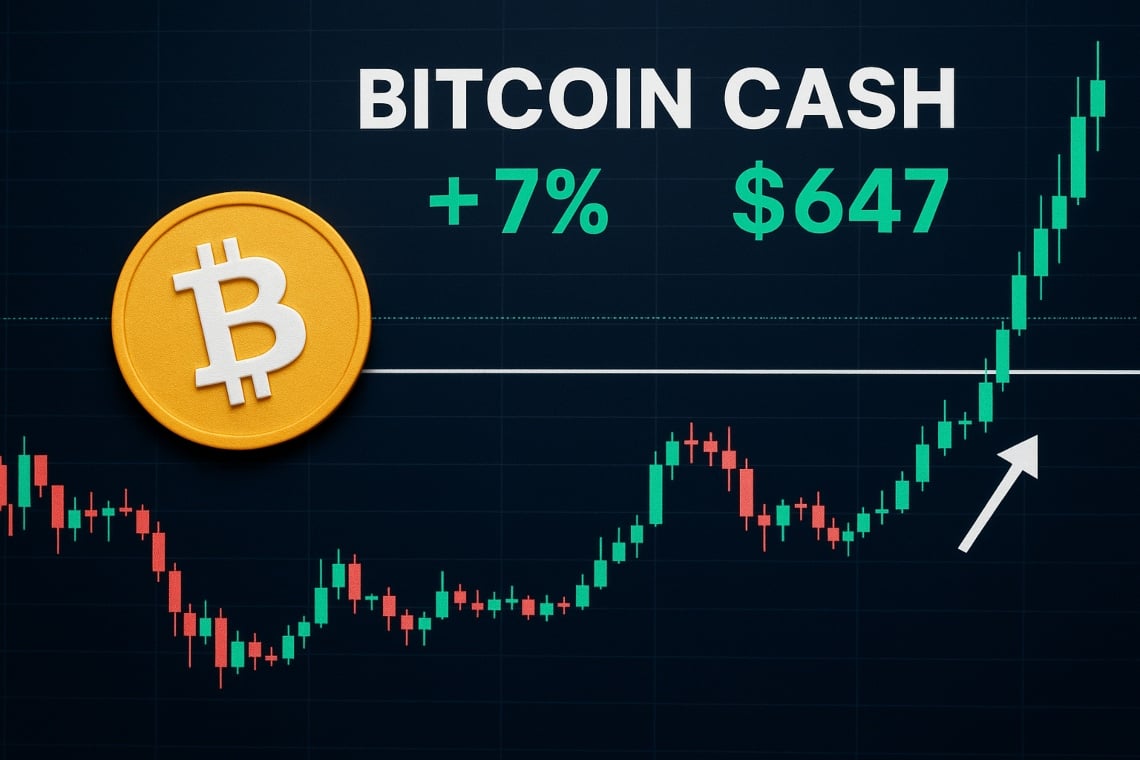
Bitcoin Cash: price +7% at $647, breakout and key levels (09/18/2025)

Bitcoin Cash: price +7% at $647, breakout and key levels (09/18/2025)

Bitcoin Cash gains 7% and reaches $647, hitting highs not seen since last April: the movement fits into a risk-on climate.
Share
The Cryptonomist2025/09/18 21:47