In retail trading over the past year, $8.1 billion in stablecoin exchanges suffered slippage losses of more than 0.1%. This article will analyze this issue.In retail trading over the past year, $8.1 billion in stablecoin exchanges suffered slippage losses of more than 0.1%. This article will analyze this issue.

1USDT≠1USDC? Analyzing the “Dark Forest” Behind Stablecoin Swaps

2025/05/30 17:44

Author: Barter

Compiled by: Tim, PANews

Stablecoin swaps: the good and the bad

The total supply of stablecoins will almost double in 2024, from $129.8 billion to $203.4 billion, more than half of which exist on the Ethereum chain. Faced with dozens of stablecoins circulating in the market and new currencies emerging, it is crucial to ensure that liquidity swaps are as close to a 1:1 exchange rate as possible. The Barter team conducted an in-depth study and found that:

Stablecoin swaps in China often deviate from the 1:1 exchange rate. This post will analyze this issue.
1USDT≠1USDC? Analyzing the “Dark Forest” Behind Stablecoin Swaps

Looks ordinary, but is actually priceless

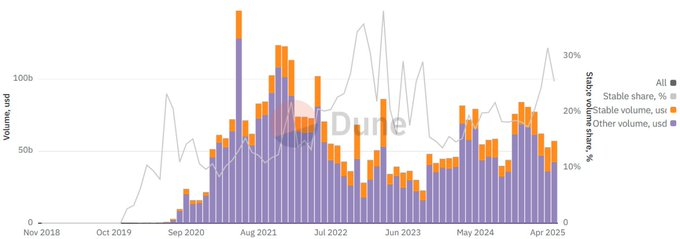
According to DEX transaction data, the proportion of stablecoin transactions in total transactions has remained in the range of 20-30%, while the number of transactions has always been less than 5%. During April 2025, the proportion of stablecoin transactions reached 31.5% (absolute value of US$16.6 billion), and the number of transactions accounted for only 4.6%. This means that the average size of a single stablecoin transaction is 9.5 times that of an ordinary DEX transaction.
1USDT≠1USDC? Analyzing the “Dark Forest” Behind Stablecoin Swaps

The lower the TVL, the higher the efficiency

The TVL of stablecoin liquidity pools fell from a peak of $12.3 billion in January 2022 to $600 million in May 2025. However, since the beginning of 2022, stablecoin trading volume has continued to grow, increasing liquidity turnover by 34 times, and as of April 2025, the weekly turnover rate was as high as 824%. This means that the market structure is transforming towards higher capital efficiency, and liquidity pools now support significantly larger trading volumes.

Stable exchange ≠ stable execution

In retail transactions over the past year, $8.1 billion in stablecoin exchanges suffered slippage losses of more than 0.1%. Among them, $930 million in transactions had slippage of more than 1%, which is an abnormally high situation in stablecoin exchanges, and 78.5% of high slippage transactions were concentrated in stablecoin trading pairs with poor liquidity.

While 1% slippage may seem insignificant at first glance, it exposes deep-seated efficiency issues in the high-volume stablecoin exchange scenario. As a result, stablecoin exchanges currently account for 53.8% of all sandwich-attacked transactions, while MEV (miner extractable value) and arbitrage transactions account for 47.0% of total stablecoin exchange volume, or $1.61 billion per week. ​​

Low cost but high price

The root cause of the high proportion of harmful transactions in stablecoin swaps is fee compression. In the past two and a half years, the average fee for stablecoin swaps has plummeted 5.5 times to only 0.011%, and the fee weighted by transaction volume is as low as 0.005%. Although low fees can attract order flow, they also lead to an abnormal increase in the proportion of harmful transactions. For example, on the Uniswap V4 platform, which offers an ultra-low fee of 0.001%, harmful MEV transactions now account for up to 80.2% of the stablecoin swap transaction volume.

Numerical analysis of friction costs in stablecoin exchange

1USDT≠1USDC? Analyzing the “Dark Forest” Behind Stablecoin Swaps

Market Opportunity
Moonveil Logo
Moonveil Price(MORE)
$0.002674
$0.002674$0.002674
-9.44%
USD
Moonveil (MORE) Live Price Chart
Disclaimer: The articles reposted on this site are sourced from public platforms and are provided for informational purposes only. They do not necessarily reflect the views of MEXC. All rights remain with the original authors. If you believe any content infringes on third-party rights, please contact service@support.mexc.com for removal. MEXC makes no guarantees regarding the accuracy, completeness, or timeliness of the content and is not responsible for any actions taken based on the information provided. The content does not constitute financial, legal, or other professional advice, nor should it be considered a recommendation or endorsement by MEXC.

You May Also Like

Coinbase Data Breach Fallout: Former Employee Arrest in India Over Customer Data Case Raises Bitcoin Security Concerns

Coinbase Data Breach Fallout: Former Employee Arrest in India Over Customer Data Case Raises Bitcoin Security Concerns

The post Coinbase Data Breach Fallout: Former Employee Arrest in India Over Customer Data Case Raises Bitcoin Security Concerns appeared on BitcoinEthereumNews.
Share
BitcoinEthereumNews2025/12/27 10:36
Burmese war amputees get free 3D-printed prostheses, thanks to Thailand-based group

Burmese war amputees get free 3D-printed prostheses, thanks to Thailand-based group

PROSTHETIC FEET. Silicon foot covers fitted with metal rods found in the prosthetic production unit in Mae Tao Clinic. A good prosthetic foot must absorb impact
Share
Rappler2025/12/27 10:00
China Blocks Nvidia’s RTX Pro 6000D as Local Chips Rise

China Blocks Nvidia’s RTX Pro 6000D as Local Chips Rise

The post China Blocks Nvidia’s RTX Pro 6000D as Local Chips Rise appeared on BitcoinEthereumNews.com. China Blocks Nvidia’s RTX Pro 6000D as Local Chips Rise China’s internet regulator has ordered the country’s biggest technology firms, including Alibaba and ByteDance, to stop purchasing Nvidia’s RTX Pro 6000D GPUs. According to the Financial Times, the move shuts down the last major channel for mass supplies of American chips to the Chinese market. Why Beijing Halted Nvidia Purchases Chinese companies had planned to buy tens of thousands of RTX Pro 6000D accelerators and had already begun testing them in servers. But regulators intervened, halting the purchases and signaling stricter controls than earlier measures placed on Nvidia’s H20 chip. Image: Nvidia An audit compared Huawei and Cambricon processors, along with chips developed by Alibaba and Baidu, against Nvidia’s export-approved products. Regulators concluded that Chinese chips had reached performance levels comparable to the restricted U.S. models. This assessment pushed authorities to advise firms to rely more heavily on domestic processors, further tightening Nvidia’s already limited position in China. China’s Drive Toward Tech Independence The decision highlights Beijing’s focus on import substitution — developing self-sufficient chip production to reduce reliance on U.S. supplies. “The signal is now clear: all attention is focused on building a domestic ecosystem,” said a representative of a leading Chinese tech company. Nvidia had unveiled the RTX Pro 6000D in July 2025 during CEO Jensen Huang’s visit to Beijing, in an attempt to keep a foothold in China after Washington restricted exports of its most advanced chips. But momentum is shifting. Industry sources told the Financial Times that Chinese manufacturers plan to triple AI chip production next year to meet growing demand. They believe “domestic supply will now be sufficient without Nvidia.” What It Means for the Future With Huawei, Cambricon, Alibaba, and Baidu stepping up, China is positioning itself for long-term technological independence. Nvidia, meanwhile, faces…
Share
BitcoinEthereumNews2025/09/18 01:37