Upbit replaced all stolen user funds while investigators track a Lazarus-style laundering trail. South Korea’s FIU targets Korbit, Gopax, Bithumb, and Coinone with penalties after compliance failures. South Korean authorities say a North Korean state-backed hacking group likely stole about 44.5 billion won, roughly 30 million dollars, from the country’s largest crypto exchange, Upbit. The [...]]]>Upbit replaced all stolen user funds while investigators track a Lazarus-style laundering trail. South Korea’s FIU targets Korbit, Gopax, Bithumb, and Coinone with penalties after compliance failures. South Korean authorities say a North Korean state-backed hacking group likely stole about 44.5 billion won, roughly 30 million dollars, from the country’s largest crypto exchange, Upbit. The [...]]]>

Report Claims North Korean Group Orchestrated $30M Crypto Hack in South Korea

For feedback or concerns regarding this content, please contact us at crypto.news@mexc.com
  • Upbit replaced all stolen user funds while investigators track a Lazarus-style laundering trail.
  • South Korea’s FIU targets Korbit, Gopax, Bithumb, and Coinone with penalties after compliance failures.

South Korean authorities say a North Korean state-backed hacking group likely stole about 44.5 billion won, roughly 30 million dollars, from the country’s largest crypto exchange, Upbit. The breach hit a Solana hot wallet on Nov. 27, according to Upbit’s operator Dunamu.

Around 4:42 a.m. local time, the exchange detected abnormal withdrawals of Solana-based tokens and quickly suspended deposits and withdrawals on the network. The stolen assets included SOL, USDC, and a basket of other Solana ecosystem tokens that were sent to an external wallet not controlled by the exchange.
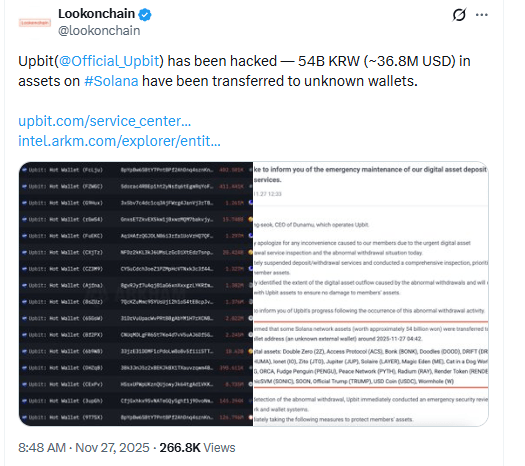
Source: LookonchainSource: Lookonchain on X

Soon after the incident, Yonhap and other local outlets reported that investigators see “North Korean fingerprints” on the attack. Officials said the operation bears similarities to the 2019 Upbit hack, as featured in our coverage, when 58 billion won worth of Ethereum disappeared in a case later tied to North Korea’s Lazarus Group.

South Korea’s police cyber unit, financial regulators, and intelligence agencies are conducting on-site inspections at Dunamu. They are tracing flows linked to about 44.5 billion won in stolen crypto and reviewing whether compromised or impersonated administrator credentials opened the door, rather than a direct break of Upbit’s core servers.

Upbit Pays Back $30M Losses as Suspected North Korean Trail Appears

Upbit said it has already reimbursed all affected member assets from its own reserves and absorbed a corporate loss of about 5.9 billion won. It also reported freezing a portion of the stolen funds with help from project teams and blockchain analytics firms, while shifting remaining Solana holdings into cold storage.

As the investigation unfolds, blockchain traces show the attacker quickly swapped multiple Solana tokens into wrapped Solana and SOL, then moved the proceeds across roughly 185 wallets before bridging into Ethereum. That pattern, according to analysts, matches earlier Lazarus-linked laundering routes.

South Korea Targets Four More Exchanges After Upbit Case

Meanwhile, South Korea’s Financial Intelligence Unit is now turning to Korbit, Gopax, Bithumb, and Coinone after the Upbit incident. Regulators plan penalties for these four platforms following a 35.2 billion won fine against Dunamu, as previously mentioned in our report, the operator of Upbit, for weak anti–money laundering and customer checks.

Inspectors ran on-site reviews across the exchanges from 2024 into early 2025 and kept finding similar problems. They flagged poor ID verification, slow reports of suspicious activity, and large transfers that slipped past AML controls. As a result, authorities expect further sanctions to land in the first half of next year.

]]>
Disclaimer: The articles reposted on this site are sourced from public platforms and are provided for informational purposes only. They do not necessarily reflect the views of MEXC. All rights remain with the original authors. If you believe any content infringes on third-party rights, please contact crypto.news@mexc.com for removal. MEXC makes no guarantees regarding the accuracy, completeness, or timeliness of the content and is not responsible for any actions taken based on the information provided. The content does not constitute financial, legal, or other professional advice, nor should it be considered a recommendation or endorsement by MEXC.

You May Also Like

South Korea’s $657 Million Exit from Tesla Signals a Big Crypto Pivot
South Korea’s $657 Million Exit from Tesla Signals a Big Crypto Pivot

In a dramatic shift in investment patterns, South Korean retail investors withdrew $657 million from Tesla stock in August 2025, representing the largest monthly outflow in more than two years. At the same time, by mid-2025, they had shifted more than $12 billion into U.S.-listed companies tied to cryptocurrency, indicating a deepening preference for digital […]
Share
Tronweekly2025/09/18 14:00
MetaMask to Launch Its Token Sooner Than Expected, Says ConsenSys CEO

MetaMask to Launch Its Token Sooner Than Expected, Says ConsenSys CEO

The post MetaMask to Launch Its Token Sooner Than Expected, Says ConsenSys CEO appeared first on Coinpedia Fintech News MetaMask, the world’s leading Web3 wallet and gateway to decentralized apps, is gearing up to launch its own token. In a recent interview, Consensys CEO and Ethereum co-founder Joe Lubin revealed that a MetaMask token could be launched much earlier than people think, sparking excitement among users and investors who have long been waiting for …
Share
CoinPedia2025/09/19 12:56
How is the xStocks tokenized stock market developing?

How is the xStocks tokenized stock market developing?

Author: Heechang Compiled by: TechFlow xStocks offers a tokenized stock service, allowing investors to trade tokenized versions of popular US stocks like Tesla in real time. While still in its early stages, it’s already showing some interesting signs of growth. Observation 1: Trading is concentrated in Tesla (TSLA) As in many emerging markets, trading activity has quickly concentrated on a handful of stocks. Data shows a high concentration of trading volume in the most well-known and volatile stocks, with Tesla being the most prominent example. This concentration is not surprising: liquidity tends to accumulate in assets that retail investors already favor, and early adopters often use familiar high-beta stocks to test new infrastructure. Observation 2: Liquidity decreases on weekends Data shows that on-chain equity trading volume drops to 30% or less of weekday levels over the weekend. Unlike crypto-native assets, which trade seamlessly around the clock, tokenized stocks still inherit the behavioral inertia of traditional market trading hours. Traders appear less willing to trade when reference markets (such as Nasdaq and the New York Stock Exchange) are closed, likely due to concerns about arbitrage, price gaps, and the inability to hedge positions off-chain. Observation 3: Prices move in line with the Nasdaq Another key signal comes from pricing behavior during the initial launch period. Initially, xStocks tokens traded at a significant premium to their Nasdaq counterparts, reflecting market enthusiasm and potential friction in bridging fiat liquidity. However, these premiums gradually diminished over time. Current trading patterns show that the token price is at the upper limit of Tesla's intraday price range and is highly consistent with the Nasdaq reference price. Arbitrageurs appear to be maintaining this price discipline, but there are still small deviations from the intraday highs, indicating some market inefficiencies that may present opportunities and risks for active traders. New opportunities for Korean stock investors? South Korean investors currently hold over $100 billion in US stocks, with trading volume increasing 17-fold since January 2020. Existing infrastructure for South Korean investors to trade US stocks is limited by high fees, long settlement times, and slow cash-out processes, creating opportunities for tokenized or on-chain mirror stocks. As the infrastructure and platforms supporting on-chain US stock markets continue to improve, a new group of South Korean traders will enter the crypto market, which is undoubtedly a huge opportunity.
Share
PANews2025/09/18 08:00