

Where India builds and Australia scales: A joint blueprint for AI-led growth
India’s next decade of innovation will hinge on how effectively founders, investors, and global partners harness AI. As AI, data, and finance converge into a unified engine for value creation, India must shift from being the world’s service backbone to building companies that can stand alongside the Fortune 500. At the same time, deeper multinational collaboration, especially between India and Australia, is unlocking new pathways for shared opportunity and long-term, sustainable growth.
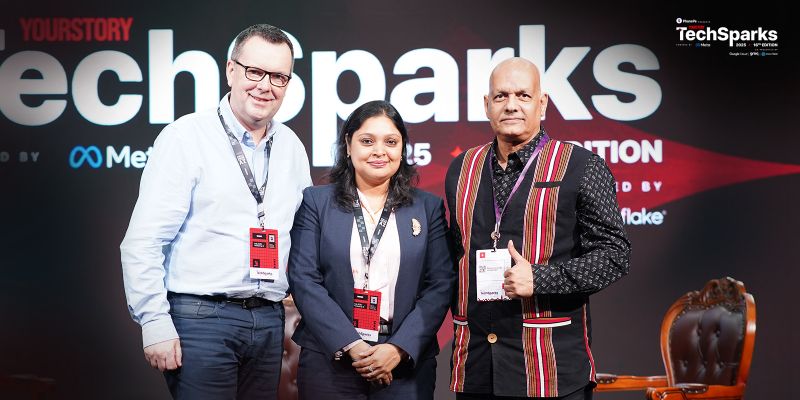
This framing set the stage for the TechSparks 2025 panel, ‘Investing in India’s Global Tech Moment, Powered by Intelligence’, moderated by Madanmohan Rao, Research Director at YourStory, and featuring Bruce Keith, CEO of InvestorAi, and Malini Dutt, Trade and Investment Commissioner, India, NSW.
Their conversation explored what it takes to build globally competitive AI products in India, how international partnerships accelerate innovation, and why Australia is becoming a strategic ally for India’s next wave of tech builders.
India’s AI shift: From services to products
Rao opened with the central question of the session: whether India can move beyond its IT services legacy to become a global product and IP engine. He asked Keith to offer an investor’s perspective.
Keith said, “I don’t think of this as an AI boom. What matters is where AI is delivering a material difference.” Drawing a parallel to the late ’90s, he said this cycle demands real outcomes, not hype.
He also highlighted India’s Digital Public Infrastructure, calling it “the best startup in India”, and said it creates enormous valuation potential. But unlocking that potential requires a shift toward a product- and IP-led mindset built on repeatability and ownership.
Policy, collaboration, and the India–Australia corridor
Rao then turned to Malini Dutt to outline how Australia, particularly New South Wales, is positioning itself as a partner for Indian tech companies.
Dutt began by putting Australia’s economic scale in context. “New South Wales is one-third of Australia’s GDP,” she said. She pointed to Sydney’s Tech Central, a six-square-kilometer innovation district supported by long-term government investment and designed for collaboration between startups, global tech firms, and research institutions.
She also highlighted Australia’s National Innovation Visa, created for founders who can deliver economic value and high-skill jobs. “If you have a unique product and create economic value, you get a PR pathway,” she noted, reinforcing Australia’s appeal for Indian entrepreneurs.
Vertical AI over horizontal approaches
As the discussion shifted to investment themes, Keith distinguished between horizontal AI models and deep domain expertise. “Just plugging things into an LLM is not going to get you the best outcome for investments,” he said.
Horizontal LLMs will continue to be dominated by North American players, but India’s strength lies in vertical AI—industry-specific models built for depth, not breadth. With its scale and sector-rich data, India can build defensible, domain-focused intelligence.
Australia’s priority areas for innovation
Rao then asked Dutt about Australia’s upcoming opportunities. She highlighted Australia’s three priority areas for innovation.
“Domestic housing is a major issue across Australia,” she said, identifying it as a strong area for tech-enabled infrastructure solutions. She also pointed to Australia’s renewable energy push and the opening of a new green-powered data center in New South Wales, which will unlock a wide range of AI opportunities.
Her third focus area was domestic manufacturing, especially IoT, robotics, and smart factory systems. These priorities give international founders, including Indian companies, a clear roadmap for collaboration.
The critical shift from services to products
Returning to the India narrative, Keith pointed out that the country must move beyond its time-and-materials IT services model, which no longer scales in an AI-driven world where companies must “do more with less”.
He believes that India’s next chapter requires a product and IP-led mindset—a different organizational DNA that builds repeatable innovation instead of scaling headcount.
With India poised to become the world’s third-largest economy, he explained that the goal should not just be serving the Fortune 500 but building companies capable of joining and influencing that list.
The bilateral opportunity
Dutt expanded the conversation to policy, highlighting the interim Free Trade Agreement as a major step for both nations. Although Australia represents just 0.3% of the world’s population, it contributes more than 1.5% to global GDP and has a tech sector valued at $134 billion.
She encouraged Indian companies to view Australia not merely as a market but as a test bed for co-developing solutions through partnerships with universities, research institutions, and government-backed innovation programs.
The patent question: Why India needs more product companies
When asked why India holds only 0.2% of global patents while China accounts for 60%. Keith said, “A services company has a different DNA,” and added that Indian IT firms must create product divisions and commit real R&D investment, around 20% of headcount, to stay competitive.
Dutt added that Australia has backed joint R&D for over 15 years through initiatives such as the Australia–India Critical Technologies Partnership and Maitri grants, supporting spacetech collaborations led by Space Machines, Anand Technologies, and Vikaantra.
What it takes to expand internationally
Rao asked both speakers for practical advice for founders entering global markets. Keith talked about resilience, noting that fundraising often involves difficult conversations and intense scrutiny.
Dutt pointed to the biggest mistake founders make: trying to run Australia remotely. “You cannot operate Australia with a fly-in, fly-out model,” she said. She urged companies to invest locally, hire local teams, and align with the government’s strategic focus areas.
What lies ahead
As the session wrapped up, both panelists shared predictions for the coming year. Keith anticipated a massive wave of AI-driven change, triggering job shifts, retraining, and new wealth creation. “I think we’re just touching the surface with agentic AI,” he said.
Dutt encouraged attendees to explore opportunities in Australia through events such as South by Southwest Sydney and the National Tech Summit. With trade agreements progressing and innovation ecosystems strengthening across both nations, the India–Australia corridor is evolving into a pathway for building globally relevant IP, scaling AI products, and enabling India’s shift from a services-led economy to a product innovation leader.


You May Also Like

Siren Token Sheds 70% as Analysts Question Supply Structure

Academic Publishing and Fairness: A Game-Theoretic Model of Peer-Review Bias

