Aster token price fails to reclaim $1.10 volume resistance, signaling a dead-cat bounce.
Aster token price fails to reclaim the $1.10 point of control, triggering a rejection that raises concerns the recent rally was a dead-cat bounce lacking meaningful bullish volume.
- Failure to reclaim $1.10 confirms strong resistance and bearish momentum.
- Weak bullish volume undermines the sustainability of the latest rally.
- Downside continuation toward the $0.92 high-time-frame support appears likely.
Aster (ASTER) token price is entering a fragile phase after failing to reclaim the $1.10 point of control, a major resistance zone within its current trading range. The rejection from this level has shifted momentum back in favor of sellers and cast doubt on the strength of the asset’s recent rally.
With bullish volume thinning out and market structure still leaning bearish, Aster now faces an elevated risk of a deeper corrective move as traders monitor whether the broader downtrend will resume.
Aster token price key technical points
- Aster rejects the $1.10 point of control, confirming heavy resistance.
- Weak bullish volume suggests the recent upswing may have been a dead-cat bounce.
- Downside targets include the high-time-frame support zone at $0.92.
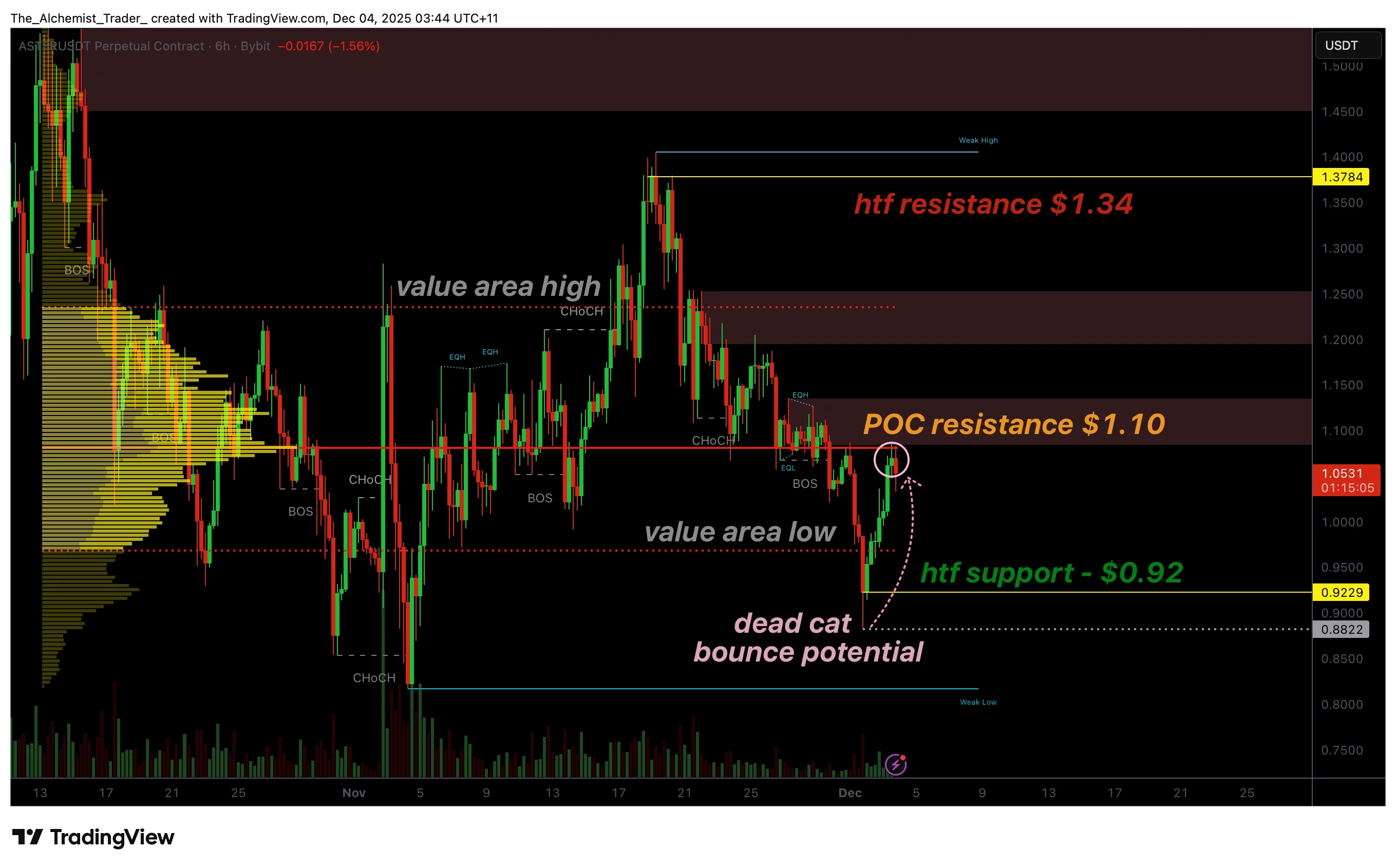
Aster’s latest rally initially appeared promising, but the underlying data shows it lacked the critical element needed for continuation: sustained bullish volume. Without strong participation from buyers, rallies into significant resistance tend to fade quickly.
This is precisely what occurred when price attempted to reclaim the $1.10 point of control. Instead of breaking above it, Aster encountered immediate selling pressure, leading to a sharp rejection.
The point of control represents the highest volume node within Aster’s entire trading range, making it a crucial pivot level. Historically, price has responded strongly to this area, either launching bullish expansions when it is reclaimed or triggering heavy sell-offs when it is rejected.
The latest reaction mirrors previous bearish retests in which Aster failed to rise above the point of control, followed by a sizeable downward move. This historical pattern increases the likelihood that a similar move may unfold again.
If this scenario repeats, the price may rotate lower toward the next high-time-frame support near $0.92. This level has acted as a key structural base during earlier declines and remains an important reference point for traders.
With the market still printing lower lows and lower highs, the path of least resistance appears to favor a continuation to the downside. Some traders have even begun questioning whether Changpeng Zhao is attempting a Musk-style move with Aster, although such speculation has not affected the immediate technical outlook.
The setup aligns with the characteristics of a dead-cat bounce. A dead-cat bounce occurs when price temporarily rises due to short-term buying or short covering, only to quickly reject and resume the broader bearish trend.
Aster’s rally showed impulsiveness, but the absence of substantial volume made it unsustainable. As soon as the price hit the point of control, the market rejected sharply, grinding the rally to a halt and bringing the price back into the heart of the downtrend.
Additionally, Aster now faces a bearish order block directly below the $1.10 resistance. The most recent test of this zone resulted in an immediate rejection, reinforcing its strength. This comes as on-chain analysis has already debunked the $35 million Aster transfer allegation against Changpeng Zhao, showing that recent market weakness is technical rather than news-driven. A second test may yield another rejection, further validating the bearish bias and supporting the idea that sellers are regaining complete control.
What to expect in the coming price action
As long as Aster remains below the $1.10 point of control, bearish continuation is the most likely scenario. The $0.92 support stands as the next logical downside target unless a convincing surge in bullish volume allows the market to reclaim resistance and shift momentum.
You May Also Like

TRM Labs Launches Revolutionary AI Agent for Natural Language On-Chain Analysis

Unlocking SEO, GEO & AEO: The Future of Search Optimization