DOJ Seizes Burma Crypto Scam Domain After Victims Lost Millions in Fake Trading Scheme
The U.S. Department of Justice (DOJ) has taken down a web domain linked to a major crypto investment scam operating out of Burma, targeting people in the United States.
The site, tickmilleas(dot)com, was allegedly run by operators inside the Tai Chang scam compound, also known as Casino Kosai, in the village of Kyaukhat.
Investigators say the website pretended to be a legitimate trading platform but instead pulled victims into a coordinated and highly deceptive crypto scheme.
Federal Agencies Remove Thousands of Accounts, Apps in Crackdown on Tai Chang Scam Network
An affidavit supporting the seizure links the Tai Chang compound to the Democratic Karen Benevolent Army and the Trans Asia International Holding Group Thailand Company Limited.
The department said both groups were sanctioned last year for ties to Chinese organized crime and their involvement in setting up scam centers across Southeast Asia.
The domain seizure follows the recent launch of the District of Columbia’s Scam Center Strike Force and the takedown of two other domains tied to the same operation.
Victims told the FBI that the tickmilleas(dot)com platform showed fake profits, staged deposits, and other fabricated data meant to make it look like their trades were performing well.
Scammers reportedly walked victims through these fake trades to build trust, even though the entire system was controlled behind the scenes.
Although the domain was only registered in early November 2025, investigators have already identified several victims who lost money within weeks.
The DOJ has since replaced the site with a notice telling visitors the domain has been seized.
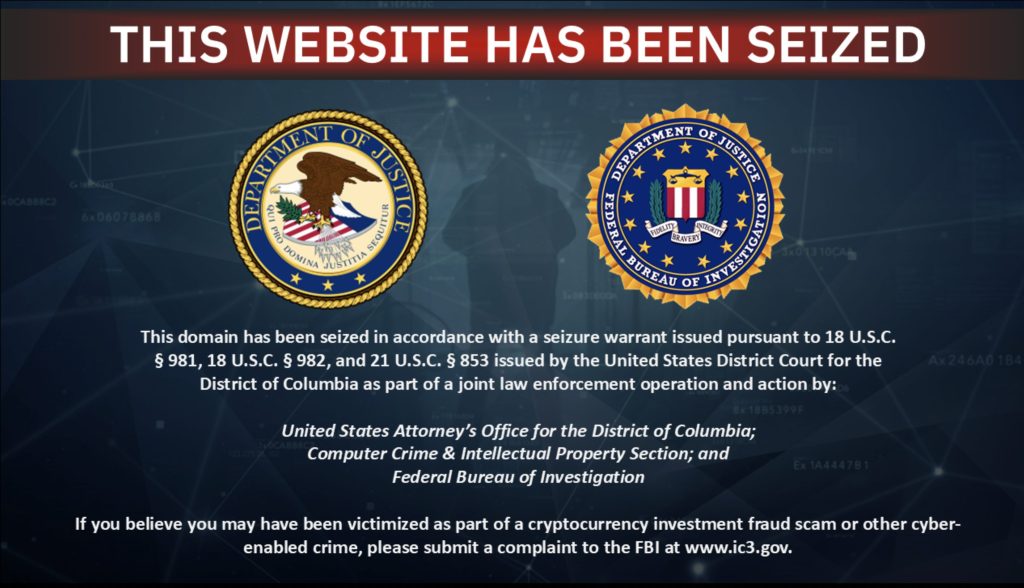 Source: Tickmilleas.com
The affidavit also says the domain directed people to download scam mobile apps from Google Play and the Apple App Store.
After receiving warnings from the FBI, both companies removed several apps linked to the operation.
Meta also took down more than 2,000 connected accounts after receiving information about the Tai Chang network.
Federal officials say these actions reflect growing concern about crypto-related investment scams, which remain one of the most damaging categories of online crime in the United States.
In 2024, the FBI’s Internet Crime Complaint Center recorded more than 41,000 complaints tied to crypto investment fraud, totaling an estimated $5.8 billion in losses.
DOJ Intensifies Crypto Crime Crackdown With New Charges, Seizures, and Sanctions
The action comes during a period of intense federal activity against crypto-related crime.
On November 20, prosecutors unsealed charges against former Olympic snowboarder Ryan Wedding, accusing him of running a Tether-based laundering network for drug money and allegedly ordering the murder of a federal witness in Colombia earlier this year.
A few days earlier, on November 14, the DOJ announced the sentencing of Travis Ford, the CEO of Wolf Capital Crypto Trading, who received a five-year prison sentence for running a $9.4 million investment scam advertised as offering daily returns of up to two percent.
Federal investigators also moved to seize more than $15 million in USDT connected to North Korea’s APT38 hacking unit, which they say carried out several major crypto exchange breaches in 2023.
The FBI seized the funds in March 2025 and is now asking a court for permission to return the assets to the victims.
In a separate case, prosecutors secured guilty pleas from five people accused of helping North Korean IT workers secretly obtain jobs in U.S. companies.
Other recent enforcement steps include a civil forfeiture case tied to $584,741 in USDT linked to an Iranian national accused of supporting the Islamic Revolutionary Guard Corps’ drone program.
Additionally, in September, the DOJ sanctioned 19 entities in Myanmar and Cambodia for running forced-labor scam compounds used to operate large-scale crypto fraud networks.
You May Also Like

Shocking OpenVPP Partnership Claim Draws Urgent Scrutiny

TRM Labs Launches Revolutionary AI Agent for Natural Language On-Chain Analysis