

Numerical Tests Highlight OTFS’s Spectral-Efficiency Gains Over OFDM
Table of Links
- I. Abstract and Introduction
- II. Related Work
- III. Modeling of Mobile Channels
- IV. Channel Discretization
- V. Channel Interpolation and Extrapolation
- VI. Numerical Evaluations
- VII. Conclusions, Appendix, and References
VI. NUMERICAL EVALUATIONS
In this section, we will evaluate the theoretical analyses presented in the previous discussions, based on the WSSUS channel model. Consider a carrier frequency fc = 30 GHz, and a sub-carrier spacing of 200 kHz, or a symbol duration of 5 µs. QPSK modulation is considered throughout the simulations
\ A. ISCI from Delay-Doppler Spreading
\ OFDM is based on the LTI channel model, while OTFS is built upon the D-D domain channel model and the biorthogonality. Both models suffer from modeling error, leading to system errors in OFDM and OTFS. For OFDM, the Doppler spread leads to ICI, and also time-domain channel variation; for OTFS, the modeling error results from the time-frequency spreading of the cross-ambiguity function of the transmitting/receiving pulses, as we can see from Fig. 3. Fig. 9 presents the ISI and ICI, for a delay spread of τD = 300/c = 1µs and a Doppler spread of 20 kHz
\ In Fig. 9, the bandwidth varies from 1 to 15 MHz. As we can see, the ISI and ICI are both increasing as the bandwidth increases, and they will gradually level off. Because most interference is from adjacent sub-carriers. As the bandwidth increase, the remote sub-carriers will have a weaker impact. The ISI and ICI are at the same level. In OFDM, by adding CP, we will be able to remove the ISI, but the ICI will be inevitable. This is the main source of performance degradation in OFDM. In OTFS, we can also remove the ISI by adding CP. However, for high-mobility applications, adding CP will not necessarily boost system performance. We can eliminate ISI by paying the overhead of CP, but the ICI adheres. The
\ 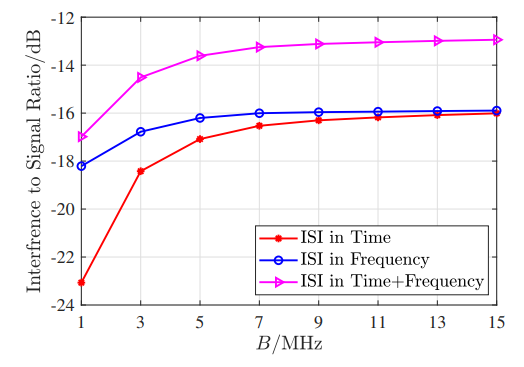
\ ISCI can thus be reduced by 3 dB, which leads to a spectral efficiency of 1 bps/Hz in high SNR regimes, which cannot necessarily compensate the overhead of CP.
\ The ISCI is apparently dependent on the delay and Doppler spreads. Larger spreads will lead to increased ISCI. In Fig. 10, the interference to noise ratio (ISR) is presented for different delay spreads and Doppler spreads.
\ 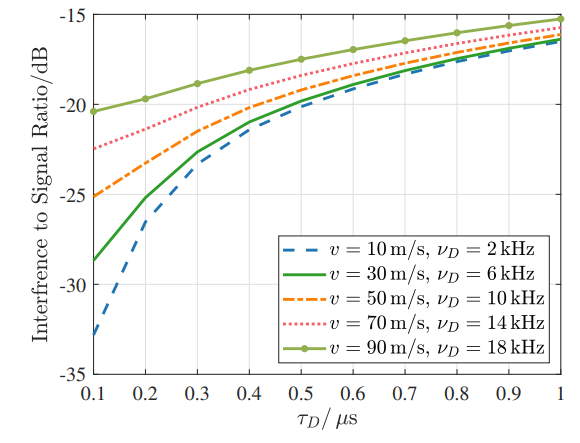
\ As we can see from Fig. 10, the τD varies from 0.1 to 1 µs, while the Doppler spread varies from 2 kHz to 18 kHz, corresponding vehicular speeds of 10 m/s and 90 m/s, respectively. The ISCI is at the level of -30 to -15 dB, which cannot be ignored. For medium- to high-SNR regime, the biorthogonality assumption does not hold anymore.
\ B. Aliasing From T-F Windowing
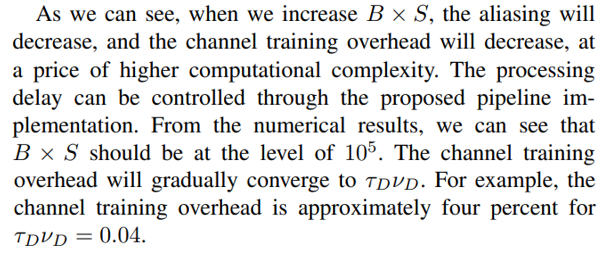
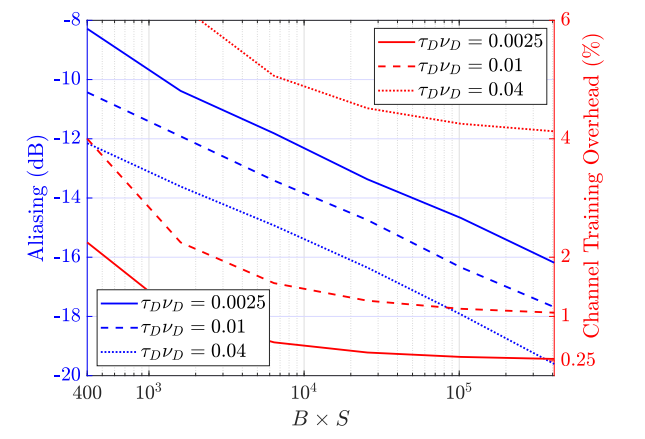
\ Apart from ISCI, aliasing also contributes to channel interpolation/extrapolation error. The results are presented in n Fig. 11.
\ 
\ 
\ C. Channel Interpolation Error
\ In Fig. 12, the normalized MSE of channel estimate is presented for both OFDM and OTFS, under different speeds. The x-axis is the achievable rate, while the y-axis is the cumulative density function (CDF). As we can see, the performance of OFDM is sensitive to the speed of the vehicle, while OTFS has similar performance in different speeds.
\ 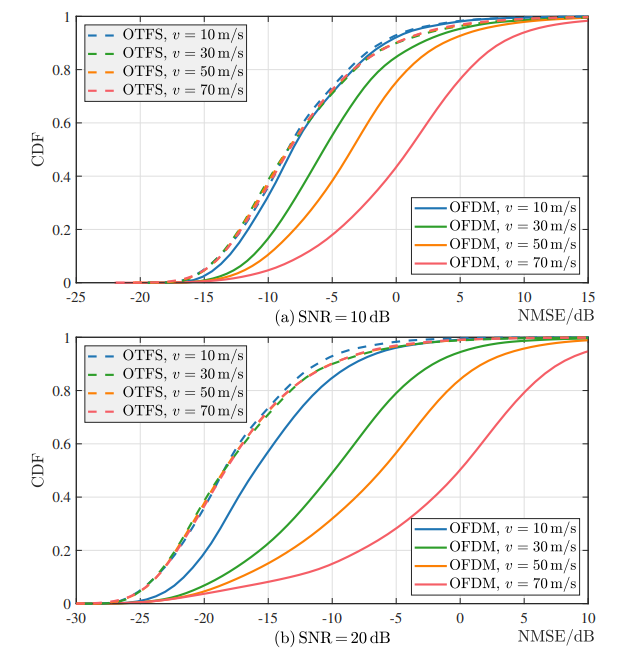
\ The results demonstrate the robustness of OTFS to Doppler spread. As the speed increase, both OTFS and OFDM will see performance degradation. For OFDM, the performance degradation is severe for two reasons. First, the LTI channel model cannot describe the dynamics of the wireless channel, and the channel estimation error accumulates over time. Second, the dispersion in delay and Doppler lead to ISCI. For OTFS, we only see slight performance degradation, due to the increase ISCR from double dispersion.
\ D. Spectral Efficiencies of OFDM and OTFS
\ As we have mentioned at the beginning, the major problem of applying OFDM in mobile channels is the frequent channel estimation, which leads to significant overhead and reduced spectral efficiency. In this part, we will compare the ergodic achievable rates of OTFS and OFDM, by considering both the ISCI, channel training overhead and also the channel estimation error. The first step is to estimate the CSI, and the CSI will then be used for data detection. In this part, the bandwidth is chosen as B = 10 MHz. The delay spread is τD = 300/c = 1µs, and Doppler spread varies with the speed of the mobile device.
\ The channel estimation error leads to reduced SINR, and thus reduced spectral efficiency. In Fig. 13, the achievable rates of OTFS and OFDM are presented. Specifically, the x-axis is the achievable rate, while the y-axis is the CDF.
\ 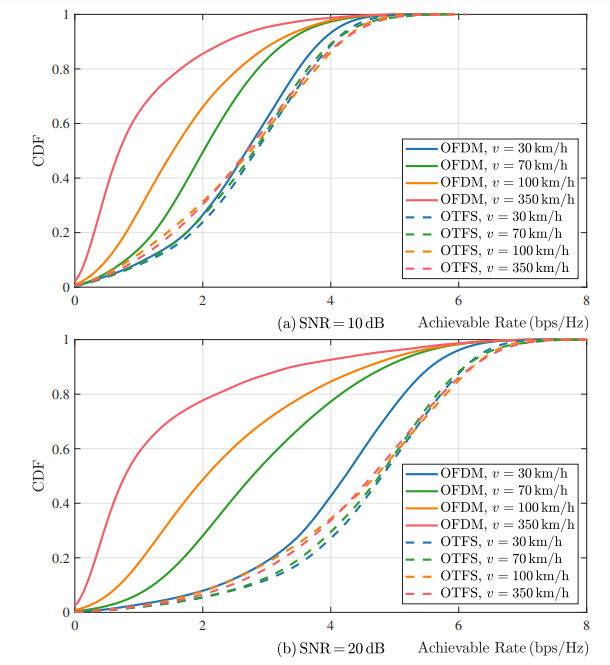
\ Similar to Fig. 12, we can see that the OTFS has much better performance than OFDM. Besides, OFDM is very sensitive to channel mobility, while OFDM is much more robust. The fundamental reason is that the OTFS is based on the timevariant D-D domain channel model, which incorporated the channel dynamics in signal processing. In this case, we assume the OFDM and OTFS are using the same amount of resources for channel estimation. In this case, the OTFS can estimate the channel with much higher accuracy. What if we assign more resources for channel estimation in OFDM, so that the channel estimation accuracy is identical for both cases?
\
:::info Authors:
(1) Zijun Gong, Member, IEEE;
(2) Fan Jiang, Member, IEEE;
(3) Yuhui Song, Student Member, IEEE;
(4) Cheng Li, Senior Member, IEEE;
(5) Xiaofeng Tao, Senior Member, IEEE.
:::
:::info This paper is available on arxiv under CC BY-NC-ND 4.0 license.
:::
\
You May Also Like

XRP Activity Rises as Trading Dynamics Shift on Binance

Ray: Streaming is revolutionizing content consumption, streamers could become political figures, and the impact of online hate on mental health

