The article explains how OTFS leverages the slow-varying nature of the delay-Doppler domain to interpolate and extrapolate channel states, enabling accurate tracking, lower pilot overhead, and reduced processing delay even in high-mobility, doubly-dispersive environments.The article explains how OTFS leverages the slow-varying nature of the delay-Doppler domain to interpolate and extrapolate channel states, enabling accurate tracking, lower pilot overhead, and reduced processing delay even in high-mobility, doubly-dispersive environments.

Why OTFS Outperforms OFDM in High-Mobility Scenarios

  • I. Abstract and Introduction
  • II. Related Work
  • III. Modeling of Mobile Channels
  • IV. Channel Discretization
  • V. Channel Interpolation and Extrapolation
  • VI. Numerical Evaluations
  • VII. Conclusions, Appendix, and References

V. CHANNEL INTERPOLATION AND EXTRAPOLATION

Motivated by the fact that the channel changes much slower and thus more predictable in the D-D domain, we will in this section investigate how we can exploit the predictability for channel interpolation and extrapolation, so that the channel training overhead can be reduced.

\ A. Channel Interpolation with SFT

\ By assuming bi-orthogonality (or ignoring the ISCI, equivalently), the signal model can be simplified as

\
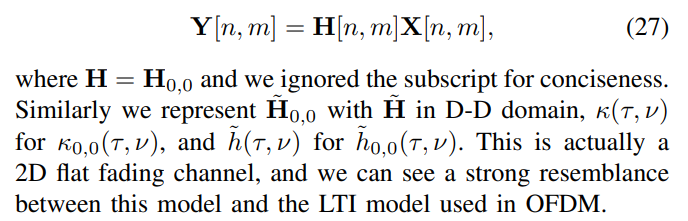
\ Consider a vehicular speed at 100 m/s, and the WSSUS channel model, Fig. 4 shows one realization of the wireless channel in T-F domain. In Fig. 4, the carrier frequency is

\ Fig. 4: Demonstration of the doubly-selective fading channel in time-frequency domain, with bi-orthogonality.
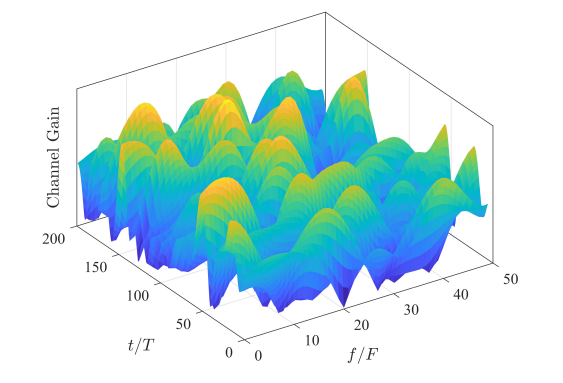
\ 30 GHz, with a sub-carrier spacing of 200 kHz, total bandwidth of 10 MHz, and 1 ms frame length (or 200 symbols). As we can see, the channel changes very fast over both time and frequency, and the channel gains can be significantly different even between adjacent T-F slots. This example demonstrates the necessity of OTFS in highly dynamic channels.

\
\
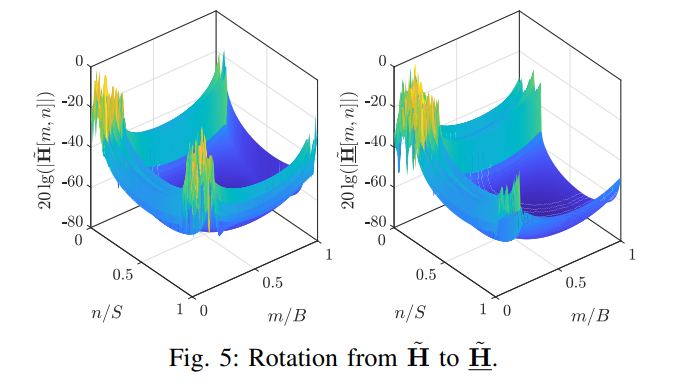
\
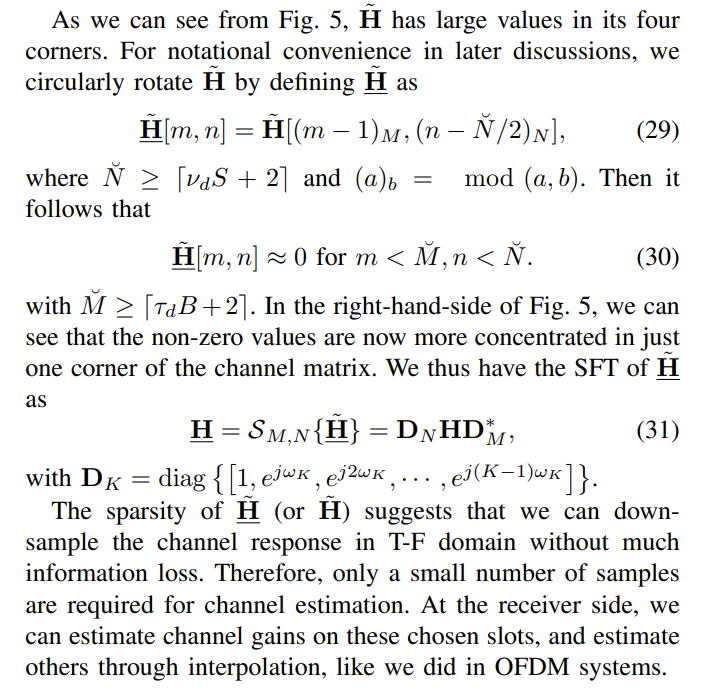
\
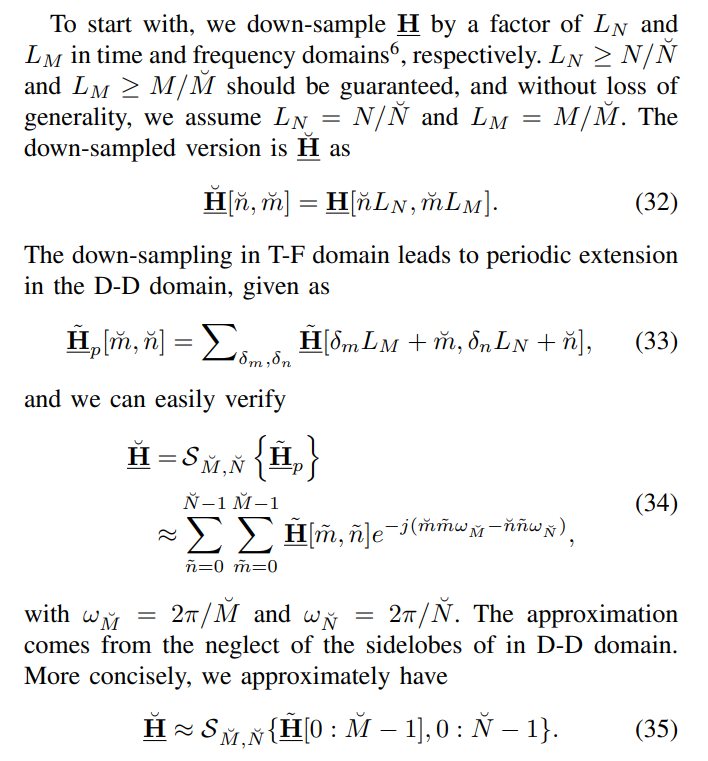
\
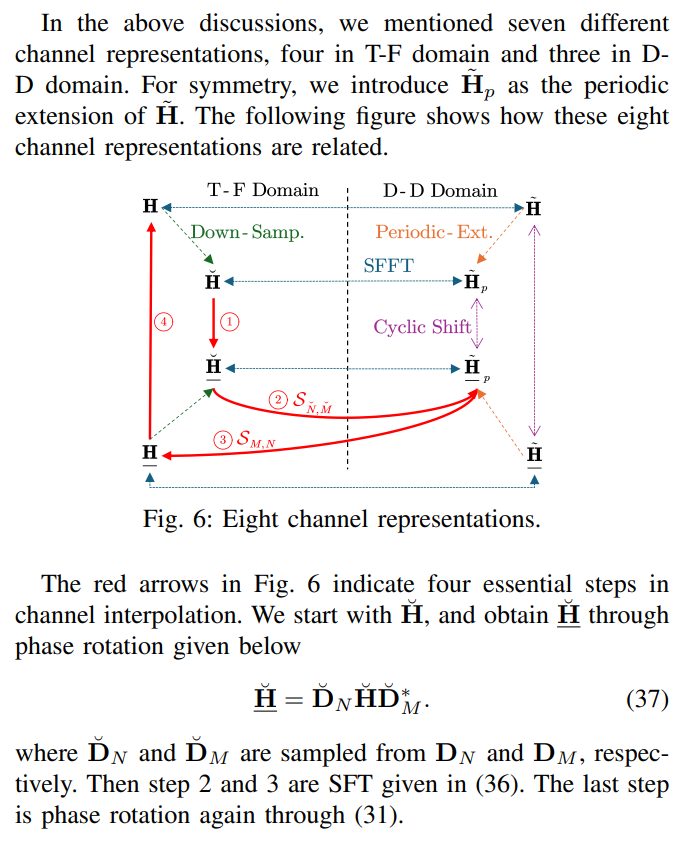
\
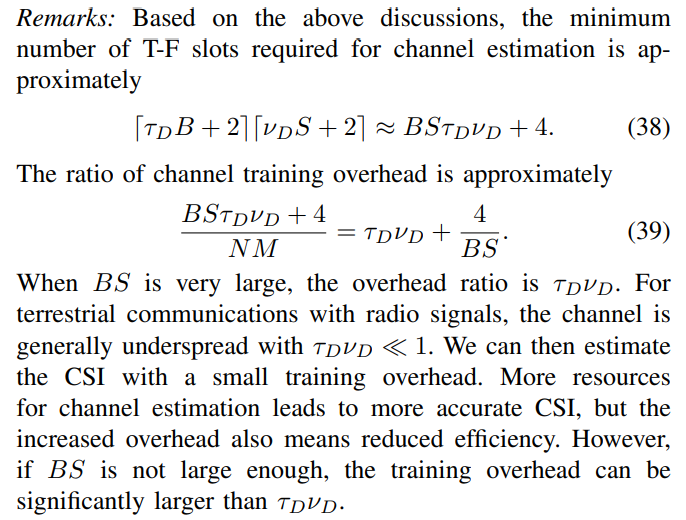
\ Remarks: The above discussions hold for both discrete and continuous D-D profiles. For discrete D-D channel model, these discussions hold even when the Doppler shifts and delays of different paths are not exactly on the D-D grids in general.

\ B. A Pipelined Implementation

\
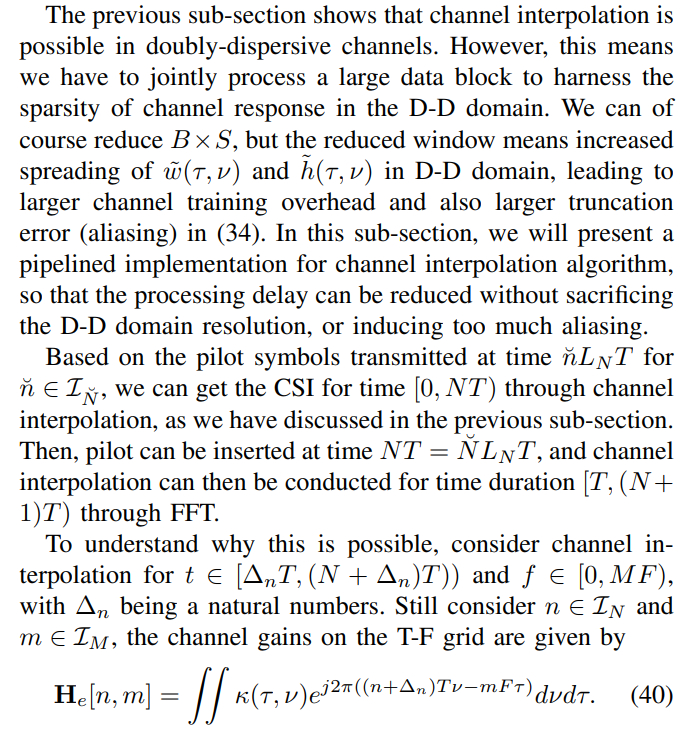
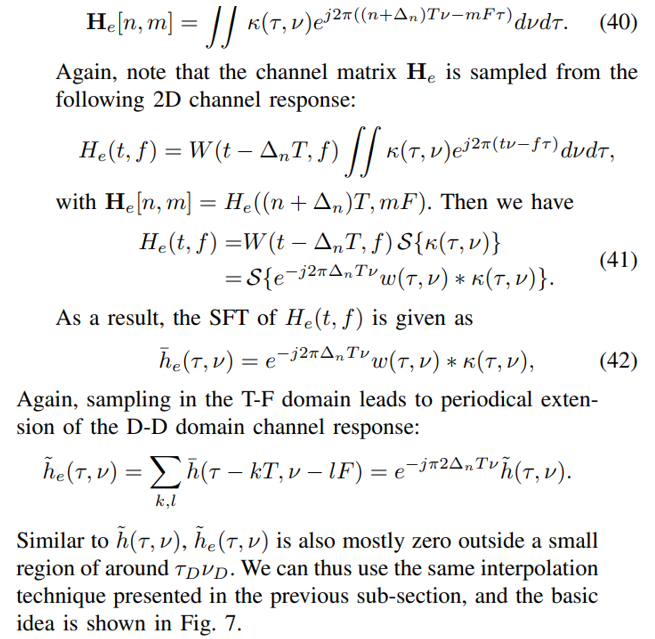
\
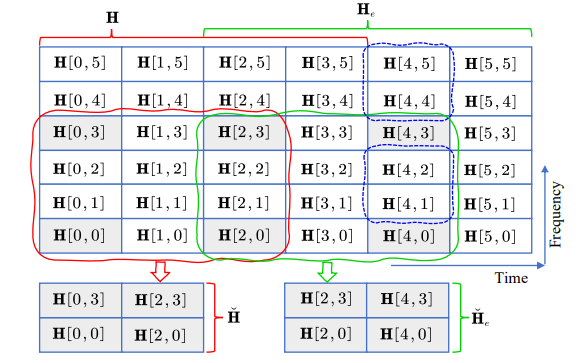
\ Fig. 7: Illustration of pipeline implementation of the channel interpolation, with N = 4, M = 6, LN = 2, LM = 3.
\

\ C. Channel Extrapolation and Tracking

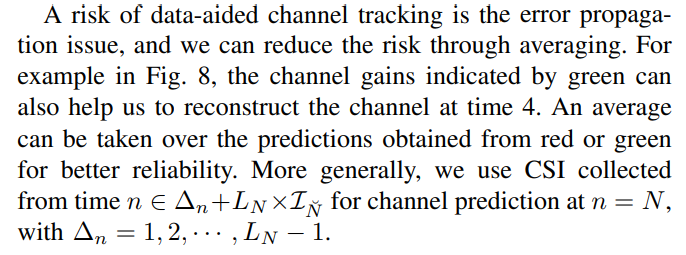
\ In Fig. 7, note that the data received at n = 4, i.e., encircled by the blue curves, cannot be demodulated immediately, because they have to wait for the pilot at time 4. However, based on the previous discussions, we should be able to use the previously estimated CSI for channel prediction. Specifically, we can employ the estimated CSI from time 1 and 3 for channel interpolation for time 1 to 4. From a different point of view, this is extrapolation. This also implies the possibility of channel tracking, and we further reduce the channel training overhead by inserting pilot less frequently. The idea is illustrated in Fig. 8.

\ Fig. 8: Data-aided channel extrapolation.
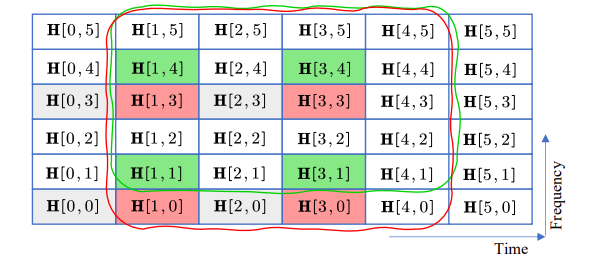
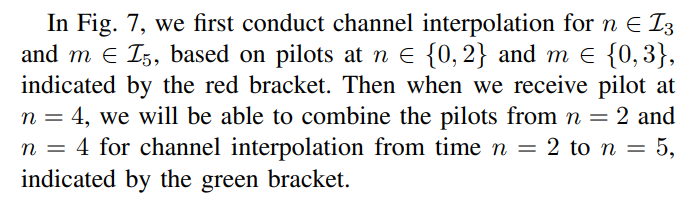
\ With pilot transmitted at time n = 0 and 2, frequency m = 0 and 3, channel interpolation can be conducted for time 0 ≤ n ≤ 3 and frequency 0 ≤ m ≤ 5. Then, we can use channel gains at n ∈ {1, 3}, m ∈ {0, 3}, i.e., the slots indexed by red, for channel interpolation between n = 1 and 4, encircled by red. We can thus estimate the channel gains at time 4 and 5, without waiting for the pilot. The processing delay can thus be further reduced to one symbol duration.

\
\

\ D. Error Analysis

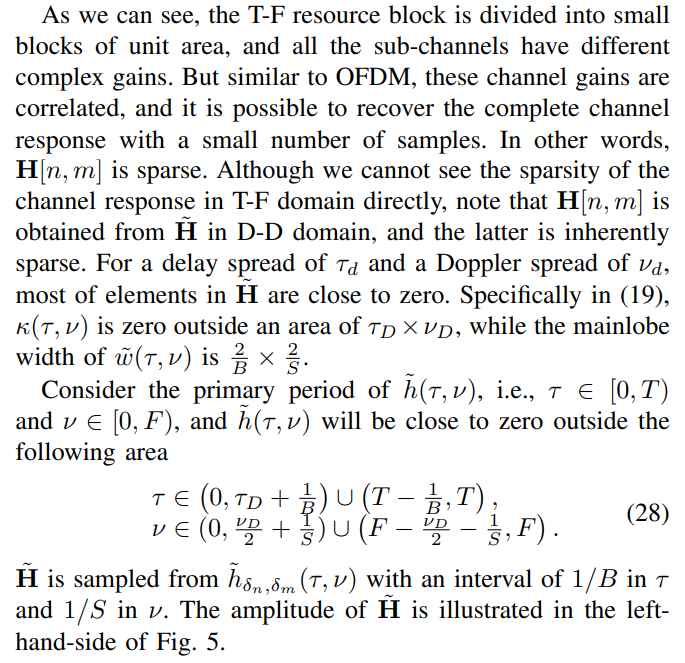
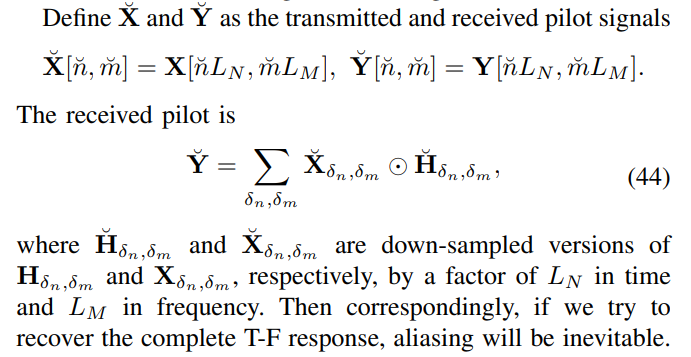
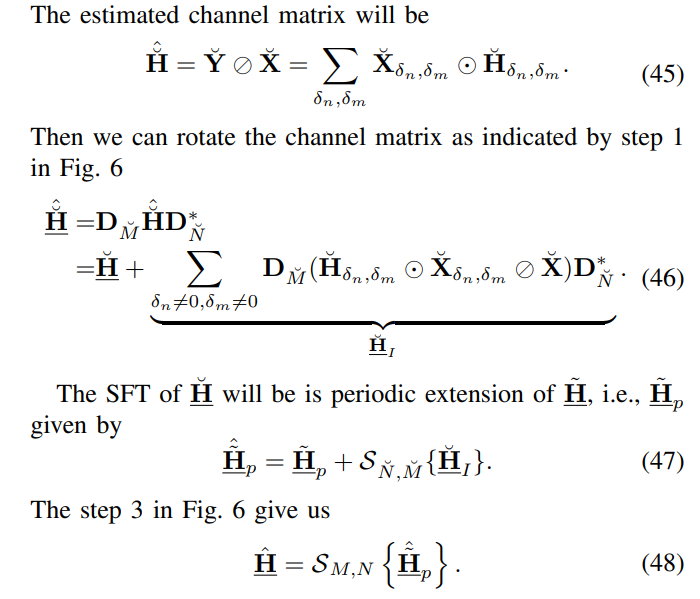
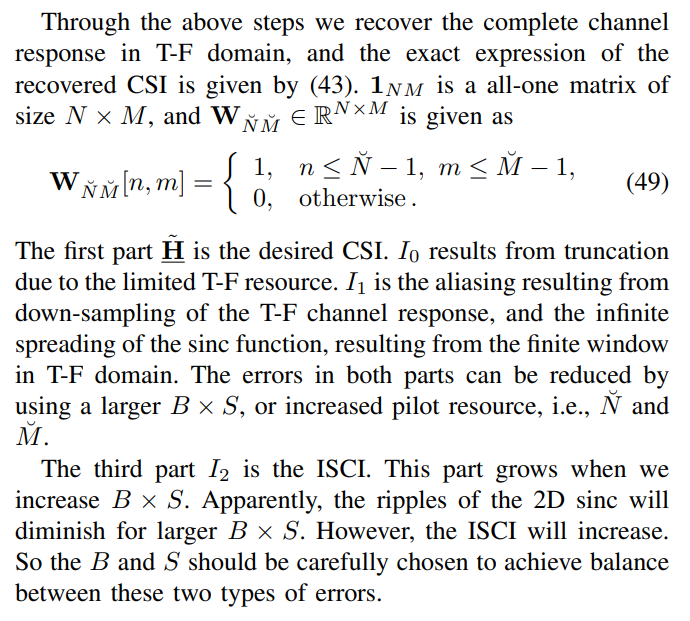
\ The interpolation inevitably leads to error, because the D-D domain channel has infinitely large spread due to the finite support in T-F domain, manifested by the 2D sinc function in D-D domain. Besides, the bi-orthogonality of the signal no longer holds after going through the doubly-dispersive channel. In this sub-section, we will try to quantify the channel estimation errors resulting from aliasing and ISCI

\
\
\
\

:::info Authors:

(1) Zijun Gong, Member, IEEE;

(2) Fan Jiang, Member, IEEE;

(3) Yuhui Song, Student Member, IEEE;

(4) Cheng Li, Senior Member, IEEE;

(5) Xiaofeng Tao, Senior Member, IEEE.

:::


:::info This paper is available on arxiv under CC BY-NC-ND 4.0 license.

:::

[6] Without loss of generality, we assume that M/LM and N/LN are integers. This can be guaranteed by choosing T and F properly.

Disclaimer: The articles reposted on this site are sourced from public platforms and are provided for informational purposes only. They do not necessarily reflect the views of MEXC. All rights remain with the original authors. If you believe any content infringes on third-party rights, please contact service@support.mexc.com for removal. MEXC makes no guarantees regarding the accuracy, completeness, or timeliness of the content and is not responsible for any actions taken based on the information provided. The content does not constitute financial, legal, or other professional advice, nor should it be considered a recommendation or endorsement by MEXC.

You May Also Like

XRP Price Prediction: $DSNT Could Outperform Ripple Once the Token Goes Live on Multiple Rumored CEXs at the End of January

XRP Price Prediction: $DSNT Could Outperform Ripple Once the Token Goes Live on Multiple Rumored CEXs at the End of January

Galaxy Digital’s $75 million tokenized loan deal shows how fast institutions are pushing traditional finance on-chain.  But while firms focus on private credit
Share
Coinstats2026/01/17 22:00
Crypto Market Cap Edges Up 2% as Bitcoin Approaches $118K After Fed Rate Trim

Crypto Market Cap Edges Up 2% as Bitcoin Approaches $118K After Fed Rate Trim

The global crypto market cap rose 2% to $4.2 trillion on Thursday, lifted by Bitcoin’s steady climb toward $118,000 after the Fed delivered its first interest rate cut of the year. Gains were measured, however, as investors weighed the central bank’s cautious tone on future policy moves. Bitcoin last traded 1% higher at $117,426. Ether rose 2.8% to $4,609. XRP also gained, rising 2.9% to $3.10. Fed Chair Jerome Powell described Wednesday’s quarter-point reduction as a risk-management step, stressing that policymakers were in no hurry to speed up the easing cycle. His comments dampened expectations of more aggressive cuts, limiting enthusiasm across risk assets. Traders Anticipated Fed Rate Trim, Leaving Little Room for Surprise Rally The Federal Open Market Committee voted 11-to-1 to lower the benchmark lending rate to a range of 4.00% to 4.25%. The sole dissent came from newly appointed governor Stephen Miran, who pushed for a half-point cut. Traders were largely prepared for the move. Futures markets tracked by the CME FedWatch tool had assigned a 96% probability to a 25 basis point cut, making the decision widely anticipated. That advance positioning meant much of the potential boost was already priced in, creating what analysts described as a “buy the rumour, sell the news” environment. Fed Rate Decision Creates Conditions for Crypto, But Traders Still Hold Back Andrew Forson, president of DeFi Technologies, said lower borrowing costs would eventually steer more money toward digital assets. “A lower cost of capital indicates more capital flows into the digital assets space because the risk hurdle rate for money is lower,” he noted. He added that staking products and blockchain projects could become attractive alternatives to traditional bonds, offering both yield and appreciation. Despite the cut, crypto markets remained calm. Open interest in Bitcoin futures held steady and no major liquidation cascades followed the Fed’s decision. Analysts pointed to Powell’s language and upcoming economic data as the key factors for traders before building larger positions. Powell’s Caution Tempers Immediate Impact of Fed Rate Move on Crypto Markets History also suggests crypto rallies after rate cuts often take time. When the Fed eased in Dec. 2024, Bitcoin briefly surged 5% cent before consolidating, with sustained gains arriving only weeks later. This time, market watchers are bracing for a similar pattern. Powell’s insistence on caution, combined with uncertainty around inflation and growth, has kept short-term volatility muted even as sentiment for risk assets improves. BitMine’s Tom Lee this week predicted that Bitcoin and Ether could deliver “monster gains” in the next three months if the Fed continues on an easing path. His view echoes broader expectations that liquidity-sensitive assets will outperform once the cycle gathers pace. For now, the crypto sector has digested the Fed’s move with restraint. Traders remain focused on signals from the central bank’s October meeting to determine whether Wednesday’s step marks the beginning of a broader policy shift or just a one-off adjustment
Share
CryptoNews2025/09/18 13:14
‘The White Lotus’ Season 4 Officially Casts Its Next Two Actors

‘The White Lotus’ Season 4 Officially Casts Its Next Two Actors

The post ‘The White Lotus’ Season 4 Officially Casts Its Next Two Actors appeared on BitcoinEthereumNews.com. With filming on the near horizon, The White Lotus
Share
BitcoinEthereumNews2026/01/17 22:35