Ethereum saw a validator drop after the Fusaka upgrade due to a Prysm bug, and while recovery was quick, client diversity concerns remain. Ethereum faced a tough moment after the Fusaka upgrade. A bug in the Prysm consensus client caused a fall in validator votes, which pushed the network close to losing finality.  Developers acted […] The post Ethereum Sees Drop In Network Validator Participation After Fusaka Upgrade appeared first on Live Bitcoin News.Ethereum saw a validator drop after the Fusaka upgrade due to a Prysm bug, and while recovery was quick, client diversity concerns remain. Ethereum faced a tough moment after the Fusaka upgrade. A bug in the Prysm consensus client caused a fall in validator votes, which pushed the network close to losing finality.  Developers acted […] The post Ethereum Sees Drop In Network Validator Participation After Fusaka Upgrade appeared first on Live Bitcoin News.

Ethereum Sees Drop In Network Validator Participation After Fusaka Upgrade

2025/12/06 01:00

Ethereum saw a validator drop after the Fusaka upgrade due to a Prysm bug, and while recovery was quick, client diversity concerns remain.

Ethereum faced a tough moment after the Fusaka upgrade. A bug in the Prysm consensus client caused a fall in validator votes, which pushed the network close to losing finality. 

Developers acted fast and the network recovered, but the event raised new questions about client diversity.

Ethereum Validator Drop After Fusaka

Ethereum hit a sudden 25% drop in voting participation right after the Fusaka upgrade.

The fall happened due to a flaw in Prysm version v7.0.0. The client produced old states when it processed outdated attestations, and this caused nodes to stop working as expected. 

Prysm developers shared a temporary fix and told validators to start the client with a special flag.

However, Beaconcha.in data showed the hit clearly. At epoch 411448, sync participation dropped to 75% and voting participation reached about 74.7%. 
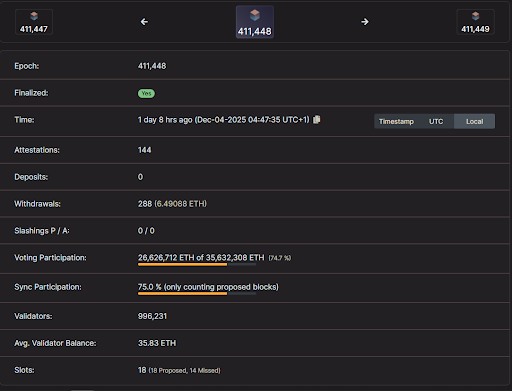
sync participation dropped to 75% and voting participation reached about 74.7% at Epoch 411448sync participation dropped to 75% and voting participation reached about 74.7% at Epoch 411448 | source: BeaconChai.in

Notably, Ethereum needs at least two-thirds of stakers to vote to keep finality. That means the network sat only a few percentage points away from losing that safety line.

Ethereum Client Diversity Brings Fresh Worries

Ethereum saw a fast recovery. At epoch 411712, voting participation climbed close to 99% and sync participation reached 97%. Before the issue, the network usually saw more than 99% of votes. 

The recovery proved that the issue stayed tied to one client group.

Validator data lined up with the scale of the drop. Prysm had about 22.7% of validators before the bug. That number dropped to 18% after the event. This matched the fall in voting participation and showed that the failure stayed focused on Prysm users.

A similar problem happened in 2022. Ethereum lost finality twice due to older attestation bugs in both Prysm and Teku. Back then, Prysm ran on most Ethereum consensus nodes. 

That created a higher risk because one client error could push the entire network into trouble.

Ethereum still has uneven client usage. Current MigaLabs data shows Lighthouse holds 52.55% of nodes while Prysm holds around 18%. 

Developers want no single client above 33% and that limit keeps the network safe, even if one client breaks. 

Thus, the recent event proved that the network still needs more balance.

Ethereum Faces Finality Challenge

Ethereum finality plays a major role in keeping the chain stable. If voting participation drops below two-thirds, the chain loses finality. 

Blocks can still appear, but they do not count as finalised. That creates real problems because bridges can freeze and rollups can halt withdrawals. Exchanges can also raise confirmation limits and users may face delays and higher risks during that period.

Prysm developers warned that the bug made nodes produce old states. This blocked proper voting and caused the sudden drop. 

The quick recovery, helped by the workaround, kept the chain safe. Yet the event served as a reminder. 

The network needs strong client diversity to protect itself from single-point failures.

Related Reading: Ethereum Rallies Strongly Past $3,000 Before the Upcoming Fusaka Upgrade

Ethereum Gains From Fusaka Despite Setback

The Fusaka upgrade still brought clear gains for Ethereum. It added PeerDAS through EIP-7594. 

This upgrade reduces bandwidth use and prepares Ethereum for higher throughput. It also supports more activity and lowers pressure on the base layer. In sum, the upgrade helps rollups scale and lowers costs for users.

Fusaka also increases blob capacity, which helps layer 2 networks. This means cheaper operations and smoother performance during heavy usage. It also makes Ethereum more suitable for large applications that need fast and cheap transactions.

Overall, the next months will show how validators respond and how fast the ecosystem builds on the upgrade.

The post Ethereum Sees Drop In Network Validator Participation After Fusaka Upgrade appeared first on Live Bitcoin News.

Disclaimer: The articles reposted on this site are sourced from public platforms and are provided for informational purposes only. They do not necessarily reflect the views of MEXC. All rights remain with the original authors. If you believe any content infringes on third-party rights, please contact service@support.mexc.com for removal. MEXC makes no guarantees regarding the accuracy, completeness, or timeliness of the content and is not responsible for any actions taken based on the information provided. The content does not constitute financial, legal, or other professional advice, nor should it be considered a recommendation or endorsement by MEXC.

You May Also Like

Shocking OpenVPP Partnership Claim Draws Urgent Scrutiny

Shocking OpenVPP Partnership Claim Draws Urgent Scrutiny

The post Shocking OpenVPP Partnership Claim Draws Urgent Scrutiny appeared on BitcoinEthereumNews.com. The cryptocurrency world is buzzing with a recent controversy surrounding a bold OpenVPP partnership claim. This week, OpenVPP (OVPP) announced what it presented as a significant collaboration with the U.S. government in the innovative field of energy tokenization. However, this claim quickly drew the sharp eye of on-chain analyst ZachXBT, who highlighted a swift and official rebuttal that has sent ripples through the digital asset community. What Sparked the OpenVPP Partnership Claim Controversy? The core of the issue revolves around OpenVPP’s assertion of a U.S. government partnership. This kind of collaboration would typically be a monumental endorsement for any private cryptocurrency project, especially given the current regulatory climate. Such a partnership could signify a new era of mainstream adoption and legitimacy for energy tokenization initiatives. OpenVPP initially claimed cooperation with the U.S. government. This alleged partnership was said to be in the domain of energy tokenization. The announcement generated considerable interest and discussion online. ZachXBT, known for his diligent on-chain investigations, was quick to flag the development. He brought attention to the fact that U.S. Securities and Exchange Commission (SEC) Commissioner Hester Peirce had directly addressed the OpenVPP partnership claim. Her response, delivered within hours, was unequivocal and starkly contradicted OpenVPP’s narrative. How Did Regulatory Authorities Respond to the OpenVPP Partnership Claim? Commissioner Hester Peirce’s statement was a crucial turning point in this unfolding story. She clearly stated that the SEC, as an agency, does not engage in partnerships with private cryptocurrency projects. This response effectively dismantled the credibility of OpenVPP’s initial announcement regarding their supposed government collaboration. Peirce’s swift clarification underscores a fundamental principle of regulatory bodies: maintaining impartiality and avoiding endorsements of private entities. Her statement serves as a vital reminder to the crypto community about the official stance of government agencies concerning private ventures. Moreover, ZachXBT’s analysis…
Share
BitcoinEthereumNews2025/09/18 02:13
Metaplanet 50M Bitcoin Loan and BTC Relief Rally

Metaplanet 50M Bitcoin Loan and BTC Relief Rally

The post Metaplanet 50M Bitcoin Loan and BTC Relief Rally appeared on BitcoinEthereumNews.com. Metaplanet has secured a 50 million dollar loan using its Bitcoin holdings as collateral to fund new BTC purchases and income products. At the same time, chartist Titan of Crypto says Bitcoin’s price action continues to track a earlier relief rally fractal on the two day chart. Metaplanet secured a 50 million dollar loan backed by its existing Bitcoin holdings, according to a new disclosure shared today. The company said the funds will support additional Bitcoin purchases and expand its Bitcoin-based income operations as part of its ongoing treasury strategy. The filing shows that Metaplanet pledged part of its current holdings to obtain the loan instead of issuing new equity or bonds. This structure allows the firm to raise capital while keeping its Bitcoin position intact. It also signals that the company continues to lean heavily on Bitcoin as both a reserve asset and a financing tool. The move follows a series of Bitcoin-focused initiatives from Metaplanet, including earlier bond issuances and ongoing accumulation programs. Today’s loan marks the latest step in that strategy as the company increases leverage to expand its holdings. Analyst Sees Bitcoin Still Following Earlier Cycle Fractal Meanwhile, Crypto chartist Titan of Crypto says Bitcoin’s latest pullback still fits the “relief rally” fractal he has been tracking on the two-day chart. In a new update, he compares the current structure to the 2021–2022 cycle, highlighting a similar sequence of a local peak, a sharp drop into a demand zone, and then a rebound. Bitcoin Relief Rally Fractal Roadmap. Source: Titan of Crypto and TradingView In the chart, Bitcoin’s price action forms a pattern that mirrors the earlier cycle, with a shaded support area marking the zone where the last major relief rally started. An accompanying momentum oscillator also shows a repeat of lower highs on price…
Share
BitcoinEthereumNews2025/12/06 01:14


