The cryptocurrency market experienced another wave of liquidations on Friday, with Bitcoin (BTC) prices dipping below the critical support level of $90,000. This decline followed a brief rally that had seen its price rise approximately $3,000 above this threshold earlier in the week. Crypto Market Faces $430 Million In Liquidations  Data from CoinGlass reveals that […]The cryptocurrency market experienced another wave of liquidations on Friday, with Bitcoin (BTC) prices dipping below the critical support level of $90,000. This decline followed a brief rally that had seen its price rise approximately $3,000 above this threshold earlier in the week. Crypto Market Faces $430 Million In Liquidations  Data from CoinGlass reveals that […]

Crypto Sell-Off: Binance, Coinbase, Dump Over $2 Billion In Bitcoin As Prices Dip Below $90,000

2025/12/06 20:00

The cryptocurrency market experienced another wave of liquidations on Friday, with Bitcoin (BTC) prices dipping below the critical support level of $90,000. This decline followed a brief rally that had seen its price rise approximately $3,000 above this threshold earlier in the week.

Crypto Market Faces $430 Million In Liquidations 

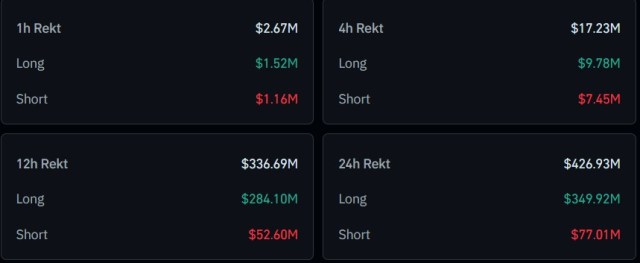
Data from CoinGlass reveals that nearly $430 million in liquidations occurred across the crypto market over the past 24 hours, predominantly affecting leveraged long positions, which accounted for about $350 million. 

During this period, Bitcoin underwent a 3.5% retracement, with its price settling at just above $89,120—a stark 29% below its all-time high of over $126,000 reached in October.
Crypto

Market expert OxNobler recently highlighted the role of both retail and institutional investors in this downturn. In a post on social media platform X, OxNobler detailed the reason behind Bitcoin’s decline: significant sell-offs by major players. 

According to the analyst, the world’s largest cryptocurrency exchange, Binance, sold 4,000 BTC; U.S.-based Coinbase (COIN) liquidated 5,675 BTC; and traditional finance giant Fidelity sold 3,288 BTC. Additionally, market maker Wintermute offloaded 1,793 BTC. 

Notably, the analyst pointed out that Strategy, formerly MicroStrategy, which is the largest public company holder of Bitcoin with over 650,000 coins, has also sold over 3,820 coins in this same time frame.

The firm’s sell-off comes on the heels of speculation regarding Strategy’s potential to liquidate some of its holdings due to the substantial losses affecting its financial performance amid declining Bitcoin prices. 

When Strategy CEO Phong Le was questioned about the possibility of selling off Bitcoin, he acknowledged that while the firm’s former CEO, Michael Saylor, has consistently opposed selling, circumstances may change if the company’s stock trades below the net value of its Bitcoin holdings, which aligns with the recent actions taken by the firm.

Coinbase Analysts Predict December Recovery 

Interestingly, while these institutional sell-offs have contributed to the current market dip, Coinbase’s institutional division has projected a potential recovery for the crypto market in December, citing improving liquidity, a 92% probability of the Federal Reserve (Fed) cutting rates, and supportive macroeconomic conditions.

Analysts have pointed out several reasons for optimism, including the recovery of liquidity, the resilience of the “AI bubble,” and the attractiveness of short US dollar trades at current levels. 

However, OxNobler warned that the situation may not be so straightforward. Alongside the activities of major institutions, he noted that BlackRock, the world’s largest asset manager, had recently sold $130 million worth of Bitcoin and Ethereum (ETH).

Furthermore, Vitalik Buterin, one of Ethereum’s co-founders, seems to have resumed selling Ethereum, with millions of ETH being moved from the foundation’s wallet through Gnosis Safe.

Ultimately, OxNobler asserts that these institutional activities may have a hand in manipulating crypto prices and preventing them from climbing to higher levels and key resistance points. 

Crypto

Featured image from DALL-E, chart from TradingView.com 

Disclaimer: The articles reposted on this site are sourced from public platforms and are provided for informational purposes only. They do not necessarily reflect the views of MEXC. All rights remain with the original authors. If you believe any content infringes on third-party rights, please contact service@support.mexc.com for removal. MEXC makes no guarantees regarding the accuracy, completeness, or timeliness of the content and is not responsible for any actions taken based on the information provided. The content does not constitute financial, legal, or other professional advice, nor should it be considered a recommendation or endorsement by MEXC.

You May Also Like

When Your Mom Can Use DePIN, Mass Adoption Has Arrived

When Your Mom Can Use DePIN, Mass Adoption Has Arrived

The post When Your Mom Can Use DePIN, Mass Adoption Has Arrived appeared on BitcoinEthereumNews.com. In a perfect world, the internet works like tap water: you turn it on, and it flows. Seamlessly. Nobody really wants to think about a ‘better connection spot,’ SIM cards, or the nearest cell towers. Users just want a fast, stable connection wherever they are. The good thing is they’re quietly getting it without even knowing it. The internet we have is broken (and expensive) Traditional telecom infrastructure is heavy and expensive. Every tower requires a site lease, permits, maintenance, and marketing. Every expansion takes months or years (of both construction and red tape) and can cost from $5 million to $100 million, which means installing even one small cell tower can drain a business’s finances by up to $300,000. In this system, we’re not really paying for the gigabytes we use — we’re paying for the bureaucracy built around them. This system doesn’t make economic sense anymore. Telecom companies can no longer afford to spend billions on connections that don’t improve and become harder and harder to maintain with more users all over the globe. The good news is that a better alternative is already in people’s homes and devices, even though you don’t see it on billboards. DePIN (Decentralized Physical Infrastructure Networks) is turning the Wi-Fi routers around you into a new kind of connectivity. From towers to routers According to crypto asset manager Grayscale, DePIN is already widely used in day-to-day life, and the company calls it a “significant” investment opportunity. Why? DePIN takes a software-first approach, meaning it uses what already exists. A lightweight app or firmware update turns a regular Wi-Fi router into a small piece of a bigger network. When you’re nearby, your device automatically connects through that router. With DePIN’s rising popularity, people and businesses are already implementing it: Nodle, a smartphone-based DePIN,…
Share
BitcoinEthereumNews2025/12/07 00:07
Two Casascius coins with $2,000 Bitcoin move after 13 years of dormancy

Two Casascius coins with $2,000 Bitcoin move after 13 years of dormancy

The post Two Casascius coins with $2,000 Bitcoin move after 13 years of dormancy appeared on BitcoinEthereumNews.com. Key Takeaways Two Casascius physical Bitcoin coins containing about $2,000 moved after 13 years of dormancy. Casascius coins are rare, physical coins embedding private keys beneath a tamper-evident hologram. Two Casascius physical Bitcoin coins containing approximately $2,000 worth of Bitcoin moved this week after remaining dormant for 13 years, according to Timechain Index founder Sani. Casascius, which creates physical Bitcoins that embed real crypto value through a private key concealed beneath a tamper-evident hologram, allows holders to redeem the associated Bitcoin on the blockchain. The coins include a private key hidden under the hologram, intended to secure the Bitcoin until the owner chooses to access it. These physical Bitcoin coins are considered rare collectibles due to their early issuance, making any movement of such coins a rare occurrence for crypto observers. The coins were among the earliest physical representations of Bitcoin, creating historical artifacts that bridge the digital currency’s early days with its current market presence. Casascius coins and similar physical Bitcoin representations sometimes become active after extended periods of inactivity, typically generating attention within the crypto community when holders decide to access their dormant holdings. Source: https://cryptobriefing.com/casascius-coins-move-dormant-bitcoin-activity-2025/
Share
BitcoinEthereumNews2025/12/07 00:23