The University of Ibadan student making paper bags from waste grass
When Ifeoluwa Garba missed his opportunity to study Mechanical Engineering at the University of Ibadan, one of Nigeria’s top institutions, he had no idea the alternative would lead him to tap into a $45.15 billion industry. Instead, Ifeoluwa’s admission into Wood and Biomaterial Engineering laid the foundation for Ecobag Mart, a three-man company that turns dried grass into sustainable paper bags.
When I met Garba at the University of Ibadan SME Fair in November 2025, he had just pitched Ecobag to an audience of a few hundred people—a routine he was accustomed to.
Ecobag was born from a fundamental frustration with waste and packaging, driven by a deeply held belief that Africa needs companies that truly serve its people. On one of those days, Garba attended Afrotalks, a think tank dedicated to amplifying African stories, where his conviction to build not only for Africa but with Africans, strengthened.
“Africans are leaving the diaspora back to Africa, and they want to make sense out of Africa. That was what I learned [at Afrotalks], and I began to perceive that this [was] already happening,” he said.
The medical outreach that triggered an engineering solution
The burden to establish an environmentally sustainable business began in 2022, when Garba embarked on a medical outreach to Epe village in Osun State, southwest Nigeria.
“As we travelled deeper into the village, we passed large drilling machines and deep pits,” he said. “Yet when we reached the village, people lived in heartbreaking poverty. Malnourished children, collapsing houses, no infrastructure, no schools, no opportunities. Even the Baale (village leader) lived in a deteriorating house.”
For Garba, the experience provoked a realisation: “Nigeria exports wealth, but the communities closest to the resources remain the poorest.”
While Garba had always wanted to own a company, Ecobag did not begin as a search for a viable business, but from Garba’s curiosity to discover what could be done with waste grass. One day, he stumbled upon a video that detailed the process of transforming dry grass into a piece of green paper. It piqued his interest as a student engineer at a polytechnic in Ibadan. He attempted to recreate it but faced a major challenge with the kind of grass he used. He replicated the process with different kinds of grass, integrating binders, and refining the formula as he did.
The decision on which raw material to use for the bags became a conflict between academic theory and practical reality. When Garba first proposed using a short, resilient variety of grass, his lecturer advised against it and recommended another kind, operating on the conventional assumption that a different kind of fibre was necessary for paper production.
Yet, the student engineer’s experiments to arrive at a viable formula proved otherwise. The production hurdle, however, was not only technical but logistical. He revealed that sourcing the grass would require building a complex network of gardeners to collect cuttings, which Garba found to be both stressful and inefficient to scale.
This supply chain bottleneck forced him to pivot to more accessible agricultural waste. Eventually, after much iteration, Garba arrived at his formula and secured a patent for it.
Building assets with limited capital
When Garba realised that the manual process of making grass pulp into eco-friendly paper was not scalable, he set out to solve this manufacturing problem. The challenge was, and remains, limited access to capital, but he found a workaround: “We were able to build a low-budget factory, get some machines that will help us to carry out these processes a little bit better than what I was doing manually.”
The process remains semi-manual, and the growth necessitated bringing in co-founders. Garba’s friend, Olawale Omofojoye, joined to handle the sourcing of materials. Christabel Egbegi, a childhood friend and master’s graduate in Environmental and Land Contamination, joined for investment and advisory support from the UK.
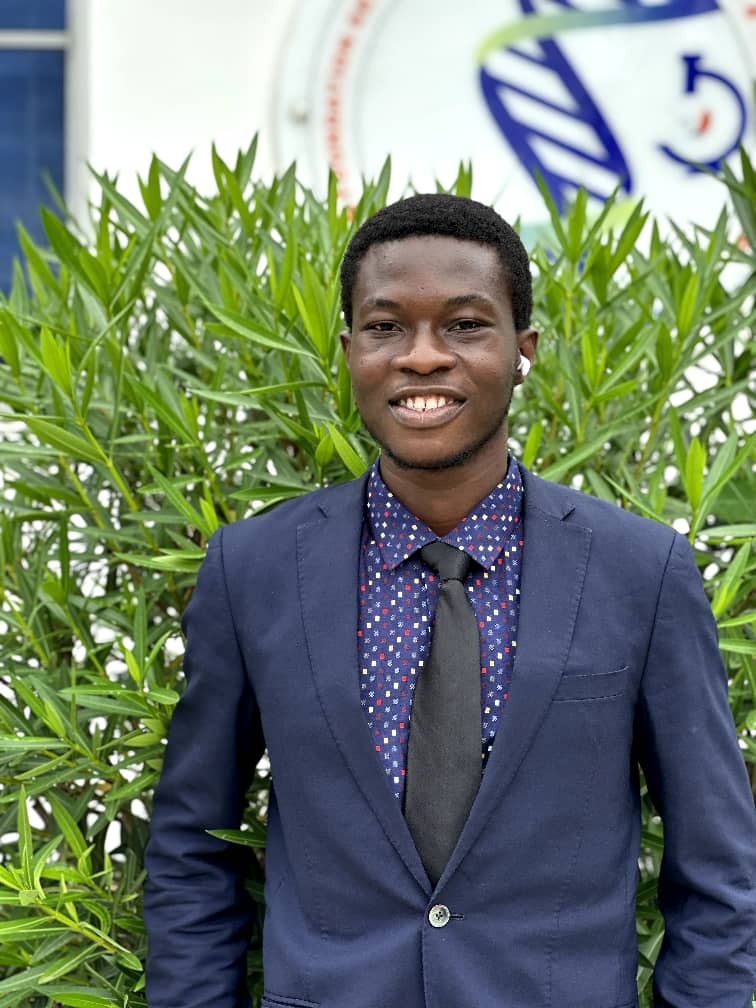 Ifeoluwa Garba, Founder, Ecobag Mart
  Olawale Omofojoye, Co-founder, Ecobag Mart
  Christabel Egbegi, Co-founder, Ecobag Mart
“Getting a team was one of the challenging parts,” Garba said, I knew I couldn’t handle much of the stuff I’m doing on my own. I was basically going nuts trying to manufacture, going for pitching [competitions]. I needed friends who could fill in a few spaces, and some of them were in what I was doing.”
Omofojoye’s mechanical engineering background helped to strengthen Garba’s vision, and Egbegi provided engineering guidance and advice for the team.
Field-testing an EcoBag
Curious about these locally made eco-sustainable bags, I demo’d a prototype. Unlike regular brown bags, my Ecobag had a rough, sturdy texture with a slim fit pair of handles. On day one, I took the bag for a market trip and filled it up with store items. It held.
I alternated between utilising it as a lunch bag, a shopping bag, and an extra carry-on for my day-to-day. While my Ecobag held up to the task after almost a week of use, my sweaty palms made the handles, which were made of a slightly different material, to become slightly undone.
 After a market trip, the Ecobag held my produce firmly.
  However, the handle, made from a different material, started to come undone after a week of use.
Garba said the rough texture is influenced by the processing machine and he would explore smoother textures when Ecobag Mart acquires better machinery. The design of the handle is intentional. “It is made from paper also because our aim is to make the entire product biodegradable and eco-friendly,” Garba said.
Garba’s alternative funding pathway
Ecobag Mart has continued to gain visibility online and offline. After one short Instagram video, Garba received enquiries about the sustainable bags, which he positioned as a more cost-effective alternative to the usual paper bags.
“I did a short video for a competition, actually, and I posted it on my Instagram. I got quite a number of people reaching out to me that they want my product,” he said.
At the most recent Global Exhibition event, Garba relayed that food and cosmetic companies also expressed strong interest, validating the demand for a cheaper alternative to their current expensive paper bags.
The company also benefits from the network effect, where recognition has come through competitions and keynote speaking engagements.
In March 2025, Garba participated in Innotech 3.0, a pitching competition where he emerged as the overall winner. At the Cleva App Business Challenge (YC 2024) held in July 2025, Garba also won the Most Innovative Award with a $250 cash prize. He continues to take the Ecobag story to every stage he sets his feet on.
Ecobag is currently focused on achieving excellence in its product through refining the physical appearance of the paper and scaling up production volume.
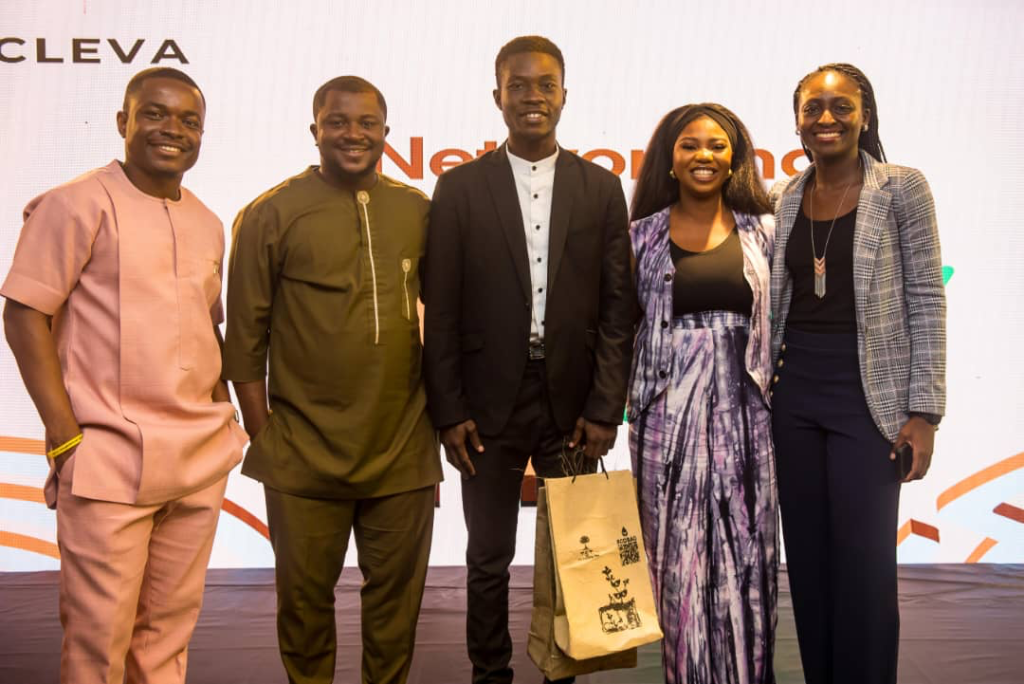 Garba (center) with the Cleva team at the Cleva Anniversary Celebration on Lagos Island
Beyond stages and awards, he commits to the unseen groundwork and grit-building required. In mid-2025, the student founder enrolled for an 8-week program sponsored by the British Council and King Trust International in Abeokuta, which coincided with his exams.
Participating was a challenge, but his co-founder, Omofojoye, pooled funds to sustain his trips between Ibadan and Abeokuta for the two-month duration. Garba recalled having to sort out accommodation by sleeping on the floor beneath a flight of stairs at a building in Abeokuta, just to make sure he could attend the workshops on time.
“I’d finish my examination on time, be the first person to finish, submit my paper, pick my bag, I’m going straight to the car park,” he said, “I had no place to sleep [but] I had this inner drive that this thing can actually work out. But I just closed my eyes and said ‘No, this thing is going to work out.’”
Ecobag Mart’s future is to move from a prototype to a scalable product to prove that local ingenuity and resilience can tackle global problems like sustainability and waste management.


You May Also Like

Arbitrum Announces Ten Innovative Teams — And Why It’s Not Just Hype

Cathie Wood’s ARK Invest Buys $13.7M in Circle Shares While Selling Robinhood Stock

Metaplanet buys 5,075 Bitcoin in Q1 to become 3rd-largest treasury