Ripple CTO has publicly displayed a hub running on the XRP Ledger (XRPL) and calls on the community to connect.  One of the objectives for starting this was to reduce network latency and increase reliability.  On December 4, Ripple Chief Technology Officer (CTO) David Schwartz publicly unveiled an XRPL hub to support the ecosystem. In [...]]]>Ripple CTO has publicly displayed a hub running on the XRP Ledger (XRPL) and calls on the community to connect.  One of the objectives for starting this was to reduce network latency and increase reliability.  On December 4, Ripple Chief Technology Officer (CTO) David Schwartz publicly unveiled an XRPL hub to support the ecosystem. In [...]]]>

Ripple CTO Shares Three Reasons Behind His Fresh XRP Ledger Push

2025/12/08 16:56
  • Ripple CTO has publicly displayed a hub running on the XRP Ledger (XRPL) and calls on the community to connect. 
  • One of the objectives for starting this was to reduce network latency and increase reliability. 

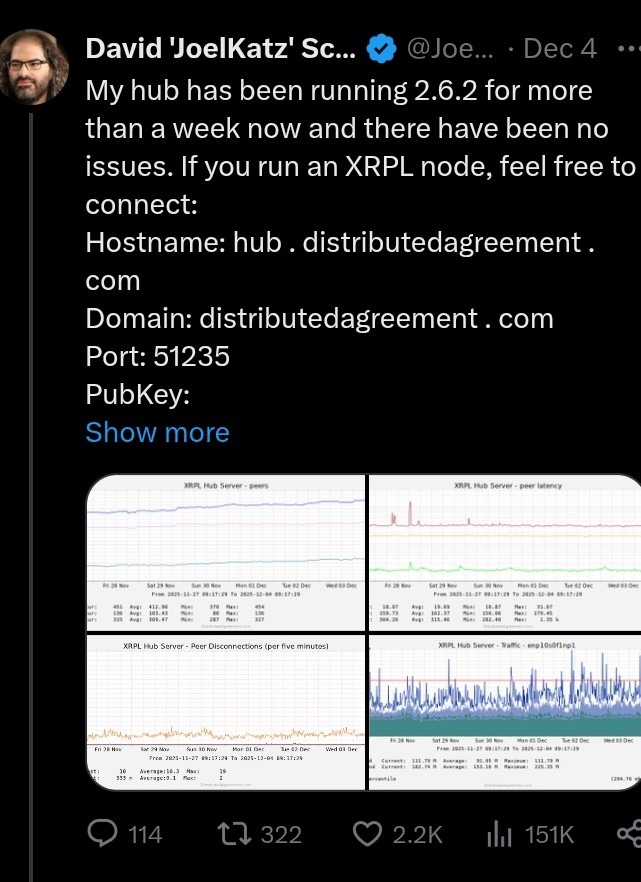
On December 4, Ripple Chief Technology Officer (CTO) David Schwartz publicly unveiled an XRPL hub to support the ecosystem. In his post, Schwartz called on the community to connect since it has successfully run for more than a week without issues.
XRPLSource: David Schwartz on X

As featured in our earlier coverage, the hub runs on version 2.6.2 and currently provides live operational information. Some of this information includes traffic throughput, peer connection, uptime statistics, and latency levels.

Why the XRPL Hub?

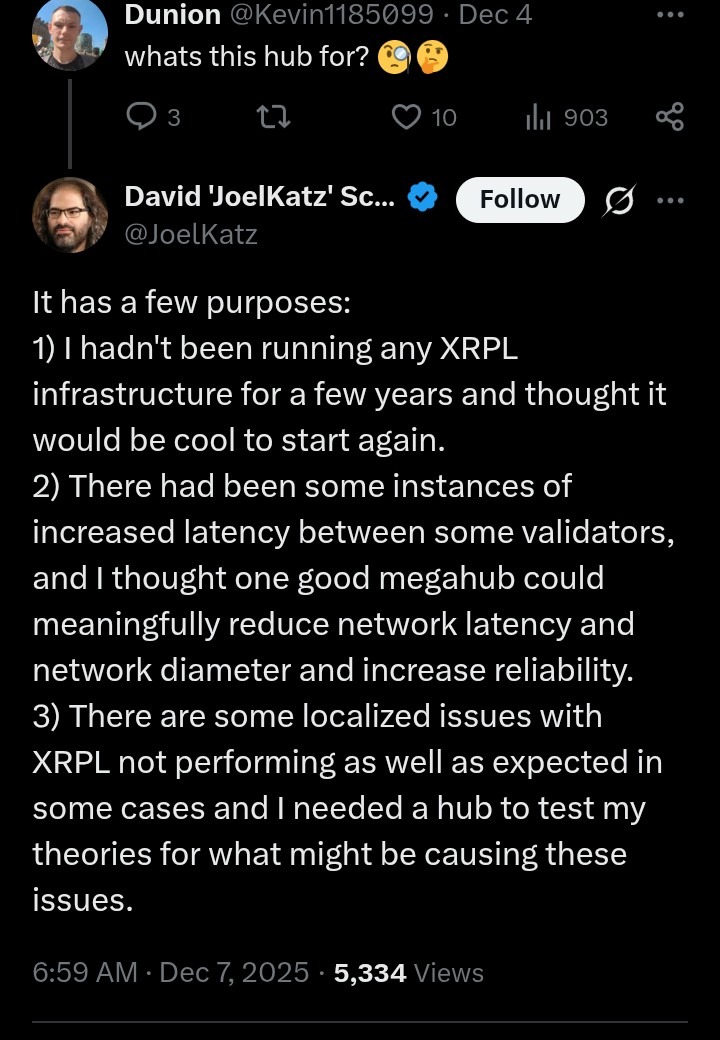
Schwartz’s call to open access to the broader community led to several comments, including the one from a user known as Dunion, who asked the reasons for starting this hub.

In response, the Ripple CTO provided three reasons. Firstly, he disclosed that he had not run any XRPL infrastructure for a few years; hence, he “thought it would be cool to start a new one.” Apart from this, Schwartz disclosed that there were some instances of increased latency between validators. In a bid to reduce this network latency and network diameter and also increase reliability, he decided to start a megahub.
XRPL Source: David Schwartz on X

Adding to this, Schwartz also highlighted some previous localized issues affecting the performance of XRPL. According to him, he started the hub to test some of his theories to find the possible cause.

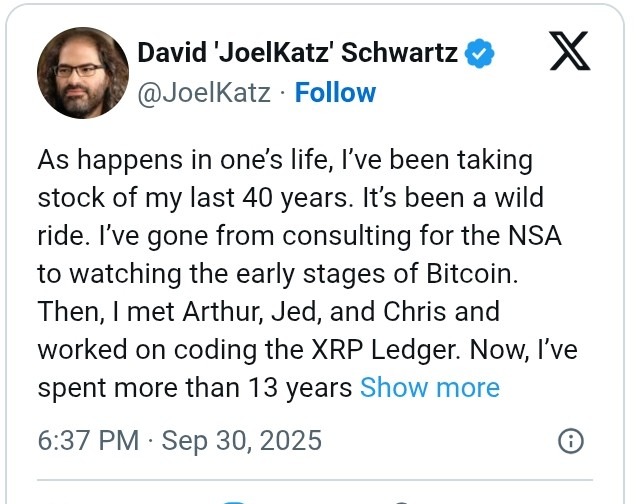
This clarification comes after Schwartz announced his step down from the role of CTO, taking effect by the end of 2025.
XRPLSource: David Schwartz on X

As detailed in our earlier post, he is not taking a complete exit from the company, as he would still “be in and out” of the Ripple office as a “CTO Emeritus.” Also, he disclosed that he would join the board of directors to support the long-term vision of the company at the request of Ripple co-founder Chris Larsen.

Fascinatingly, he made a sudden comeback in August as an independent operator to unveil a custom server he built to support XRPL. At that time, he stated that the intention is not to experiment but to provide real connectivity. According to him, the data obtained from this could be crucial in the network’s understanding of how traffic behaves across different workloads.

Amid the backdrop of this, Anodos Wallet has simplified XRPL onboarding for new users with the launch of a passkey-secured XRPL wallet, as indicated in our previous publication. Additionally, XRPL smart contracts have gone live on AlphaNet to enable developers to explore and test, as mentioned in our earlier news brief.

]]>


Disclaimer: The articles reposted on this site are sourced from public platforms and are provided for informational purposes only. They do not necessarily reflect the views of MEXC. All rights remain with the original authors. If you believe any content infringes on third-party rights, please contact service@support.mexc.com for removal. MEXC makes no guarantees regarding the accuracy, completeness, or timeliness of the content and is not responsible for any actions taken based on the information provided. The content does not constitute financial, legal, or other professional advice, nor should it be considered a recommendation or endorsement by MEXC.

You May Also Like

Tokenization Key to Modernizing US Markets

Tokenization Key to Modernizing US Markets

The post Tokenization Key to Modernizing US Markets appeared on BitcoinEthereumNews.com. The Strategy: SEC Chair Paul Atkins designates “tokenization” as the industrial strategy to modernize US capital markets, launching the “Project Crypto” initiative. The Rules: A new “Token Taxonomy” will legally separate Digital Commodities, Collectibles, and Tools from Securities, ending the “regulation by enforcement” era. The Privacy: The SEC’s Dec 15 roundtable will feature Zcash founder Zooko Wilcox, signaling a potential policy thaw on privacy-preserving infrastructure. Securities and Exchange Commission (SEC) Chair Paul Atkins has formally aligned the agency’s mission with the digital asset revolution, declaring “tokenization” as the critical alpha required to modernize America’s aging capital markets infrastructure.  In a definitive signal to Wall Street, Atkins outlined the next phase of “Project Crypto,” a comprehensive regulatory overhaul designed to integrate blockchain rails into the federal securities system. Related: U.S. SEC Signals Privacy Enhancement in Tokenization of Securities U.S. SEC Chair Touts Tokenization as the Needed Element for Modernizing Capital Markets According to Chair Atkins, tokenization is the alpha needed to modernize the capital markets in the United States. As such, Chair Atkins noted that the SEC’s Project Crypto will focus on issuing clarity under the existing rules as Congress awaits passing the CLARITY  Act. Moreover, the SEC Chair believes that major global banks and brokers will adopt tokenization of real-world assets (RWA) in less than 10 years. Currently, the SEC is working closely with the sister agency Commodity Futures Trading Commission (CFTC) to catalyze the mainstream adoption of tokenized assets. Chair Atkins stated that tokenization of capital markets provides certainty and transparency in the securities industry. From a regulatory perspective, Chair Atkins stated that tokenized securities are still securities and thus bound by the existing securities laws. However, Chair Atkins stated that digital collectibles, commodities, and tools are not securities, thus not bound by the 1940s Howey test. As such,…
Share
BitcoinEthereumNews2025/12/08 18:35