BitcoinWorld Crypto Trust Charters: US Comptroller’s Bold Warning to Obstructive Banks In a powerful move that could reshape the financial landscape, the U.S. Comptroller of the Currency has issued a stark warning to traditional banks. Jonathan Gould has criticized the industry for actively blocking cryptocurrency firms from obtaining vital crypto trust charters. This stand challenges the status quo and signals a potential new era of integration […] This post Crypto Trust Charters: US Comptroller’s Bold Warning to Obstructive Banks first appeared on BitcoinWorld.BitcoinWorld Crypto Trust Charters: US Comptroller’s Bold Warning to Obstructive Banks In a powerful move that could reshape the financial landscape, the U.S. Comptroller of the Currency has issued a stark warning to traditional banks. Jonathan Gould has criticized the industry for actively blocking cryptocurrency firms from obtaining vital crypto trust charters. This stand challenges the status quo and signals a potential new era of integration […] This post Crypto Trust Charters: US Comptroller’s Bold Warning to Obstructive Banks first appeared on BitcoinWorld.


Crypto Trust Charters: US Comptroller’s Bold Warning to Obstructive Banks

2025/12/09 04:55
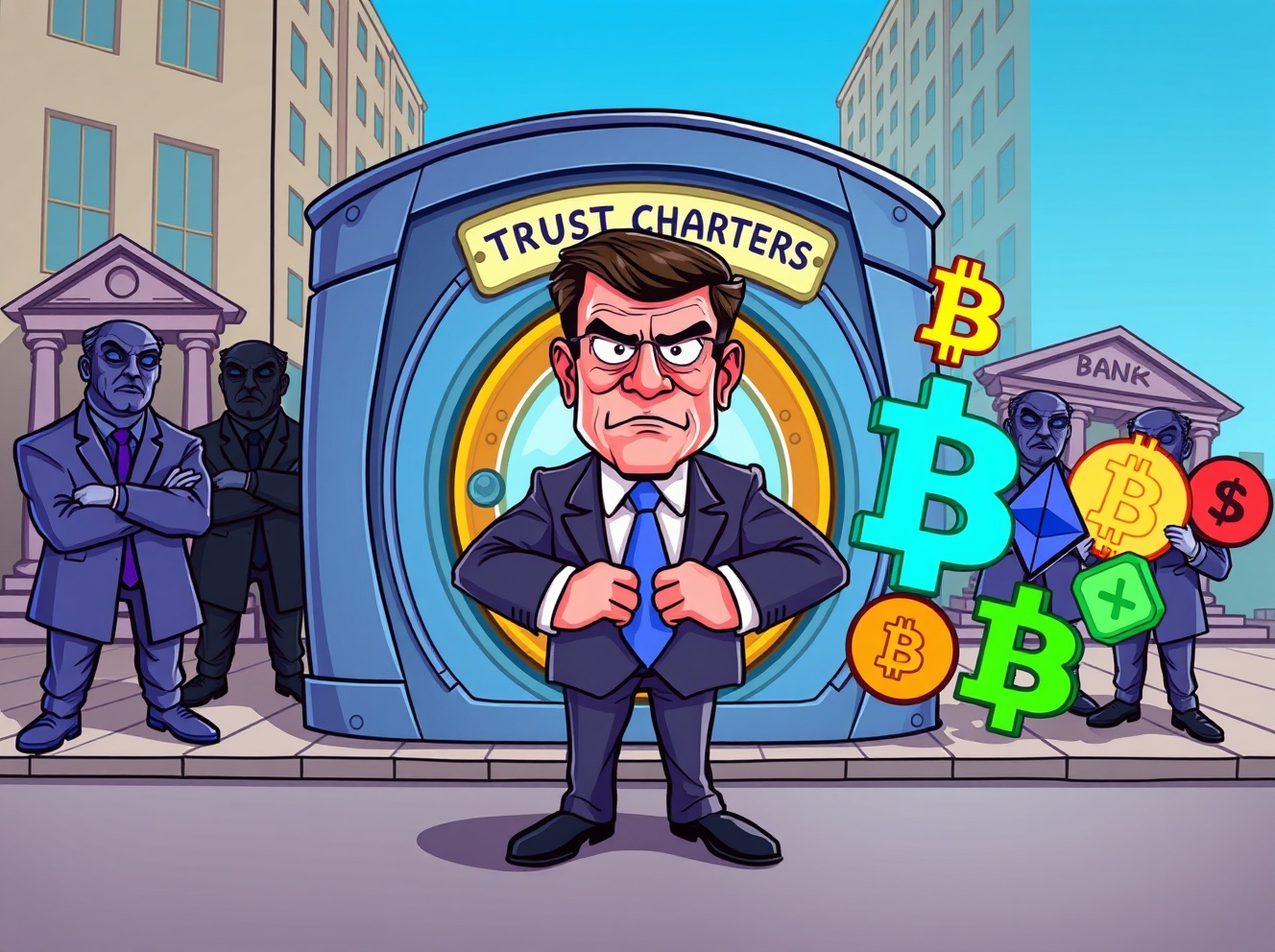
A cartoon official protecting crypto trust charters from obstructive traditional banks.

BitcoinWorld

Crypto Trust Charters: US Comptroller’s Bold Warning to Obstructive Banks

In a powerful move that could reshape the financial landscape, the U.S. Comptroller of the Currency has issued a stark warning to traditional banks. Jonathan Gould has criticized the industry for actively blocking cryptocurrency firms from obtaining vital crypto trust charters. This stand challenges the status quo and signals a potential new era of integration between digital assets and mainstream finance. Why are banks resisting, and what does this mean for the future of money?

What Are Crypto Trust Charters and Why Do They Matter?

Think of a trust charter as a special banking license. It allows a company to act as a fiduciary, holding and managing assets on behalf of clients. For crypto companies, securing a crypto trust charter is a game-changer. It provides a regulated pathway to offer custodial services, legitimizes their operations, and bridges the gap to the traditional financial system. Without it, they often face an uphill battle for credibility and access.

Gould’s core argument is simple yet revolutionary: there is no valid reason to treat digital assets differently from traditional ones like stocks or bonds. He insists that banks should not be confined to outdated technologies or business models that exclude innovation. This principle is at the heart of the debate over crypto trust charters.

Why Are Traditional Banks Pushing Back?

The resistance from established banks isn’t surprising, but the Comptroller is calling it out. Banks may fear the competition, the perceived risk of a new asset class, or the complexity of compliance. However, Gould points to the data: over the past year, new charter applications rose to 14, with many tied to digital assets and fintech. The demand is clearly there.

Moreover, the Office of the Comptroller of the Currency (OCC) is now investigating ‘de-banking’—where banks abruptly cut off services to crypto-related firms. This practice can stifle innovation and push activity into less regulated spaces. The warning against obstructing crypto trust charters is part of a broader push for fair access.

What Does This Mean for the Future of Crypto Banking?

This regulatory stance could unlock significant growth. If more firms secure crypto trust charters, we could see:

  • Enhanced Consumer Protection: Assets held under a charter are subject to strict regulatory oversight and capital requirements.
  • Mainstream Adoption: Easier for traditional investors and institutions to participate through trusted, regulated entities.
  • Innovation in Financial Services: New products blending crypto efficiency with banking stability.

The Comptroller’s position acts as a catalyst. It encourages banks to adapt rather than obstruct, fostering an environment where crypto trust charters can be evaluated on their merits, not fear.

Navigating the Path Forward for Digital Assets

The message from the top is clear: obstruction is not a strategy. The financial system must evolve. For crypto companies, this opens a door, but the path still requires navigating complex regulatory standards to prove they are safe, sound, and fair custodians worthy of a charter.

For traditional banks, the warning is an invitation—or perhaps an ultimatum—to engage with the future. They can choose to be gatekeepers of the past or architects of a modern, inclusive financial system that includes digital assets. The push for equitable access to crypto trust charters is a central battleground in this transformation.

Conclusion: A Turning Point for Finance

Jonathan Gould’s warning is more than regulatory commentary; it’s a bold declaration of principle. By challenging banks to stop obstructing crypto trust charters, he advocates for a financial ecosystem defined by technological neutrality and competitive fairness. This stance, if upheld, could accelerate the merger of traditional and digital finance, creating a more robust and innovative market for everyone. The era of walls between old and new money may finally be ending.

Frequently Asked Questions (FAQs)

What is a crypto trust charter?
A crypto trust charter is a special banking license granted by a state or federal regulator (like the OCC) that allows a company to operate as a fiduciary, legally holding and safeguarding cryptocurrency assets for clients, similar to how a trust company holds traditional assets.

Why is the US Comptroller getting involved?
As the head of the OCC, which charters and supervises national banks, the Comptroller ensures the federal banking system is safe, sound, and fair. He sees unequal access to charters and practices like de-banking as threats to competition and innovation.

What is ‘de-banking’ in the crypto context?
De-banking refers to when traditional banks refuse to provide or suddenly withdraw basic services (like bank accounts or payment processing) from businesses solely because they are involved with cryptocurrencies, often without clear cause.

Will this make cryptocurrencies more mainstream?
Yes, potentially. If more regulated entities can offer custodial services via trust charters, it reduces risk and complexity for large institutions and everyday investors, paving the way for broader adoption.

What are the biggest challenges for a crypto firm getting a charter?
The main hurdles are meeting stringent capital requirements, proving robust anti-money laundering (AML) and know-your-customer (KYC) systems, and demonstrating a comprehensive risk management framework for holding digital assets.

Found this insight into the future of crypto banking compelling? Help others understand this critical shift by sharing this article on your social media channels. Spark a conversation about innovation, regulation, and the future of finance!

To learn more about the latest trends in cryptocurrency regulation, explore our article on key developments shaping institutional adoption and market maturity.

This post Crypto Trust Charters: US Comptroller’s Bold Warning to Obstructive Banks first appeared on BitcoinWorld.

Disclaimer: The articles reposted on this site are sourced from public platforms and are provided for informational purposes only. They do not necessarily reflect the views of MEXC. All rights remain with the original authors. If you believe any content infringes on third-party rights, please contact service@support.mexc.com for removal. MEXC makes no guarantees regarding the accuracy, completeness, or timeliness of the content and is not responsible for any actions taken based on the information provided. The content does not constitute financial, legal, or other professional advice, nor should it be considered a recommendation or endorsement by MEXC.

You May Also Like

SOL Moves Sideways While Ozak AI Token Targets Life-Changing Gains for Presale Investors

SOL Moves Sideways While Ozak AI Token Targets Life-Changing Gains for Presale Investors

The post SOL Moves Sideways While Ozak AI Token Targets Life-Changing Gains for Presale Investors appeared on BitcoinEthereumNews.com. In the world of crypto, two tokens are making waves, albeit with different trajectories. While Solana (SOL) continues to move sideways, the Ozak AI token is gaining significant momentum with impressive presale results. With Ozak AI’s presale showing growth of over 1,100%, investors are eyeing substantial returns as the presale progresses. Ozak AI Presale Performance: Rapid Growth and Strong Fundamentals The Ozak AI token is in Phase 6 of its presale, with the price fixed at $0.012. The project has made remarkable strides, seeing its token grow by more than 1,100% since the beginning of the event. Over 905 million tokens have been sold, raising over $3.2 million. As the presale moves forward, the next price increase will take the token to $0.014, requiring a minimum investment of $100. Ozak AI has a total supply of 10 billion tokens, with 30% allocated to presale. Other allocations include ecosystem incentives, reserves, liquidity, and the project team. The distributions support both growth and sustainability, ensuring a balanced supply for adoption and development. Key Features and Partnerships Supporting Ozak AI’s Growth Ozak AI offers significant value beyond just speculation. The platform utilizes machine learning with decentralized networks to provide predictive analytics for financial markets. Ozak AI offers real-time data feeds, customizable prediction agents, and decentralized applications (dApps) to users. The integration of the Ozak AI Rewards Hub adds a unique feature to the platform, where users can participate in staking, governance, and rewards. This initiative also raises awareness about the presale success. Ozak AI has partnered with various leading platforms. Pyth Network enhances the reliability of its predictive models and provides accurate financial data across blockchains. Additionally, Dex3’s liquidity solutions improve the platform’s trading experience, enabling seamless transactions. The integration of Weblume’s no-code tools and the SINT protocol for one-click AI upgrades makes…
Share
BitcoinEthereumNews2025/09/18 23:49
Solana News: SOL Faces Liquidity Crunch as $500M in Longs Sit on the Brink

Solana News: SOL Faces Liquidity Crunch as $500M in Longs Sit on the Brink

The post Solana News: SOL Faces Liquidity Crunch as $500M in Longs Sit on the Brink appeared on BitcoinEthereumNews.com. Key Insights On-chain insights suggest Solana liquidity has thinned to levels typically seen in a bear market. Institutional capital continues to pour into spot Solana ETFs, which have seen $17.72 million in net inflows this week, almost matching last week’s $20.30 million. Roughly $500 million in long positions could be exposed if the price slips just 5.5%. On-chain insights suggest Solana’s liquidity has thinned to levels typically seen in a bear market. According to a top analyst,  roughly $500 million in long positions could be exposed if the price slips just 5.5%. Meanwhile, Bitcoin’s mid-week buying burst lifted most major altcoins. Even so, Solana isn’t sharing in that confidence. Its liquidity continues to pull back, and the overall market remains uneasy, leaving the token on fragile footing despite the recent lift across the sector. Solana Realized Losses Outpace Profits as Liquidity Shrinks Solana’s 30-day average realized profit-to-loss ratio has remained below one since mid-November, according to a Wednesday tweet from on-chain analytics platform Glassnode. A ratio under one shows that realized losses are outpacing profits. This suggests liquidity has contracted to levels typically seen in a bear market. Solana realized profit/loss ratio data by Glassnode A tweet by Altcoin Vector pointed out that Solana is undergoing a full liquidity reset. This signal has marked the start of new liquidity cycles in the past and often leads to bottoming phases. If the current pattern mirrors April’s setup, a market reignition could take about four more weeks, potentially lining up with early January. The reset is being driven by several factors. Realized losses are prompting sell-offs, futures open interest is declining, market-makers are pulling back, and liquidity is fragmenting across trading pools. The mid- to long-term outlook for the market remains slightly bullish, particularly if macroeconomic pressures ease. In the near term,…
Share
BitcoinEthereumNews2025/12/11 14:11