Bitcoin is once again under pressure as the market navigates a volatile and uncertain phase. After briefly reclaiming the $111K level, the world’s largest cryptocurrency is struggling to maintain $110K as a stable support zone. Sellers are regaining control, and bearish traders are calling for a deeper retrace toward lower range levels — possibly below […]Bitcoin is once again under pressure as the market navigates a volatile and uncertain phase. After briefly reclaiming the $111K level, the world’s largest cryptocurrency is struggling to maintain $110K as a stable support zone. Sellers are regaining control, and bearish traders are calling for a deeper retrace toward lower range levels — possibly below […]

2,496 Bitcoin Moved After Years Of Inactivity – Long-Term Holders Take Action

Bitcoin is once again under pressure as the market navigates a volatile and uncertain phase. After briefly reclaiming the $111K level, the world’s largest cryptocurrency is struggling to maintain $110K as a stable support zone. Sellers are regaining control, and bearish traders are calling for a deeper retrace toward lower range levels — possibly below the six-figure mark.

Adding to the cautious tone, fresh data from CryptoQuant reveals a concerning on-chain development: old Bitcoin coins are waking up. This metric, which tracks previously dormant BTC moving on-chain, has shown a sharp increase among coins aged 3–5 years, indicating that long-term holders are starting to move or sell part of their holdings. Historically, such behavior has preceded phases of heightened volatility or deeper corrections, as these older coins often represent significant, high-volume supply entering the market.

While some analysts interpret these moves as long-term holders taking profits after the year’s rally, others warn that renewed selling from this group could intensify downward pressure. As market sentiment turns defensive, traders are watching closely to see whether Bitcoin can defend key support zones or if these “old coins” will fuel the next leg of a broader correction.

Long-Term Holders Move Supply as Selling Pressure Builds

Top analyst Maartunn shared data revealing a notable spike in long-term holder activity, with 3–5-year-old BTC spent jumping to 2,496 BTC — a significant move considering the typically dormant nature of this cohort. These “old coins” represent Bitcoin that hasn’t moved in years, often held by investors with high conviction. When this group becomes active, it usually signals a major shift in market dynamics.
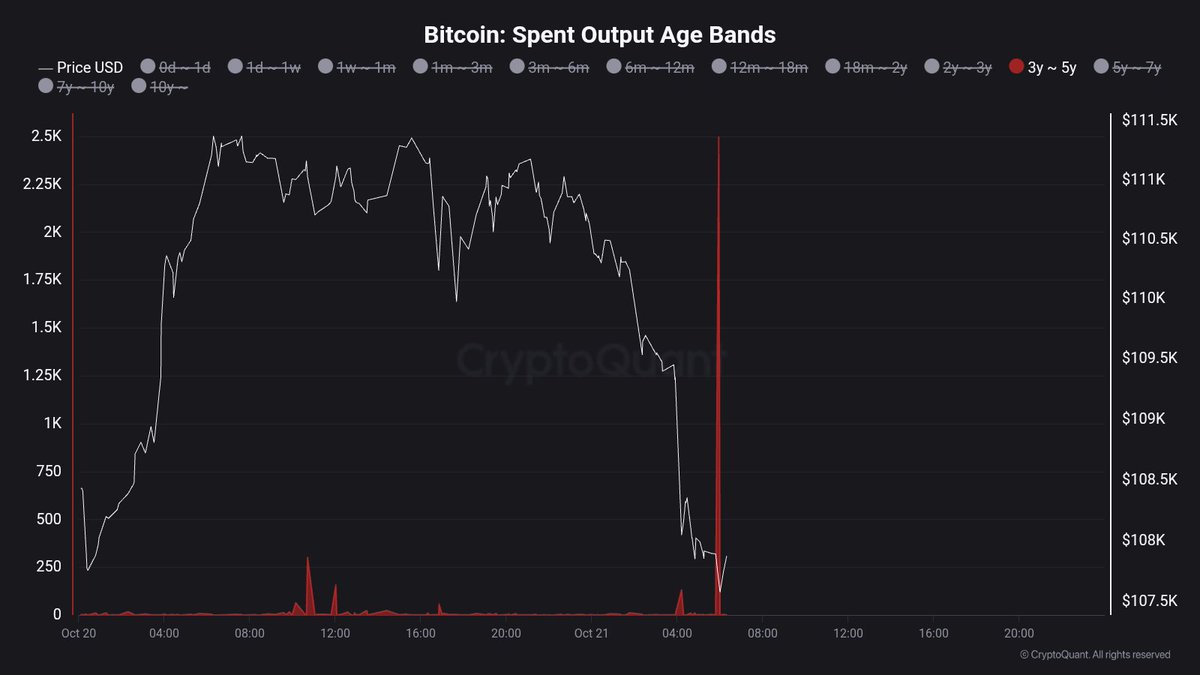
Bitcoin Spent Output Age Bands | Source: Maartunn

Historically, such spikes in long-term holder activity tend to occur near macro turning points, either as a sign of distribution during local tops or early reaccumulation phases after deep corrections. In the current context, this rise in aged coin movement could mean two things. First, it might reflect profit-taking from early holders who are capitalizing on gains as market volatility intensifies. Second, it could indicate reallocation or strategic rotation, where coins move between wallets as investors prepare for renewed market turbulence.

This comes amid a backdrop of persistent selling pressure, with Bitcoin struggling to hold above the $110K level. The broader market remains cautious, as liquidity thins and short-term traders react to each downside move.

While long-term holders moving supply can appear bearish in the short run, it’s also a natural part of market cycles — often preceding phases of redistribution that ultimately strengthen long-term structure. If Bitcoin can absorb this supply and maintain support above $106K–$108K, it could set the foundation for a more sustainable rebound. However, failure to do so might confirm a deeper correction, potentially testing the $100K zone once again.

Testing Support Amid Renewed Weakness

Bitcoin is struggling to find momentum after days of selling pressure, currently trading around $107,800. The 3-day chart shows BTC fighting to stay above the 200-day moving average (green line) near $106,000, a crucial support that has historically served as a base during major corrections. The bounce from the recent $103K low suggests some buying interest, but momentum remains fragile as bulls attempt to defend this key zone.
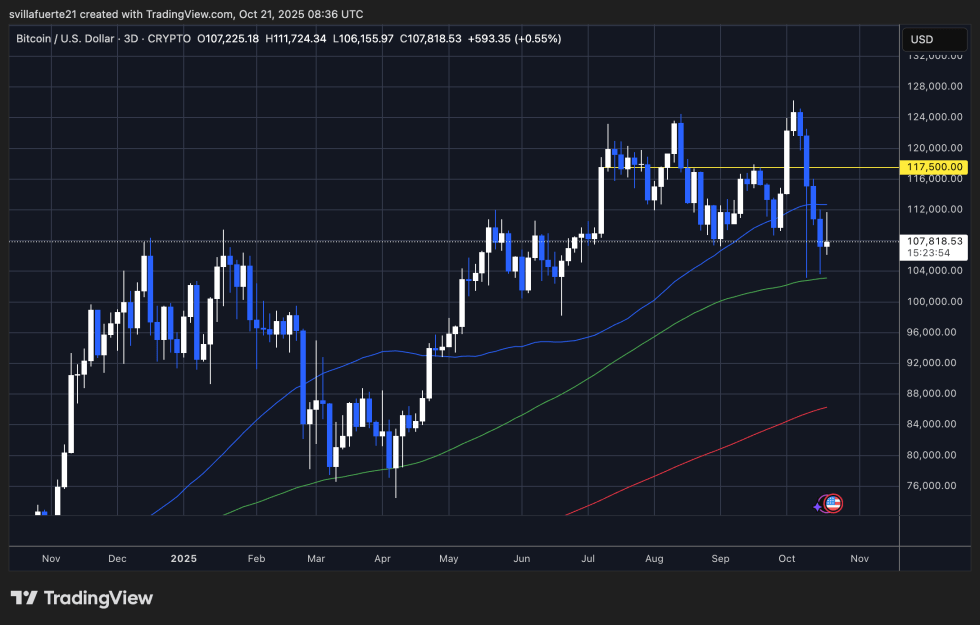
BTC testing key demand | Source: BTCUSDT chart on TradingView

The 50-day moving average (blue line), sitting above $112,000, now acts as short-term resistance, with a broader supply area forming around $117,500 — the same level that capped previous rallies. A close above this threshold could confirm a short-term reversal, signaling renewed buyer confidence. However, repeated failures to reclaim it may invite another wave of selling pressure.

Market structure remains neutral-to-bearish, with volatility compressing following the October 10 flash crash. If BTC loses the $106K–$107K zone, downside targets could extend toward $100K, where the yearly average offers the next layer of support.

Featured image from ChatGPT, chart from TradingView.com

Market Opportunity
Overtake Logo
Overtake Price(TAKE)
$0,0627
$0,0627$0,0627
-2,38%
USD
Overtake (TAKE) Live Price Chart
Disclaimer: The articles reposted on this site are sourced from public platforms and are provided for informational purposes only. They do not necessarily reflect the views of MEXC. All rights remain with the original authors. If you believe any content infringes on third-party rights, please contact service@support.mexc.com for removal. MEXC makes no guarantees regarding the accuracy, completeness, or timeliness of the content and is not responsible for any actions taken based on the information provided. The content does not constitute financial, legal, or other professional advice, nor should it be considered a recommendation or endorsement by MEXC.

You May Also Like

Taiko Makes Chainlink Data Streams Its Official Oracle

Taiko Makes Chainlink Data Streams Its Official Oracle

The post Taiko Makes Chainlink Data Streams Its Official Oracle appeared on BitcoinEthereumNews.com. Key Notes Taiko has officially integrated Chainlink Data Streams for its Layer 2 network. The integration provides developers with high-speed market data to build advanced DeFi applications. The move aims to improve security and attract institutional adoption by using Chainlink’s established infrastructure. Taiko, an Ethereum-based ETH $4 514 24h volatility: 0.4% Market cap: $545.57 B Vol. 24h: $28.23 B Layer 2 rollup, has announced the integration of Chainlink LINK $23.26 24h volatility: 1.7% Market cap: $15.75 B Vol. 24h: $787.15 M Data Streams. The development comes as the underlying Ethereum network continues to see significant on-chain activity, including large sales from ETH whales. The partnership establishes Chainlink as the official oracle infrastructure for the network. It is designed to provide developers on the Taiko platform with reliable and high-speed market data, essential for building a wide range of decentralized finance (DeFi) applications, from complex derivatives platforms to more niche projects involving unique token governance models. According to the project’s official announcement on Sept. 17, the integration enables the creation of more advanced on-chain products that require high-quality, tamper-proof data to function securely. Taiko operates as a “based rollup,” which means it leverages Ethereum validators for transaction sequencing for strong decentralization. Boosting DeFi and Institutional Interest Oracles are fundamental services in the blockchain industry. They act as secure bridges that feed external, off-chain information to on-chain smart contracts. DeFi protocols, in particular, rely on oracles for accurate, real-time price feeds. Taiko leadership stated that using Chainlink’s infrastructure aligns with its goals. The team hopes the partnership will help attract institutional crypto investment and support the development of real-world applications, a goal that aligns with Chainlink’s broader mission to bring global data on-chain. Integrating real-world economic information is part of a broader industry trend. Just last week, Chainlink partnered with the Sei…
Share
BitcoinEthereumNews2025/09/18 03:34
Kalshi Prediction Markets Are Pulling In $1 Billion Monthly as State Regulators Loom

Kalshi Prediction Markets Are Pulling In $1 Billion Monthly as State Regulators Loom

The post Kalshi Prediction Markets Are Pulling In $1 Billion Monthly as State Regulators Loom appeared on BitcoinEthereumNews.com. In brief Kalshi reached $1 billion in monthly volume and now dominates 62% of the global prediction market industry, surpassing Polymarket’s 37% share. Four states including Massachusetts have filed lawsuits claiming Kalshi operates as an unlicensed sportsbook, with Massachusetts seeking to permanently bar the platform. Kalshi operates under federal CFTC regulation as a designated contract market, arguing this preempts state gambling laws that require separate licensing. Prediction market Kalshi just topped $1 billion in monthly volume as state regulators nip at its heels with lawsuits alleging that it’s an unregistered sports betting platform. “Despite being limited to only American customers, Kalshi has now risen to dominate the global prediction market industry,” the company said in a press release. “New data scraped from publicly available activity metrics details this rise.” The publicly available data appears on a Dune Analytics dashboard that’s been tracking prediction market notional volume. The data show that Kalshi now accounts for roughly 62% of global prediction market volume, Polymarket for 37%, and the rest split between Limitless and Myriad, the prediction market owned by Decrypt parent company Dastan. Trading volume on Kalshi skyrocketed in August, not coincidentally at the start of the NFL season and as the prediction market pushes further into sports.  But regulators in Maryland, Nevada, and New Jersey have all issued cease-and-desist orders, arguing Kalshi’s event contracts amount to unlicensed sports betting. Each case has spilled into federal court, with judges issuing preliminary rulings but no final decisions yet. Last week, Massachusetts went further, filing a lawsuit that calls Kalshi’s sports contracts “illegal and unsafe sports wagering.” The 43-page Massachusetts lawsuit seeks to stop the company from allowing state residents on its platform—much the way Coinbase has had to do with its staking offerings in parts of the United States. Massachusetts Attorney General…
Share
BitcoinEthereumNews2025/09/19 09:21
[Pastilan] End the confidential fund madness

[Pastilan] End the confidential fund madness

UPDATE RULES. Former Commission on Audit commissioner Heidi Mendoza speaks during a public forum.
Share
Rappler2026/01/16 14:02